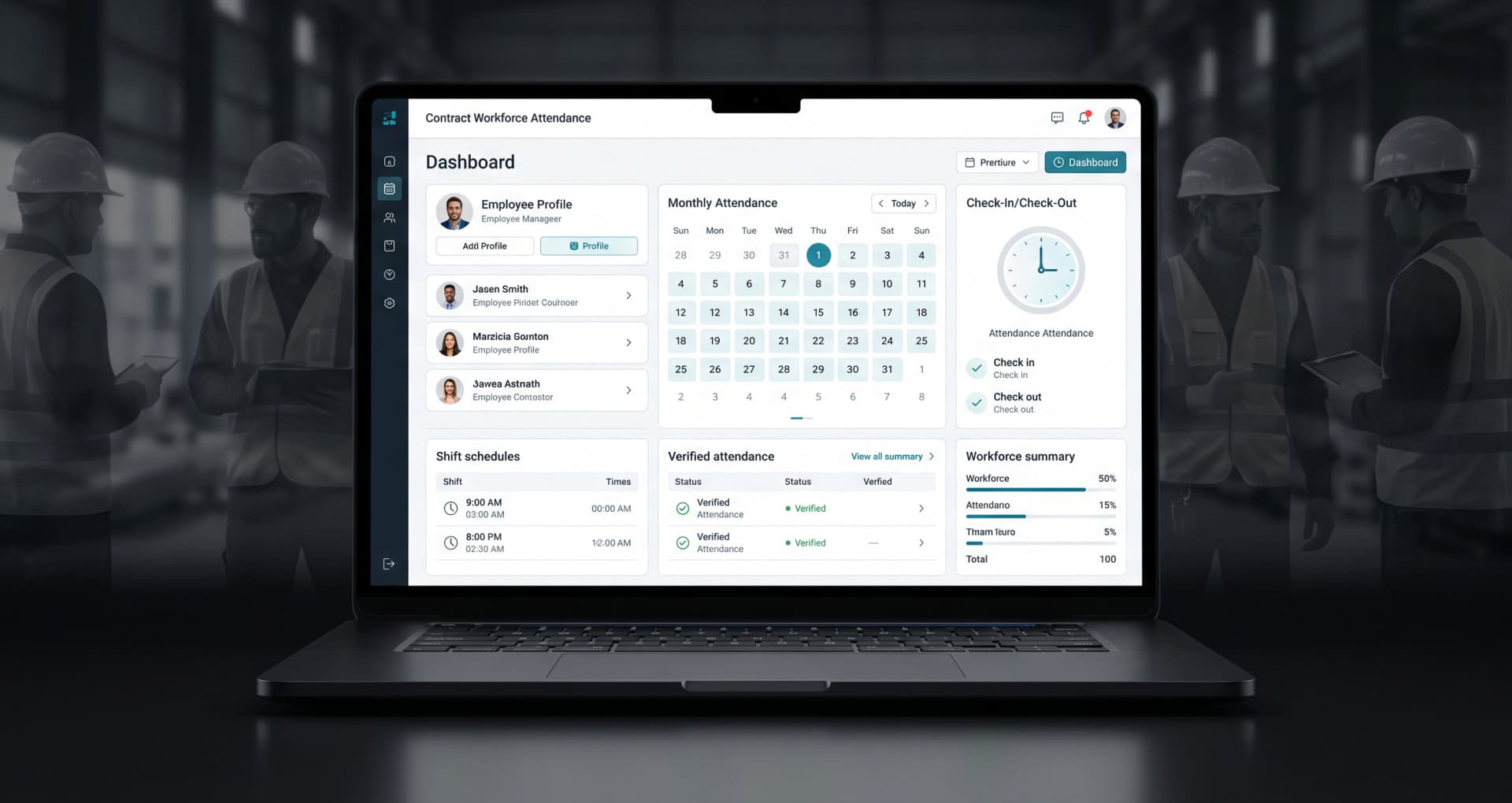
Attendance systems for labour are already in use across almost all manufacturing and EPC companies. With nearly 3.7 billion people in the global labour force, managing workforce data accurately remains a major operational need across industries. In many projects, contractors submit muster rolls that are later used for billing and payroll, but validating whether those attendance records are accurate can be challenging.
Incorrect attendance data can lead to higher labour costs, compliance issues, and poor workforce planning. To overcome these challenges, a smarter digital attendance system was implemented for a power transmission EPC company managing 300 to 500 workers across more than 40 remote sites.
This modern attendance system can help you to verify worker attendance using location and photo-based checks, even in areas with limited connectivity. In this blog, we explain the challenges with traditional attendance systems, how the solution works, and the business impact of having more reliable labour records.
Why Traditional Attendance Systems Fail at Remote Sites
Attendance systems for labour are already in use across almost all manufacturing and EPC companies. For remote sites, things become more complex and different, especially when it comes to tracking labour attendance. The reason? Traditional attendance systems are mainly built for a particular office, area, or premises. Let’s explore in detail about the drawback not really but actual limitation of tradition one:
Fixed-point attendance assumes every worker passes the same gate. EPC execution has no gate.
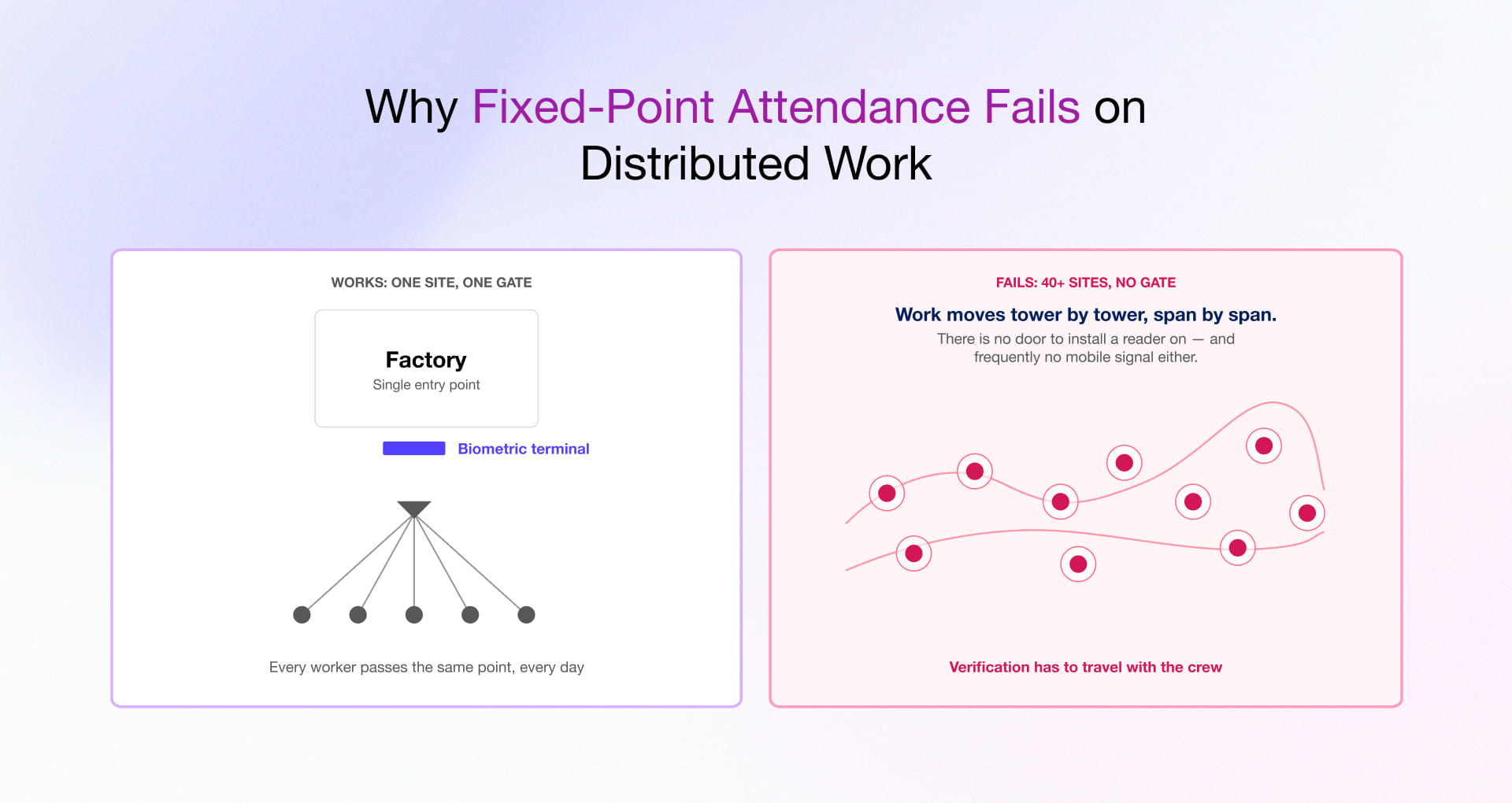
- Biometric readers work only at fixed locations: Transmission line projects do not have one fixed gate. The work keeps moving from one location to another. A fingerprint machine at the site office can confirm that someone touched the machine. It cannot confirm that the same person spent the day working several kilometres away.
- Paper muster rolls are difficult to verify: In many projects, contractors prepare the attendance records that are later used for billing and payment. So, the same party that gets paid also provides the numbers used to decide the payment. This does not automatically mean the records are wrong. It simply means the project team still has to spend time checking whether they are right.
- Most HR attendance apps need internet connectivity: Most HR attendance apps are built with one simple assumption: there will be a network. Remote project sites do not always agree with that assumption. When workers are in locations with weak or no connectivity, an app that needs the internet cannot record attendance properly. And when the digital system stops working, paper usually makes a quick comeback.
- Dashboards only work well when the data is correct: A dashboard looks clean, fast, and convincing. But it cannot check whether the attendance data entered into it is correct. If the input is wrong, the report is wrong too. It simply presents bad data in a better-looking format.
What Verified Labour Attendance Changes for the Business
Once attendance is verified at the site level, the impact goes beyond just tracking workers. It improves billing, workforce planning, delay tracking, and dispute resolution. Once attendance is verified at the actual work location, it does more than just track workers. It also improves billing, workforce planning, delay tracking, and dispute handling.
- Contractor billing becomes easier to check: Only attendance sessions reviewed and approved by the supervisor are included in payroll settlement. Rejected or unchecked sessions are left out automatically. This gives the payroll team a clear record of approved labour days by contractor, work location, and date range. Instead of paying based only on attendance submitted by the contractor, the business can pay based on verified records.
- Planned vs actual workforce becomes visible on the same day: Supervisors can see how many workers were planned for a session and how many were actually present. This helps identify workforce gaps early instead of finding them at the end of the month. For example, if a contractor regularly sends fewer workers than planned, the team can discuss the issue early with the contractor, procurement team, or project planners.
- Reasons for delay become easier to understand: When attendance is marked late, the team leader has to select a reason such as weather, material shortage, access issues, labour shortage, or another reason. Over time, this creates a clear picture of why the work is getting delayed. If many delays happen because materials are not available, the issue is with supply planning. If delays keep happening at a few work locations, the problem could be access or logistics. This helps teams find the actual problem.
- Disputes become easier to resolve: Every attendance action is recorded with worker identity, time, location, and action type. These records cannot be changed or deleted later. If a contractor questions a deduction or a client questions the work progress, the team can check verified attendance records and geo-tagged photos instead of going back to memory or paper records. This gives everyone a clear record of what actually happened.
Key Considerations Before Implementing a Digital Attendance System
Before introducing a digital attendance system, companies need to look at a few practical areas that can affect how well it works in day-to-day operations.
- Contractor and workforce acceptance: A new attendance process can take time to get used to. Contractors and workers should clearly understand why the system is being introduced, how attendance will be recorded, and how the data will be used.
- Ease of use for field teams: The system should be simple enough for teams working in remote or busy work locations. Basic actions such as selecting a work session, capturing a photo, and submitting attendance should take only a few steps.
- Data privacy and security: Attendance systems can collect personal information such as worker photos, location, and time records. Companies should define how this data is collected, stored, accessed, and retained before rollout.
- Audit and compliance requirements: Attendance records may also be used for payroll, contractor billing, and compliance checks. The system should maintain a clear record of attendance, approvals, changes, and related activity so the information can be checked when needed.
Questions to Ask Before Choosing a Labour Attendance System
Before choosing any labour attendance system, it is important to check how well it works in real field conditions, not just during a product demo.
- What happens when there is no internet?
Ask whether attendance can still be recorded when the network is unavailable and how the data is synced later. - Can old photos be used to mark attendance?
Check whether the system allows photos from the phone gallery. If it does, it becomes difficult to confirm whether the worker was actually present at that time. - How often is worker location checked?
Find out whether location is checked only at login or during the entire work session. - Can someone mark attendance for workers who are not present?
The system should have controls to reduce proxy or bulk attendance marking. - Can attendance records be changed later?
Ask whether administrators can edit or delete attendance records after submission and whether every change is tracked. - Does only approved attendance move to payroll or billing?
Unreviewed or rejected attendance records should not be included in payroll or contractor settlement. - How are delays recorded?
Check whether the reason for a delay is captured when it happens, using clear options such as weather, material shortage, access issues, or labour shortage.
Why Choose Rishabh Software for Labour Attendance Solutions
Building a labour attendance system for remote operations needs more than a standard HR app. The solution has to work with real field conditions, changing work locations, poor connectivity, contractor workflows, and business processes such as payroll and billing.
Rishabh Software, as a leading software development company, develops custom digital solutions based on how businesses actually operate. This includes features such as location-based attendance, photo verification, offline data capture, approval workflows, dashboards, and integration with existing business systems.
The focus is not only on recording attendance, but on helping businesses get more accurate workforce data, improve contractor management, and reduce manual work across operations.
Whether the requirement is for EPC, manufacturing, construction, or other field-based operations, the solution can be designed around the company’s workforce structure, processes, and existing technology environment.
Success Story: Streamlined Contract Labour Attendance Across 40+ EPC Sites
We developed a mobile-based attendance verification solution for a power transmission EPC company managing 300–500 workers across more than 40 remote sites. The solution addressed the challenges of verifying attendance across dispersed work locations, particularly where network connectivity was limited. It uses GPS-based geo-fencing, live photo capture, and offline attendance tracking to help field teams record and verify worker attendance, even in low-connectivity areas.
Key Outcomes:
- More reliable, verified attendance records
- Greater transparency in contractor billing
- Better visibility into workforce attendance across remote sites
- Attendance tracking in areas with limited network connectivity