Modernization of CSR Governance with a Centralized Digital Monitoring Suite
Digitized end-to-end CSR lifecycle management for a leading private sector bank, enabling real-time visibility, audit readiness, and operational efficiency on Microsoft Power Platform.
Financial institutions are increasingly moving away from decentralized CSR operating models to ensure stronger governance, transparency, and measurable impact. As project volumes increased and compliance requirements became more rigorous, existing manual workflows and siloed reporting began to limit visibility and slow decision-making. The absence of a centralized system made it difficult to track partner onboarding, fund utilization, compliance documentation, and impact metrics in a structured and auditable manner.
To modernize its CSR operations and establish a scalable digital foundation, the bank partnered with Rishabh Software to implement a centralized CSR Monitoring platform built on Microsoft Power Platform and SharePoint. The solution unified CSR program management into a secure, intelligent digital ecosystem delivering real-time visibility, streamlined governance, and stronger operational control across the entire CSR lifecycle.
Capability
Microsoft Power Platform
Industry
FinTech
Country
India
Key Features
The CSR management solution establishes a centralized digital backbone for CSR operations, enabling structured governance, automated approval workflows, secure documentation management, and real-time performance insights.
Unified CSR Operations Management
The CSR team now manages partners, projects, funds, and impact within a single CSR management system. No more chasing spreadsheets or email threads. Everyone works on the same latest information.
Due Diligence & Compliance Management Automation
A structured partner due diligence framework digitizes document verification, regulatory screening, and multi-level approvals, ensuring only compliant partners are onboarded while strengthening audit readiness and risk control.
Partner Approval Process
Proposals follow a structured, fully digital approval matrix with defined review stages. Teams have real-time visibility into pending actions and decisions, supported by a complete audit trail.
Project Creation
Projects are digitally created within a structured framework aligned to approved proposals, defined objectives, timelines, and implementing partners. This ensures standardized project initiation with complete traceability from approval to execution.
Milestone-Based Project Monitoring
Projects are tracked against defined milestones with structured field updates and documented evidence. This enables real-time visibility into progress and early identification of risks.
Integrated Fund Utilization Tracking
Fund allocations, disbursements, and utilization are mapped to defined milestones and deliverables, providing early visibility into spending and stronger financial oversight across CSR programs
Budget Planning & Allocation
Budgets are planned and allocated at project initiation with defined categories and approval controls, ensuring disciplined financial planning, improved cost predictability, and stronger governance before funds are released.
Leadership Dashboards with Audit-Ready Reporting
Executive dashboards consolidate project progress, fund utilization, and impact metrics in real time. Centralized records and structured audit trails simplify reviews and strengthen compliance reporting.
Challenges
CSR operations from partner onboarding to impact reporting were fragmented across multiple tools and offline trackers, driving inconsistent data and high coordination effort.
Partner due diligence relied on manual reviews and email-based approvals, constraining scalability and making governance validation and audit evidence management cumbersome.
The absence of a unified, real-time view of milestones, project progress, partner compliance, fund utilization, and outcomes limited proactive lifecycle oversight.
Multi-level approvals were in place, but inconsistent routing, escalation, and decision traceability increased cycle times, reduced transparency, and weakened delegation control.
Budget tracking was not systematically tied to milestone progress and supporting evidence, limiting early variance detection and making outcome-linked spend reporting difficult.
Solutions
Rishabh Software followed a structured, governance-first approach to unify CSR operations on Microsoft Power Platform and SharePoint. End-to-end CSR workflows were digitized, and security with auditability was embedded by design and delivered through an MVP-led, sprint-based rollout without disrupting ongoing CSR programs.
Centralized CSR Digital Backbone On Microsoft Power Platform
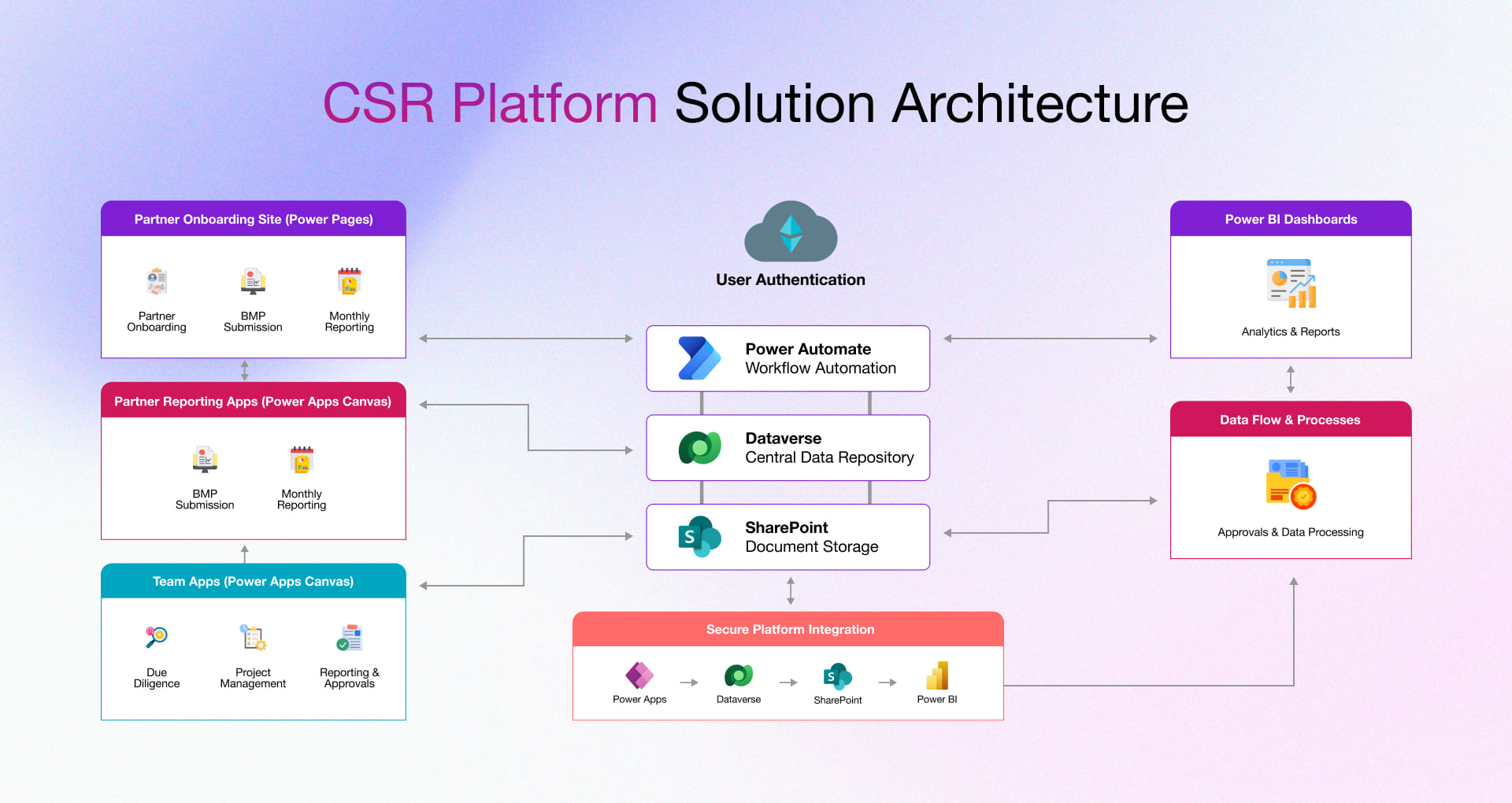
To move the CSR function from coordination to control, our team built a CSR management platform on Microsoft Power Platform. Dataverse became the system of record for implementing partners, initiatives, budgets, utilization, and impact, so leadership and program teams are working from the same facts across multiple geographies and programs.
Lifecycle Orchestration Across CSR Operations
We translated the full CSR lifecycle into one connected operating flow, from partner onboarding and due diligence through proposal evaluation, approvals, milestone execution, disbursements, utilization, and impact assessment. This replaced handoffs across email and spreadsheets with a repeatable cadence that makes progress, ownership, and next steps visible at every stage.
Security-First, Role-Driven Access Framework
Using Microsoft Entra ID, we set role-based access aligned to segregation of duties for CSR teams, implementing partners, reviewers, finance, leadership, and auditors, ensuring the right people see the right information and every action is traceable.
Modular Architecture For Scale And Extensibility
We designed the platform as modular building blocks rather than a monolith, so new themes, workflows, and reporting needs can be added without reworking the foundation. This gives the institution room to scale program volume and geographic reach while keeping change effort predictable.
Outcomes
Reduction in CSR Operational Effort
Data Fragmentation
Digital Governance
Technologies Used







Project Snapshots
Recent Case Studies
Optimize your cloud infrastructure, implement robust solutions, and stay ahead of trends with our resource hub.