Digital Payments Platform for Banks and FinTechs
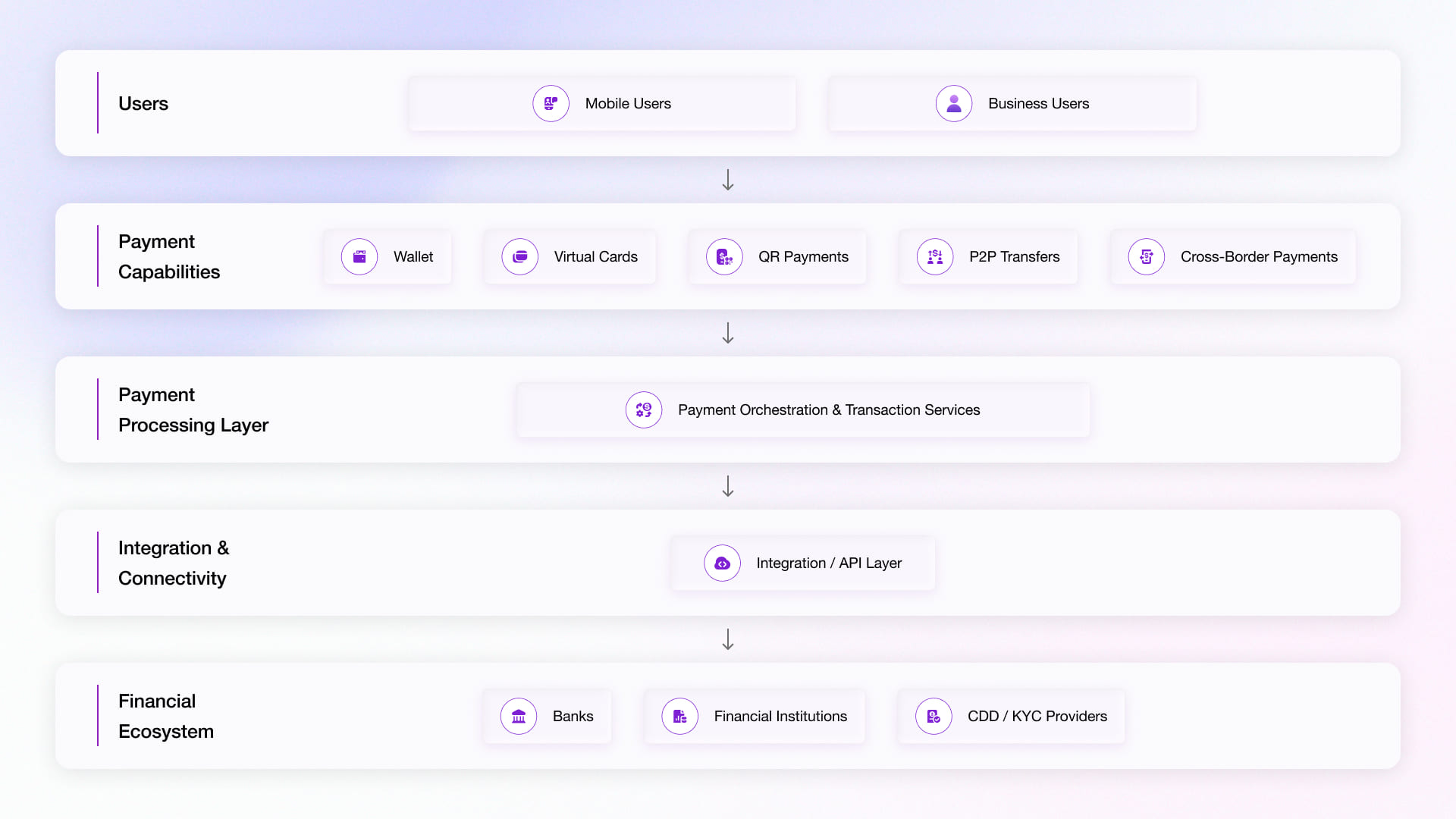
Digital payments platform connecting consumers, businesses, banks and financial institutions
A Mauritius-based FinTech organization engaged Rishabh Software to engineer a secure, scalable digital payments platform that simplified payment journeys across a fragmented financial ecosystem. The platform connected consumers, businesses, and financial institutions through a single mobile application, supporting P2P payments, QR transactions, bank transfers, virtual cards, and cross-border payments.
The platform used API-led integrations to connect with banks and external financial systems, enabling transactions across different payment channels and financial institutions. It also supported ISO 20022 messaging and unregistered number transfers, streamlining payment processing and making digital transactions more accessible to users not yet registered on the platform.
Key Features
To meet the client’s need for a custom digital payment platform, we developed a unified platform that connected individuals, businesses, banks, financial institutions, and customer due diligence agencies. The solution brought payment services, financial integrations, transaction processing, and status management together while supporting different digital payment channels and use cases.
Digital Wallet
The platform provides a digital wallet that lets users manage funds and initiate payments through a single mobile interface by bringing everyday payment activities into one place.
Virtual Cards
The platform provides virtual cards for one-time and recurring subscription payments, with configurable payment schedules and spending limits.
Payment Enablement
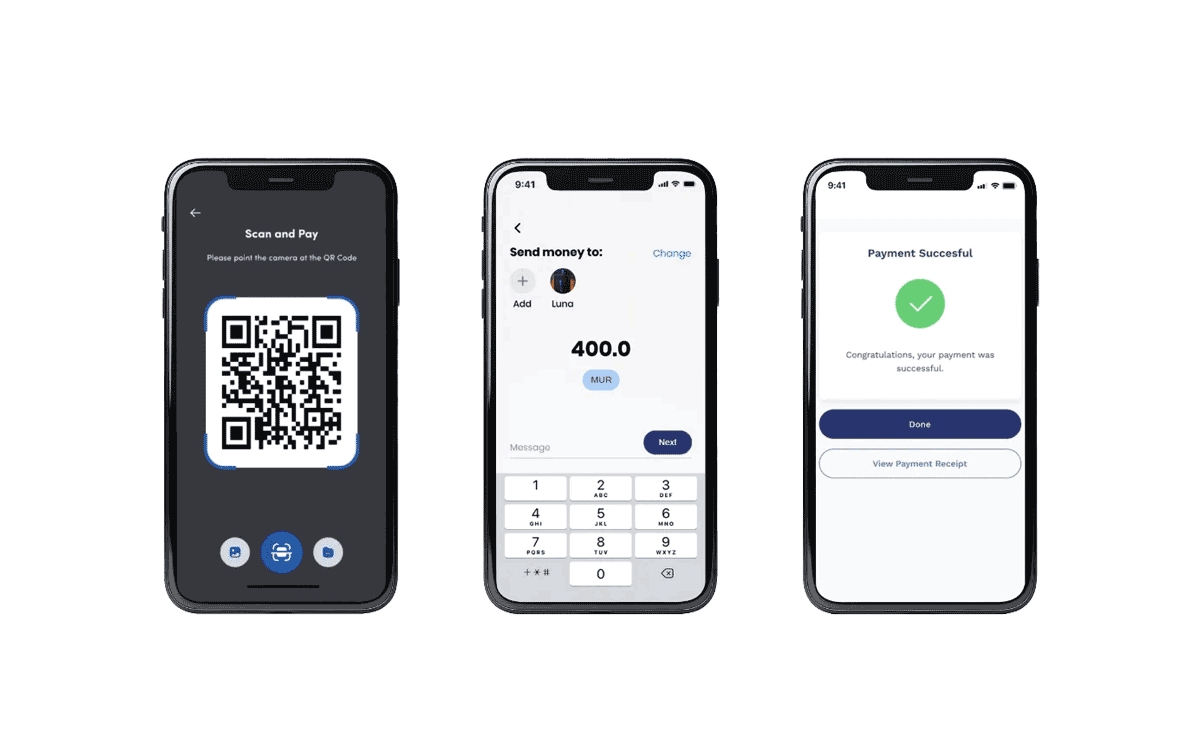
The platform supports P2P payments, QR-code payments, bank transfers, and contactless transactions for individuals and businesses, bringing multiple payment methods into a unified payment environment. Bringing these payment methods into one platform helped simplify payment workflows across connected financial systems.
Cross-Border Payments
The app supports cross-border payment use cases with configurable fees and foreign-exchange rates, enabling businesses to manage international payment transactions through the platform.
ISO 20022 Messaging Standard Support
The solution supports ISO 20022-based payment information exchange within relevant financial integration workflows, helping structure and process payment data across connected systems.
Transaction Status Visibility
The platform receives transaction-status updates from connected financial systems and presents them within the application, giving users clearer visibility into the progress and outcome of their payments.
Challenges
Fragmented payment ecosystem created inconsistent payment workflows across banks and financial institutions, making it difficult to provide a unified payment experience.
Complex and asynchronous bank integrations made payment initiation, data exchange, and transaction-status synchronization difficult. External systems controlled transaction outcomes through their own notifications, requiring reliable failure handling.
Recipient-registration requirements added friction to mobile-to-mobile transfers by requiring recipients to register before receiving payments.
Cross-border transaction complexity required configurable fees, real-time foreign-exchange rates, and reliable communication across multiple financial systems.
Scalability and customer friction required the platform to handle growing transaction volumes without adding complexity to the customer experience.
Limited transaction-status visibility made it difficult for users to track payment progress and outcomes.
Solutions
We developed a digital payments platform that connected payment workflows across banks, financial institutions, businesses, and customers. The implementation brought together payment processing, financial-system integrations, transaction management, customer due diligence, and payment-status handling within a unified platform architecture.
Connected Payment Experience
The platform brought wallet management, virtual cards, P2P transfers, QR payments, bank transfers, contactless transactions, and cross-border payments into a unified payment platform. This gave individuals and businesses one platform to manage different payment workflows.
Unregistered Number Transfers
Recipient registration was creating friction in mobile-to-mobile transfers. We enabled users to initiate transactions without requiring the recipient to register in advance. This simplified the transfer process and reduced the onboarding steps for recipients.
API Integration
Complex banking APIs and multiple external dependencies made reliable payment execution critical. We integrated the platform with banks, financial institutions, and customer due diligence agencies to support payment initiation, data exchange, transaction processing, and due diligence workflows.
Cross-Border Payment Processing
The platform supported cross-border payment workflows with configurable fees and foreign exchange rates, enabling businesses to manage international transactions across connected financial systems.
Callback Handling
Payment processing involved multiple external systems, so transaction outcomes were not always available in the initial response. We built a callback mechanism to process success and failure notifications from connected services. This kept transaction statuses synchronized between external systems and the application and provided users with timely payment updates.
Transaction Status Mapping
Different financial systems returned transaction outcomes in different formats. The platform mapped these responses to application-level statuses, giving users clear visibility into payment progress and outcomes.
QR Code Decoding
Slow or inaccurate QR scanning could affect payment initiation. We built a QR-code decoder for fast and accurate scanning and processing, making QR-based payments quicker and more reliable.
AI-Ready Payment Operations
The platform’s transaction data, payment workflows, and financial-system integrations create a foundation for AI-assisted payment operations, including anomaly detection, payment-failure analysis, exception management, transaction monitoring, reconciliation support, customer-service assistance, and operational monitoring.
Outcomes
Increase in transaction volume through simplified transfers
Increase in user base through streamlined payment journeys
CSAT score post-launch
Technologies Used





Project Snapshots
Recent Case Studies
Optimize your cloud infrastructure, implement robust solutions, and stay ahead of trends with our resource hub.