
Programmatic CTV marks a fundamental shift in digital advertising by combining premium inventory, brand-safe environments, and measurable outcomes on a scale that traditional TV never achieved. Yet it operates under very different conditions than other digital channels. Inventory is finite, outcomes unfold over time, and decisions made within one platform often affect performance across the ecosystem.
From over a decade of working across AdTech, especially programmatic CTV and DOOH at Rishabh Software, one reality stands out: most decision frameworks in use today were built for faster, more predictable environments. They depend on predefined rules and post-performance adjustments, which limit control in a channel as complex and premium as CTV.
This is where Agentic AI addresses this gap, extending human intent across execution to maintain consistency and control. Rather than correcting flaws in CTV, it enhances decision-making in an environment that evolves continuously.
Let us walk you through in detail to understand the significant importance of Agentic AI in programmatic advertising ecosystem.
Why Programmatic CTV Requires an Agentic Approach
Traditional programmatic advertising relied on automation to operate at scale in environments with immediate signals, plentiful inventory, and short feedback loops. CTV breaks these assumptions.
- Delayed outcomes: Decisions are made in milliseconds, but their impact often unfolds over days or weeks.
- Finite, fragmented supply: Actions taken on one platform shape outcomes across others, making rule-based automation insufficient.
- Complex objectives: ROAS, reach, quality, and sustainability must be enforced continuously, not just monitored post-campaign.
Agentic AI introduces a decision layer that persists beyond initial configuration. Instead of relying on static rules and reactive optimization, agents carry intent forward during execution through Microsoft-based data and AI services and continuously aligning bidding, pacing, quality, and yield decisions with campaign objectives as conditions evolve. The goal is not faster optimization, but sustained coherence across the lifecycle of a premium campaign.
Several structural realities make this shift inevitable in CTV:
- Millisecond-level bidding leaves no room for manual intervention
- Manual tuning of DSPs leads to measurable performance and yield losses
- Traditional auction models underperform when autonomous agents negotiate supply and demand in real time
- Fragmented DSP–SSP workflows collapse without autonomous coordination
- ROAS, inventory quality, and sustainability targets require agent-led enforcement rather than dashboard monitoring.
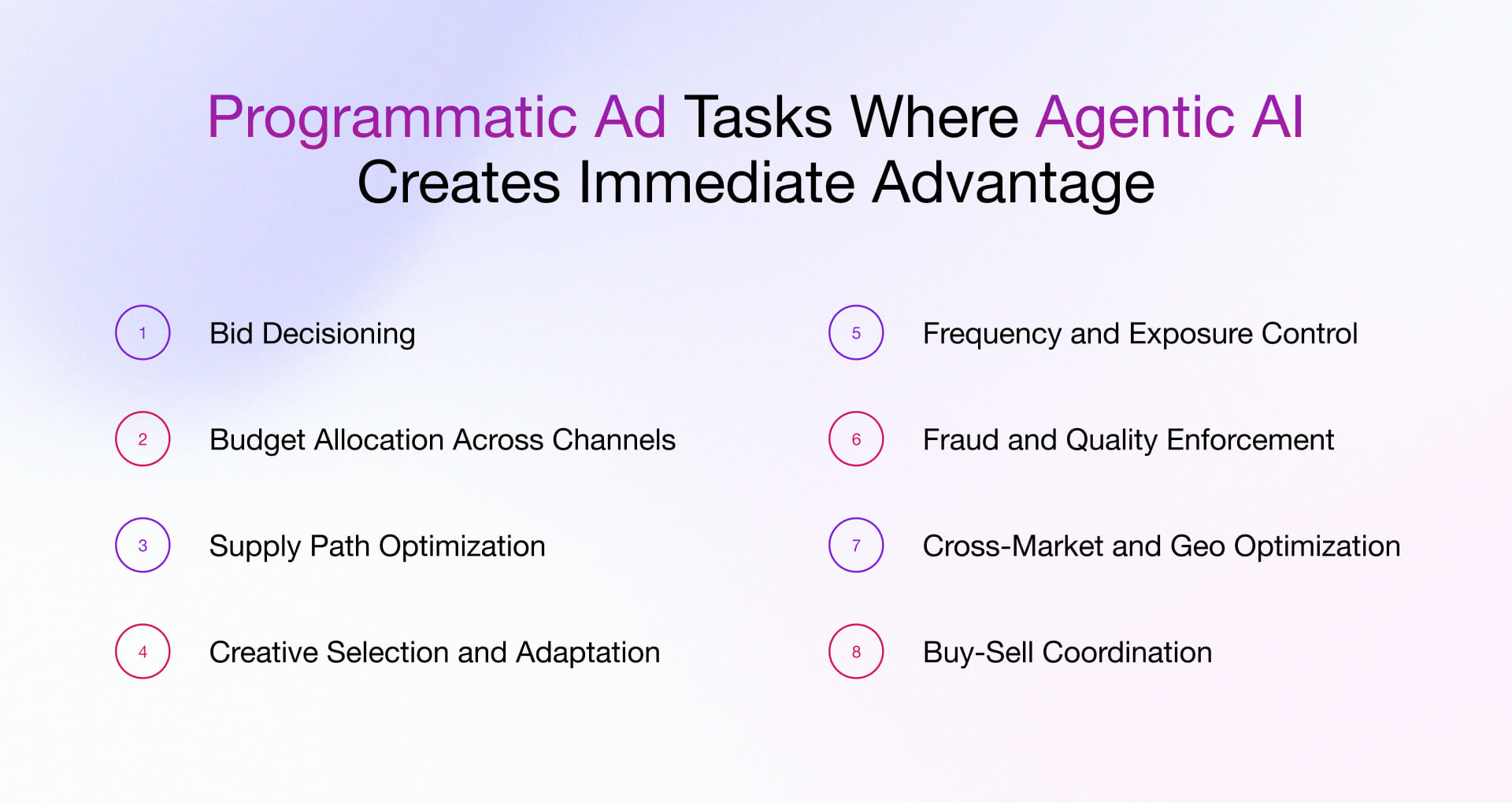
How Agentic AI is Reshaping the AdTech Ecosystem
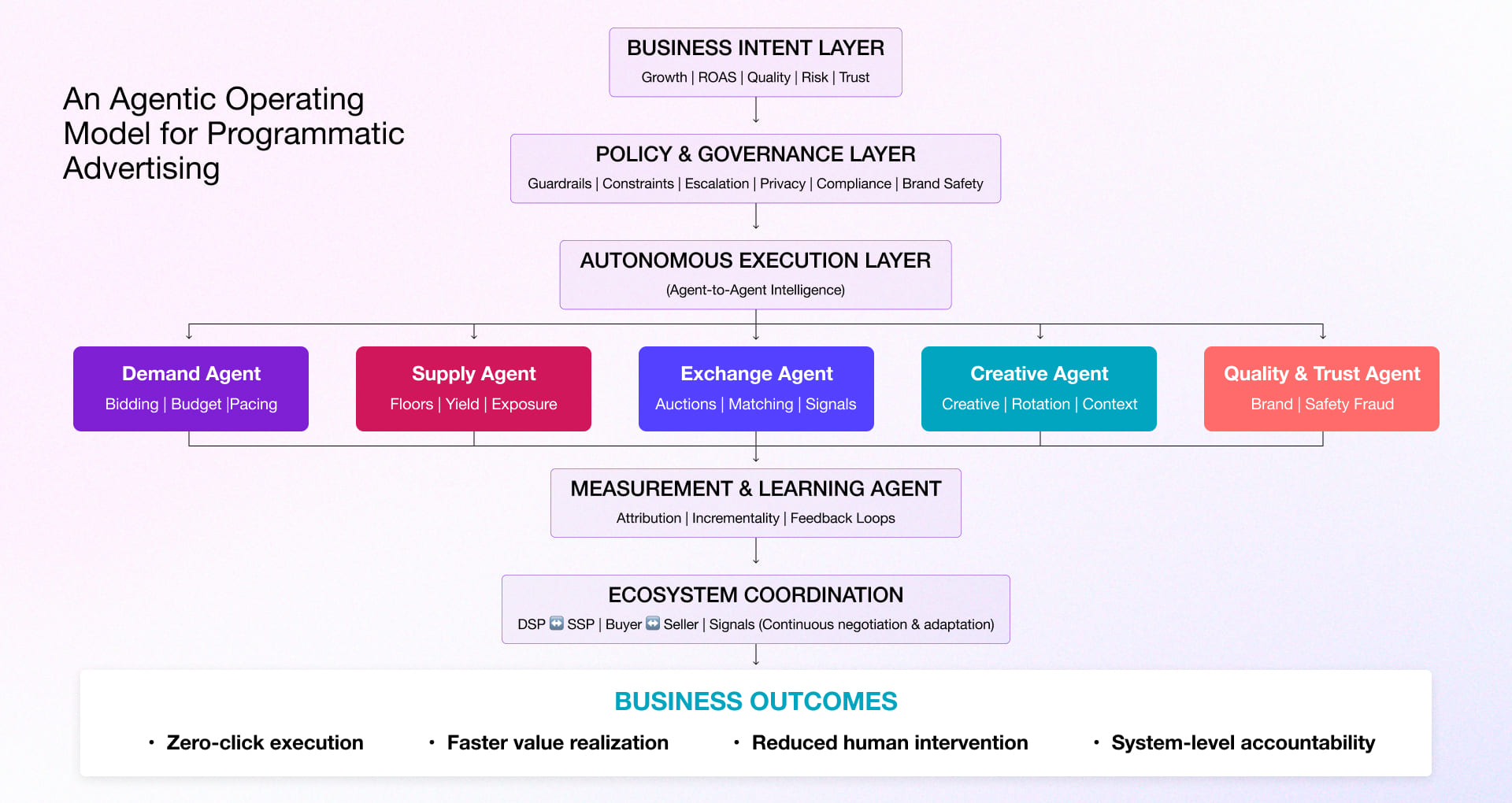
Agentic AI Within DSPs
- Within demand side platforms, AI agents autonomously manage bidding, budget pacing, and cross-channel spend allocation. They continuously interpret auction dynamics, performance signals, and strategic constraints without relying on manual tuning or reactive human intervention.
- These agents optimize multiple objectives simultaneously, at the impression level, rather than focusing on a single KPI in isolation.
- By replacing manual bid adjustments and fragmented optimization logic, AI agents can operate at the speed of high-frequency auctions, maintaining performance where human intervention alone would lag.
- Autonomous spend governance ensures that media investments remain aligned with overarching business goals, even as market conditions shift in real time.
- In a guaranteed premium CTV campaign (e.g., mid-roll ads in a flagship streaming show), when early delivery falls behind pace, the AI agent automatically redistributes budget across available premium slots and adjusts bids within fixed CPM limits to bring delivery back on track without end-of-flight spend spikes.
Agentic AI Across Supply-Side Platforms
- With supply side platforms, AI agents dynamically manage floor pricing and inventory exposure by learning from live demand signals, historical performance, and buyer behavior, moving beyond static price rules.
- These agents balance short-term yield optimization with long-term buyer relationships, preventing revenue spikes that could degrade demand quality over time.
- By eliminating manual yield tuning and rigid monetization strategies, AI agents ensure performance even under highly volatile demand conditions.
- Autonomous supply governance stabilizes revenue, improves monetization efficiency, and coordinates across diverse demand sources without constant human oversight.
- When rising open-auction demand threatens guaranteed premium CTV deals, the SSP-side AI agent prioritizes reserved inventory and gradually adjusts floor pricing to maintain delivery while protecting long-term yield.
Agentic AI at the Exchange Layer
- AI agents coordinate auction mechanics, demand–supply matching, and price discovery by responding to real-time market signals rather than enforcing fixed auction structures.
- At the ad exchange platform level, they enable direct machine-to-machine negotiation between buying and selling agents, reducing friction and latency caused by human arbitration.
- By adapting to rapid changes in demand, supply, and pricing behavior, they mitigate inefficiencies from rigid exchange logic.
- AI agents transform exchanges from passive transaction pipes into active market orchestrators, maintaining equilibrium at scale.
- If a guaranteed CTV campaign shows pacing risk across multiple DSPs, exchange-level AI agents rebalance demand and pricing in real time to ensure smooth delivery, CPM stability, and inventory quality.
Agentic AI Within Ad Servers
- AI agents govern creative rotation, sequencing, and frequency control in real time by incorporating performance feedback, contextual relevance, and user experience signals.
- They dynamically adapt ad delivery decisions without requiring trafficking updates, manual creative swaps, or campaign restarts.
- They solve chronic issues of creative fatigue, overexposure, and inconsistent user experience across channels.
- They enable zero-click ad delivery, transforming ad server platform from static execution endpoints into intelligent delivery systems.
Agentic AI Across Curation and Deal Platforms
- AI agents autonomously select, prioritize, and negotiate curated inventory access based on live performance, quality, and pricing signals rather than predefined deal hierarchies.
- They evaluate supply paths dynamically, moving beyond static SPO rules that fail to reflect real-time market efficiency.
- They eliminate rigid deal configurations that require frequent human intervention to remain effective.
- They enable continuous, adaptive market access decisions that improve efficiency for both buyers and sellers.
Agentic AI in Measurement, Attribution, and Incrementality Platforms
- AI agents continuously reconcile delayed, probabilistic, and incomplete measurement signals across channels to provide actionable insight during execution, not after campaigns end.
- They adapt attribution and incrementality models dynamically as user behavior, media mix, and signal availability change.
- They remove dependence on retrospective reporting cycles that slow down optimization decisions.
- They close the feedback loop between outcomes and execution, allowing strategy to evolve autonomously in real time.
Agentic AI in Quality, Brand Safety, and Fraud Platforms
- AI agents in Ad fraud detection & prevention software enforce brand safety, fraud prevention, and quality thresholds pre-bid and in-flight by learning from adversarial patterns and contextual signals.
- They adapt continuously to new fraud tactics and unsafe inventory patterns faster than rule-based systems.
- They eliminate reactive, post-bid quality interventions that fail to prevent wasted spend.
- They embed trust, safety, and quality as systemic properties of programmatic execution rather than external checkpoints.
Agentic AI Across Data, Identity, and Context Platforms
- AI agents dynamically prioritize identity, contextual, and attention signals at the impression level based on their real-time contribution to outcomes.
- They adapt targeting logic under privacy regulations, signal loss, and data degradation without breaking execution workflows.
- They reduce overreliance on static identity graphs that are increasingly incomplete or restricted.
- They enable relevance-driven decisioning where the data management platforms accelerate execution rather than merely supplying inputs.
Key Market Signals Driving Agentic AI Adoption in Programmatic Ads
The adoption of agentic AI in advertising is being driven less by experimentation and more by structural ways. As decision velocity, fragmentation, and execution complexity increase, human-governed and model-centric systems are proving economically unsustainable. Explore the key drivers!
- Execution speed exceeds human capacity: Real-time bidding, supply path selection, creative decisions, and budget pacing occur in milliseconds, making manual intervention a bottleneck.
- Programmatic fragmentation is structural: The proliferation of DSPs, SSPs, exchanges, and marketplaces favors distributed agent-to-agent execution.
- Model-centric optimization faces diminishing returns: Incremental improvements in algorithms no longer offset delays, siloed decision-making, and coordination gaps.
- Auction mechanics are evolving: Static rules and fixed floors fail under volatile demand, necessitating autonomous, real-time adjustment.
- Operational effort scales faster than performance: Manual tuning grows linearly, while agentic systems scale non-linearly across impressions and channels.
- Trust, quality, and sustainability move upstream: Brand safety, fraud mitigation, and carbon considerations require enforcement during execution.
- Leadership priorities shift to outcome reliability: CMOs, CEOs, and platform leaders increasingly value predictable performance and operational resilience over hands-on optimization.
Architectural Foundation of Agentic AI–Driven Programmatic CTV Ad Ecosystem
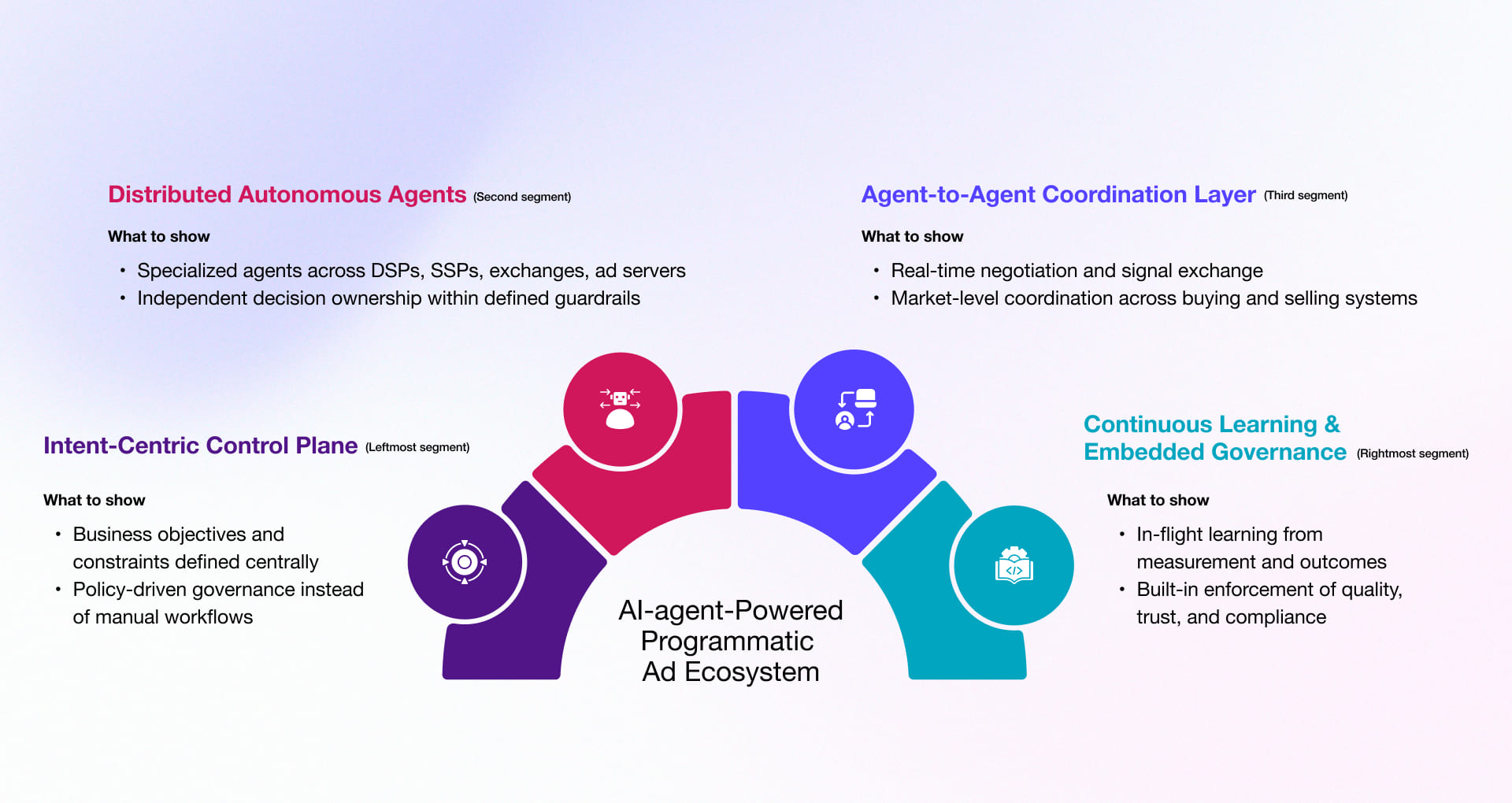
Transformation of Programmatic CTV Advertising Driven by AI Advancements
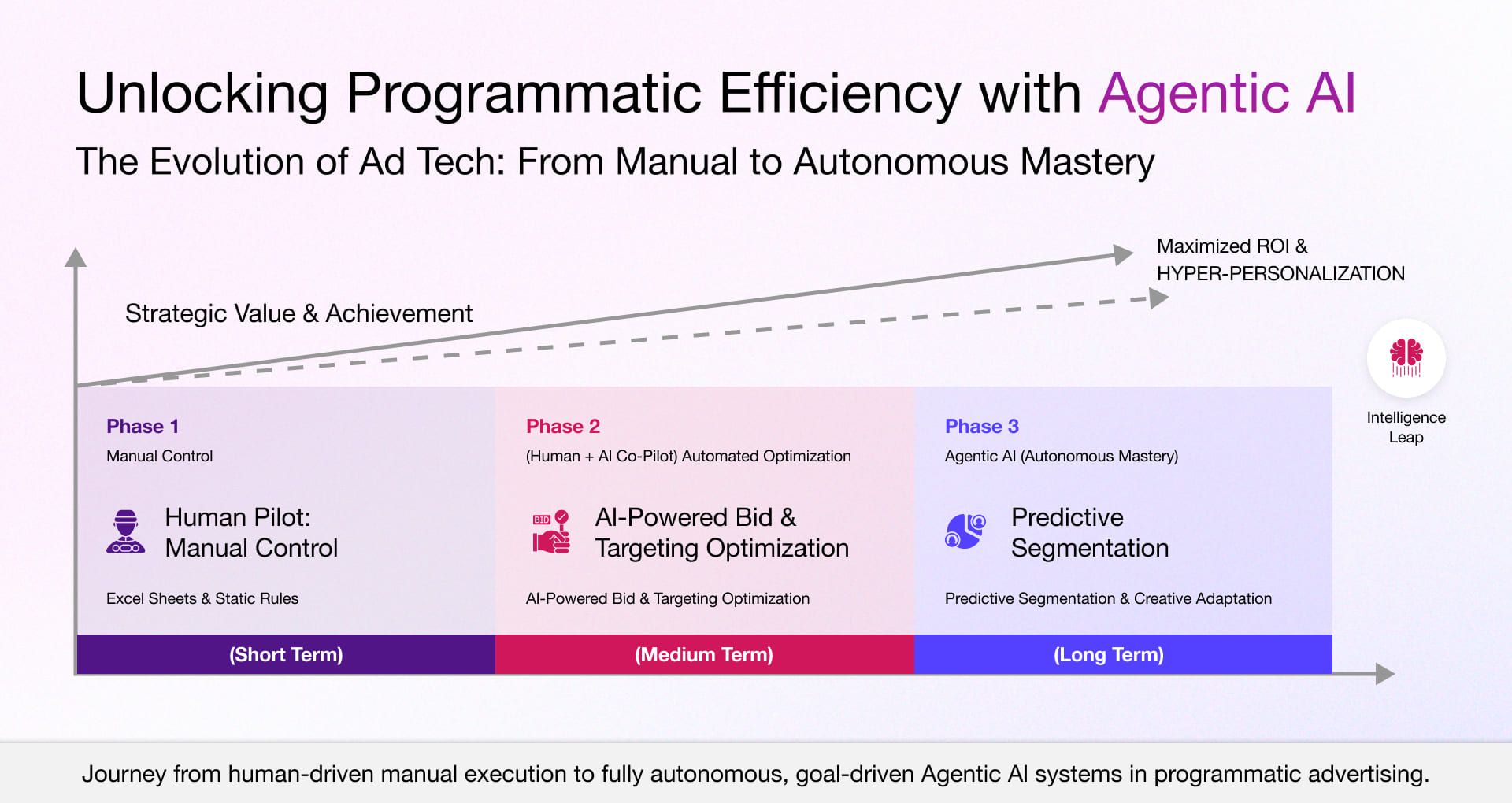
Closing Perspective: The Future of Programmatic CTV Execution is Agentic AI
Agentic AI is not just a technological upgrade; it’s a fundamental shift in how programmatic CTV campaigns are executed, optimized, and governed. By embedding autonomous decision-making across DSPs, SSPs, exchanges, ad servers, and supporting platforms, Agentic AI ensures campaigns are efficient, resilient, and aligned with business intent in an increasingly complex and fragmented ecosystem.
At Rishabh Software, we bring hands-on expertise of AdTech software development and Microsoft Data and AI across programmatic CTV, AdTech platforms, and agentic AI architectures, helping advertisers and platform providers embed autonomous decision-making across the broader programmatic ecosystem.
Frequently Asked Questions:
Q: What is Agentic AI in Programmatic Ads?
A: Agentic AI in programmatic ads refers to autonomous systems that can decide, act, and optimize across media buying, selling, and execution with minimal human intervention, guided by intent and constraints rather than manual rules.
Q: What are the Common Myths and Misunderstandings of Agentic AI in Advertising?
- Agentic AI is just advanced automation or rule-based optimization
- It is limited to bidding or targeting improvements
- It works in isolation without interacting with other systems
- It removes human oversight entirely
Q: How Do AI Agents Work in Media Buying and Programmatic?
A: AI agents continuously interpret live signals, coordinate with other agents across the ecosystem, and adjust bidding, budgeting, and execution decisions in real time during campaigns.
Q: Does Agentic AI Replace Media Buyers?
A: No. Agentic AI shifts media buyers from manual execution to strategy definition, intent setting, and governance, while autonomous systems handle real-time decision-making.