

The combined capabilities of Retrieval-Augmented Generation (RAG) and agentic AI are reshaping how enterprises think about accuracy, reliability, and trust in AI systems. As AI integration expands across every next solution or application, accuracy is not just a fancy word to go with, it is a top choice for forward-thinking business leaders. The room for hallucinations is especially limited when core business processes are involved.
Do you know which gaps are still present in today’s AI systems that make Agentic RAG necessary? Despite improvements introduced by Retrieval-Augmented Generation (RAG), limitations persist in empirical validation, user-centric evaluations, contextual adaptability, and ethical considerations, especially as AI systems move closer to core business decision-making. Research shows that even advanced RAG variants can reduce hallucination rates to around 5.8% in controlled settings, proving that grounding models in external knowledge helps.
Let’s explore, like never before, why Agentic RAG is critical for improving AI accuracy, how it outperforms traditional RAG approaches, and how it creates new opportunities for business leaders and operations teams, and more.
How Agentic RAG Outperforms Traditional RAG?
| Dimension | Traditional RAG | Agentic RAG |
| Retrieval Strategy | Executes a one-time, query-driven retrieval step | Orchestrates multi-step, goal-driven retrieval through autonomous agents |
| System Intelligence | Relies on prompt engineering and static workflows | Embeds planning, reasoning, and decision logic within the system |
| Hallucination Risk | Reduces hallucinations, but residual errors remain | Actively identifies, verifies, and corrects potential hallucinations |
| Context Management | Assumes context is stable throughout the interaction | Continuously adapts context as new information emerges |
| Validation Mechanisms | Limited or externally enforced validation | Built-in verification loops and confidence checks |
| Complexity Handling | Performs well for straightforward, factual queries | Designed for multi-hop reasoning and ambiguous problem spaces |
| User-Centric Evaluation | Quality assessed post-response | Quality assessed dynamically during reasoning and retrieval |
After reviewing multiple valid comparison points, it should now be clear how Agentic RAG stands out and why it is better than traditional RAG. Let’s now look at their workflows to understand another key difference.
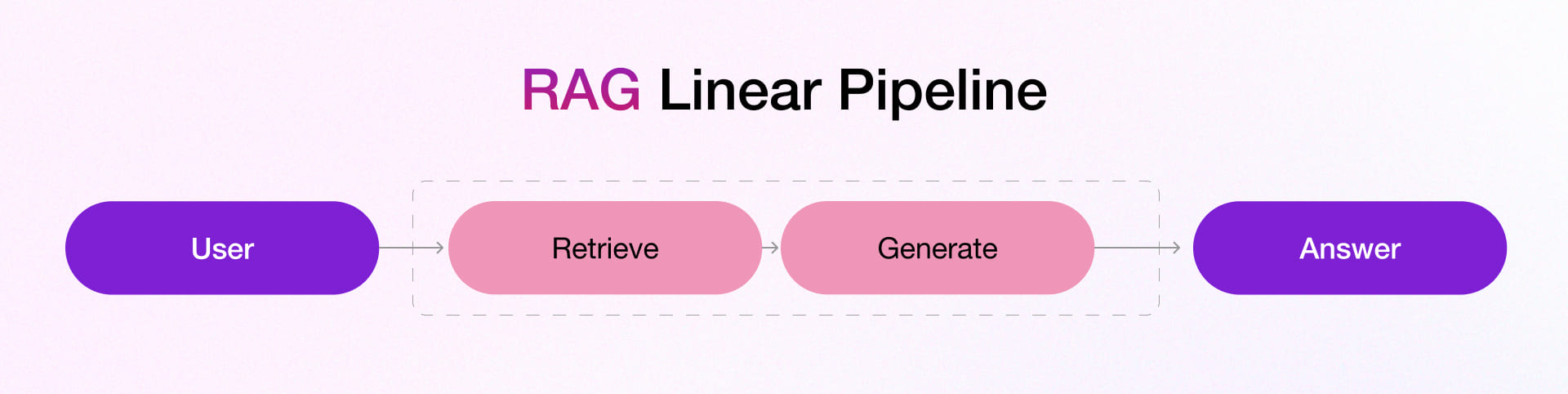
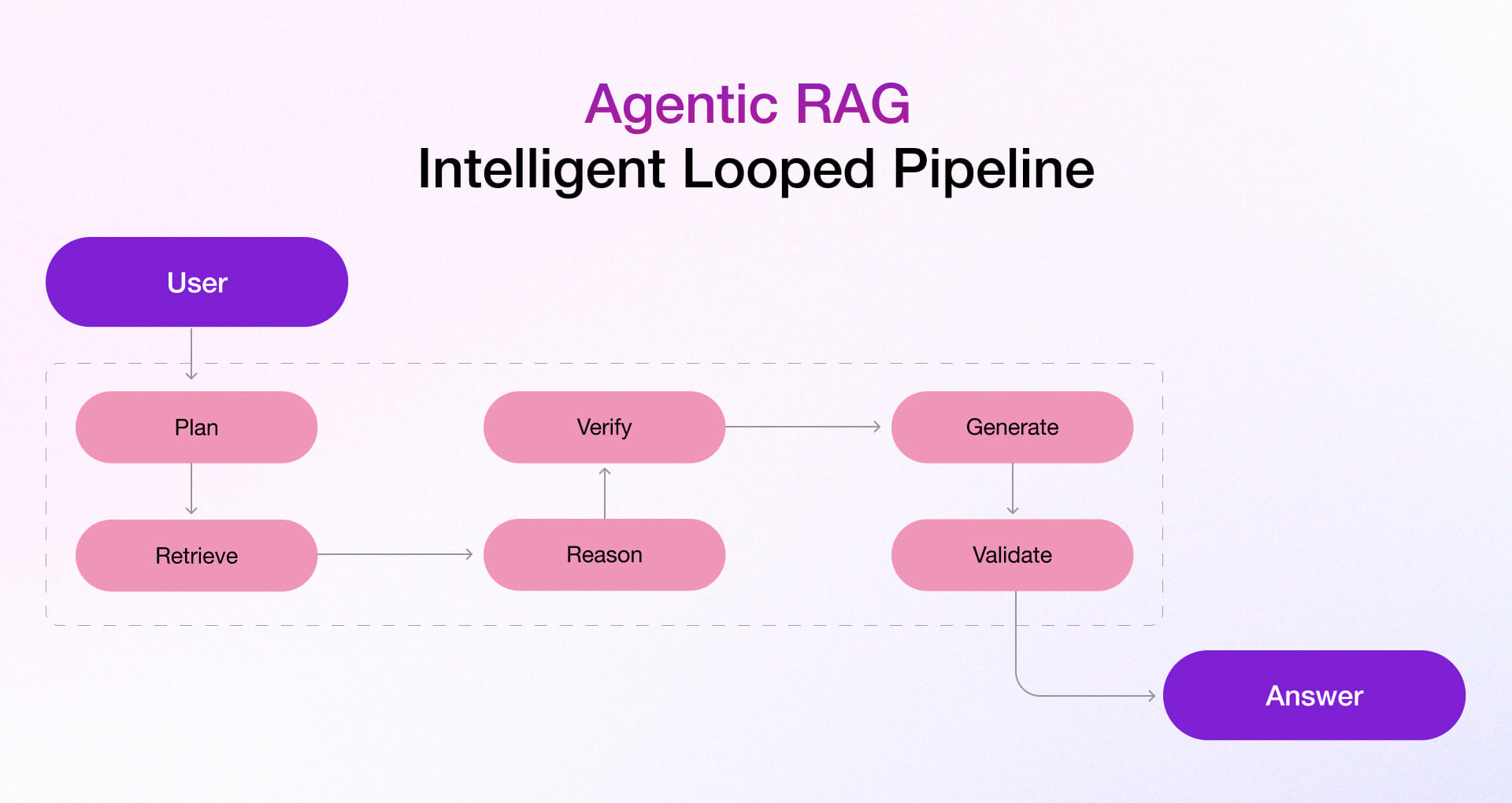
Business-Critical Benefits of Agentic AI–RAG Integration
Let’s explore how agentic RAG integration helps businesses build trustability of output, better decision making, optimize cost, and other factors that matter the most for business leaders are positively influenced. Along with know how:
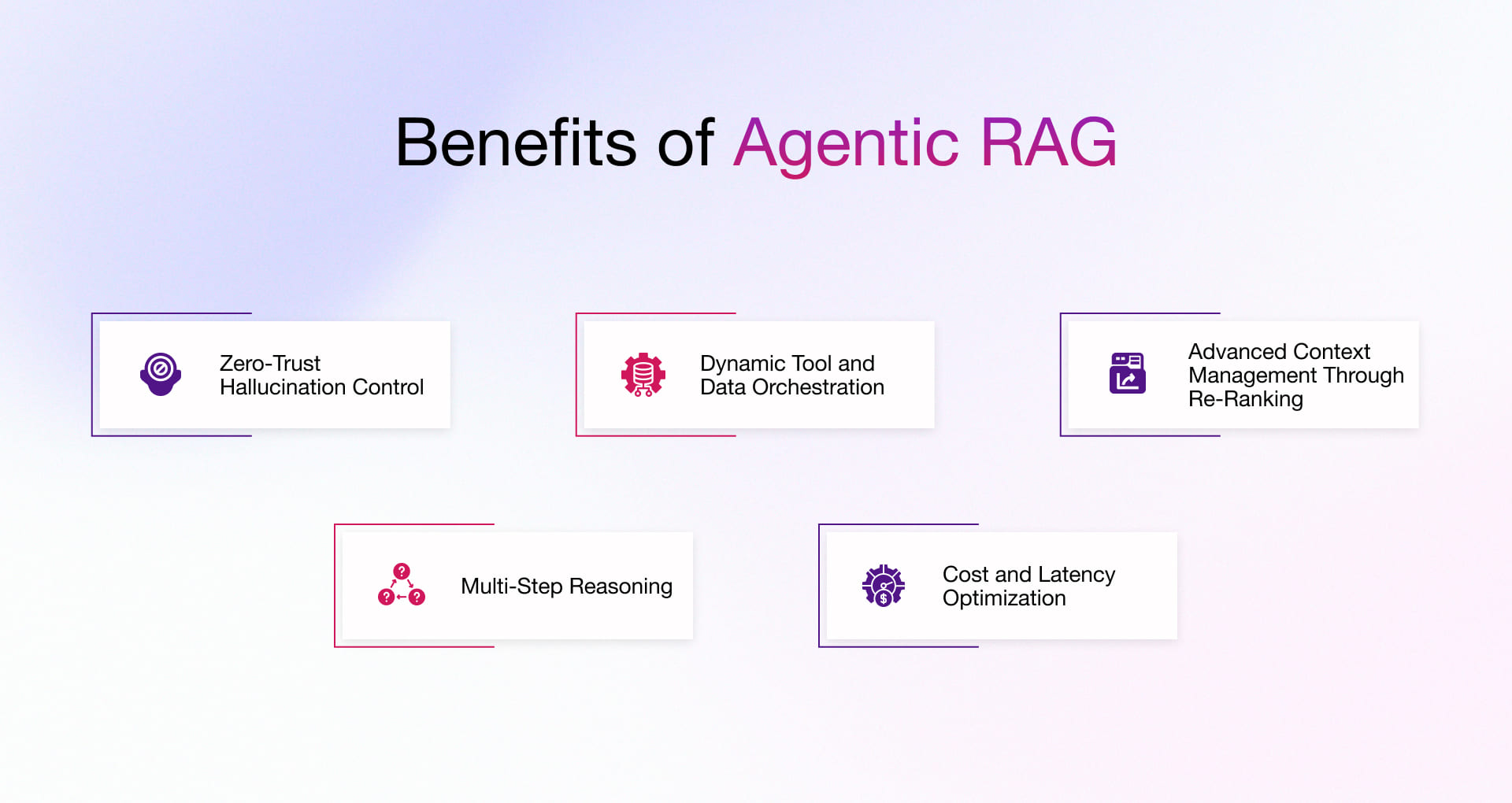
1. Zero-Trust Hallucination Control
Business Benefit: Reliability in high-stakes environments such as legal, healthcare, and financial operations, where incorrect answers are unacceptable.
- Technical / Operational Foundation:
Agentic RAG replaces linear generation pipelines with a multi-stage validation loop. Before an answer is delivered, a dedicated Critic Node performs a Natural Language Inference (NLI) check, systematically comparing the generated response against the retrieved source material. This validation step quantifies grounding confidence rather than assuming correctness. - Operational Impact:
By enforcing a “cite-or-silent” policy, the system suppresses unsupported outputs. If the grounding score drops below a defined threshold (e.g., 0.85), the agent automatically triggers secondary retrieval or returns “Information not found” instead of hallucinating. The result is near-zero hallucination tolerance, suitable for regulated and decision-critical use cases.
2. Dynamic Tool and Data Orchestration
Business Benefit: Real-time decision-making without data silos, powered by live enterprise data.
- Technical / Operational Foundation:
Agentic RAG enables autonomous tool routing using structured function calling. The agent dynamically selects the most appropriate data source, whether a vector database for policy text, a SQL system for operational metrics, or a web API for external signals, within a single interaction. - Operational Impact:
Enterprises no longer need multiple task-specific bots. A single agentic interface acts as a unified intelligence layer, orchestrating retrieval across the entire technology stack and dramatically simplifying system architecture while improving response relevance.
3. Advanced Context Management Through Re-Ranking
Business Benefit: Higher accuracy when working with long, dense documents such as contracts, technical manuals, or compliance frameworks.
- Technical / Operational Foundation:
Initial retrieval typically surfaces dozens of semantically similar chunks. Agentic RAG introduces a cross-encoder re-ranking layer that evaluates semantic relevance and informational density, narrowing large candidate sets (50–100 chunks) down to the most contextually critical few. - Operational Impact:
This directly addresses the “lost in the middle” problem common in large contexts. The system achieves higher recall, lower noise, and reduced token consumption, ensuring the generation model operates only on the most authoritative information.
4. Multi-Step Reasoning and Task Decomposition
Business Benefit: Enables AI to handle complex analytical and comparative tasks previously reserved for human analysts.
- Technical / Operational Foundation:
When faced with compound questions, the agent performs sub-query decomposition, breaking the request into discrete tasks. These are executed sequentially or in parallel, with the agent maintaining stateful memory of intermediate results to preserve logical continuity. - Operational Impact:
This capability elevates AI from transactional Q&A to research-grade analysis, supporting workflows such as performance comparisons, root-cause analysis, and multi-source synthesis without manual data stitching.
5. Cost and Latency Optimization at Scale
Business Benefit: Lower total cost of ownership without sacrificing intelligence or accuracy.
- Technical / Operational Foundation:
Agentic RAG employs model cascading, using lightweight models for intent detection, routing, and early retrieval, while reserving larger, more expensive models for high-complexity synthesis tasks. - Operational Impact:
This architecture prevents over-spending on routine queries while ensuring maximum reasoning depth when required. Enterprises achieve predictable performance, controlled latency, and optimized AI spend, making large-scale deployment economically viable.
Core Components of Agentic RAG that Improve AI-powered output
Let’s explore the key components of Agentic RAG that drive the entire process and ensure accuracy.
1. Agentic Decision and Planning Layer
Agentic RAG introduces a planning layer that evaluates user intent, task complexity, and acceptable confidence thresholds before execution begins. This layer determines whether retrieval is required, how retrieval should be structured, and when generation should be deferred or constrained.
- Contribution to output quality:
By aligning system behavior with intent and uncertainty levels, this component reduces premature responses and improves precision in downstream generation.
2. Dynamic and Context-Aware Retrieval
Unlike conventional RAG pipelines that rely on a single retrieval pass, Agentic RAG employs adaptive retrieval strategies. Agents can reformulate queries, retrieve additional evidence, or switch data sources when initial results are insufficient or inconsistent.
- Contribution to output quality:
This adaptability increases retrieval accuracy and recall, ensuring that generation is grounded in comprehensive and contextually relevant information.
3. Multi-Agent and Tool Orchestration
Agentic RAG systems coordinate multiple specialized agents and tools such as vector databases, structured data systems, and external APIs within a unified reasoning flow. These agents share intermediate results and maintain state across sub-tasks.
- Contribution to output quality:
Collaborative problem decomposition and orchestration improve consistency and enable the system to handle complex, multi-step queries that exceed the capabilities of single-pass retrieval models.
4. Validation and Grounding Mechanisms
Before generation, Agentic RAG applies explicit validation checks to evaluate whether retrieved evidence sufficiently supports the intended response. These checks include relevance scoring, cross-source consistency analysis, and grounding confidence thresholds.
- Contribution to output quality:
This component directly mitigates hallucinations by preventing unsupported or weakly grounded content from entering the generation stage, improving trustworthiness and factual reliability.
5. Controlled and Reasoned Generation
Generation in Agentic RAG is treated as a gated outcome, not an automatic step. Responses are synthesized only after validation criteria are satisfied, using verified context and structured reasoning constraints.
- Contribution to output quality:
This approach improves precision and explainability of outputs, making them suitable for enterprise and decision-critical use cases.
6. Feedback-Driven Adaptation
Advanced implementations incorporate feedback signals such as confidence scores, system metrics, or user evaluations to continuously refine retrieval strategies and validation logic.
- Contribution to output quality:
Over time, this feedback loop enables measurable gains in performance, adaptability, and user satisfaction.
Best Practices for Seamlessly Integrating Agentic RAG to Ensure Success
Building an Agentic RAG system isn’t about stacking tools or chasing the newest AI idea. It’s about making careful choices so the system behaves in ways people can actually rely on. Most failures don’t happen because the model is weak. They happen because the system wasn’t designed to think before it spoke.
1. Start with the decision you’re trying to support
Before writing a single line of code, be honest about what you want the system to help with. Is it checking contract terms? Handling support issues? Assisting leaders with performance questions? When the goal is fuzzy, the system will be too. Clear decisions lead to clearer behavior.
2. Give the system room to slow down
Agentic RAG works best when it’s allowed to pause, fetch more information, and double-check itself. Fast answers feel impressive, but careful answers are the ones people trust. Let the agent ask, “Do I know enough?” before it responds.
3. Don’t wire everything too tightly
Keep decision-making, retrieval, checks, and response generation as separate pieces. When everything is glued together, problems stay hidden. When pieces are loosely connected, it’s easier to see where things went wrong and fix them without breaking everything else.
4. Watch how the system thinks, not just what it says
The final answer is only part of the story. Pay attention to the steps it takes. Where does it hesitate? When does it look things up again? When does it decide not to answer at all? Those moments tell you whether the system is behaving responsibly.
5. Earn trust before pushing scale
Pick situations where getting it wrong would hurt. When teams see that the system stays grounded and knows when to stay quiet, confidence builds quickly. Once trust is there, expansion becomes much easier.
High-Impact Agentic RAG Use Cases
Agentic RAG delivers the most value in situations where businesses need accurate answers, clear traceability, and the ability to reason through complex questions. These are not quick lookups. They are scenarios where decisions depend on context, evidence, and confidence. Here are the key use cases of Agentic RAG:
1. Enterprise Knowledge Intelligence
The Agentic RAG system transforms unorganized company knowledge into practical resources for team members. Employees can request information about contracts and policies and operational documents to receive answers that they can verify through grounded evidence. Teams such as procurement and HR can use this system to quickly establish terms and understand rules without needing to search through separate document systems.
2. Customer Support and Service Automation
Agentic RAG introduces contextual information into its full response system for support environments. The system analyzes product documents combined with past support requests and current customer account information to generate solutions after developing comprehensive product knowledge. The system decreases both incorrect problem assessments and unexpected problems because critical information remains unknown. At Rishabh Software, we have developed an Agentic RAG–enabled assistant named RAA, which you can explore to learn more.
3. Regulatory, Legal, and Compliance Analysis
Agentic RAG offers legal and compliance teams a solution to eliminate most regulatory interpretation challenges. The system identifies essential contract clauses which it verifies for validity in multiple regions while maintaining consistent understanding of contractual obligations. The team can handle regulatory changes with improved understanding and trust instead of depending on time-consuming manual verification processes.
4. Financial and Operational Decision Support
The performance data analysis process needs Agentic RAG because it enables leaders to comprehend data without organizing information manually. The system extracts data from reports and real-time metrics to create a unified flow that displays both trends and fundamental causes while maintaining clear traceable paths to all conclusions.
5. Research and Strategic Analysis
The strategy teams use Agentic RAG to accelerate their process of turning data into valuable insights. The system combines multiple data sources which include market reports and internal research to help teams identify essential signals that lead to better understanding of their competitors and potential business opportunities and risks.
How We Help Enterprises Build Production-Grade Agentic RAG Systems
At Rishabh Software, we help organizations turn these challenges into levers for action. Through our Agentic RAG Development Services, we build Agentic RAG systems that prioritize coherent outputs, measured reasoning, and dependable behavior. The goal is simple: help teams deal with complexity without adding more of it, and ensure AI delivers answers that can be trusted when decisions are on the line.
Frequently Asked Questions
Q: What is Retrieval-Augmented Generation (RAG)?
RAG or retrieval augmented generation allows an AI to incorporate relevant external source information into its generated response, thus improving the chances of having a complete and accurate response grounded in real data versus just using its memory.
Q: What types of data can various agentic AI RAG systems access or retrieve?
Agentic AI RAG systems have the ability to retrieve various forms of content including documents, databases, historical records, live systems via APIs. They also decide which sources would provide enhanced information and how much additional information may be needed prior to responding.
Q: What is the future of RAG technology/solution/field beyond 2025?
RAG is anticipated to trend towards systems that are more focused on reasoning, validation, and traceability with the increasing role AI plays as a decision support function and will therefore continue to play an important role in generating trusted and explainable outputs.