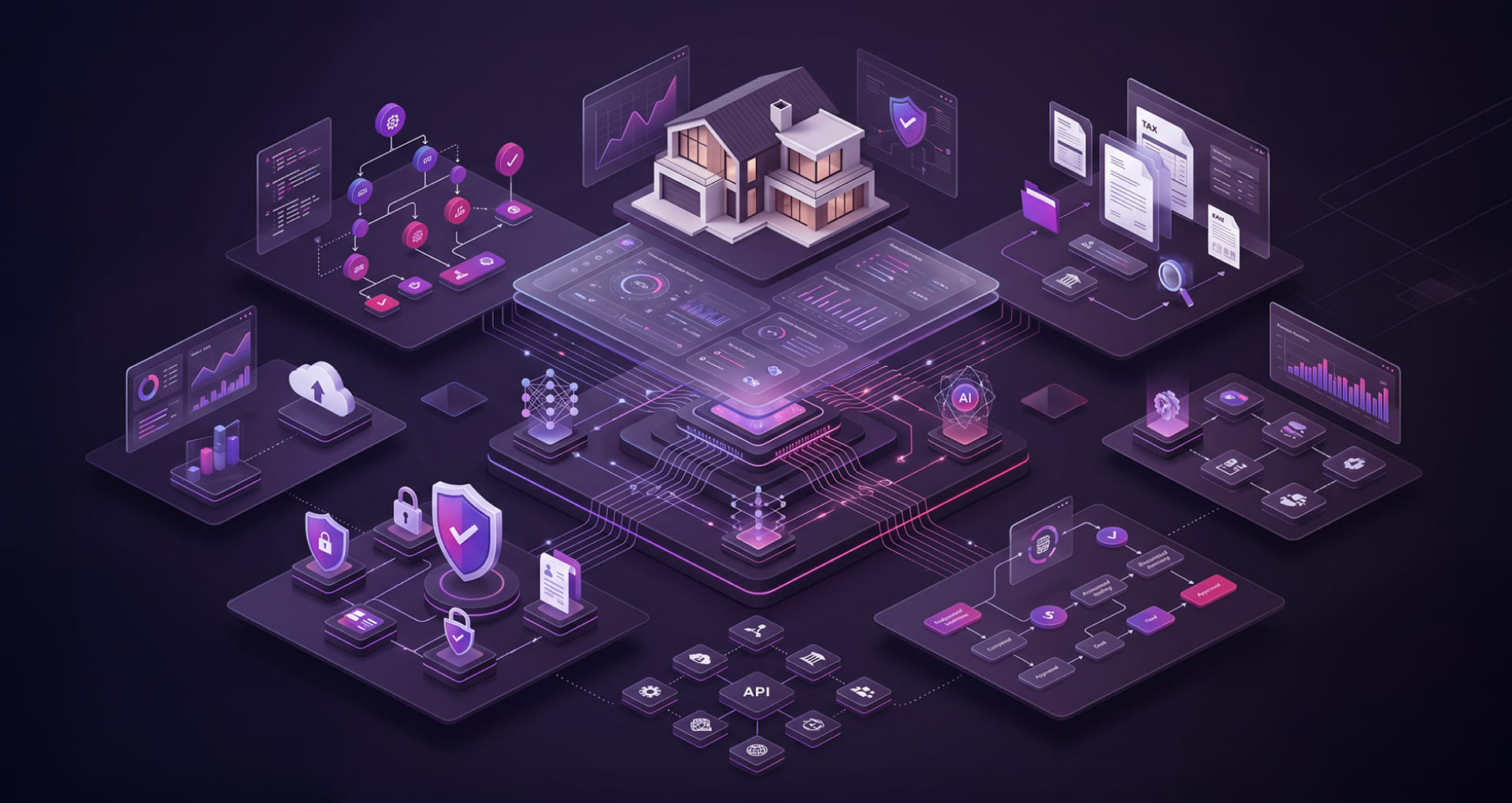

By 2:00 PM today, you will likely lose a qualified borrower. Your rates did not cause the loss. Slow loan approvals and delayed underwriting decisions caused it. While you wait for manual checks, a digital-first competitor has already funded the lead. When outdated lending systems create data delay in underwriting, you lose money.
The Measurable Impact of Automation in Modern Lending
- A McKinsey study found that banks using automation reduced costs by 20–30%
- Many traditional banks still take 7–15 days to process loan applications, while fintech and automated systems can approve and disburse loans in just a few hours.
- Leading lenders are significantly reducing decision times. A Deloitte example shows a bank cutting mortgage approval time from 15–20 days to just 3–5 days using digitization and automation.
The gap keeps widening. You can wait for a total rebuild or start winning deals next month. Lending system modernization gives you a smarter way forward. You avoid ripping out your core, and you skip the five-year wait. Doing nothing costs you lost deals, slower product launches, and a competitive gap that grows every month.
This blog covers four proven strategies from lenders who chose the third path: intelligent augmentation. No core replacement. No five-year wait.
Why Legacy Lending Data Architecture Is a Hidden Profit Drain
Legacy lending systems were not built for the world lenders operate in today. Engineers designed them for batch processing, overnight reconciliation, and siloed operations. That was the right call in 2003, but in 2026, it’s a liability.
The damage appears across the entire lending lifecycle from origination through underwriting, servicing, and collections in four key areas.
Batch Latency Turns Decision-Making into a History Review
When your risk engine runs on data that is six to twelve hours old, you review past events instead of assessing current risk. In loan origination, a borrower’s credit profile or income verification changes while a competitor acts faster. Your system updates at midnight, but you lose the deal at noon. This situation creates slow loan decisions and missed opportunities, especially in competitive segments like small business loans or merchant factoring. Real-time visibility into cash flow or invoices often decides approval.
Point-to-Point Integrations Make Every Upgrade a Liability Event
When systems connect directly to the core, one version change or regulatory update breaks multiple integrations. Maintenance cycles stretch and release windows shrink. Engineers spend their time maintaining pipelines instead of building features like faster KYC or AI-assisted document intelligence.
Fragmented Borrower Records Weaken the Entire Lifecycle
Origination, underwriting, servicing, and collections each maintain their own borrower record. No single source of truth exists. The systems drift out of sync. Someone performs manual reconciliation every day. Every quarter, auditors ask why records do not match. This problem becomes especially risky in asset-based lending or factoring, where BBC validation depends on accurate, up-to-date financial data. Without centralized real-time data, compliance checks take longer, and errors increase.
AI and Analytics Projects Stall Before They Deliver Anything
You cannot build an intelligent system on delayed or inconsistent data. Most lending AI initiatives fail to launch because the data arrives too late and lacks trust. Real-time risk scoring and automated underwriting need live data. Only live data helps lenders avoid delays in underwriting, improve approval speed, increase risk accuracy, and deliver a better borrower experience.
Full migrations rarely justify the risk. Your core system already handles transactions reliably. The real opportunity lies in building a smarter layer around it to solve these lifecycle pain points.
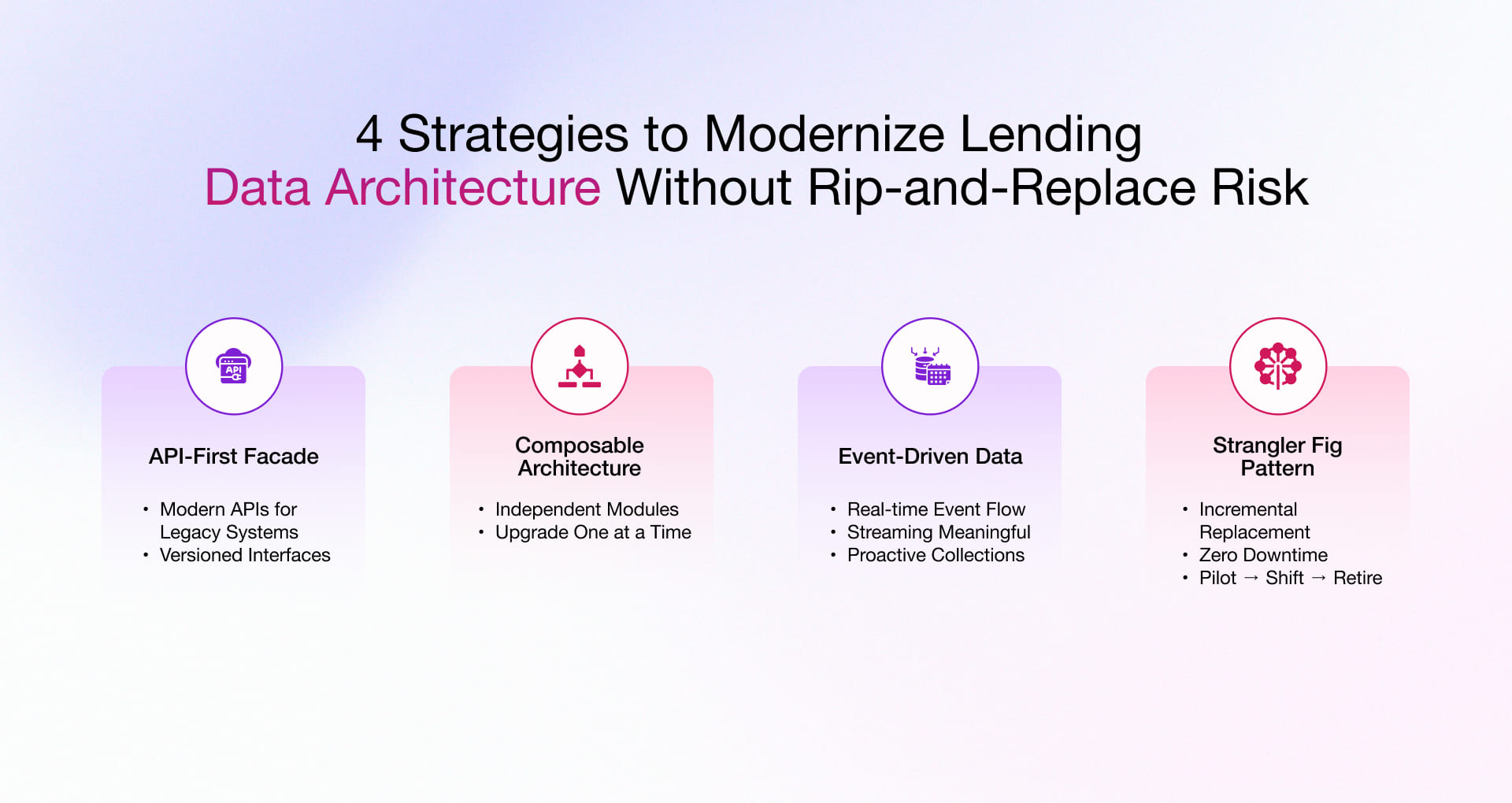
4 Strategies to Modernize Lending Data Architecture Without Rip-and-Replace Risk
These four strategies form a practical toolkit. A community bank that modernizes its BBC validation workflow for commercial lending needs different tools than a FinTech lender that adds AI underwriting for consumer or invoice-based products. You should start where the pain is highest in your origination or underwriting processes and add layers gradually as the business case grows.
Strategy 1: API-First Facade
Abstracting Legacy Internals Behind Clean, Versioned Interfaces
A 1990s core banking system wasn’t architected for REST APIs, LLM integrations, or real-time KYC calls. An API facade layer abstracts the legacy interface to let you plug in modern services without ever touching the core.
Imagine a skilled translator working between a cardiologist and a radiologist who need to share patient data. Neither system speaks the other’s protocol. A translation layer sits in the middle, handles the schema mapping and data transformation and both sides get exactly what they expect.
The facade sits between the legacy core and every modern application. It exposes versioned, documented APIs that hide the underlying complexity. A developer who builds a new digital origination product with instant KYC or alternative data sources does not need to understand the core’s internal logic. The developer simply calls the API, receives consistent data, and moves forward. This approach accelerates underwriting without integration headaches.
Best fit for: Lenders extending their core with new digital products, third-party integrations, or AI tooling without touching live operations.
Strategy 2: Composable Lending Architecture
Decoupled Services, Modular by Design
Imagine two houses. The first, poured from concrete: solid, load-bearing, permanent. To add a room, you break walls. The second, built from interlocking blocks: just as solid, but you click on a new section, move it if it does not fit, and replace a piece without touching what surrounds it.
Composable lending architecture treats the legacy core as the reliable concrete foundation. You leave it untouched. Origination, underwriting, servicing, and collections run as independent modules above it. Each module connects through APIs. You can upgrade one module by swapping in a best-of-breed AI underwriting engine for faster risk decisions without disrupting the others. You can introduce specialized tools for ABL, factoring, or BNPL products and launch them faster. This approach reduces time-to-market for new lending offerings.
Rishabh Software goes where off-the-shelf tools stop. We handle lending platform engineering, microservices, and specialized ABL and factoring systems. We build for the complexity most vendors avoid and manage intricate data flows across the full lending lifecycle.
Best for: Lenders who need faster product launches without waiting on core system upgrade cycles.
Strategy 3: Event-Driven Data Architecture
Replacing Batch Processing with Real-Time Data Flow
A senior collections officer called a borrower at 2 PM about an overdue balance. The borrower had settled it in full at 9 AM. The team did not know yet. The batch had not run.
Making lending decisions on batch data is like navigating a city with yesterday’s traffic report. The roads have changed, accidents have cleared up, and new routes have opened. The report you hold is accurate, but it’s just not about today.
An event-driven data layer captures every meaningful change in the core the moment it occurs: a loan booked, a payment received, an account flagged, a limit breached. Each event streams to a modern data platform in real time. Dashboards update, risk scores recalculate, and alerts trigger before a human has to check a spreadsheet. This shift powers real-time lending decisions and eliminates the frustration of outdated data.
Reconciliation drops, proactive collections become possible, and every team works off the same live picture instead of three separate versions of last night’s run.
Rishabh Software builds these pipelines with knowledge of lending-specific event types, not generic ETL tooling adapted to a lending context after the fact.
Best for: Lenders investing in AI-driven risk scoring, real-time dashboards, or proactive collections management.
Strategy 4: Strangler Fig Migration Pattern
Decommissioning Legacy Services One Module at a Time
In the rainforest, a strangler fig wraps gradually around a host tree. New growth takes over slowly while the host tree keeps standing and functioning throughout. The migration replaces the legacy core one service at a time, with zero disruption to the systems running on top. That’s how the Strangler Fig pattern works in practice.
The software pattern named after it works the same way. Pick one lending domain: BBC validation, document intelligence for origination, or a specific collections workflow. Build a modern replacement running alongside the legacy process. Shift traffic incrementally as the new system proves itself. Retire the legacy component when the replacement is fully live and tested.
Each phase is a contained pilot with measurable outcomes. A phase that underperforms does not disrupt the core. According to Deloitte’s research on legacy modernization, incremental replacement strategies consistently outperform big-bang migrations in cost control and delivery reliability.
Our experience in regulated lending environments makes this pattern safer. We map compliance controls, such as audit trails for loan files, before we build. This step alone saves months of rework in highly scrutinized areas like factoring or consumer lending.
Ideal for: Lenders modernizing one high-risk domain at a time, with board-level scrutiny on every technology dollar spent.
Rishabh Software’s Approach to Lending Architecture That Actually Holds Up Under Audit
Most lenders don’t need a new core system. They need better control over what sits around it. Faster decisions, clean data, systems that adapt without slowing teams down and governance that survives audit inspection without last-minute scrambling.
The architecture advantage is yours to take and that’s where we focus. Here is what that looks like in the real-world.
Client Success Story: Modernizing a Merchant Factoring Platform for Scalable Lending
Client:
A US-based fintech firm offering working capital and merchant factoring solutions.
The Challenge:
As the client scaled its lending operations, legacy systems created a serious bottleneck in the factoring lifecycle.
- Scattered borrower/debtor data across origination, underwriting, and servicing
- Slow underwriting due to manual data pulls
- No real-time visibility into invoice status (critical for factoring)
- Fragmented audit trails increase compliance risk
- Scalability issues during rapid merchant onboarding
What Made It Complex:
- Inconsistent data structures and formats across systems
- Need to preserve historical records for audits
- Clash between real-time needs (invoice validation, payment monitoring) and legacy batch processes
- Risk of disrupting live lending operations and cash flow
- Compliance and data lineage challenges common in specialty lending
Our Approach:
We rebuilt the platform as a unified, cloud-native system on Microsoft Azure while focusing on four areas:
- Unified Data Layer
Consolidated financial, transactional, and borrower data into a single, consistent platform to ensure accuracy across underwriting, reporting, and audits.
- Cloud Modernization
Migrated legacy systems to a scalable, modular Azure environment built to integrate with modern fintech tools and support future lending capabilities.
- Real-Time Underwriting Visibility
Deployed Power BI dashboards giving underwriters instant access to borrower financials
- Compliance-Ready Architecture
Built structured audit trails and streamlined access to historical data to reduce the time and effort needed for compliance checks.
The Results:
- 95% increase in operational efficiency
- 98% improvement in system performance and stability
- Real-time financial visibility enabling faster underwriting decisions.
- Stronger audit readiness with structured, easily accessible historical data.
Learn more about our fintech software development practice to see how Rishabh Software builds for the full fintech stack.
How Rishabh Software Helps Lending Platforms Scale
Our lending software development expertise goes beyond surface-level fixes. We strengthen the foundation of lending systems:
- Cloud-first modernization delivers scalable, resilient platforms.
- Data platform engineering powers underwriting and decisioning across the lifecycle.
- Real-time analytics supports faster, insight-driven lending such as dynamic risk scoring.
- Compliance-ready architecture meets the needs of regulated environments.
We focus on outcomes that matter: faster processing, fewer manual steps in origination and underwriting, reduced reconciliation in servicing and collections, and systems that scale with your lending business instead of working against it.
Frequently Asked Questions
Q. What does it mean to modernize lending data architecture?
A. Modernizing your lending data architecture means building a modern, intelligent layer around your existing core systems instead of replacing them. The process typically includes real-time data pipelines, API interfaces, composable lending modules, and strong governance controls. The goal is to make legacy systems faster, better connected, and capable of supporting today’s business tools, such as real-time risk decisions in underwriting or unified views across origination and collections.
Q. Can banks and lenders really modernize lending systems without replacing the core?
A. Yes. Most successful modernization programs in 2026 follow this exact approach. The legacy core continues to handle transactions reliably. The augmentation layer manages real-time data flow, AI model integration, analytics, and modern user experiences in lending workflows. Both layers work side by side. No full migration is required. Many lenders achieve strong results through incremental approaches. They modernize specific modules like loan origination or underwriting first, while keeping the core stable. This method delivers quicker wins in approval speed and compliance without the risks of a big-bang replacement.
Q. What is composable lending architecture?
A. Composable lending architecture treats origination, underwriting, servicing, and collections as independent modules connected through standard APIs. This design enables teams to upgrade, replace, or extend one module, for example, by adding AI for faster credit decisions—without disrupting adjacent systems. New product launches, such as expanding into new factoring verticals, move faster. Vendor lock-in decreases over time. The legacy core remains the transaction engine while every layer above it evolves independently.