To reduce AWS costs on a recurring basis through resource optimization, idle resource cleanup, and improved infrastructure governance
An IT services company was spending more on AWS infrastructure than its workloads required. Some resources were oversized or remained idle, while provisioning and decommissioning lacked standardized processes. Incomplete infrastructure diagrams also made system understanding and team onboarding more difficult. The client engaged Rishabh Software to address these issues through an audit-led AWS cloud cost optimization initiative, supported by our AWS development services. Our team aligned infrastructure capacity with actual workload demand, removed unnecessary resources, standardized resource lifecycle practices, and improved documentation to support ongoing cost governance.
Capability
Cloud Consulting
Industry
IT Services
Country
India
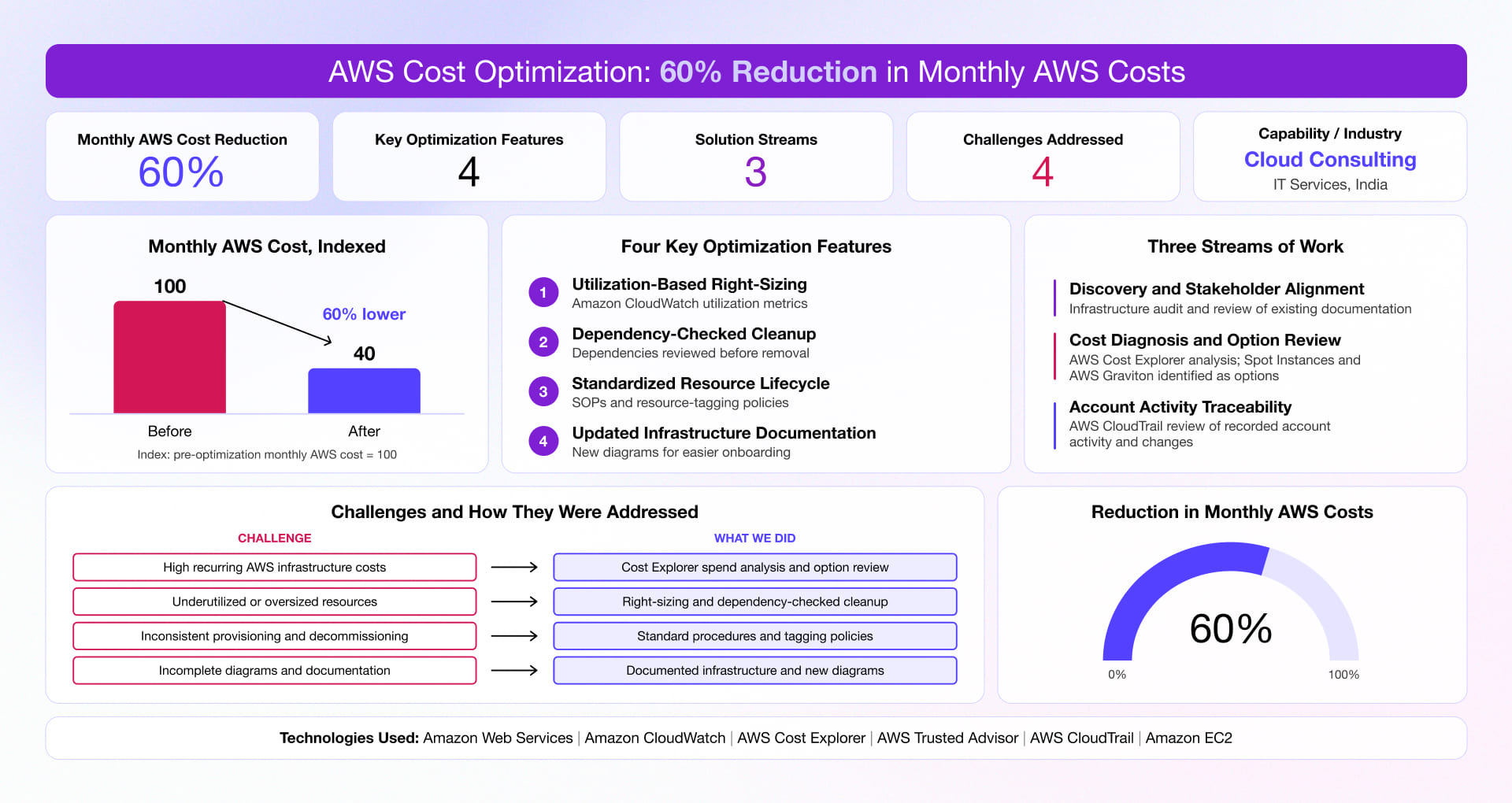
The goal was to lower recurring costs, standardize the provisioning and retirement of resources, improve documentation and build governance for AWS cloud cost management to sustain the savings. To achieve these goals, we ran an audit-led optimization program across the client’s AWS environment.
Our engineers analyzed Amazon CloudWatch utilization metrics to identify oversized instances and determine where capacity could be optimized. We then downscaled each oversized instance to the capacity its workload actually used.
We introduced standardized operating procedures for resource provisioning and decommissioning, along with resource-tagging policies. These practices established a more consistent approach to resource lifecycle management and improved infrastructure governance.
Before removing idle resources, our engineers checked their dependencies to identify any connected workloads or services that could be affected. This helped prevent unnecessary disruptions during resource cleanup.
Our team documented the existing infrastructure and created new diagrams to improve visibility into the AWS environment. This made it easier for new team members to understand the infrastructure during onboarding.
High recurring AWS infrastructure costs required a structured assessment and a clear optimization strategy.
Some AWS resources were underutilized or oversized compared to actual workload requirements.
Inconsistent provisioning and decommissioning practices made resource lifecycle management and ownership tracking difficult.
Incomplete infrastructure diagrams and documentation limited visibility and slowed onboarding.
To address these challenges, we drew on our AWS Select Tier Services Partner expertise and diagnosed before we changed anything. We used AWS CloudTrail to review recorded account activity and maintain visibility into changes made across the AWS environment, including when those changes occurred. Three streams of work set the direction for every change.
Our team conducted an infrastructure audit and reviewed existing documentation to understand the deployed resources and their dependencies. This helped establish better visibility into the AWS environment before making optimization decisions.
We used AWS Cost Explorer to analyze infrastructure spending and identify major cost contributors. We also identified Spot Instances and AWS Graviton as further options for cost optimization in AWS on suitable workloads. Our eBook, The CTO’s Blueprint for AWS Cost Optimization, sets out the wider playbook behind this approach.
EC2 instances are rightsized
Worth of idle resources are removed
5 Accounts
Resources are validated across 5 AWS accounts under the organization

Explore our success stories to see how we have helped clients overcome business challenges, drive innovation, and achieve measurable results with tailored solutions.