Artificial Intelligence, as a technology, is enabling computers to learn, solve problems, and make decisions like humans. Since its early adoption in product design around 2010, product owners have started experimenting with how to apply AI in product development. Over the last decade, AI-powered systems have transformed how organizations drive innovation in software products and enable a data-driven approach to product development.
At Rishabh Software, we have tracked this transformation firsthand. Our software engineering teams incorporated AI throughout the development workflows. Over the 25+ years, we have successfully built hundreds of products. When we started integrating AI into the product development lifecycle, from ideation to deployment, we observed an SDLC revolution.
Let us walk you through this informative piece of content as a business case for embracing Artificial Intelligence, powered product development in 2026.
Uses of AI in Various Stages of Product Development Lifecycle
The software product development lifecycle consists of multiple layers, stages, and phases to ensure outcome-oriented deliveries. AI in the product development lifecycle can empower processes and, to some extent, speed up each phase’s operations execution for increased productivity and efficiency, thereby hastening the market launch of new services and products. Let’s explore how AI and Gen AI capabilities can impact different areas in the SDLC (software development lifecycle).
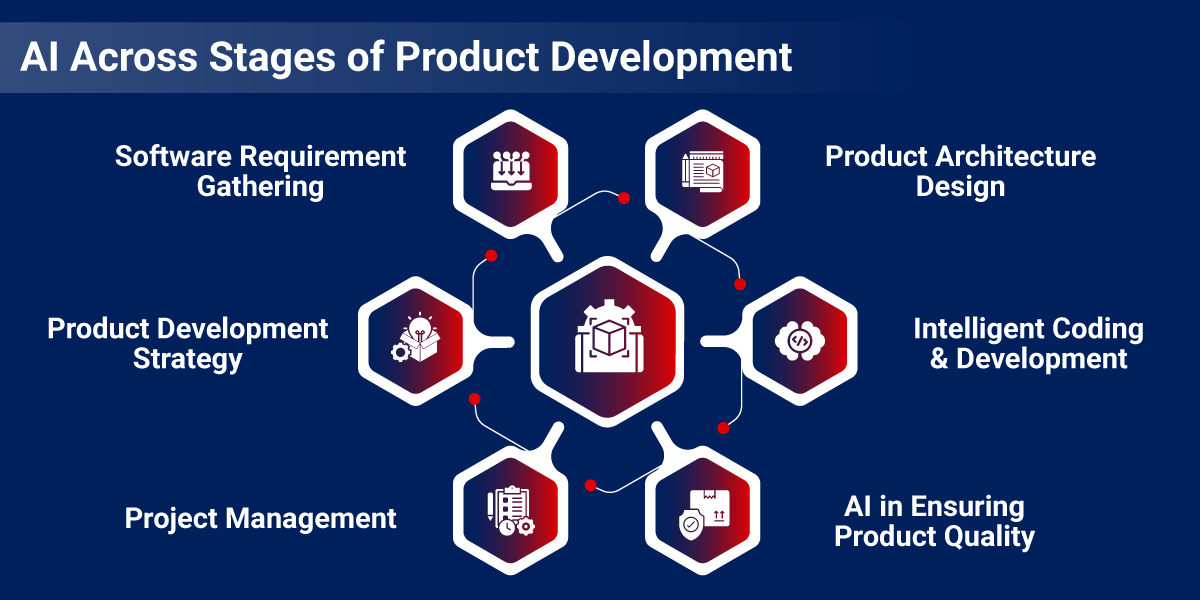
Software Requirement Gathering: AI’s capability of analyzing large sets of data allows software product development teams to collect insights and identify patterns across various factors, such as past projects, user feedback, and market trends, and to predict project outcomes. NLP can be used for feedback, support tickets, and to pinpoint information from unstructured datasets. AI-enabled tools can further help business analysts create comprehensive requirement documentation that is clear, concise, and easy to understand for the client as well as the software development team. If we talk further, generative AI can turn users’ initial inputs into structured requirements drafts, thereby minimizing uncertainty and speeding up documentation.
Product Development Strategy: Integrating Artificial Intelligence in product development strategy helps you achieve three core principles: being customer-centric, implementing a strategic deployment process, and ensuring efficient product management. AI unlocks the data-driven digital product engineering concept. Generative AI, a subset of AI, analyzes vast amounts of data from various sources to assist in brainstorming product ideas, feature listing, and more. It also offers predictive modeling to forecast market trends, user adoption rates, and potential product performance. Thus, AI empowers you to make market-based, informed, data-driven decisions, optimize product features and functionalities, analyze competitors’ data, and align product vision and mission with dynamic market trends.
Project Management: From initiating a project to building it, deploying it, and managing it throughout its lifecycle, AI for product development offers a wide range of effective tools and solutions. It enables product stakeholders, managers, and teams to automate business analysis and track project progress with accurate measures. AI enhances the project management process by optimizing resource allocation and making proactive adjustments based on ML models. AI-powered tools such as Microsoft Project, Asana, Jira, and others automate the procedures of generating and optimizing project timelines, managing risks proactively, focusing on project progress, and increasing the likelihood of project success. The new generation of Gen AI-powered assistants has the capability to automatically provide summaries of project updates, foresee blockers, and suggest measures to be taken in real-time. According to research, AI will eliminate 80% of project management tasks by 2030.
Product Architecture Design: AI tools leverage ML models to analyze past and existing digital product development architecture design and recommend optimal patterns and strategies. It can further predict the impact of factors like cost, time, performance and security, allowing developers to define the structured solution of a software project that not only meets technical and operational requirements but also optimizes attributes, including security, performance, and manageability. AI-driven product development architecture design helps generate UI/UX prototypes and mockups based on design guidelines defined by stakeholders.
Intelligent Coding & Development: An AI-powered code editor with advanced capabilities helps developers by suggesting code completions, recommending refactoring to improve code structure, and automating bug fixing. Generative AI for code generation provides developers with solutions to basic errors, enhancements, and bugs, freeing up time to focus on more creative problem-solving. This increases productivity, code quality, and overall software delivery. AI can boost developer productivity by automating up to 70% of coding tasks.
AI in Ensuring Product Quality: AI in product development automates the entire testing process, making it more reliable, efficient, and effective. AI-powered testing tools & software are built to enhance the testing phase. From software product modernization to development, AI is automating repetitive tasks and manual testing approaches, allowing testers to focus on complex testing scenarios. AI also plays a major role in predicting defects in product software, making the testing process more accurate and streamlined. Generative AI can auto-generate extensive test cases and synthetic datasets to strengthen coverage beyond manual methods.
Benefits of AI in Product Development Lifecycle
From improved accuracy and bug detection to personalized customer experiences, the integration of AI technologies and their extended capabilities, like generative AI, is transforming the way businesses approach product development. Due to the significant benefits of AI, it is predicted that the software development AI market is expected to reach $1286 Million by 2030. Let’s explore the key benefits:
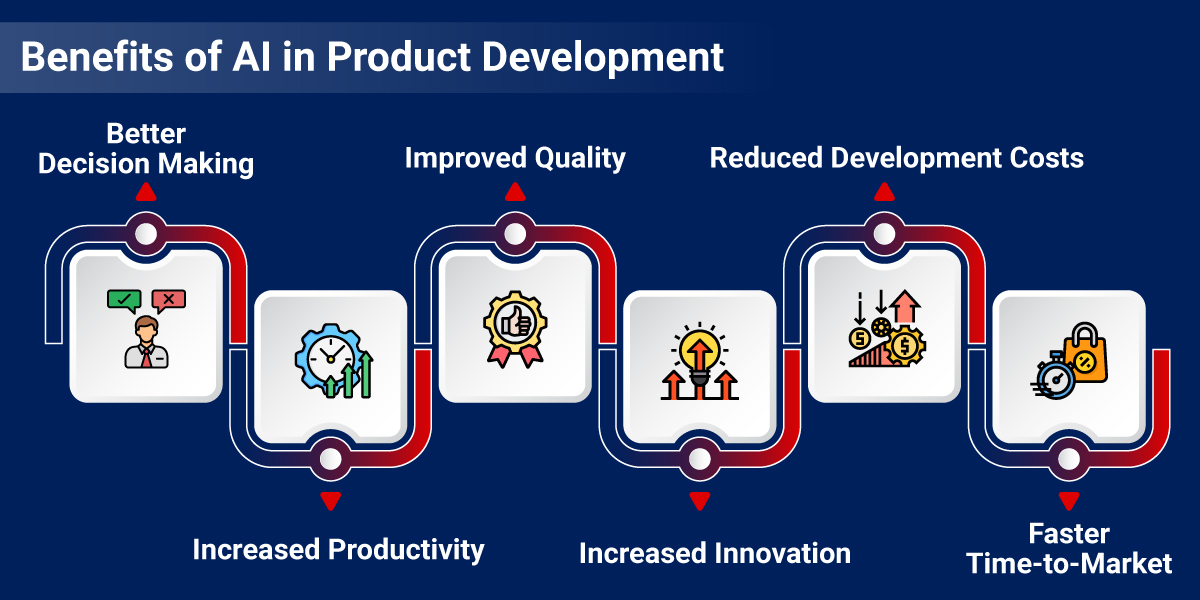
Better Decision Making: Artificial Intelligence in the product development lifecycle creates decision-making, a smart and data-driven process. The software product development services provider can utilize refined data that derive insights and analyzed via AI and ML algorithms on crucial factors of project stages, such as project metrics, on-demand software trends, client requirement charts, etc. It guides project development toward strategic decisions, while GenAI-powered forecasting provides clearer visibility into potential outcomes, enabling more effective resource allocation, mitigating risks, and ensuring product success in the market.
Increased Productivity: The combination of AI and product development drives and enhances productivity at an extended level among team members and interconnected operations. It automates time-consuming and repetitive tasks involved in software product development, such as code generation for basic and repetitive modules, testing, documentation creation, and prototyping design. With Generative AI tools/platforms like GitHub Copilot, OpenAI Codex, assisting in creating code snippets, drafting documents, and accelerating early designs, developers, testers, and BAs can focus on complex, creative tasks. AI tools can significantly speed up the coding process and even automatically fix bugs earlier in the development cycle which reduces debugging time. Integrating AI optimizes the development workflow, reduces inefficiency, and enhances collaboration between diverse teams. It translates into increased job satisfaction and enhanced productivity.
Improved Quality: Integrating AI into the product development process enhances the quality of the end delivery. How? AI has the capability to detect bugs at an early stage of development, which was previously done during the testing process. This helps in proactive resolution. Additionally, generative AI in product development (SDLC) enable to draft all possible test cases for the product, covering a broad area and ensuring reliable software delivery. AI assistance helps developers with optimizations and improvements, leading to higher-quality code, best practices, and coding standards across the project.
Increased Innovation: Artificial Intelligence in product development acts as a powerful pillar for driving innovation. The generative capabilities of AI contribute to fostering an environment of innovation by generating ideas after analyzing vast amounts of data from various sources for breakthrough products or features that can create a competitive edge in the market. Quick iterations on prototyping push the innovation boundaries of the team by allowing them to generate and test multiple product concepts or designs quickly. Leveraging AI in software development thus enables companies to explore new possibilities, take calculated risks, and push the boundaries of product innovation.
Reduced Development Costs: Incorporating AI in product development can create a significant impact on various aspects of investment. It helps major entities in development to analyze and optimize, identifying areas to manage future expenses, streamline development, and ensure the best use of resources. Improved quality and reduced error/bug ratios save on rework costs. Better requirement gathering reduces the risk of misunderstandings, saving money by driving the project in the right direction.
Faster Time-to-Market: With its core proficiency in bringing automation and efficiency to the software product development lifecycle, AI accelerates the overall process. This enables faster time to market, which has become a cornerstone in the race to be unique in a competitive marketplace. Generative AI models can assist in code generation, automate product testing, enhance project management, and streamline deployment, speeding up the delivery process and ensuring high-quality products.
How to Successfully Integrate Gen AI into Your product Development Project
We now have generative AI chatbots like ChatGPT, Gemini, and Llama, and we’ve seen how they can converse in ways that resemble human interaction. These generative AI models can also perform tasks that surpass human capabilities. To fully understand their value, it’s important to understand that it stems from their ability to engineer predictability from probabilistic behavior. The following steps will guide you on how to integrate generative AI effectively into your product development process.
1. Identify High-Value Use Cases
GenAI integration must start with a strategic filter. Research shows GenAI’s strongest ROI in four areas: coding, customer engagement, creative generation, and knowledge synthesis. Your use case must either reduce cognitive load or solve a cold-start problem; otherwise, it becomes novelty, not value.
JTBD-Driven Evaluation: Use the Impact vs. Feasibility Matrix to prioritize:
| Quadrant | Action | Example |
| High Impact / High Feasibility | Prioritize for MVP | Doc summarization, text-to-SQL |
| High Impact / Low Feasibility | Strategic investment | Autonomous negotiation agents |
| Low Impact / High Feasibility | Useful add-on | Tone correction |
| Low Impact / Low Feasibility | Avoid entirely | Open-ended GPT-style creativity in regulated apps |
Before selecting a use case, understand: “Does this require deterministic output?” If yes, GenAI should supplement the workflow, not handle core logic.
2. Assess Data, Architecture & Readiness
GenAI models are stateless. Without foundational architecture, they cannot deliver contextual or reliable outputs in your product development cycle.
Data Readiness Checklist:
- ETL for Unstructured Data: Ensure systems can ingest PDFs, chats, and HTML and convert them into clean semantic units.
- Vector Infra Preparedness: Choose and configure a vector DB (Pinecone, Milvus, Weaviate) and finalize your chunking strategy.
- Compliance: Build PII-redaction layers upfront, especially for regulated industries.
Shift from a database-centric to a context-centric architecture using RAG. Your system must fetch the right data before sending it to the model, enabling higher accuracy and lower hallucination rates.
3. Choose the Right GenAI Models & Tools
Selecting GenAI models and tools is an architectural decision instead of a feature-level choice. The right combination depends on how GenAI participates across your software development lifecycle, from experimentation to production scale.
Model Landscape:
- Proprietary LLMs (GPT-4o, Claude 3.5 Sonnet): Best for complex reasoning, early-stage prototyping.
- Open-weights models (Llama 3, Mistral): Best for scale, privacy, customization, and cost efficiency.
System Architecture
- Adopt compound AI architectures instead of relying on a single, large model.
- Use smaller, faster models for classification, routing, validation, and extraction.
- Delegate synthesis, planning, and complex reasoning to larger models only when needed.
- This layered approach improves system stability, latency, and cost efficiency.
4. Build & Integrate GenAI into the Development Workflow
At this stage, GenAI moves beyond experimentation and becomes a first-class component of the product architecture. GenAI creates real value when it fits naturally into existing development workflows. Instead of changing how teams work, GenAI should assist them during planning, development, and collaboration activities.
Integration Approach
- Implement hybrid retrieval by combining semantic search with traditional keyword search to improve accuracy and relevance.
- Use well-defined system prompts to constrain reasoning behavior, response format, and contextual boundaries.
- Design fallback mechanisms to handle incomplete data, low-confidence outputs, or retrieval failures gracefully.
A well-integrated AI module enhances user experience and decision-making while remaining predictable, observable, and safe within the broader system.
5. Test for Quality, Reliability & Safety
Unlike deterministic software, GenAI outputs are probabilistic and context-dependent, which means the same input can produce different responses over time. Testing must therefore go beyond functional correctness and include evaluation of reasoning quality, factual grounding, consistency, safety, and bias.
Effective GenAI testing requires continuous, LLMOps-driven evaluation using real user prompts, automated scoring, human-in-the-loop reviews, and guardrail validation to ensure reliable behavior in production environments.
6. Deploy, Monitor & Continuously Improve (Direction: Treat GenAI as a living system)
GenAI integration is not a one-time effort; it demands an ongoing cycle of improvement. Its effectiveness must be measured continuously to ensure it delivers real business value as products evolve.
What businesses should track
- Improvement in development speed and productivity
- Impact on product quality and user feedback
- Ongoing relevance of GenAI use cases
By refining GenAI usage over time, businesses ensure it continues to support product growth and innovation.
How to Mitigate the Risks of AI in Software Product Development?
Data Quality and Bias Mitigation
The presence of low-quality and biased data can drastically reduce the use of AI to its fullest extent in the product-development stage, resulting in biased and unreliable outputs. Consequently, the analysis, which is based on such data, will be untrustworthy, thus lessening the quality of the software development process.
Solution: Build an infrastructure to maintain high-quality data, perform various cleansing and pre-processing operations on the data, and apply fairness metrics and auditing of data as additional layers of protection.
Security and Privacy
AI integration in the product development life cycle can lead to security and privacy concerns since the training of AI models requires access to sensitive data.
Solution: Protect the AI model from unauthorized access or tampering by securing the data pipelines and exploring privacy-invasive techniques to ensure that the data used is not exposed to the outside world.
Transparency and Explainability
Transparency and explainability represent major challenges when AI is employed in product development. Most AI and ML algorithms and models are functionally “black boxes” and hence, the lack of transparency can lead to difficulties in the development process.
Solution: Leverage the usage of interpretable AI models, employ Explainable AI (XAI) techniques, keep up with the detailed documentation, and engage in the rigorous testing process.
Model Drift and Performance Degradation
An AI model, if not regularly updated with new data and gradually moved on with the product development cycle, has a high probability of being inaccurate and irrelevant.
Solution: Monitor the performance of the model on an ongoing basis, conduct the retraining of models using the latest datasets and create feedback loops to detect and fix drift at an early stage of the development cycle.
Over-Reliance on AI and Reduced Human Oversight
Excessive dependence on AI-generated outputs in product development can diminish human judgment, leading to design flaws, incorrect decisions, or overlooked edge cases.
Solution: Maintain human-in-the-loop processes, define clear decision boundaries for AI usage, and ensure final approvals and critical decisions remain under human control.
Partner with Rishabh Software to Integrate AI in Your Software Product Development
With practice-proven expertise in software product development, Rishabh Software prioritizes quality, performance, scalability, and security in all stages of the software product development lifecycle. Our team conducts a 360-degree assessment, meticulously examining your business needs, requirements, and technical infrastructure. With the integration of AI, we ensure rigorous quality assurance benchmarks are met in order to deliver a robust and secure software solution.
As a leading software product engineering company, we excel in everything from requirement gathering to providing comprehensive support throughout product initiation, development, deployment, and maintenance. We guide projects from the pre-lifecycle stages to maturity with expertise and dedication. By leveraging emerging technology & services such as Cloud, Data & Analytics, and AI, our Gen AI consulting team fosters innovation in AI product development. Our Gen AI experts can help identify the right tools, models, and approach for your product lifecycle.
Frequently Asked Question
Q: What is AI in Product Development?
A: Artificial Intelligence in product development involves integrating AI-powered solutions, tools, and software to enhance the software product development lifecycle stages. This includes utilizing AI algorithms and machine learning models to enhance product design, optimize production processes, personalize user experiences, and ensure product quality.
Q: How does AI impact the Product Development Timeline?
A: AI in the product development cycle brings a drastic improvement in productivity and timelines. By automating frequently repeated tasks, enabling stronger and faster decision-making, and supporting quicker iterations across design, development, and testing phases, AI significantly accelerates delivery.
Q: What are the Future Trends of AI in Product Development?
A: Future trends of AI in software product development will be included:
- Predictive Bug Detection and Remediation
- Generative AI for Software Design and Prototyping
- Automated Software Documentation Creation
- AI-Assisted Software Testing and Quality Assurance
- Responsible AI Development
- Explainable AI (XAI) Techniques
Q: Is it Necessary for Every Business to integrate AI into Product Development?
A: Yes, if the business aims to scale, improve efficiency, or reduce time-to-market.