
DevOps as a practice enables organizations to develop and deploy software faster and more efficiently. Strong collaboration between software engineers, operations personnel, and other stakeholders helps achieve growth and success. Automating and optimizing IT processes allows developers, operations personnel, and other stakeholders in the software delivery value chain to work together.
While this technology concept has entered its second decade, the focus has moved beyond product delivery. It is no longer just about development and operations but also focuses on value delivery. It eliminates the businesses and customers’ constraints, focusing on delivering new features and products and adding value.
The write-up will help you understand the latest in DevOps to accelerate the pace of innovation, disruption, and digitalization through this article. Let’s check out the DevOps markets trends 2026 and beyond to help your business stay ahead in the modern competitive landscape without further ado.
Leading DevOps Statistics You Should Know
- Expected to grow to $37.33 billion in 2029 at a compound annual growth rate (CAGR) of 25.7%.
- The DevOps market is projected to reach $81.14 billion by 2033, growing at a CAGR of 19.95%.
- According to MarketsandMarkets, the global DevOps market is anticipated to expand at a robust CAGR of 19.7% by 2028, driven by enterprise cloud adoption and automation demand.
- GM Insights reports that the on-premise DevOps segment alone is expected to reach $70 billion by 2032, reflecting sustained demand for controlled, in-house deployment environments.
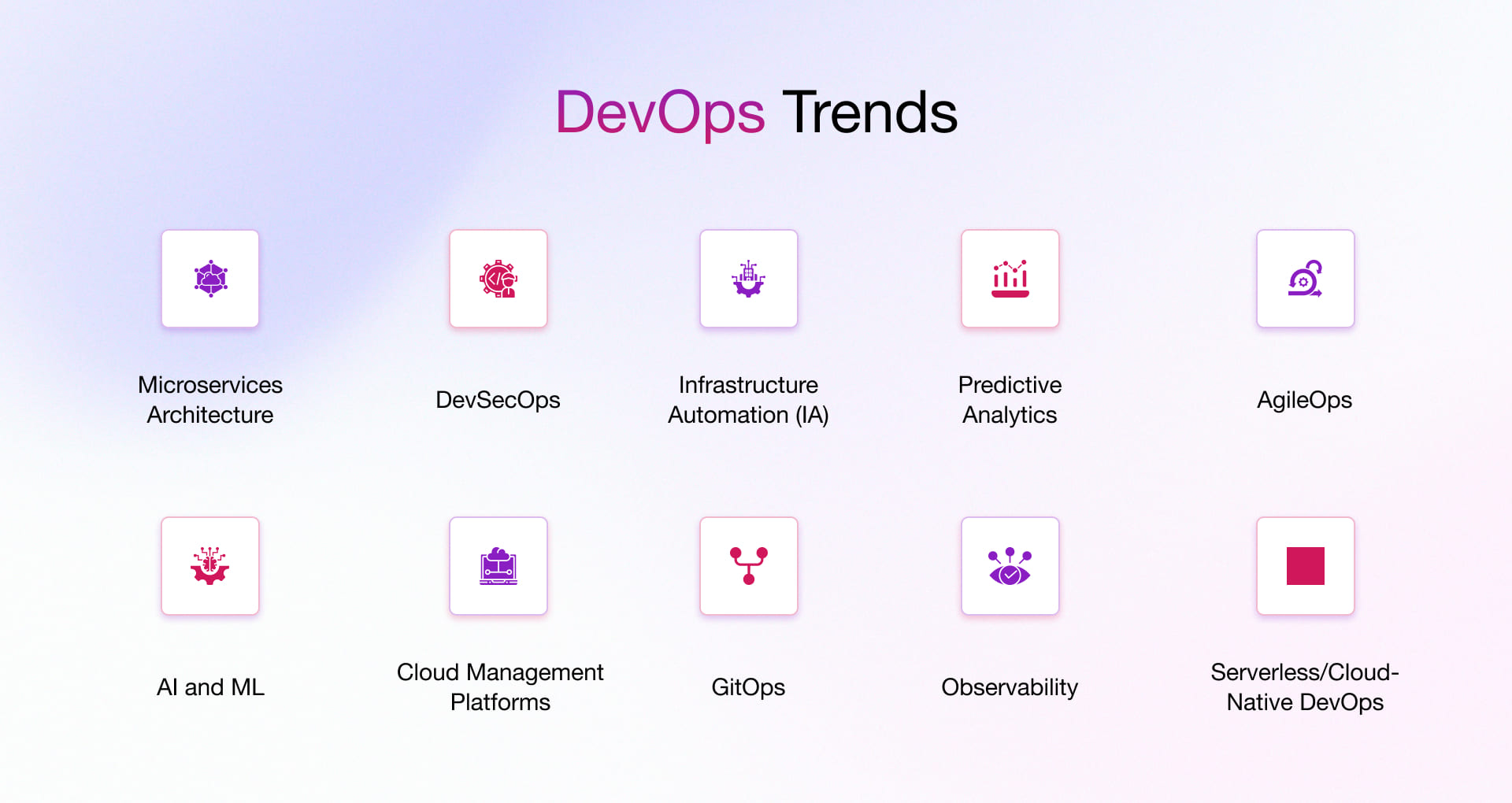
Major DevOps Trends to Watch in 2026
The Rise of Microservices Architecture
With microservices, the fragments of units are connected independently. It enables DevOps to focus on individual companies. This ensures rapid delivery of complex applications with the Microservices architecture approach. It helps save a lot of time, effort, cost and resources while developing the system.
Benefits
- Cost-effective
- Supports customization as per business needs
- Easy maintenance and testing
- Highly flexible and scalable
- Easy deployment
Increase in DevSecOps Adoption
Security will continue to top of the list for businesses irrespective of their size. So, it’s no surprise that it is part of top trends and predictions. As companies are increasingly adopting cloud-based technologies, the development lifecycle will need a cloud-native security methodology that can only come from DevSecOps. Thus, businesses will take up this technology rapidly to ensure agile security measures. It offers timely detection of security vulnerabilities.
Benefits
- Rapid response to ever-changing business needs
- Quality assurance/test automation
- Early detection and mitigation of vulnerabilities
- Enhanced collaboration between teams
Infrastructure Automation (IA) Tools
The next on the list of DevOp’s latest trends is IA tools. The implementation of infrastructure automation tools enables DevOps teams to design and automate delivery, configuration and overall IT infrastructure management. Companies will embrace integrations of IA tools with different pipeline components. You can experience more agility by applying Continuous Integration and Continuous Delivery (CI/CD) concepts to IT infrastructure.
Benefits
- Automated workflows to achieve accuracy and efficiency
- Efficient resource provisioning
- Self-service, on-demand environment creation
- Better reliability with instant updates
Predictive Analytics in DevOps and AIOps
It plays a vital role in preventing latency from managing the ever-changing user needs. The organizations must leverage predictive analytics to build a strong focus on continuous improvement as part of DevOps service offerings. It provides deeper insight into services and resources to predict how frequently it is to be used in the future to deliver business value.
Benefits
- Production failure prevention
- Reduced unplanned downtime
- Improved asset utilization
- Better maintenance and performance of assets
- Quick software delivery with quality
Growth of AgileOps for Improved Agility
It combines proven agile and DevOps methodologies (both on the Infrastructure and Operations side) to boost agility. AgileOps techniques help streamline both software development and tasks in other business fields:
Benefits
- Delivery of high-quality and high-performance applications
- Maximized apps stability
- Eliminate delays through cross-functional teams
Artificial Intelligence (AI) and Machine Learning (ML)
The management of the volume, variety and velocity of data being generated today proves to be an uphill task for organizations with a traditional approach. AI and ML-based DevOps approach help organizations to compute and analyze data of any size and scale. It boosts workflow transformation to develop, deliver, deploy, and manage applications efficiently.
Benefits
- Improved decision-making process
- Optimized DevOps environment
- Shortened release time
- Enhanced customer experiences
- Quick identification and resolution of issues
Broad Scope of Cloud Management Platforms(CMPs)
Enterprises are deploying CMP for DevOps to gain higher visibility in cloud deployments. This facilitates them to control and monitor their resources in the cloud environment.
Benefits
- Costs, performance and resources optimization
- Enhanced security
- Provisioning and orchestration
- Cloud migration, backup, and disaster recovery
- Resource optimization
GitOps: Revolutionizing Continuous Delivery
GitOps is becoming the go-to model for handling infra and deployments. With Git as the central control point, teams get cleaner workflows and tighter delivery discipline.
Benefits
- Version-first infrastructure
- Reliable and faster rollouts
- Clear audit trails
- Less configuration drift
- Better team alignment
The Rise of Observability in DevOps
Observability is gaining traction as systems scale. It enables teams to read system behavior in real time and reacts before small issues grow big.
Benefits
- Live system visibility
- Quick root-cause tracking
- Higher service stability
- Stronger cloud-native monitoring
- Reduced downtime risk
Serverless and Cloud-Native DevOps
More teams are shifting to serverless and cloud-native setups to reduce ops load. This gives them faster builds, easy scaling, and space to focus on product outcomes.
Benefits
- Zero server handling
- Built-in scalability
- Faster development cycles
- Lower operational overhead
- Better performance resilience
How Rishabh Software Helps You Accelerate DevOps Success?
DevOps will continue to be a deployment choice option in an Enterprise marketplace as the world is going digital. It is vital to set realistic goals and expectations while aligning your journey towards DevOps implementation. It will help save money to improve the product quality with a faster time to market.
Rishabh Software offers full-fledged DevOps services with a proficient team of highly professional and expert engineers. We use custom frameworks and the right tools to complete a project of any complexity. We can even create full-fledged from the ground up to streamline your end-to-end delivery cycle.