A critical support ticket comes in at 9:12 A.M. A new rep searches the internal wiki, opens a few pages, and reaches out to two teammates for help. Seven minutes later, the ticket is still unresolved, and the escalation thread is getting longer. The rep finished onboarding, but they are not job-ready at the moment that matters.
That gap is exactly why the AI-powered LMS is taking off. Modern teams need training that improves job readiness and retention, not training that ends at completion. When organizations use an AI-powered learning management platform for training and development, they can personalize learning, deliver realistic practice, assess mastery, and reinforce skills over time.
This guide explains how an AI-Powered LMS in corporate training replaces one-time training with a closed loop: personalize, practice, assess, reinforce, and measure. You will also see practical use cases across industries, along with a simple pilot plan to demonstrate results without disrupting your existing LMS.
How AI-Powered LMS Is Replacing One-and-Done Training?
Corporate learning used to be simple: assign a course, track completion, and move on. That worked when roles stayed stable, and processes changed slowly.
Now work shifts constantly. Tools update, workflows change, and policies evolve. Training that happens once cannot keep people ready for real situations.
That is why AI-powered LMS in corporate training is replacing one-and-done programs. It focuses on outcomes leaders care about:
- Job readiness: Can employees complete the workflow correctly in real conditions?
- Retention: Do they still remember what matters weeks later?
When you design for readiness and retention, learning becomes performance infrastructure. This is the shift driving the adoption of AI in L&D.
Why AI-Powered Learning Platform in Corporate Training Matters Now?
- Content does not match real decisions
Learners finish modules but still struggle to pick the right next step during tickets, audits, incidents, or compliance scenarios. - No reinforcement, so skills fade
Most programs do not track knowledge decay or refresh high-risk topics before mistakes happen. - Too much manual work for L&D
Updating content, tagging, assigning, and reporting takes time away from improving outcomes. - Completion gets treated like competence
Completion reports look good, but they do not prove performance on the job.
This is the gap AI in corporate learning closes by shifting from completion tracking to measurable capability.
Customizable Corporate Training LMS Powered by AI
Customization is what makes training useful. Generic courses rarely reflect how work actually happens. The most effective programs start with what your teams already use: SOPs, policies, runbooks, and playbooks.
That is where AI-powered LMS helps with training and development. It turns your internal knowledge into structured learning that supports real work.
- Turn documents into learning assets
Upload a document once and generate summaries, key points, insights, and FAQs that reduce repetitive questions. - Build learning paths based on workflows
Create guided paths that match how users ramp in a role, not a random library of content. - Create assessments faster
Generate knowledge checks from your internal content so you can validate understanding at scale. - Prove readiness with proctored assessments
Use consistent monitoring to protect the integrity of high-stakes or regulated training.
Benefits of an AI-Powered LMS for Corporate Training
The use of an AI-driven LMS in corporate training helps people ramp faster, make fewer preventable mistakes, and prove job readiness with clear data.
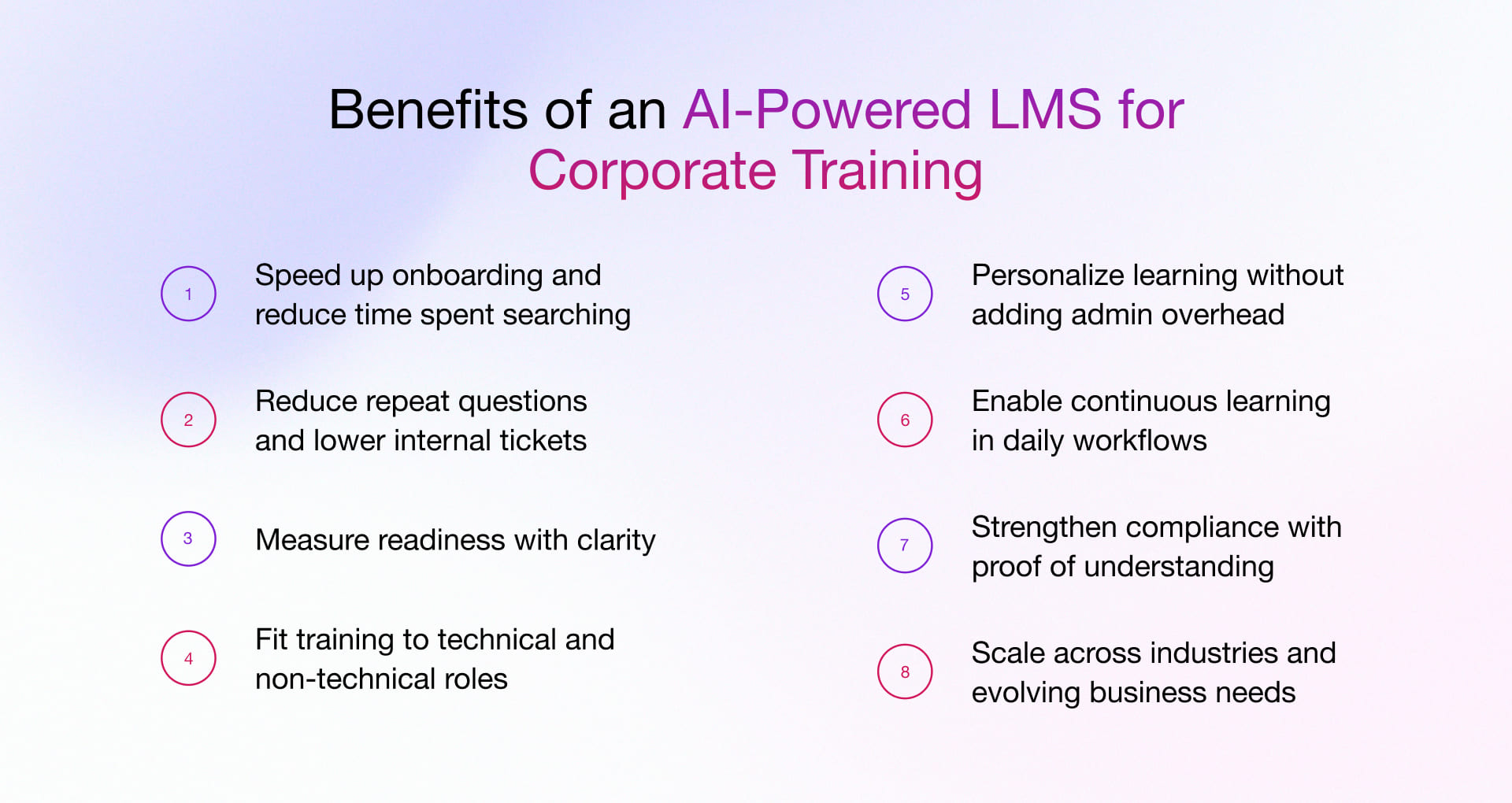
Listed below are key benefits:
- Speed up onboarding and reduce time spent searching
Convert scattered docs into structured learning paths. Help with new hiring, find answers fast, and execute workflows correctly from day one. - Reduce repeat questions and lower internal tickets
Provide guided answers and knowledge workflows so the same questions stop bouncing across Slack, email, and meetings. - Measure readiness with clarity
Track assessment results and skill progress in dashboards, so managers spot gaps early and coach with focus. - Fit training to technical and non-technical roles
Support hands-on evaluation for technical teams and structured paths and certifications for operational teams. - Personalize learning without adding admin overhead
Adapt pacing and difficulty to role and performance, while scaling across teams without constant redesign. - Enable continuous learning in daily workflows
Deliver microlearning when employees face real tasks and exceptions, not only during scheduled training. - Strengthen compliance with proof of understanding
Validate knowledge through assessments and certifications with audit-ready evidence. - Scale across industries and evolving business needs
Use the same approach in any industry to turn internal knowledge into training, prove people can do the work, and keep learning up to date.
A Practical Multi-Agent Architecture for AI-Driven L&D
Many teams hear “AI” and imagine one assistant doing everything. In practice, the best systems divide the job. A multi-agent setup keeps learning accurate, easy to update, and simple to measure. It works like a relay team. Each agent handles one clear job, then passes clean output to the next agent.
- Knowledge structuring agents
Turn SOPs, policies, and playbooks into clear objectives, summaries, key takeaways, and FAQs. - Assessment agents
Generate MCQs and task-based questions from internal content so you validate understanding, not just completion. - Reinforcement agents
Trigger refreshers when learners miss concepts or when knowledge starts fading. - Recommendation agents
Suggest next best steps based on gaps, such as practice, refreshers, or coaching. - Measurement layer
Tracks retention, mastery, confidence, and risk hotspots so leaders can intervene early.
This is where AI-powered learning management solution in corporate training becomes a closed loop that improves performance over time.
Top Use Cases for AI-Powered LMS Across Industries
The best use cases share one trait: people must execute SOPs correctly under pressure.
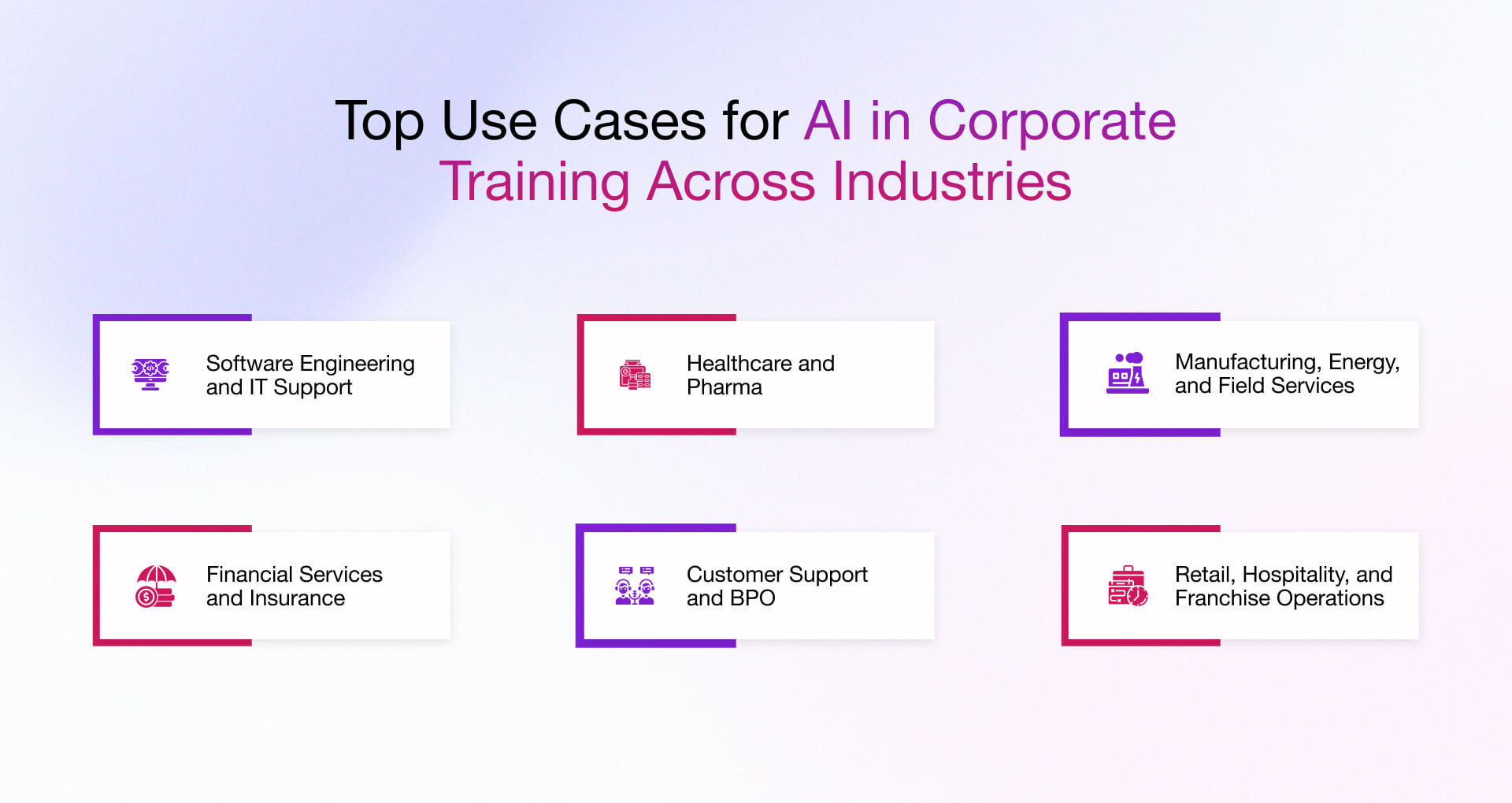
Here are the highest-impact examples:
1) Software Engineering and IT Support: Developer onboarding by stack and role, on-call readiness from runbooks, secure coding refreshers, tool adoption, and support enablement to reduce escalations.
2) Healthcare and Pharma: Train teams on protocols and SOPs, then use assessments to confirm they understand the steps. Keep audit-ready records for regulated work.
3) Manufacturing, Energy, and Field Services: Reinforce safety and SOP execution for shift teams. Keep procedures consistent across sites and track readiness with clear data.
4) Financial Services and Insurance: Deliver role-based compliance and policy training. Validate skills through assessments and standardize decisions across teams.
5) Customer Support and BPO: Speed up onboarding for high-turnover teams. Use knowledge-based FAQs to cut repeat questions and improve resolution quality.
6) Retail, Hospitality, and Franchise Operations: Onboard fast across locations, roll out procedures consistently, and use refreshers to keep execution uniform across distributed teams.
Implementing AI in Corporate Learning Without Disrupting Your Existing LMS
Most organizations do not want to rip and replace their LMS. The good news is you do not need to. The fastest path is to deploy an AI-powered LMS as an overlay that adds retention loops and readiness measurement on top of what you already use.
A practical rollout looks like this:
- Scope one domain and one role group (onboarding, compliance, support, incident readiness)
- Ingest current documentation and generate structured learning assets plus assessments
- Run an initial assessment to establish baseline mastery and confidence
- Trigger targeted reinforcement when performance drops or gaps persist
- Roll out to the next domain once metrics stabilize and the workflow is repeatable
This approach keeps change manageable and makes outcomes easy to prove.
Where Our AI-Enabled LMS Fits in Workforce Training
If your goal is retention and job readiness, you need more than content creation. You need an operating system for learning that connects internal knowledge to practice, measurement, and reinforcement.
Our AI-powered learning management solution operationalizes internal knowledge into measurable learning workflows across AI in corporate learning, AI in workforce training, and broader AI in L&D initiatives.
Automation
- Generates course summaries, FAQs, MCQs, and structured learning assets from internal sources
Assessment integrity
- Enforces camera and audio pre-check before high-stakes assessments
Learning operations
- Learning paths, assignments, scheduling, certificates, projects, announcements
- Reinforcement recommendations triggered by observed gaps
Integrations
- Slack, Teams, Jira, Confluence, Notion, SharePoint, Zendesk
- HRMS, LMS, CRM, cloud storage, and APIs
Learning That Holds Up in the Real World
IT teams often feel the impact first because knowledge gaps show up quickly as incidents, vulnerabilities, and delivery delays. But the challenge is industry-wide. Any organization that relies on people applying knowledge correctly, repeatedly, and under pressure needs more than one-time training.
That is why learning management solutions in corporate training deliver broad value across sectors. Whether you run healthcare protocols, manufacturing safety checks, financial compliance programs, support workflows, or distributed operations, a learning management solution in training and development can turn SOPs into role-specific practice, real assessments, targeted reinforcement, and proof of readiness.
Frequently Asked Questions
Q: What is an AI-powered corporate LMS?
A: An AI-powered corporate LMS is an intelligent learning platform that personalizes training based on role, skill gaps, and performance data. It transforms your existing content into interactive, role-based practice, evaluates understanding through adaptive assessments, and reinforces knowledge over time to ensure long-term retention and measurable business impact.
Q: How do you prevent AI training from spreading outdated information?
A: We connect AI training to a governed single source of truth with version tracking. When content updates, older versions are automatically retired and refreshers are triggered to ensure learners always access current, approved information.
Q: How do you estimate ROI for AI in corporate training?
A: Compare before and after results. Measure ramp time, rework, escalations, audit exceptions, and incidents, then translate the improvements into time saved and risk reduced.