
Cloud services give businesses a real edge in terms of faster scaling, more flexibility, and lower upfront infrastructure costs. But as cloud environments grow, so do the operational challenges: managing multiple cloud providers, controlling runaway spending, and maintaining visibility into what is running and why.
The cost of that complexity adds up quickly. Servers stay on when no one is using them. Test environments run through the weekend. Kubernetes clusters stay overprovisioned long after peak hours. According to Flexera, nearly 29% of cloud spend is wasted on idle or underutilized resources. And when something does go wrong, engineers end up jumping between monitoring tools, log files, and dashboards, reacting to problems rather than getting ahead of them.
That is the core challenge with managing cloud infrastructure today. Most teams are still operating reactively, when the real opportunity is to detect and resolve issues before they impact the business.
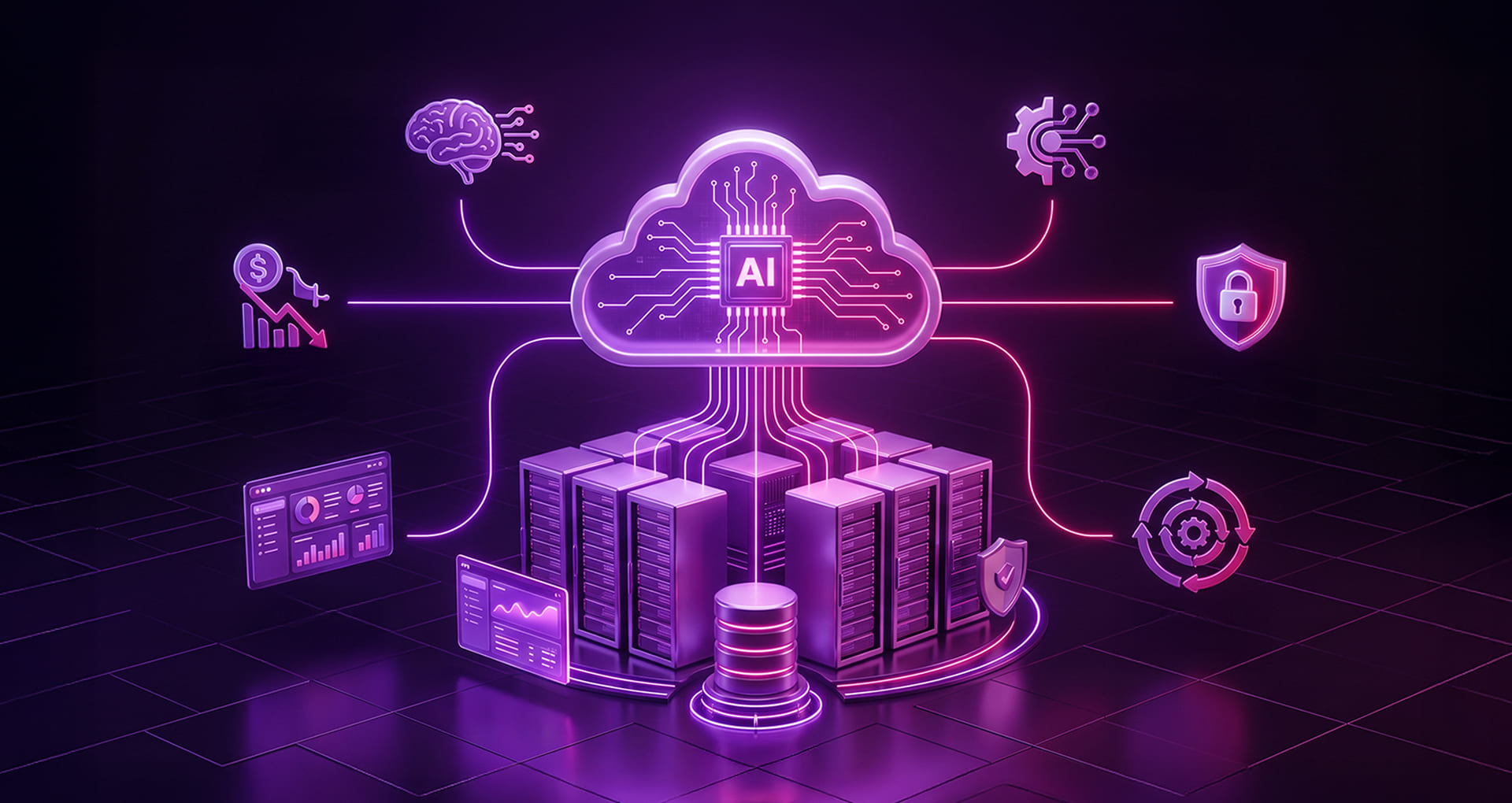
AI is shifting that dynamic. Businesses that embed AI into their cloud operations can move from constant firefighting to proactive management without scaling the ops team. This blog covers how AI-powered cloud infrastructure management works, why it matters right now, and what it takes to put it into practice, from foundational components to the tools and best practices your team can act on.
An Overview of Core Cloud Infrastructure Components
The emergence of cloud computing has allowed businesses to access a wide range of services and resources without requiring substantial further investment. The need for and importance of cloud infrastructure and its efficient management are multiplying over time. From managing to storing and processing data, cloud infrastructure and its combined components are core to maintaining smooth business operations.
- Hardware: Includes physical devices like servers, storage devices, and network infrastructure components like routers, switches, and firewalls. These enable effective communication and make up the underlying infrastructure of the cloud.
- Software: Includes various types of software such as operating systems, middleware, virtualization software, programs, and cloud management tools. These provide the necessary capabilities to utilize cloud infrastructure, enabling virtualization, management, automation, and orchestration of cloud resources.
- Virtualization: A foundational element of managing cloud infrastructure, virtualization creates virtual versions of physical resources such as servers, storage, and networks, allowing multiple workloads to run on shared hardware. This improves resource utilization and reduces the need for dedicated physical infrastructure.
- Storage: A distributed storage system that enables a strong and secure way for managing, storing, and retrieving data across virtual and physical systems. It offers a scalable, secure, and flexible path for businesses to rely on cloud-based storage instead of on-premises hardware.
- Network: Includes the physical and virtual networks that enable seamless data transfer between hardware components, software solutions, and other systems through internal and external network connections.
4 Benefits of Managing Cloud Infrastructure
Efficiently managing cloud infrastructure is integral to leveraging cloud computing services. As AI becomes embedded in cloud operations, these benefits are no longer about stability they are about building infrastructure that thinks, adapts, and optimizes itself. Here are the key benefits of AI-driven cloud infrastructure management for CTOs and engineering teams:
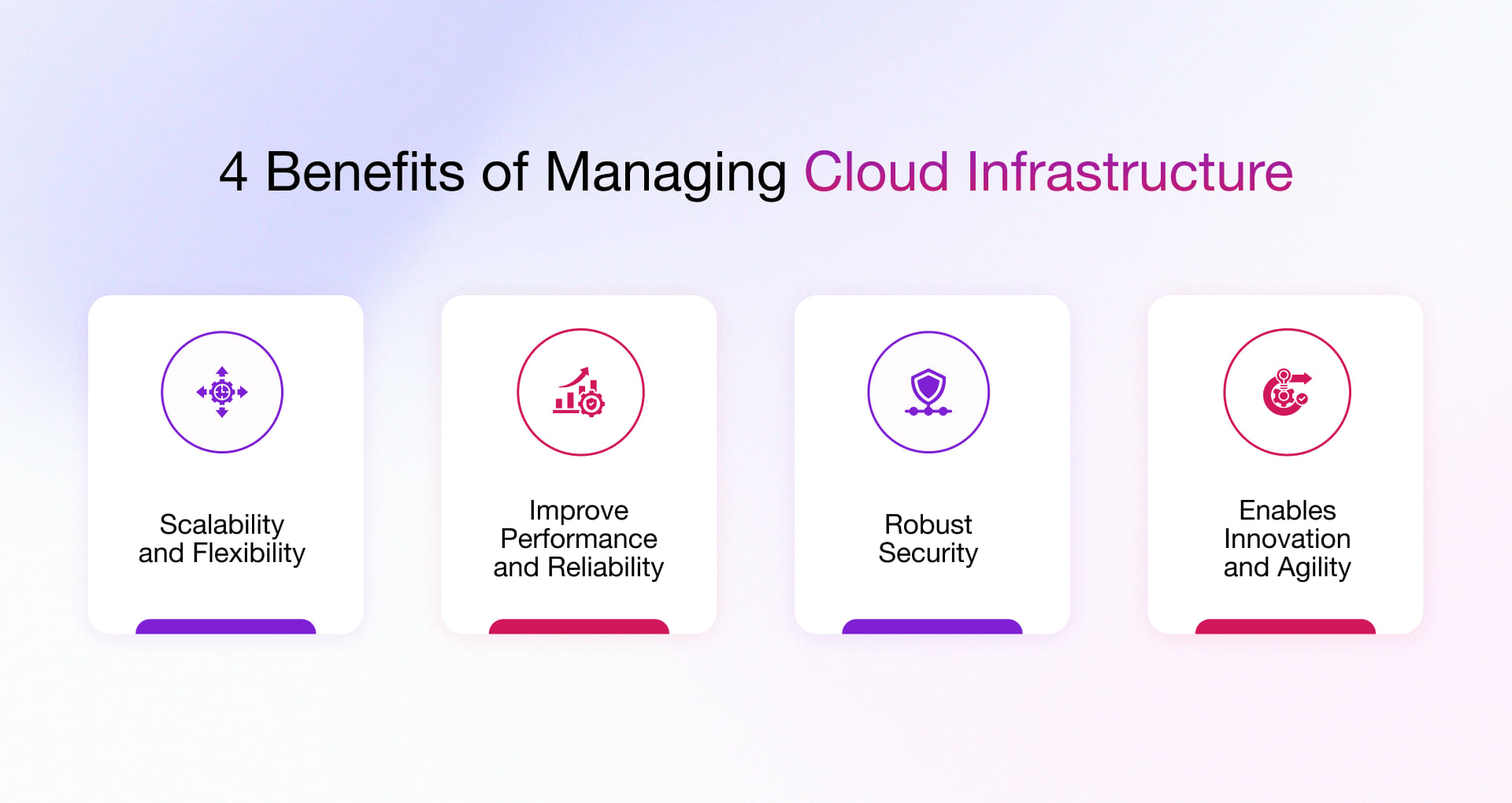
1. Scalability and Flexibility
Effective cloud infrastructure management enables businesses to scale resources up or down based on actual demand. Tools like Terraform and AWS CloudFormation automate infrastructure provisioning, while platforms like Docker and Kubernetes handle deployment and scaling consistently across environments.
AI takes this a step further with predictive auto-scaling. By analyzing historical traffic patterns, AI can anticipate spikes in demand and scale resources proactively, reducing both performance risk and unnecessary cloud spend.
2. Improve Performance and Reliability
Real-time resource scaling prevents slowdowns, and load balancing distributes traffic across servers to eliminate bottlenecks. AI shifts monitoring from alert-driven to intelligent observability, continuously analyzing system behavior, detecting anomalies early, and triggering corrective actions automatically. The result of managing cloud infrastructure is a performance management approach that is proactive rather than reactive, improving fault tolerance and reducing the blast radius of failures.
3. Robust Security
A multi-layered security approach covering identity and access management, encryption for data at rest and in transit, and security system protection forms the baseline. AI strengthens this by using machine learning to detect behavioral anomalies and unusual access patterns in real time. AI-enhanced IDPS systems also reduce alert fatigue by distinguishing genuine threats from false positives far more accurately than rule-based systems.
4. Enables Innovation and Agility
Cloud managed services like serverless computing and container orchestration empower teams to build and deploy applications faster. AI-driven cloud infrastructure management amplifies this by automating routine operational tasks from environment provisioning to release validation so engineering teams spend less time maintaining and more time building. Intelligent systems continuously monitor quality, flag regressions, and maintain production stability, enabling faster releases with greater confidence.
3 Major Types of Cloud Infrastructure
- Private Cloud: Dedicated to a single business in which control is totally in the hands of a single organization within its servers. The organization has the authority to manage the cloud environment and its resources solely.
- Public Cloud: Third-party service providers or vendors such as AWS and Azure allow businesses and individuals across the globe to leverage services through a pay-as-you-go model, making it accessible for any type of business or project.
- Hybrid Cloud: A combination of both private and public cloud environments, offering the benefits of both types.
Learn more about different cloud environments in our blog on Multi-cloud vs Hybrid Cloud.
Along with these infrastructure types, organizations can also choose from different cloud delivery models such as IaaS, PaaS, and SaaS based on their operational needs and scalability goals.
4 Best Practices for Effective Cloud Infrastructure Management
To ensure outcome-driven management of cloud infrastructure, teams must go beyond conventional approaches and embrace AI-augmented practices that enable continuous optimization:
1. Automate Intelligently, Not Just Broadly:
Integrating AI in cloud computing has evolved beyond automating repetitive tasks. AI-driven automation identifies patterns in workload behavior, adjusts resource allocation proactively, and reduces human error in ways that rule-based automation simply cannot. The goal is intelligent automation that compounds efficiency over time.
2. Implement Robust, AI-Augmented Security Measures
Encryption, firewalls, and access management remain foundational. But in complex, multi-cloud environments, static security rules are no longer sufficient. AI interprets by continuously learning normal user and system behavior, flagging deviations in real time, and adapting threat detection models as attack surfaces evolve. Regular security audits combined with AI-driven continuous monitoring create a security posture that is both proactive and adaptive.
3. Move from Cost Management to Cost Intelligence
Traditional cost management tools help track and cap cloud spending. AI takes this further by providing cost intelligence analyzing usage patterns, predicting future spend, identifying idle or underutilized resources before they inflate bills, and recommending right-sizing actions automatically.
4. Shift From Regular Monitoring and to Intelligent Observability
Monitoring network, storage, CPU, and hardware components is necessary but insufficient on its own. AI-powered observability platforms go deeper correlating signals across distributed systems, surfacing root causes rather than just symptoms, and reducing the time engineers spend manually triaging alerts. The shift from monitoring to observability means teams spend less time reacting to incidents and more time preventing them.
What to Look for in Cloud Infrastructure Management Tools
Selecting the right tools is critical to managing cloud infrastructure effectively. The best ones go beyond basic dashboards and reporting; they give teams the visibility, control, and intelligence needed to keep operations running efficiently at scale.
1. Real-time Monitoring with Intelligent Observability
Good monitoring solutions do not just flood you with numbers; they tell you what those numbers mean. Tools like AWS CloudWatch and New Relic show how apps behave under pressure such as CPU spikes, downtime patterns, traffic surges, but AI layers on top of this by correlating signals across your entire stack, distinguishing noise from genuine anomalies, and surfacing root causes before your team even opens a dashboard. The shift is from monitoring that informs to observability that acts.
2. AI-Driven Cost Tracking and Optimization
Cloud bills have a way of surprising even experienced teams. AWS Cost Explorer, Azure Cost Management, and Flexera give you visibility into what you are paying for but AI-powered cost intelligence goes further. It detects idle resources, forecasts based on usage trends, and recommends right-sizing actions before costs spiral. Instead of reviewing last month’s bill and then reacting, teams can continuously and proactively govern cloud spend.
3. Intelligent Automation Beyond Infrastructure as Code
Tools like Terraform and Ansible let you define infrastructure as code and deploy it consistently every time, eliminating manual configuration errors. AI extends this by making automation adaptive. Rather than executing predefined scripts, AI-driven automation learns from operational patterns, dynamically adjusts workflows, and flags when infrastructure drift or anomalous behavior warrants intervention. It is the difference between automation that executes and automation that thinks.
4. Resilient Backup and AI-assisted Recovery
Cloud infrastructure management services like Veeam Backup, Azure Site Recovery, and AWS Backup ensure your data is protected, and systems can be restored quickly when things go wrong. AI adds an extra layer here, intelligently prioritizing recovery sequences based on business criticality, predicting potential failure points before they cause outages, and reducing recovery time by automating decisions that would otherwise require manual triage. It is not just a safety net; it is a safety net that gets smarter over time.
5 Common Challenges and Solutions in Cloud Infrastructure Management
Even well-architected cloud environments run into obstacles. Here are five of the most common challenges organizations face when managing cloud infrastructure and how to address them effectively.
1. Limited Visibility
Businesses often struggle to get end-to-end visibility into their cloud resources. This lack of insight drives inefficient resource allocation, unnoticed security vulnerabilities, and difficulties in tracking usage and costs.
Solution: Implement comprehensive cloud monitoring tools, such as CloudWatch and Datadog, to provide end-to-end visibility with real-time analytics on resource usage, performance metrics, and security status. Deploying centralized logging and conducting regular audits of cloud resources also helps maintain streamlined operations.
2. Cost Management and Optimization
Businesses frequently struggle with unexpected bill spikes. This may happen due to overlooking on-demand pricing, failing to use cost-saving techniques, underutilized or unused resources, and complex pricing models.
Solution: Implement automated cost monitoring to identify unusual spending patterns early. Regularly right-size resources to ensure applications run on appropriately sized infrastructure.
3. Siloed Data and Services
In a multi-cloud environment, data and services can become isolated within different departments or result in inconsistent API management. This leads to inefficiencies and difficulties in accessing critical information.
Solution: Adopt a centralized data management strategy, integrating data lakes for easier access and collaboration across teams. Deploy API gateways to connect disparate systems and facilitate data sharing.
4. Compliance and Governance
Complying with stringent industry regulations such as HIPAA, GDPR, and data governance standards is a complex task. Continuous compliance monitoring and maintaining a comprehensive audit trail add further challenges.
Solution: Establish a clear governance framework that includes regular compliance audits, implementation of automated compliance tools, continuous monitoring of cloud activities, and staff training on compliance requirements.
5. Complexity and Distributed Systems
Every cloud provider has its own set of tools, interfaces, and APIs, making it challenging to track and monitor each component thoroughly. Maintaining consistency and communication between all components is difficult.
Solution: Implement a unified management platform to centralize operations control over various cloud services, reducing the need for multiple tools. Adopt Infrastructure as Code (IaC) practices for automation of routine tasks.
Partner with Rishabh Software to Improve Your Cloud Infrastructure Management Strategy
As a prominent cloud computing development service provider, we offer proven expertise across the entire cloud lifecycle to accelerate business transformation and maximize performance in high-performance cloud environments.
Our services cover the entire cloud architecture design, migration, and deployment, along with seamless cloud integration across private and public cloud ecosystems. We provide continuous monitoring, management, and optimization to ensure high availability, strong network performance, and cost efficiency.
As Select Tier Services Partners for AWS and Microsoft Azure, we combine deep platform expertise with proven delivery frameworks to accelerate cloud adoption. From readiness assessments and cloud migration to modernization and long-term cloud strategy, our cloud consulting helps businesses streamline operations, strengthen security, and leverage AI-driven automation for sustained operational excellence.
Frequently Asked Questions
Q: What is cloud infrastructure management?
A: It is the process of overseeing and optimizing cloud resources, including computing, storage, and networking. It ensures that these resources are efficiently utilized, secure, and scalable to meet business needs.
Q: What is the role of cloud infrastructure in cloud computing?
A: Cloud infrastructure serves as the foundation for cloud computing, enabling on-demand access to computing resources. It supports the delivery of services and applications, facilitating scalability, flexibility, and cost efficiency for businesses.
Q: How does cloud infrastructure work?
A: Cloud infrastructure operates through a network of remote servers hosted on the Internet to store, manage, and process data. Users access these resources via the cloud service provider, which handles the underlying hardware and software management.
Q: What are the three major pillars of cloud infrastructure?
A: The three major pillars of cloud infrastructure are computing, storage, and networking. These elements work together to provide the resources necessary for hosting applications and managing data in the cloud.
Q: What is AI-Driven Cloud Optimization?
A: Cloud optimization undertakes using Machine Learning, predictive analytics, and real-time telemetry to fine-tune resources automatically and gain optimum productivity. It evaluates workloads, traffic patterns, and usage data round-the-clock to:
- refine computing and storage resources
- predict downtime and enable prevention through anomaly detection
- optimize workload placement across demographics and pricing
- predict cloud costs accurately
Businesses are at an advantage in continuously learning, which improves system performance and reduces cloud waste spending.
Q: How does AI optimize cloud costs?
A: Artificial Intelligence identifies usage patterns and automatically eliminates inefficiencies such as idle resources, overprovisioned events, and suboptimal workload placement. With AI, you can expect cost prediction, automated rightsizing, and dynamic scaling, allowing enterprises to maintain cost spending and enable seamless performance.
Q: What are future trends in cloud infrastructure management?
A: Future trends include increased automation through AI and machine learning, which will enhance resource management and efficiency. Additionally, the rise of multi-cloud and hybrid cloud strategies will demand tools that provide seamless integration and management across various platforms.