For years, Data Lakes have served as the foundation of enterprise data strategies, centralizing data from diverse sources to support big data analytics, cross-functional access, and advanced AI and Machine Learning initiatives. According to Grand View Research, the global data lake market was valued at USD 13.62 billion in 2023 and is projected to reach USD 59.89 billion by 2030, growing at a CAGR of 23.8% as enterprises continue investing in scalable, AI-ready data environments.
As enterprise data ecosystems expanded, Data Fabric emerged as an architectural approach designed to connect, govern, and access across cloud platforms, on-premises databases, SaaS applications, data warehouses, streaming platforms, and partner ecosystems. This shift is reflected in market trends. According to Precedence Research, the global Data Fabric market is projected to grow from USD 3.24 billion in 2025 to USD 13.35 billion by 2035, at a CAGR of 15.21%, as enterprises increasingly prioritize connected, intelligent, and governed data ecosystems.
While both Data Lakes and Data Fabrics aim to unlock value from enterprise data, they address different challenges and deliver distinct advantages. The question is not which architecture is more advanced, but which one aligns best with your organization’s data landscape, analytics objectives, governance requirements, and long-term innovation roadmap.
This blog aims to provide a detailed comparison between data fabric vs data lake on various parameters. We’ll also explore their benefits and specific use cases to help you choose the right approach for your data management strategy.
Key Difference Between Data Lake and Data Fabric on Various Parameters
The following table compares Data Fabric vs Data Lake across key architectural, operational, governance, and AI-readiness considerations.
| Parameter | Data Lake | Data Fabric |
| Purpose & Architecture | Centralized data storage for large volumes of structured and unstructured data. | Metadata-driven architecture that combines and manages data across multiple systems, apps, and environments. |
| Data Accessibility & Integration | Requires data to be transferred to the Data Lake for analysis and access. | Provides unified access to data across cloud, on-premises, and third-party sources without extensive data movement. |
| Data Governance & Compliance | Governance is implemented within the repository and can become complex at scale. | Built-in governance, lineage, and policy enforcement across the entire data ecosystem. |
| Analytics & AI Readiness | Supports large-scale analytics, reporting, and Machine Learning using centralized datasets. | Enables real-time analytics and AI by connecting data from multiple sources through a unified layer. |
| Hybrid & Multi-Cloud Support | Support hybrid environments but often requires additional integration efforts. | Designed to seamlessly operate across hybrid, multi-cloud, and distributed environments. |
| Scalability & Performance | Highly scalable for storing and processing massive data volumes. | Scales across distributed data sources while maintaining consistent access and governance. |
| Implementation Complexity | Faster initial deployment with a focus on centralized data storage. | Requires greater upfront planning and integration efforts but delivers broader enterprise-wide data connectivity and governance. |
| Cost & Operational Overhead | Lower storage costs but may require ongoing investments in integration, governance, and maintenance. | Higher implementation complexity initially but can reduce long-term data management overhead. |
| Best-Fit Enterprise Scenarios | Big data analytics, historical data storage, machine learning model training, and IoT data management. | Real-time insights, enterprise-wide data integration, regulatory compliance, and hybrid/multi-cloud data strategies. |
To further help you understand data lake vs data fabric, let’s shed light on various parameters in detail:
Purpose & Architecture
Data Lake
Enterprises can leverage Data Lakes to store their voluminous data in a single environment for analysis. It creates a centralized foundation for analytics, AI initiatives, and long-term data retention.
Data Fabric
On the other hand, when data is scattered across clouds, applications, enterprise units, and legacy systems, Data Fabric creates a unified layer that connects data wherever it resides. This enables enterprises to work with distributed data without consolidating it into a single repository.
Data Accessibility & Integration
Data Lake
Think of Data Lake as a central library: once the information is stored there, teams know where to find it. The challenge arises when critical data remains outside the repository, requiring additional effort before a complete enterprise view can be created.
Data Fabric
Instead of bringing every book into one library, Data Fabric helps users access information wherever it’s located. This approach reduces data silos and makes it easier for teams to obtain a consistent view of enterprise information across multiple platforms.
Data Governance & Compliance
Data Lake
Governance can certainly be achieved within a Data Lake environment, but it often depends on additional controls, policies, and oversight mechanisms. As data volumes and sources expand, maintaining consistency may require significant operational effort.
Data Fabric
For enterprises operating under strict regulatory requirements, governance cannot be an afterthought. Data Fabric embeds governance across the broader data ecosystem, helping maintain visibility, lineage, and policy enforcement regardless of where data resides.
Analytics & AI Readiness
Data Lake
AI and analytics initiatives depend on access to large volumes of historical and diverse data. Data Lake provides a centralized foundation for storing and analyzing such datasets, making it well-suited for enterprise intelligence, forecasting, machine learning, and data science workloads.
Data Fabric
The effectiveness of AI depends not only on data volume but also on data accessibility and consistency. By connecting data across systems and environments, Data Fabric helps organizations deliver trusted information to analytics and AI initiatives faster, enabling more timely insights and decision-making.
Hybrid & Multi-Cloud Support
Data Lake
Data Lake can support cloud-based and hybrid deployments but managing data across multiple environments often requires additional integration and synchronization efforts.
Data Fabric
Modern enterprises rarely operate within a single platform. Data Fabric is particularly effective in hybrid and multi-cloud environments because it creates consistency across diverse systems without forcing enterprises to redesign their existing infrastructure.
Scalability & Performance
Data Lake
If the priority is handling ever-growing volumes of data, Data Lakes excel. They are designed to scale efficiently and support high-volume analytical workloads without requiring frequent architectural changes.
Data Fabric
Along with dealing with large datasets, Data Fabric also scales when there are multiple applications, platforms, and enterprise systems. It extends visibility, governance, and access across an expanding ecosystem, helping enterprises maintain control as complexity increases.
Implementation Complexity
Data Lake
For enterprises primarily focused on consolidating data for analytics, implementing a Data Lake is highly recommended. The scope is narrow, allowing teams to establish a centralized data foundation relatively quickly.
Data Fabric
Data Fabric requires broader planning because it touches multiple systems, teams, and governance processes. While the initial effort is higher, the outcome is a connected and enterprise-wide approach to data management.
Cost & Operational Overhead
Data Lake
Data Lake is introduced as cost-effective data storage architecture. However, enterprises should also account for the long-term effort required to integrate data sources, maintain quality, and govern expanding datasets.
Data Fabric
Data Fabric usually involves greater upfront investment, but the enterprise case often centers on reducing operational inefficiencies, minimizing duplication, and simplifying data management across the enterprise over time.
Best-Fit Enterprise Environments
Data Lake
Enterprises focused on large-scale analytics, machine learning, AI readiness, or long-term data retention often get the maximum ROI from Data Lakes. In these environments, centralized storage remains a strategic advantage.
Data Fabric
Enterprises operating across multiple clouds, enterprise applications, and distributed data environments typically benefit more from Data Fabric. The ability to connect data, enforce governance, and improve accessibility at scale aligns well with complex enterprise ecosystems.
How Can Data Fabric and Data Lake Benefit Your Business?
Data Fabric helps your business in data discovery, simplifies data management, and automates analytics, whereas Data Lake benefits as a scalable storage foundation, as both have their own set of advantages. Let’s explore the individual benefits in detail to help you choose the right one for your organization’s data management.
Benefits of Data Fabric
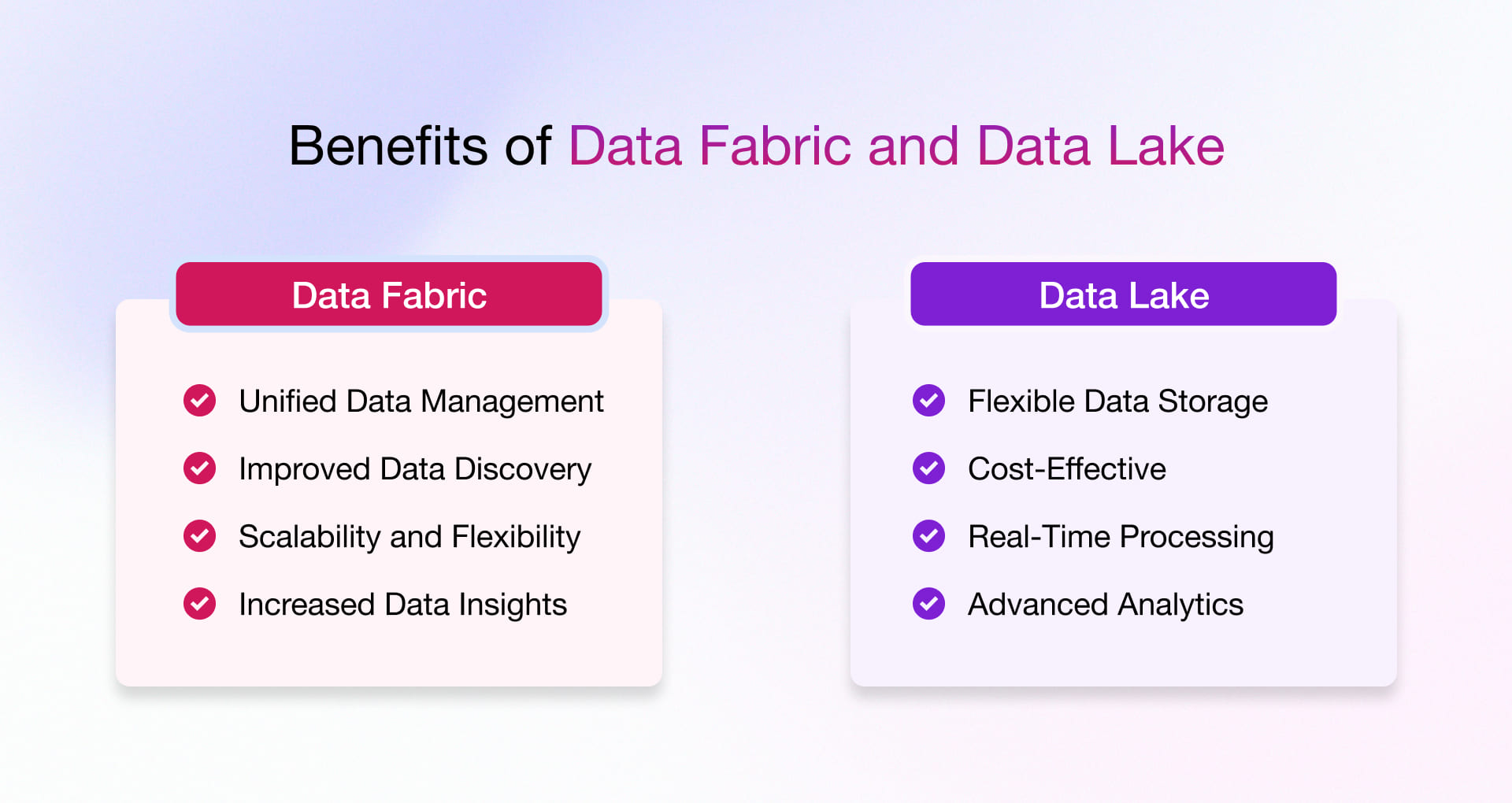
- Unified Data Management: This data management approach provides a single platform for managing and governing data, ensuring consistency and standardization. This simplifies data management and reduces complexity.
- Improved Data Discovery: The metadata-driven approach and semantic data models enable easy data discovery, allowing users to locate and access relevant data quickly. This improves data utilization and reduces search time.
- Scalability and Flexibility: Data fabric scales horizontally and vertically, making it suitable for large-scale data processing and analytics. This flexibility adapts to changing business needs and data requirements.
- Increased Data Insights: It supports various data processing and analytics tools, enabling deeper insights and better decision-making. This leads to improved business outcomes.
Benefits of Data Lake
- Flexible Data Storage: Since data lakes don’t have rigid structures or need to fit a specific schema, they store raw data in their native format, handling diverse data formats and sources. This flexibility is particularly useful for big data.
- Cost-Effective: This approach reduces storage costs by not requiring data processing or transformation. This enables cost-effective data storage.
- Real-Time Processing: It enables real-time data processing and analytics, allowing for faster decision-making. This leads to improved business outcomes.
- Advanced Analytics: Data lakes support various data processing and advanced analytics tools like Apache Spark, Apache Hadoop, Trino, Hive, and machine learning/AI platforms, enabling deeper insights and better decision-making. This leads to improved business outcomes.
When Should You Use a Data Lake or a Data Fabric? Real-World Use Cases Explained
Now that you have understood the benefits and data lake vs data fabric comparison, let’s look at some practical use cases for efficient data management.
Data Fabric Use Cases
- 360-degree View: Data Fabric unifies data of your customers, operations, etc., to help you understand customer behavior, preferences, and needs for delivering more personalized marketing and customer experiences.
- Churn Prediction: This predictive analytics capability enables businesses to proactively identify at-risk customers and implement retention strategies, reducing churn rates and improving customer loyalty.
- Fraud Prevention: Data Fabric’s ability to integrate and analyze data from multiple sources helps prevent fraud by identifying suspicious patterns and anomalies.
Here is real-world example wherein an enterprise has leveraged Data Fabric to gain real-time insights and boost fraud detection.
IWG implemented Microsoft Fabric to unify data from multiple business systems and gain real-time operational insights. According to Microsoft’s customer story, the company improved its ability to detect fraud and respond more quickly to emerging risks through real-time intelligence capabilities.
- Modernization of Legacy Systems: Enterprises can connect legacy applications with modern cloud platforms without completely replacing existing infrastructure, accelerating digital transformation initiatives.
- Multi-Cloud Data Management: Organizations operating across AWS, Azure, Google Cloud, and on-premises environments use Data Fabric to improve data accessibility and reduce operational silos.
- Real-Time Operational Intelligence: Manufacturing, logistics, and telecom enterprises leverage Data Fabric to combine data from operational systems, enabling faster responses to disruptions, performance issues, and changing business conditions.
- AI and Generative AI Readiness: As enterprises deploy AI initiatives, Data Fabric helps provide governed and connected access to enterprise data, improving the quality and reliability of AI-driven outputs.
Read our detailed blog on Data fabric and explore the architecture, benefits, capabilities and more.
Data Lake Use Cases
- Big Data Analytics: Data Lakes can store and process large volumes of raw and structured data from various sources. Businesses can leverage this approach to perform advanced analytics, data mining, and machine learning on massive datasets to uncover valuable insights.
Here is how Netflix leveraged Data Lake:
Netflix is one of the most frequently cited examples of Data Lake adoption, using large-scale centralized data platforms to process massive volumes of viewing, operational, and customer interaction data for analytics, personalization, and business intelligence.
- IoT Data Management: A Data Lake is well-suited for ingesting and processing vast amounts of data generated by IoT devices and sensors. Manufacturing, utilities, automotive, and smart-city initiatives generate enormous amounts of sensor data that can be efficiently stored and analyzed within a Data Lake.
- Customer Behavior Analysis: It enables enterprises to store and analyze vast amounts of customer data from multiple sources, providing insights into behavior patterns, preferences, and journeys. This comprehensive customer data can drive personalized marketing, product development, and customer experience optimization strategies.
- Log Data Analysis: Enterprises can use Data Lakes as centralized repositories for application logs, network events, and system telemetry data to improve monitoring, troubleshooting, and operational visibility.
- Historical Trend Analysis: Enterprises requiring long-term data retention use Data Lakes to analyze historical trends, benchmark performance, and support strategic planning initiatives.
The Intersection of Data Fabric and Data Lake: Can They Coexist in Your Data Strategy?
Yes, they are two distinct concepts that can coexist in an organization’s comprehensive data management strategy. In modern data architecture, organizations can leverage the combined strength of both approaches to effectively manage the data and achieve holistic data management.
Data fabric ensures data governance, security, and compliance, while the data lake provides a scalable platform for processing and analyzing large volumes of data.
This intersection enables seamless data access, processing, and analysis, which provides you with better data insights and decision-making capabilities.
Why a Hybrid Approach Makes Sense
As enterprises adopt cloud platforms, SaaS applications, AI initiatives, and distributed business systems, relying solely on centralized storage or data connectivity can create limitations. Combining Data Lake and Data Fabric enables organizations to:
- Store and process data at scale without compromising accessibility.
- Improve data governance and compliance across distributed environments.
- Support AI and analytics initiatives with trusted, connected, and high-volume datasets.
- Reduce data silos while maintaining a centralized repository for historical and operational data.
- Accelerate decision-making by providing a consistent view of enterprise data across business functions.
If your priority is managing massive datasets, a Data Lake may be the foundation you need. If your challenge lies in connecting, governing, and accessing data across a complex environment, Data Fabric can bridge the gap. Together, they provide a balanced framework for supporting analytics, AI, compliance, and long-term digital transformation initiatives.
Choose Rishabh Software as Your Partner to Implement the Right Data Management Strategy
As a leading data engineering company, we provide a comprehensive data architecture approach to help you enhance real-time insights and drive data-driven decision-making. Whether you choose data fabric, data lake, or a hybrid approach, we help you replace siloed data infrastructure with automated data pipelines and data management services, ensuring an efficient and integrated approach to a data-driven ecosystem.
Our data engineering experts will assist you in assessing your data architecture to provide robust recommendations and a fit-for-purpose architecture that expand data management capabilities without compromising data quality. By choosing Rishabh Software as your data engineering partner, you can benefit from our extensive expertise and focus on end-to-end data management, data governance capabilities, and real-time processing solutions.
Frequently Asked Questions
Q: Can small and mid-sized businesses use data fabric or is it only for large enterprises?
A: Small and mid-sized businesses can leverage data fabric if they are managing data across multiple cloud apps, systems, or locations. However, the decision should be driven by complexity rather than company size. If there are scattered data, governance challenges, or limited visibility across systems, a Data Fabric approach can easily streamline data access and management.
Q: Which is better for AI and machine learning workloads: data fabric or data lake?
A: Both play different roles in supporting AI and machine learning. Data Lake provides the scalable storage and historical data needed for model training and advanced analytics. Data Fabric ensures that AI initiatives have access to connected, governed, and trusted data across the organization. For enterprises, the strongest AI foundation comes from using both Data Lake for data storage and Data Fabric for data accessibility and governance.
Q: What is the difference between a Data Lake and a Data Lakehouse?
A: Data Lake enables enterprises to store large volumes of structured, semi-structured, and unstructured data at scale and low cost. While it offers flexibility for data exploration, analytics, and AI use cases, without proper governance and metadata management, a data lake can become a data swamp making data difficult to discover, trust, and use effectively.
A Data Lakehouse delivers the same scalability and flexibility while adding capabilities such as data reliability, governance, and high-performance analytics. This enables organizations to generate trusted insights faster, support self-service analytics, reduce data silos, and use a single platform for reporting, data science, and AI initiatives.
Q: How does Data Lake optimize data workflows for efficient analytics and insights extraction?
A: It provides scalable storage foundation for large raw and unstructured data volumes. This helps store diverse data types and formats, making it suitable for big data analytics and machine learning applications. With the help of real-time analytics and data exploration, the data lake assists in the efficient and insightful optimization of data workflows.
Q: What is the impact of data quality and governance on choosing between Data Fabric and Data Lake?
A: Due to the data lake’s open and flexible approach, it can pose challenges in efficient data management, governance, and maintaining quality data.
While data fabric provides robust data governance and security frameworks, ensuring consistent policy adherence across all data sets. It is better suited for environments where data integration, access, and management are critical, whereas data lakes are better suited for long-term data storage and big data analytics.
Q: How to analyze scalability, flexibility, and security when transitioning from Data Lake to Data Fabric?
A: These three are the critical analysis factors:
- Scalability: Evaluate the data fabric’s ability to handle large volumes of data and its scalability in data processing and storage.
- Flexibility: Assess flexibility in managing diverse data types and formats of data fabric and its ability to integrate with various data sources and systems.
- Security: Analyze the data fabric’s robust data governance and security frameworks to ensure compliance with regulatory requirements and maintain data integrity.