Digital transformation in financial services is redefining how banks, insurance companies, lenders, wealth management firms, and fintech organizations operate in an increasingly digital economy. Rising customer expectations, evolving regulatory requirements, growing cyber threats, and intense competition from digital-native financial institutions are accelerating the need for modernization.
Rather than being just a technology upgrade, digital transformation for the finance industry combines cloud computing, Artificial Intelligence (AI), Machine Learning (ML), intelligent automation, modern data platforms, and API-first architectures to streamline operations, improve customer experiences, strengthen risk management, and accelerate innovation.
Financial institutions that embrace digital transformation are better positioned to automate manual processes, deliver personalized financial services, improve fraud detection, accelerate digital onboarding, strengthen compliance, and respond quickly to changing market conditions.
In this blog, we’ll explore the latest trends of digital transformation in the finance industry, the technologies driving change, the business benefits, implementation strategies, real-world examples, and best practices for building a future-ready financial organization.
Digital Transformation in Financial Services
Digital transformation in financial services is rapidly changing how the industry operates, from how customers interact with their financial institutions to how transactions are processed and managed. Financial services companies leverage digital technologies to improve operational efficiency, enhance customer experience, and drive innovation.
Digital transformation in the financial sector involves various technologies such as cloud computing, data analytics, artificial intelligence, machine learning, and the Internet of Things (IoT). This may not involve entirely displacing your existing systems. It is about implementing new technologies and changing organizational culture and processes to adapt to the rapidly evolving digital landscape. It remarkably changes how you do business and provide value to consumers. Also, it’s a cultural shift that necessitates constant status quo challenge and experimentation.
Did you know?
Recent industry research highlights the growing pace of digital transformation across financial services:
- Global financial services technology spending reached USD 650 billion in 2025 and is projected to grow at a 9.8% CAGR through 2029.
- Financial institutions that have modernized their core systems report 30–40% faster time-to-market for launching new financial products and services.
- Cloud-native core banking platforms can reduce core infrastructure operating costs by 40–60% compared to legacy mainframe environments, helping institutions improve operational efficiency and business agility.
Advantages of Digital Transformation in Financial Services
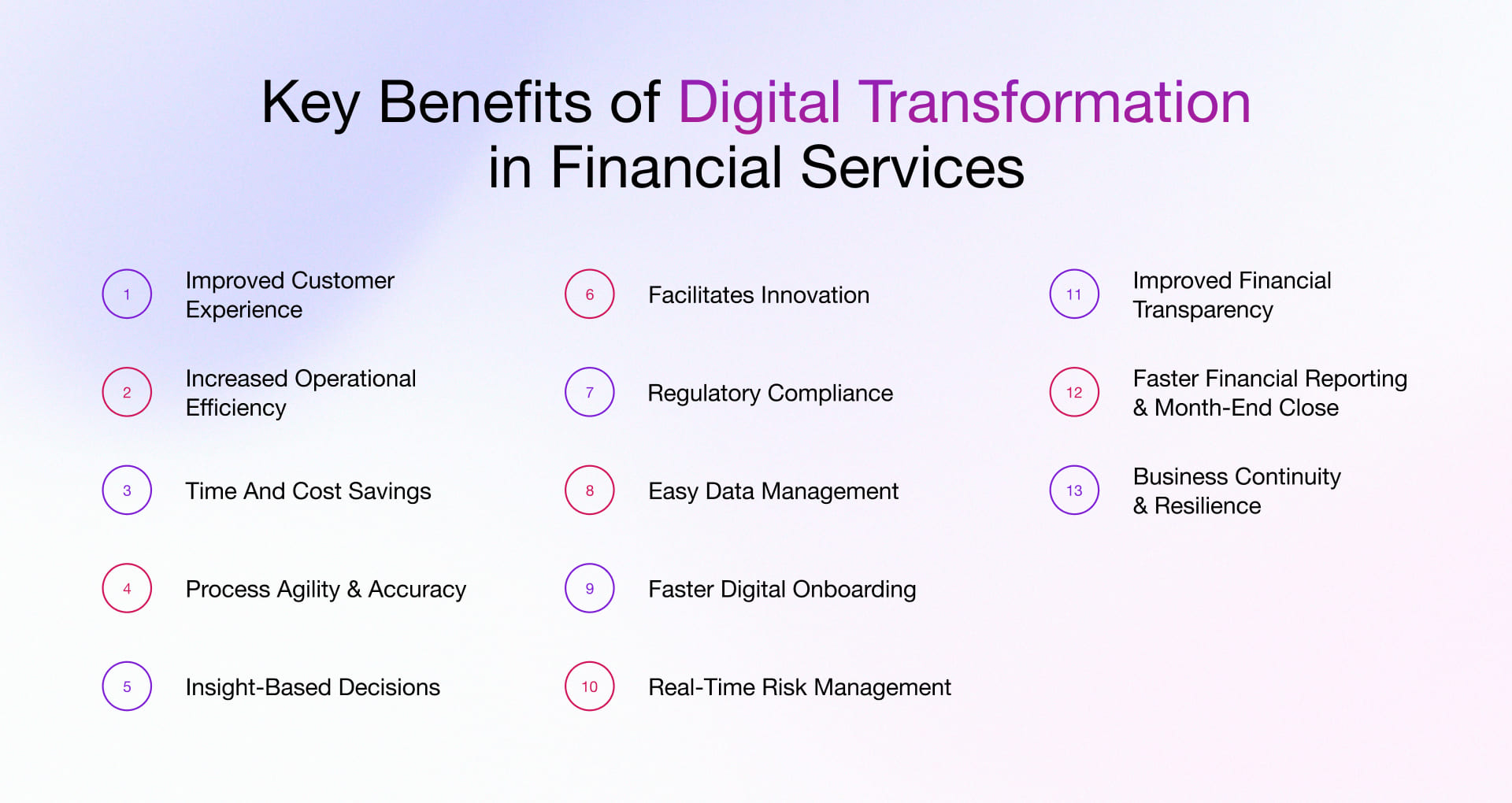
Digital transformation in financial services refers to integrating digital technologies into financial services, enabling the industry to meet customers’ evolving needs, increase efficiency, and reduce costs. Some of the advantages of digital transformation in financial services include the following:
- Improved Customer Experience: Digital transformation provides customers with a seamless and convenient experience. Today’s tech-savvy customer expects fast-paced services, and digitization takes financial services to their fingertips. It helps financial service companies positively engage customers and offer personalized products and services. It enables customers to access financial assistance anytime and from any location, improving their satisfaction with the services.
- Increased Operational Efficiency: Digitization helps streamline operational processes and automate manual tasks. Using digital technologies such as artificial intelligence, blockchain, and cloud computing reduces the time and cost of financial transactions. Automation of processes also reduces human error and improves efficiency. It helps integrate and share data across the systems easily while enhancing operational efficiency. Digital transformation helps financial institutions move from legacy applications to a user-friendly centralized system.
- Time And Cost Savings: Digitization facilitates cashless transactions that reduce spending on intermediary channels to deliver cash from one party to another. Digital transformation projects leading to reduced hardware by retiring old systems could save costs. Digital transformation enables financial institutions to reduce manual processes, paper-based transactions, and physical infrastructure costs. It leads to cost savings that can be passed on to customers.
- Process Agility & Accuracy: Automation in operations eliminates human errors and increases the precision of repetitive tasks while enhancing efficiency and productivity.
- Insight-Based Decisions: Accurate and real-time data availability with advanced analytics powered by AI (Artificial Intelligence) and ML (Machine Learning) helps finance companies make tough decisions faster and meet customer needs. It is while analyzing this data through effective analytics to derive valuable insights and optimize growth.
- Facilitates Innovation: Digital transformation provides opportunities for financial institutions to create new products and services that are more responsive to customer needs. It also enables them to collaborate with fintech companies to develop new business models.
- Regulatory Compliance: Digital transformation helps financial institutions to comply with regulatory requirements more efficiently. For example, it enables real-time tracking of transactions, which helps prevent fraud and money laundering.
- Easy Data Management: Digital transformation helps finance companies collect, manage, and store data effectively with cloud technologies. Cloud-based digital transformation solutions help smooth transition during events like mergers and acquisitions, which are commonplace in the financial services sector. Contrarily, traditional physical systems cause compatibility issues and increase complexities.
- Faster Digital Onboarding: E-KYC, biometric verification, and automated document capture cut new account opening from days down to minutes. A streamlined due diligence process for onboarding reduces applicant drop-off and helps institutions convert more prospects into active, funded accounts.
- Enhanced Market Agility: API-first, modular architecture lets financial institutions launch products, adjust pricing, and respond to competitor moves far faster than a monolithic legacy core allows. This agility is especially important as banks and NBFCs adopt digital-first lending platforms to defend market share against digital-native challengers.
- Real-Time Risk Management: Continuous data feeds and AI-based monitoring give risk teams a live view of credit, market, and operational exposure instead of relying on end-of-day batch reports. This also strengthens anti-money laundering in banking by shortening the time between a risk event and a response.
- Improved Financial Transparency: Centralized, auditable data pipelines give finance leaders and regulators a consistent view of transactions and positions across business lines, reducing reconciliation gaps and manual overrides.
- Faster Financial Reporting & Month-End Close: Digital transformation helps financial institutions automate data collection, reconciliation, and reporting processes across systems. It reduces the time required to complete month-end and year-end financial close activities while improving reporting accuracy, minimizing manual effort, and enabling faster, data-driven decision-making.
- Business Continuity & Resilience: Cloud technologies, automated backups, and disaster recovery solutions help financial institutions maintain business continuity during system failures, cyberattacks, or unexpected disruptions. They ensure critical business operations remain available, protect sensitive financial data, and strengthen organizational resilience while supporting regulatory compliance.
Key Drivers of Digital Transformation in Finance
- Rising Customer Expectations: Customers now compare their bank or insurer to the consumer apps they use every day and expect the same speed, convenience, and personalization from financial services.
- Competitive Pressure from FinTechs and Neobanks: Digital-native challengers built without legacy infrastructure move faster on product launches and pricing, pushing incumbents to modernize or lose ground.
- Regulatory and Compliance Demands: Evolving requirements around KYC, AML, data privacy, and open banking push institutions toward automated, auditable systems that can prove compliance on demand.
- Cost and Efficiency Pressure: Legacy infrastructure is expensive to run and hard to scale, and digital transformation offers a practical path to a lower cost base.
- Data and AI Maturity: Wider access to cloud infrastructure and AI tooling makes it practical to automate processes, such as underwriting and reconciliation, that were previously too costly to modernize. However, institutions need a clear AI readiness assessment and AI-ready data foundation to scale these initiatives successfully.
- Growth of Instant Payments Infrastructure: Real-time rails such as FedNow and RTP are pushing institutions to modernize core payment systems to support round-the-clock settlement.
Digital Transformation Trends in the Financial Industry
Banks and non-banking financial institutions that adopt and implement the latest tools and technologies in their operations are far more likely to keep up with changing customer expectations and dynamic market demands. The effective use of technology in the financial services sector offers a lucrative opportunity to update traditional work methods, upskill, innovate, and start adopting digitalization. Some of the pivotal trends that banks and other financial institutions must prioritize include the following:
Banking Sector
- With the surge in FinTech offerings, digital banking services are booming. The use of Automation and Artificial Intelligence has made “digital banking” a reality – from front-end to back-end! For instance, these technologies now enable customers to apply for loans, make account deposits, process transactions, and receive personalized money management advice remotely.
- Neobanks are fully digitalized banks or app-based financial services providing a wide range of services. These banks work much faster, are more convenient, safer, and cost-effective, as all the interactions are 100% online. Plus, customer support services are easily accessible round-the-clock.
- Contactless, instant payments, digital wallets, and “buy now, pay later” (BNPL) options are reshaping the entire payment ecosystem.
- Banks are moving towards cloud-native technology for cost savings, flexibility, and enhanced security.
- With APIs facilitating faster, easier, and cost-effective connections between banks and third-party financial companies, open banking and Banking-as-a-Service (BaaS) are gaining momentum.
Investment Services
- The investment sector is prioritizing digital transformation, especially after facing challenges during the pandemic. APIs, cloud adoption, and automation are industry-specific trends transforming investment experience in terms of convenience, speed, and security.
- Hybrid advisory models that combine self-learning tools and human expertise are gaining traction as robo-advisors are being leveraged to provide wealth management advice.
Insurance Companies
- Insurers are transitioning to user-first, omnichannel approaches to meet evolving client expectations of an omnichannel experience.
- They are leveraging automation and RPA to enhance customer satisfaction while lowering operating costs.
- Insurance companies are turning to advanced analytics to detect fraudulent claims, mitigate risks, personalize marketing campaigns, and predict customer lifetime value.
Tax and Accounting Industry
- Continuous accounting is an innovative approach that leverages automation and technology to streamline processes and enhance accuracy across accounting procedures.
- Data harmonization combines all the transactional data from different sources and forms into a unified system to eliminate data disparities. This is paving the way for more effective analysis and reporting with the use of analytics powered by AI and other predictive tools.
Digital Transformation Strategy for Financial Institutions
A digital transformation strategy for financial institutions works best as a phased roadmap rather than a single, sweeping overhaul. The following steps outline a practical approach:
- Assess Current State and Define Objectives: Audit existing systems, data quality, and processes, and tie the transformation plan to specific business goals rather than technology for its own sake.
- Prioritize Use Cases by Business Impact: Sequence initiatives, such as digital onboarding, fraud detection, or reporting automation, by the value they deliver and the effort they require, so early wins build momentum.
- Modernize the Technology Foundation: Move toward cloud infrastructure, API-first architecture, and unified data platforms that make future changes faster and less disruptive.
- Build In Security, Risk, and Compliance from Day One: Treat data protection, access controls, and regulatory reporting as core design requirements, not add-ons applied after launch.
- Manage Organizational Change: Invest in training and change management so staff adopt new tools and workflows, since technology alone rarely drives lasting transformation.
- Measure, Iterate, and Scale: Track adoption, cost, and customer experience metrics, then use those results to refine the roadmap and expand successful initiatives across the organization.
Institutions weighing whether to build these capabilities in-house or bring in a specialist partner can also review our take on build-vs-buy decisions for financial software.
Real-World Examples of Digital Transformation in Finance
- FedNow Instant Payments: The Federal Reserve’s FedNow Service has grown to more than 1,700 participating banks and credit unions as of 2026, giving institutions of every size a round-the-clock rail for instant settlement instead of waiting on next-day batch processing.
- RTP Network Modernization: The Clearing House’s RTP network now reaches close to three-quarters of U.S. demand deposit accounts and supports transactions up to 10 million USD, showing how quickly instant settlement is becoming standard infrastructure rather than a niche capability.
- BNY’s $10 Million RTP Payment: BNY completed a $10 million instant payment on The Clearing House’s RTP network after the network’s transaction limit was increased, marking one of the clearest real-world examples of instant payments moving into high-value corporate and treasury use cases
How can Rishabh help with Digital Transformation in Financial Services?
As digital transformation consultants, we can support you in driving better outcomes powered by enterprise-level tools & technologies. Our team enables us to identify and unlock opportunities. We help identify, open, and activate options for achieving tangible, accurate results regardless of project scope or focus. As an experienced fintech software development services provider, we have worked on developing several FinTech solution to enable organizations throughout their digital transformation journey. We will ensure that the digital transformation project meets your current and potential needs.
Here are some ways in which a custom enterprise software development company can help you with your digital transformation initiatives;
- Assessment And Planning: We help you to assess your current state of digital readiness, identify areas of improvement, and develop a digital transformation roadmap that aligns with the organization’s strategic goals.
- Technology Consulting: Our technology consulting services focus on helping organizations choose and implement the right digital technologies, such as cloud, analytics, and IoT, to enable them to achieve their digital transformation goals.
- Change Management: We support you in managing the cultural and organizational changes that come with digital transformation. It would include developing a change management plan, communicating with stakeholders, and providing employee training and support.
- Data Analytics: We help organizations collect, analyze, and interpret data from various sources to develop their digital transformation strategy. It includes using advanced analytics tools to identify trends, opportunities, and risks to help the organization make data-driven decisions.
- Project Management: Our team provides accurate project management support to help organizations to plan, execute, and monitor their digital transformation initiatives. It includes defining project scope, managing resources, and ensuring the project stays on schedule and within budget.
Success Stories: High-Impact Software Solutions Built for Financial Services
From basic initiatives to advanced transformations and build-from-scratch solutions, we have been a top choice for several financial services organizations. Here is proof of why digital transformation is being taken very seriously across the financial services industry.
1) CSR Management Platform for a Private Bank
- Before: CSR activities were handled through manual tracking, scattered records, and limited visibility across teams. This made reporting slower and harder to manage.
- After: The bank now has a centralized CSR monitoring platform with better visibility, smoother tracking, and stronger governance.
2) Legacy Monolithic Application Modernization
- Before: The application was built on a rigid monolithic structure, which made updates slower, scaling harder, and maintenance more complex.
After: It was modernized into a microservices-based architecture, making it more flexible, scalable, and easier to improve over time.
3) Microsoft Purview DLP Implementation
- Before: Data protection and control were less structured, which increased the risk of policy gaps and compliance issues.
- After: Microsoft Purview DLP helped introduce stronger data loss prevention, better policy enforcement, and improved compliance readiness.
Concluding Thoughts
Digital transformation is rapidly changing the financial services industry, enabling financial institutions to innovate, streamline operations, and enhance customer experiences. To stay competitive, financial institutions must embrace digital transformation and adopt new technologies and business models that will enable them to serve their customers better, reduce risks, and create new revenue streams. From AI/ML development services to cloud computing, a range of emerging technologies is driving this transformation, creating new business opportunities, and disrupting traditional models. At Rishabh Software, we help financial institutions accelerate their digital transformation journey by providing the engineering capabilities, strategic guidance and digital enterprise services needed to build secure, scalable, and future-ready digital solutions.
Frequently Asked Questions
Q: What are the key technologies driving digital transformation in finance?
A: Cloud computing, artificial intelligence and machine learning, APIs and open banking, robotic process automation, and instant payment rails such as FedNow and RTP are the technologies doing the most work in financial services transformation today. Together they let institutions modernize customer-facing services and back-office operations at the same time.
Q: How does AI support digital transformation in the finance sector?
A: AI supports fraud detection, credit risk scoring, and personalized product recommendations, and it powers chatbots and virtual assistants that handle routine customer queries. On the back end, AI-driven forecasting and anomaly detection help finance teams catch issues earlier and make faster, more informed decisions.
Q: What are the biggest challenges in finance digital transformation?
A: Legacy system integration, fragmented data across silos, regulatory compliance, and talent shortages are the most commonly cited obstacles. Change management is just as important. New technology delivers little value if staff and workflows don’t adapt alongside it.
Q: How should financial firms start their digital transformation journey?
A: Start with an honest assessment of current systems and data quality, then prioritize the use cases that deliver the clearest business impact, such as digital onboarding or automated reporting. From there, build a modern cloud and data foundation, bake in security and compliance from the outset, and work with an experienced technology partner to keep the roadmap realistic and outcome-focused.