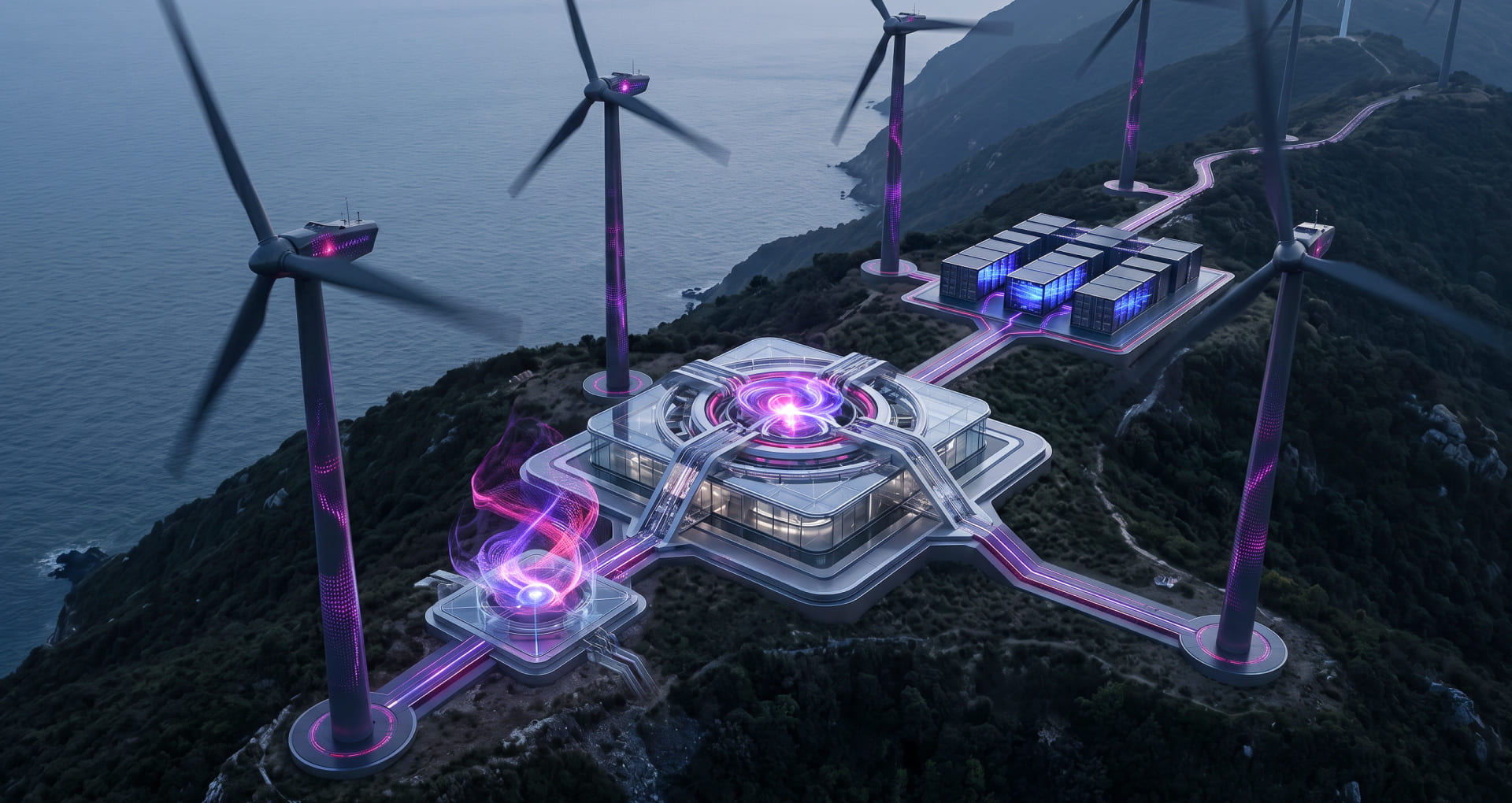
It’s 2:17 AM. Somewhere on a renewable energy site, a critical asset begins showing early signs of failure. Vibration data spikes fractionally, almost unnoticeable across multiple sensor channels. Operational systems detect the anomaly alongside hundreds of other alerts generated that night.
By 6:00 AM, your operations team arrives at what they have privately taken to calling the Alarm Wall: a cascade of alerts, most of them noise, a handful of them critical, and no reliable way to determine the cause without a skilled engineer spending 2 hours triaging. Meanwhile, Turbine 14 is spinning at reduced efficiency, bleeding kilowatt-hours that will never be recovered.
When a technician is finally dispatched, the bearing has already damaged the main shaft. What started as a routine maintenance issue is now a far more expensive repair. For renewable energy operators, this is a familiar problem. The industry doesn’t lack data. It lacks the ability to act on it fast enough.
Agentic AI changes that equation. Instead of stopping at recommendations, AI agents can evaluate operational conditions, trigger predefined actions, and coordinate responses across systems.
In this blog post, we will explore the challenges limiting renewable energy operations today, how Agentic AI in renewable energy helps address them, and the business outcomes organizations can expect from more autonomous operations.
Why Traditional Renewable Operations Are Reaching Their Limits?
We will break down the six structural challenges most renewable energy operators are navigating today, such as reactive maintenance cycles, data overload, workforce shortages, distributed asset complexity, forecasting uncertainty, and grid integration. The growing adoption of Agentic AI in renewable energy is helping operators address these challenges.
Reactive Maintenance Cycles
When a turbine inverter fails or a solar tracker freezes, the cost isn’t just the repair. It’s the emergency dispatch, the overnight parts order, the crane hire, the lost generation during downtime, and if it cascades, the PPA shortfall. The Agentic AI in renewable energy industry averages for unplanned maintenance runs 3-5x the cost of equivalent planned work.
Data Overload Without Action
Modern wind turbines generate upwards of 500 data points per second. A 30-turbine wind farm can produce more operational data in a day than a human team can meaningfully process in a month. The data is there. The insight let alone the action is not.
Workforce and Skills Shortages
The renewable energy sector is scaling faster than its talent pipeline. Experienced O&M engineers who can interpret complex sensor patterns, cross-reference weather forecasts, and make sound maintenance decisions are scarce and expensive. Asking them to spend their days triaging alarm walls is one of the costliest misallocations of expert human capital in industry.
Distributed Asset Complexity
Each additional site adds not just more assets, but more data streams, more maintenance contractors, more grid interconnection points, and more regulatory interfaces. The operational overhead scales non-linearly. Manual workflows that worked for a 5-site portfolio become structurally unworkable at 30.
Forecasting Uncertainty
Annual Energy Production forecasts drive investment decisions, PPA negotiations, and grid dispatch commitments. When those forecasts are built on static weather models and historical averages rather than real-time adaptive inputs the error margins are wide enough to materially affect project economics.
Grid Integration and Balancing Complexity
Grid operators expect predictable delivery. Renewable generation is inherently variable. Bridging that gap using battery storage, demand response, and energy trading requires constant, rapid decision-making that manual teams simply cannot sustain at scale.
Where Are You on the Operational Maturity Journey?
Before evaluating Agentic AI in renewable energy, it helps to understand your current operational baseline. Most renewable energy operators today sit somewhere on this three-stage spectrum — often straddling Stage 1 and Stage 2 without realizing it.
| Stage | Model | What It Looks Like Day-to-Day |
| 1 | Reactive | Alerts arrive after failures. Engineers triage manually. High firefighting ratio. Maintenance is scheduled reactively. AEP forecasts are static. |
| 1.5 | Predictive (Partial) | ML models flag risks. Dashboards have improved. But humans still decide, prioritize, and act often hours or days after the signal. |
| 2 | Predictive (Mature) | Reliable anomaly detection. Maintenance planning is proactive. Forecasting models are dynamic. But action still requires human initiation. |
| 3 | Agentic | AI monitors, decides within parameters, and acts autonomously. Teams focus on strategy, exception management, and portfolio growth. |
5 Ways Agentic AI Transforms Renewable Energy Operations
With Agentic AI in renewable energy, organizations can move from reactive operations to autonomous optimization. By continuously monitoring assets, analyzing conditions, and initiating actions, AI agents improve efficiency, reliability, and decision-making at scale.
1. Predictive Maintenance That Actually Prevents, Not Just Predicts
The difference between predictive AI and agentic AI in maintenance is the difference between a smoke alarm and a sprinkler system. One tells you there’s a problem. The other acts on it. Agentic AI enables renewable energy assets to move from reactive monitoring to autonomous maintenance workflows. It analyzes health signals, vibration frequencies, thermal gradients, and electrical signatures to detect degradation early. When thresholds are crossed, it automatically creates work orders, schedules maintenance, coordinates contractors, and initiates parts requests before your team even starts the day.
2. Smarter Energy Production Forecasting
PPA obligations don’t move. Weather does. That gap is one of the most underappreciated financial exposures in renewable operations. Agentic AI for renewable energy maintains a continuously updated model that integrates NWP data, live SCADA metrics, grid frequency signals, and curtailment constraints, recalibrating hour by hour. When actual production diverges from the forecast, it triggers pre-approved responses automatically. Less a quarterly report, more a living model.
3. Autonomous Asset Performance Optimization
The efficiency losses that quietly erode LCOE rarely look dramatic in isolation. A solar tracker 1.2 degrees off azimuth. A pitch control algorithm on outdated firmware. A battery cycling at 85% of its optimal pattern. Individually, rounding errors. Across a 30-asset portfolio over 12 months, the difference between a project that meets its IRR targets and one that doesn’t. Agentic AI identifies and corrects these micro-inefficiencies in the same window they occur not at the next quarterly review.
4. Autonomous Grid and Storage Management
Grid operators want predictable, dispatchable generation. Renewable energy is inherently variable. Bridging that gap is a daily tightrope walk, and it’s only going to get tighter as grid codes evolve.
Rather than reacting to grid signals after they arrive, agentic systems anticipate them by pre-positioning storage, adjusting generation profiles, and optimizing export schedules ahead of grid events. For operators with battery assets, which means higher ancillary services revenue and lower curtailment exposure, without real-time human intervention.
5. Scalable Operations Across Growing Portfolios
There’s a hard arithmetic problem at the heart of renewable growth: you cannot scale headcount linearly with asset count and keep the economics viable. A team managing 10 sites well cannot manage 40 by quadrupling in size, the talent isn’t there and the margins won’t hold it.
Agentic AI automates the high-volume routine alarm triage, performance reporting, maintenance scheduling, and compliance documentation, so experienced engineers focus on decisions that need them. Adding 10 sites increases operational overhead by 15%, not 100%.
Day in the Life: Before vs. After Agentic AI
| Without Agentic AI — Monday, 6:00 AM | With Agentic AI — Monday, 6:00 AM |
| 47 unread SCADA alerts from overnight. 3 are critical. 44 are noise. No automated way to distinguish them. | Operations dashboard shows 3 prioritized issues, pre-triaged by AI. 44 alerts have been auto resolved or deprioritized with audit logs. |
| Turbine 14 has been underperforming for 6 hours. The bearing signal was in the overnight data but nobody saw it. | At 2:17 AM, the bearing degradation was detected. A maintenance work order was auto generated. The O&M contractor was notified. A low-wind window next Thursday was reserved. |
| The team spends 2 hours triaging before any operational decisions are made. | The team reviews a prioritized action list and makes 3 strategic decisions before 7:00 AM. |
| The weekly performance report will take half a day to compile from multiple dashboards. | The performance report was auto generated at midnight, integrating SCADA, weather, and grid data. |
| A solar farm in the eastern cluster is running 6% below AEP targets. Nobody has had time to investigate. | The tracker misalignment causing the shortfall was identified 4 days ago and corrected automatically. AEP impact: recovered. |
Benefits of Agentic AI in Renewable Energy: What Leaders Can Expect
For renewable energy organizations, the business value of Agentic AI in renewable energy extends beyond operational automation. Its real impact lies in helping teams make faster decisions, improve resource utilization, and create a more resilient operating model that can adapt to growing business demands.
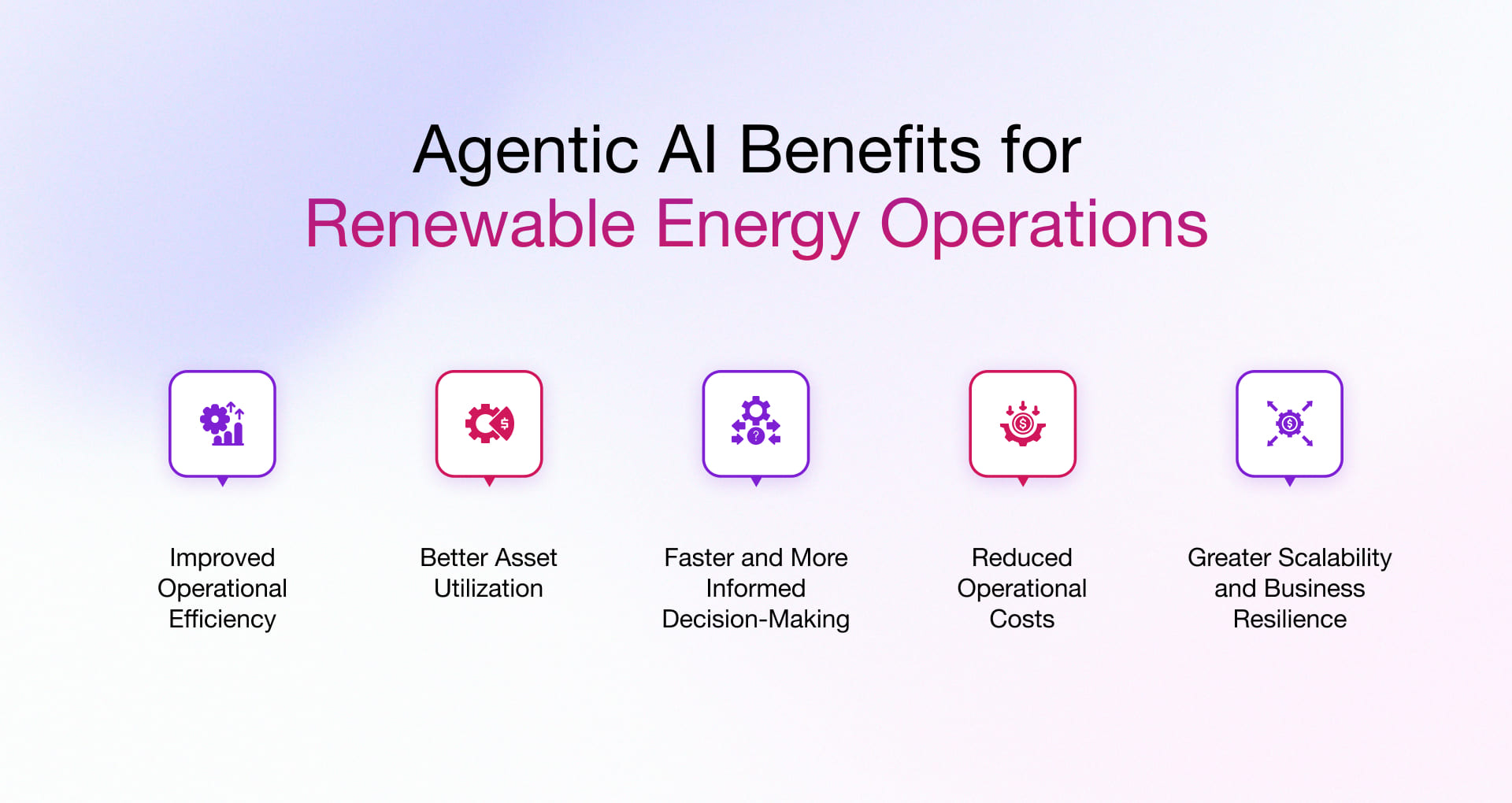
Improved Operational Efficiency
By reducing manual intervention across monitoring, analysis, and routine decision-making, organizations can streamline operations and improve productivity without increasing operational complexity.
Better Asset Utilization
Continuous optimization helps ensure that renewable energy assets operate closer to their full potential, enabling organizations to maximize returns from existing infrastructure investments.
Faster and More Informed Decision-Making
With AI agents continuously analyzing operational conditions and responding to changing scenarios, teams can make decisions with greater speed, accuracy, and confidence.
Reduced Operational Costs
Proactive issue detection, optimized maintenance planning, and intelligent automation help minimize unnecessary operational expenses while improving overall performance.
Greater Scalability and Business Resilience
As renewable energy portfolios expand, organizations need operating models that can grow without proportionally increasing resources. Agentic AI provides the foundation for scalable, data-driven operations capable of adapting to future demands and market changes.
Bring Agentic AI to Renewable Energy Operations with Rishabh Software
Moving from reactive operations to autonomous decision-making requires more than deploying AI models. It requires a deep understanding of how renewable energy assets, operational systems, and business processes work together in real-world environments.
At Rishabh Software, we help renewable energy operators build Agentic AI solutions that integrate with existing operational ecosystems, including SCADA, EMS, IoT platforms, asset management systems, and enterprise applications. Our focus is on helping organizations turn operational data into timely action across maintenance, forecasting, asset performance, and grid operations.
Combining our tailored digital manufacturing solutions expertise in AI engineering, connected operations, industrial data platforms, and cloud-native development, we build solutions designed to deliver measurable operational outcomes rather than isolated proofs of concept.
Our capabilities include:
- AI agent and multi-agent system architecture and development
- Predictive analytics and intelligent automation engineering
- Real-time data engineering and time-series analytics platforms
- IoT integration across sensor networks, SCADA, EMS, and enterprise systems
- Cloud-native application development across AWS and Azure
Frequently Asked Questions
Q: Will Agentic AI work with our existing SCADA and EMS systems?
A: Yes. Agentic AI is designed to be additive, not a replacement. It connects to existing SCADA, EMS, and asset management platforms via APIs, data connectors, or direct integration layers. The integration approach depends on the platforms in use and the data architecture in place. The first step in any deployment is an integration assessment to map data flows and identify any gaps in sensor coverage or data quality.
Q: How is Agentic AI different from traditional AI in renewable energy?
A: Traditional AI primarily analyzes data and provides insights, while Agentic AI goes a step further by autonomously taking action. In renewable energy operations, it can detect asset issues, determine the required response, initiate workflows, coordinate maintenance activities, and continuously optimize decisions reducing manual intervention and improving operational efficiency.
Q: How can Agentic AI help reduce downtime in renewable energy assets?
A: Agentic AI reduces downtime by identifying early indicators of equipment degradation, predicting potential failures, and automatically triggering corrective actions. It can generate work orders, schedule maintenance, coordinate field teams, and initiate parts requests, helping operators resolve issues before they impact energy production.
Q: Can Agentic AI improve renewable energy forecasting accuracy?
A: Yes. Agentic AI can improve forecasting accuracy by continuously analyzing weather patterns, historical performance, grid conditions, and real-time asset data. It adapts predictions dynamically, enabling better energy planning, improved grid stability, and more effective resource management.
Q: Does Agentic AI replace human operators in renewable energy facilities?
A: No. Agentic AI augments human expertise by automating repetitive decisions, accelerating response times, and providing actionable recommendations. Operators remain in control, using AI-driven insights to make faster, more informed decisions and focus on higher-value operational priorities.