AI coding assistants and agents are changing how software gets built. Developers can generate code faster and turn ideas into working applications with less manual effort. However, faster development can come at a cost if generated code introduces bugs, security issues, or maintenance problems that go unnoticed.
A 2026 study analyzing 302,600 verified AI-authored commits across 6,299 GitHub repositories identified 484,366 distinct issues. More than 15% of commits from each of the five AI coding assistants studied introduced at least one issue, and 22.7% of tracked issues remained in the latest version of the repositories examined. These findings highlight the need for stronger quality assurance in AI-assisted development.
This is where Spec-Driven Development (SDD) comes in. Rather than relying on prompts and code generation alone, SDD gives AI coding tools a defined set of requirements, constraints, and acceptance criteria to work against. Teams can use these specifications to guide implementation and check whether the resulting code meets the intended requirements.
In this blog, let’s look at how Spec-Driven Development with AI works, its key benefits, and how teams can introduce it into their software development process.
Inside the Spec-Driven Development Workflow
Spec-Driven Development (SDD) provides a structured path from requirements to working software, keeping the specification as a reference throughout AI-assisted development. Here’s how the workflow typically works.
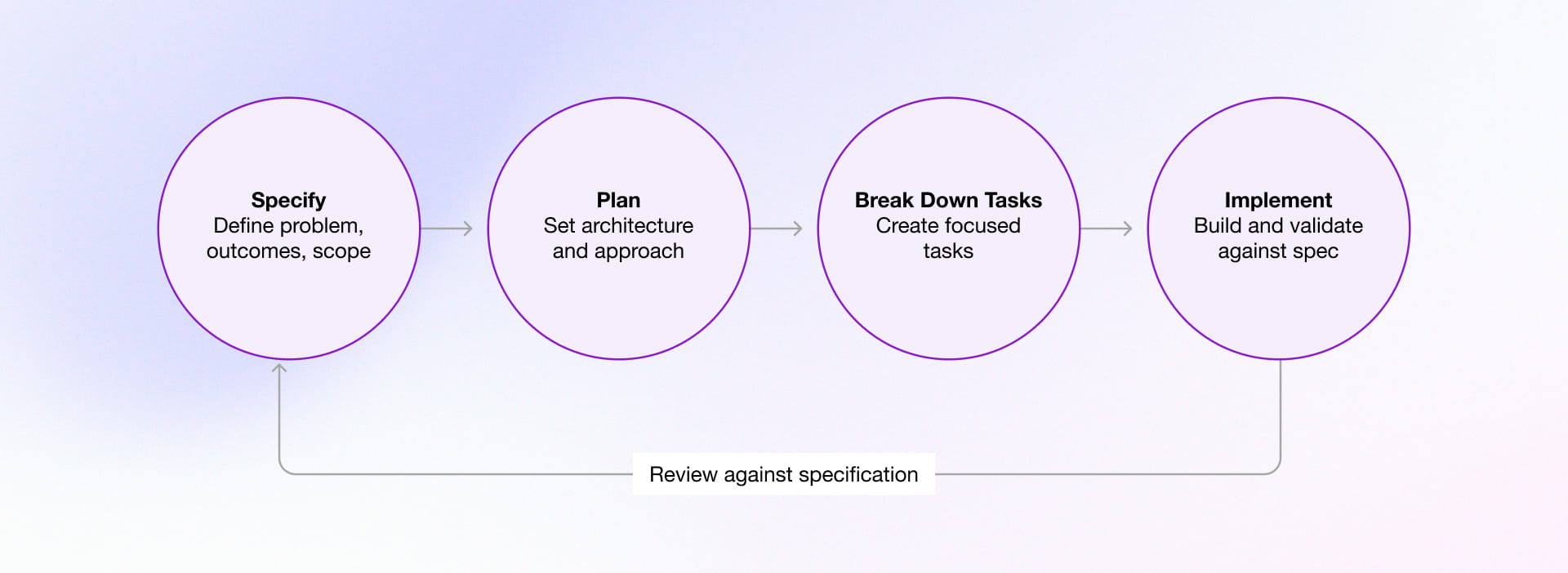
1. Specify – Establish the Intent
Start by defining the problem the software needs to solve. Outline the expected outcomes, user behavior, business rules, and boundaries of the solution. This gives everyone a clear understanding of what needs to be built and what “done” looks like.
2. Plan – Shape the Solution
Translate the requirements into an implementation strategy. Determine the architecture, components, dependencies, interfaces, and technical constraints needed to turn the specification into a workable solution.
3. Break Down Tasks – Structure the Execution
Break the implementation plan into focused development tasks. Each task should have a clear objective, defined inputs and outputs, and enough context for developers or AI tools to work on it without making unnecessary assumptions about the broader system.
4. Implement – Build Against the Specification
Work through the tasks while checking the implementation against the specification and its acceptance criteria. Review the results against the agreed requirements and address any gaps, keeping the intended solution aligned with the evolving codebase and the SaaS product development process.
The Benefits of Spec-Driven Development for AI-powered Engineering
Spec-Driven Development can help teams bring more structure to AI-assisted software engineering. By defining requirements, constraints, and acceptance criteria before implementation, teams have a clearer basis for making decisions, reviewing code, and validating results. Here are five ways SDD can support software teams.
1. Reduces Ambiguity and Rework
Vague requirements can lead to repeated revisions. The AI makes an assumption, the developer discovers the gap during review, QA identifies another interpretation, and the team sends the feature back for revision.
SDD interrupts this cycle before implementation begins. The specification defines:
- What the user needs to accomplish
- What the system must do
- What is outside the scope
- Which constraints apply
- How edge cases should behave
- What conditions define completion
Example: “Add user authentication” is open to interpretation. A useful specification clarifies whether the feature requires multi-factor authentication, session expiration, role-based access control, account recovery, or passwordless login.
- A 2026 study on specification-governed agentic development reported a 50% reduction in time-to-market through specification-governed delivery. This is a study finding, rather than a universal SDD benchmark.
2. Improves the Quality of AI-Generated Code
AI coding agents need sufficient context to produce code that meets the intended requirements. A prompt may describe what someone wants at a high level, but a specification can define the expected behavior and constraints in greater detail.
A specification can be given by the agent:
- API endpoints and response behavior
- Data structures and validation rules
- Security and authorization requirements
- Performance expectations
- Error-handling behavior
- Integration boundaries
- Compatibility constraints
Consider a payment service. “Build a payment flow” may produce a basic transaction path. A specification can require unique transaction IDs, duplicate-payment prevention, timeout handling, refund rules, and audit events. These constraints give the agent a defined target instead of leaving critical decisions to inference.
- The need for this control is reflected in developer sentiment: 46% of developers distrust the accuracy of AI output, according to Stack Overflow’s 2025 survey.
- A 2026 study further reported a 73% reduction in security defects under constitutional specification constraints in its specification-governed agentic development evaluation.
3. Creates a Shared Source of Truth
Different stakeholders can have different expectations of the same feature. Consider a file-upload function. The business requirement may sound simple, but the details could include file-size limits, supported formats, access permissions, failure handling, and security checks.
By defining these conditions early, SDD gives teams a more objective way to answer a basic question: Did we build what was actually agreed?
This approach is already appearing at scale in public software repositories. The 2026 SPECMINE study identified 470,795 specification files across 73,030 repositories, spanning 17 named SDD tools. It also found more than 2.42 million typed references connecting specifications with code, documents, pull requests, branches, and issues.
4. Makes Testing More Systematic
Testing becomes more structured when it starts from the specification. This also aligns with how AI in software testing can support automated test creation, validation, and defect identification. Acceptance criteria can be translated into test scenarios before or alongside code generation:
Requirement -> Acceptance Criteria -> Test Case ->Result ->Evidence
For example, if the specification states that an account must be locked after five failed login attempts, validation can cover the successful-login path, repeated failures, lockout behavior, and account recovery. This creates a direct connection between what was requested and what was tested, making gaps easier to identify before release.
5. Improves Traceability and Audit Readiness
As AI generates more implementation artifacts, teams need to know why a piece of software exists and which requirement it satisfies. SDD creates that connection by linking intent to implementation and validation.
A typical traceability chain looks like:
Requirement -> Specification -> Design -> Task -> Code ->Test ->Evidence
Recent study found 2,421,323 typed references across the repositories it studied, including 1.28 million references to code files, 863,000 to related documents, and more than 200,000 references to pull requests, branches, and issues.
How to Implement Spec-Driven Development
Spec-Driven Development represents an AI-native paradigm shift in how software engineering moves from intent to working software. Operationally, it brings structure, accuracy, and coherence to AI-assisted development by keeping the specification at the center of the development journey. Instead of relying on unlimited prompts that may miss context or intent, SDD provides a spec-centric path from requirements to implementation and validation.
The following implementation steps, informed by industry practices and expert perspectives, show how teams can bring this approach into their software engineering workflow.
Step 1: Decide How Much Spec the Work Actually Needs
Not every feature requires the same level of documentation and control. A small change to an existing interface may need only a few clearly defined requirements, whereas a complex enterprise application may require detailed specifications, technical designs, and traceable acceptance criteria.
Before starting, consider the project’s complexity, risk, number of contributors, and the consequences of getting something wrong. An organization’s broader AI readiness assessment can also help determine whether its teams, processes, and systems are prepared for AI-assisted development.
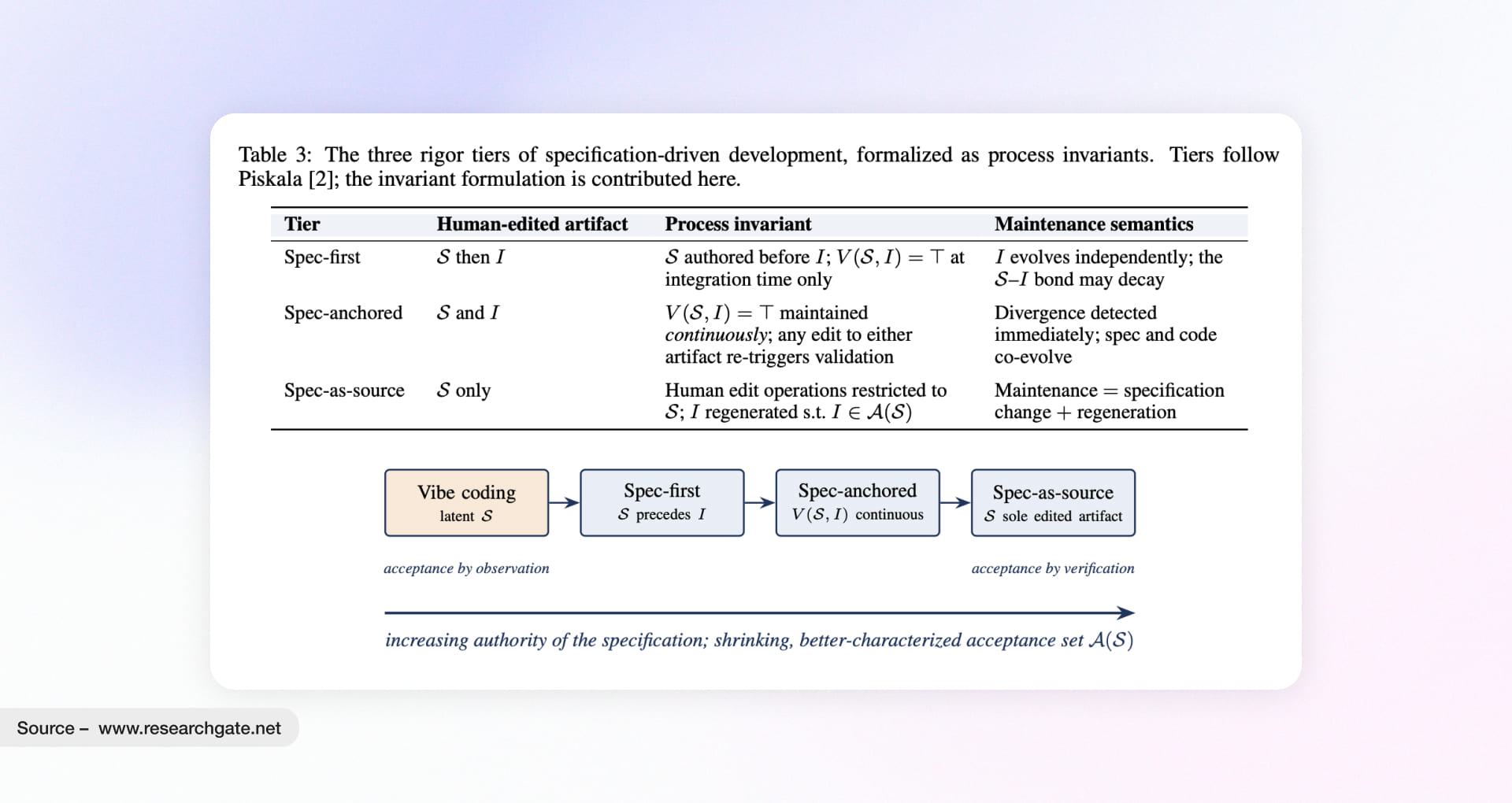
The following model can help teams decide how much structure a project needs.
| Level | What It Means | Best For |
| Spec-first | Define the requirements before implementation and use them as a guide. Changes can be made without requiring every decision to pass through a formal approval process. | Prototypes and smaller features |
| Spec-anchored | Maintain the specification as the main reference for requirements and check implementation changes against it. | Team projects and systems with multiple contributors |
| Spec-as-source | Version the specification as a primary artifact and use it to generate or verify implementation artifacts where the tooling supports it. | Regulated, high-risk, or long-lived systems where traceability is important |
What This Looks Like in Practice
- Define requirements first: Capture the expected behavior, constraints, and acceptance criteria before implementation.
- Maintain a shared reference: Keep requirements, design decisions, and relevant tests connected to the specification.
- Make requirements testable: Define what the software must do and how the team will verify that it works as intended.
- Allow specifications to evolve: Update the specification when requirements change, and keep those changes traceable.
When to Use a Specification, and When Not To
A detailed specification isn’t necessary for every development task. The decision depends on the potential impact of the change and the level of coordination required.
- Does every feature need a detailed specification? A small, isolated UI change may need only a brief requirement and a clear definition of done.
- When is a more detailed specification useful? Consider one when several teams or AI agents work on the same codebase, when compliance requirements apply, or when a mistake would be expensive to reverse.
- What happens when a necessary specification is missing? Developers and AI tools may make different assumptions about expected behavior, leaving gaps that surface during testing or after release.
Step 2: Define the Intent Before Touching Architecture
Before making any technical decision, the team needs to agree on what they’re building and why. This foundation is also critical to AI in product development, where business objectives need to stay connected with technical execution. Along with, this step produces the answers everything downstream gets checked against.
Define the Business and User Problem
- What problem are we actually solving?
- Who experiences it, and how often?
- What outcome should this feature create for them?
- Why does this need to exist now, versus later or not at all?
Establish Scope and Boundaries
| Covers | |
| In scope | Features and capabilities included in the current release |
| Out of scope | Requirements that are explicitly deferred |
| Dependencies | External systems, teams, services, or data required for implementation |
| Constraints | Budget, timelines, regulatory obligations, and technical limitations |
Define Expected Outcomes
Set measurable outcomes and high-level acceptance expectations before anyone touches architecture.
Step 3: Build the Specification in Layers
A specification doesn’t have to be one large document containing every detail. Teams can organize it into layers, moving from the business need to the technical design and then to the work required to implement and validate the solution.
| Layer | What It Defines | Typical Contents |
| 1. Requirements and intent | What needs to be built and why | Business objectives, user personas, use cases, and business rules |
| 2. Technical design | How the solution should work | Architecture, APIs, data models, security requirements, and dependencies |
| 3. Implementation and tasks | What needs to be developed and verified | Development tasks, task sequencing, test scenarios, and acceptance criteria |
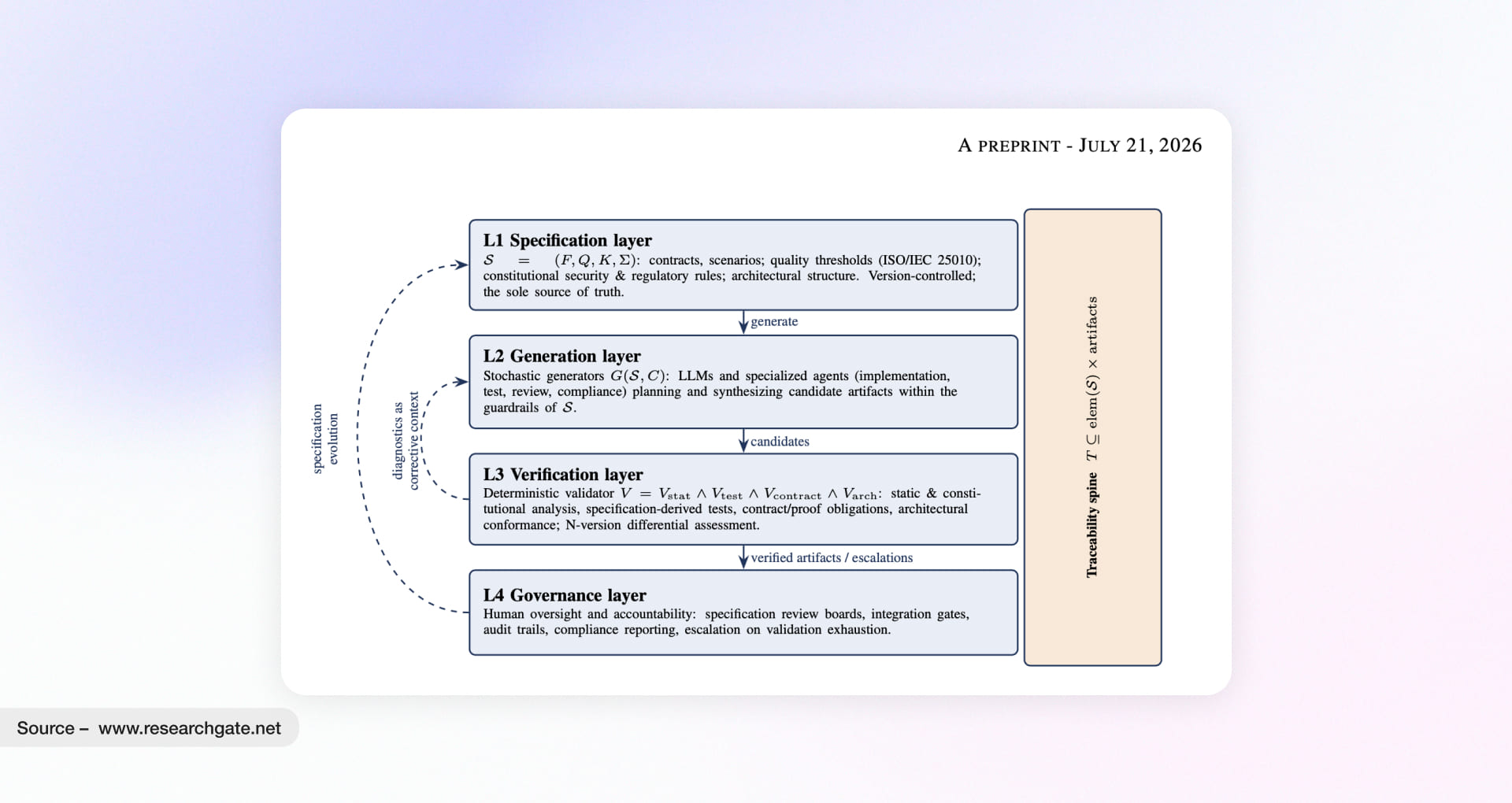
Teams can refine these layers as they learn more about the problem. The aim is to give developers and AI coding tools enough context to make implementation decisions without leaving important requirements open to interpretation.
Step 4: Review the Specification Before Implementation
A specification may look complete and still contain gaps, conflicting requirements, or assumptions that have not been discussed. Reviewing it before implementation helps teams identify these issues before they lead to unnecessary code changes.
Involve the relevant product, engineering, and testing stakeholders. Check whether the proposed solution is feasible, dependencies are understood, and the expected behavior can be verified.
Common Pitfalls and How to Avoid Them
- Writing the specification once and leaving it unchanged: Review it at key milestones and whenever requirements change.
- Defining too much detail upfront: Match the level of specification to the project’s complexity and risk.
- Leaving ownership unclear: Assign responsibility for maintaining the specification and approving requirement changes.
- Overlooking edge cases: Identify important failure scenarios and define the expected system behavior before implementation.
- Ignoring dependencies: Check how the proposed changes could affect existing services, integrations, and other parts of the application.
Step 5: Implement With AI Agents, Then Validate Against the Spec
For AI-assistance or agentic AI in software development, the implementation phase requires AI support. Multiple AI assistants and agents are available today. GitHub Spec Kit is an open-source option for teams standardizing across multiple AI coding agents, Kiro fits teams already built on AWS, and OpenSpec suits teams evolving an existing codebase without adding heavy tooling. These are a few options you can consider for development purposes.
Whichever tool generates the code, validation asks one question: Does the implementation satisfy the specification? That means checking functional requirements, acceptance criteria, and edge cases to ensure the output remains a stable and modifiable artifact.
If you find it difficult to manage the Spec-Driven Development process, Rishabh Software’s AI agent development and software development services can help you manage the process on behalf of your organization.
Step 6: Keep the Spec and the System in Sync
Software requirements change after release. New features, bug fixes, integrations, and changes in business rules can make an existing specification outdated if the team updates the code without revisiting the original requirements.
A consistent change-management process helps prevent that gap.
- Identify the change: Determine which requirement needs to be added, modified, or corrected.
- Update the specification: Record the intended behavior and revise the relevant acceptance criteria.
- Assess the impact: Identify affected components, dependencies, integrations, and tests.
- Implement the change: Use your preferred development tools, including AI coding assistants where appropriate.
- Validate the result: Run relevant tests and check the updated implementation against the revised specification.
- Maintain traceability: Keep the specification, code, tests, and supporting documentation aligned as the system evolves.
The specification should remain useful throughout the software lifecycle, rather than becoming a document that reflects only the original implementation.
If you’re looking to introduce Spec-Driven Development into your engineering workflow, Rishabh Software’s Gen AI Development and Digital Engineering services can help you evaluate the approach and establish engineering practices suited to your needs.
Spec-Driven Development vs Vibe Coding
Businesses and teams keep using trending terms like Spec-Driven Development and vibe coding. In reality, they approach the development process differently, their purposes are different, and they achieve different outcomes. In this section, we will explore spec-driven development vs. vibe coding and answer whether these two approaches can work together.
Key Differences Between SDD and Vibe Coding
1. Development Approach
- SDD: Start with a clear specification and use it to guide development.
- Vibe Coding: Start with a prompt and refine the output through ongoing interaction with AI.
2. Source of Truth
- SDD: The specification remains the reference point for what the software should do.
- Vibe Coding: The intended outcome is usually carried through prompts, conversations, and the generated code.
3. Validation
- SDD: Check the implementation against requirements, acceptance criteria, and edge cases.
- Vibe Coding: Run the output, observe how it behaves, and refine it when something does not work as expected.
4. Handling Changes
- SDD: Update the specification first, then make and validate the corresponding implementation changes.
- Vibe Coding: Continue the conversation with AI and modify the code based on the new requirement.
5. Where It Fits
- SDD: Useful when the software needs consistency, maintainability, traceability, or stronger governance.
- Vibe Coding: Useful for exploring ideas, quick prototypes, and smaller or short-lived development tasks
Can Spec-Driven Development and Vibe-Coding Work Together?
Yes, they both serve different stages of the software development lifecycle. Vibe coding to production is best for exploring ideas, moving ahead with prototyping, and testing initial concepts. On the other hand, SDD with AI brings structure to every step, helping turn an initial solution into sustainable development.
How Rishabh Software Can Help with Spec-Driven Development
Adopting Spec-Driven Development requires more than defining specifications. Teams need to translate business requirements into clear, actionable instructions for AI coding tools, validate generated code, and maintain software quality throughout the development lifecycle.
Rishabh Software brings digital product engineering experience across industries, along with expertise in AI agent development. We help businesses evaluate AI-assisted development approaches and build software focused on maintainability, scalability, and alignment with business requirements.
If you’re exploring Spec-Driven Development or looking to make AI-assisted software development more structured and reliable, talk to our experts to discuss your engineering requirements.
Frequently Asked Questions
Q: What is Spec-Driven Development with AI?
A: Spec-Driven Development with AI is a software development approach in which a structured specification guides AI-assisted development from requirements through implementation and validation.
Q: How is SDD different from TDD, BDD, PRDs, and design documents?
A: Spec-Driven Development (SDD) uses a structured specification as the central reference for guiding implementation and validation. The other approaches serve different purposes:
- TDD (Test-Driven Development): Uses tests to guide implementation and verify code behavior.
- BDD (Behavior-Driven Development): Defines expected system behavior through examples and scenarios.
- PRDs (Product Requirements Documents): Describe product goals, user needs, and functional requirements.
- Design documents: Describe the proposed architecture, system components, and technical decisions.
Q: Is spec-driven development the same as vibe coding?
A: No. Vibe coding relies on prompts and iterative AI interactions to generate and refine code, whereas Spec-Driven Development (SDD) uses a structured specification to guide implementation and validation. Vibe coding can be useful for rapid exploration and prototyping, while SDD provides a more structured approach to building and maintaining software. The two approaches can also be used together.