

Unstructured content is where enterprise ROI hides. Contracts, emails, PDFs, tickets, and policies hold obligations, exceptions, and approvals, but they stay buried across documents and systems. Teams pay the price in delays, rework, and avoidable risk.
Governed AI changes that. It retrieves only what a user is permitted to see, answers with citations, and applies strong hallucination controls inside everyday workflows. Many teams employ AI for unstructured data processing because it delivers fast wins in document-heavy workflows without a platform rebuild. And you don’t need a heavy ETL/ELT program or platform replacement to get results. Start incrementally, modernize source by source, prove value in one high-friction workflow, then scale by domain!
This blog shows how enterprises can extract maximum ROI from unstructured data with AI. AI removes the cost of document-heavy work, cuts time spent searching, reading, summarizing, routing and rework. It also improves throughput now, without waiting for a multi-year platform migration.
Where Unstructured Data Slows Enterprise Workflows
Unstructured data does not exist in a single organized storage area. The unstructured data created by different teams demands extensive financial resources because it spreads across all systems and departments. You will typically find it in:
- Content repositories and file shares such as SharePoint, shared drives and knowledge bases
- Attachments inside operational platforms like ERP, CRM, claims, procurement, and case management
- Communications like email threads, chats, meeting notes, and call transcripts
- Work systems like ticketing tools, incident management, and customer support platforms
- Technical and operational docs like logs, runbooks, SOPs, manuals, images and diagrams.
The problem is not storage. The problem exists because teams need to use multiple sources of information and they spend time hunting for it, and even when they find it, they cannot confidently reuse it across the board because access, definitions and traceability break down.
The Role of AI in Unstructured Data Processing
AI and unstructured data work together to surface obligations, exceptions, and context buried across contracts, emails, PDFs, and tickets sxo decisions happen faster inside real workflows.
In day-to-day terms, AI helps teams get tasks done rapidly by handling reading, finding, and summarizing at scale by:
- Analyzing documents even when formatting varies
- Extracting key fields, entities, obligations, and exceptions from messy text
- Classifying content by type, sensitivity, and business relevance
- Summarizing long threads into decision-ready context
- Connecting documents and notes to business entities such as customer, policy, claim, case, supplier, or order.
This is bigger than search. It is workflow acceleration. Work moves faster when the right context appears at the right moment, without someone spending an hour opening attachments and cross-checking details. Explore our AI and ML Development Services to build workflow-ready solutions that turn your document-heavy processes into decision-ready outcomes!
Key AI Techniques That Power Unstructured Data Use Cases
Leveraging high-impact unstructured data with AI doesn’t require a sprawling stack. Most unstructured data and AI programs succeed when they combine extraction, retrieval, governance and monitoring in a repeatable pattern.
- Document intelligence and extraction: Convert forms, PDFs, emails, and attachments into structured outputs like entities, key-value fields, clauses, obligations, and exception flags.
- Classification and metadata tagging: Label content by document type, owner, sensitivity, retention class, and routing rules so workflows stay policy-aligned and access-controlled.
- Semantic search and vector retrieval: Retrieve based on meaning, not keywords, so teams find the right precedent, clause, or prior case quickly.
- Enterprise RAG with citations: Anchor responses in approved sources and return evidence-backed answers with citations for fast verification and audit readiness.
- Evaluation, drift detection and monitoring: Track extraction accuracy, retrieval relevance, coverage, and behavior over time. Detect drift as templates, terminology, and workflow language change.
These techniques unlock business intelligence. Enterprise data management provides the governance and integration foundation needed to deploy these AI patterns repeatedly without rebuilding pipelines each time.
The next challenge is operationalizing it across fragmented systems and teams without turning every request into a new pipeline project.
Data Engineering That Uses AI To Reduce Heavy Lifting Without Ripping Out Your Stack
Modern data engineering doesn’t mean “replace everything.” It’s how you operationalize unstructured data with AI across ERP, CRM, cloud apps, warehouses, and content repositories without heavy ETL.
Instead of treating every new request like a bespoke ETL build; AI, GenAI and BI agents can accelerate the repetitive work:
- Discover and profile new sources faster
- Auto-document schemas, lineage, and business definitions
- Generate mappings and transformations with human review
- Detect anomalies and quality issues earlier
- Build governed semantic layers so metrics don’t drift
- Enable BI agents for controlled self-serve Q&A
- Bring unstructured data into analytics and ops workflows using document intelligence and RAG
This isn’t hands-off automation. It’s practical acceleration that shifts data engineering effort from manual assembly to design, governance, reliability, and scale. Teams get there by building AI-Ready Data with the right quality, structure, governance, and accessibility to deliver reliable outcomes. The right AI patterns combined with an incremental data foundation turn unstructured content from static storage into decision-ready workflow input.
High-Impact Unstructured Data with AI Use Cases Across Key Industries
Unstructured content drives critical decisions, but it is hard to use at speed because it sits in documents, notes, and attachments across multiple systems. Listed below are real-world examples of unstructured data and AI improving cycle time, cost per case, and compliance without forcing platform replacement.
Financial Services: faster audits and regulatory responses
Audit evidence is spread across policies, approvals, emails, case notes, and operational reports. Teams lose time assembling proof, reconciling definitions, and controlling access to sensitive content.
AI pulls out obligations, approvals, and exceptions from policies, emails, and case notes. Permission-aware retrieval and RAG with citations speed evidence collection and regulator responses.
Healthcare: operational analytics without compliance risk
The process of handling authorization documents and referral documents together with intake forms and their accompanying documentation causes delays because it needs manual assessment and subsequent tracking efforts. Information sharing is restricted by privacy and audit regulations which also determine the pace of information dissemination.
AI extracts required fields from referrals, authorizations, and intake documents, then tags and routes them based on policy. Access controls and audit logs support privacy and compliance.
Manufacturing: better quality and throughput decisions
Downtime and defects are explained in maintenance logs, shift notes, supplier communications, and SOPs. Troubleshooting slows when context is scattered.
AI makes maintenance logs, shift notes, supplier messages, and SOPs searchable by meaning. Teams retrieve the right context, summarize findings with citations, and act faster on quality and downtime issues.
Insurance: shorter claims cycle times
Claims stall because essential details live in adjuster notes, attachments, photos, estimates, and emails. Manual re-entry and inconsistent exception handling increase rework.
AI extracts claim details from notes and attachments, flags exceptions, and supports evidence-based triage. Retrieval with citations helps adjusters verify decisions while maintaining control.
SaaS and Tech: faster support resolution and customer intelligence
Ticket threads, product logs, and CRM data exist in silos, causing repeated investigations and slow escalations. Knowledge is scattered across docs and internal conversations.
AI connects tickets, product logs, and CRM context, then retrieves the best answers from approved knowledge. Citation-backed responses and thread summaries reduce escalations and speed resolution.
We modernize the workflow, not the entire stack!
Business Outcomes Enterprises Expect from Unstructured Data AI
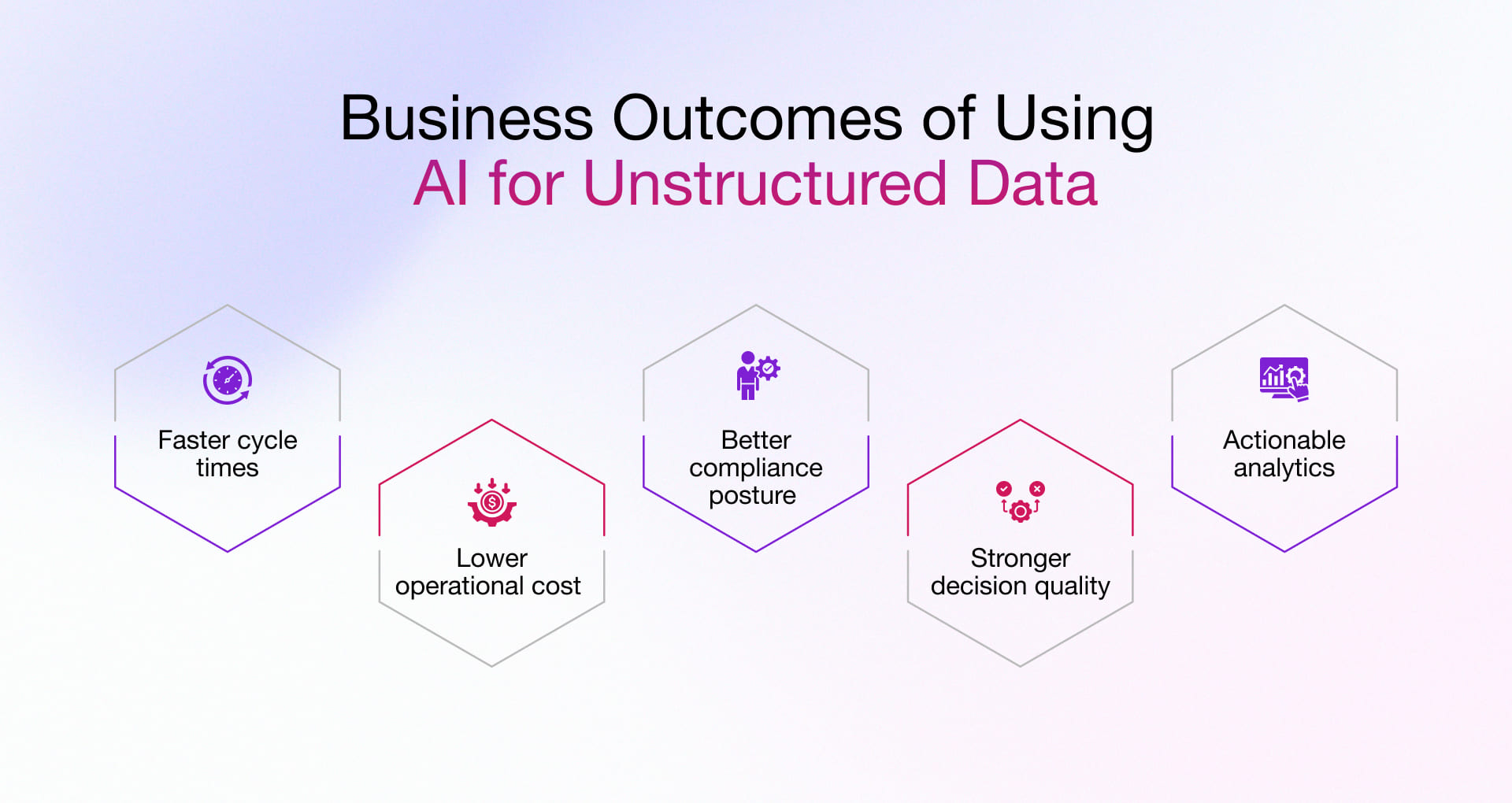
When unstructured data is searchable, governed, and usable inside workflows, outcomes show up quickly in metrics leaders care about. That’s the measurable upside of using AI for unstructured data that’s governed, embedded and tied to a specific workflow KPI.
- Faster cycle times: Less time lost to searching, reading, and rebuilding context. Work moves because information arrives when it is needed.
- Lower operational cost: Manual review drops, rework drops, escalations drop. The hidden effort of document-heavy processes becomes measurable and reducible.
- Better compliance posture: Access is controlled, actions are logged, and evidence can be traced back to source documents without frantic reconstruction.
- Stronger decision quality: Exceptions, obligations, and edge cases surface earlier, so teams make fewer decisions with missing context.
- More useful analytics: Structured metrics become more actionable when paired with the narrative and evidence in the supporting artifacts.
Our Implementation Approach: Modernize Without Heavy ETL/ELT Investment
To scale unstructured data with AI, we choose the lightest architecture that meets the outcome, security model, and audit requirements. Here’s the practical decision model we follow:
Approach 1: “Thin pipelines” for fast value
- extract only what’s needed for priority outcomes
- standardize patterns
- automate tests and documentation
Best fit when: you need fast delivery and can’t pause operations.
Approach 2: Semantic-first modernization
- define governed metrics once
- standardize meaning across BI and AI agents
- reduce dashboard sprawl
Recommended when: trust is low and metrics are inconsistent.
Approach 3: Add unstructured intelligence where it matters
- index and retrieve operational documents with ACL controls
- cite sources, mitigate hallucinations
- integrate into workflows
Ideal when: people spend time searching/reading or risk depends on documents.
Approach 4: Hybrid (most common)
- extraction for deterministic fields
- RAG for contextual guidance and evidence
- semantic layer for consistent definitions
Best when: you want operational impact + trust + scale.
We help enterprises build governance-first data engineering that improves speed, quality, and usability across structured and unstructured data without forcing a heavy overhaul. Want the operating model behind these approaches? Explore our Data Engineering best practices for Ops readiness.
From Insight to Impact: How Rishabh Software Delivers Measurable Results
Rishabh Software focuses on outcomes first, then builds the minimum production-grade foundation required to deliver those outcomes safely.
A typical engagement follows a simple pattern:
- Choose one workflow with obvious friction such as claims intake, audit evidence gathering, support resolution, or contract obligation search.
- Connect the minimum set of sources across structured systems and content repositories, without forcing platform replacement.
- Build a governed solution by default using permission-aware retrieval, citations, logging, and quality checks.
- Embed it where users work so adoption is natural and measurable.
- Scale by domain using reusable onboarding, metadata, testing, and monitoring patterns.
Our Data Engineering Services are built to modernize incrementally and connect into your current stack whether cloud, on-prem, hybrid, warehouse or lakehouse, operational systems, or content repositories. We can help you extract ROI quickly, prove value without overspending, and expand confidently without taking on a disruptive overhaul.