

One rule change in one state can break your entire lending operations overnight!
Every state sets its own rules for disclosures, fees, licensing, and servicing. As digital lending platforms scale, those differences compound quickly. Manual fixes can’t keep up. Generic tools won’t either.
Most lenders build first and fix compliance later. That strategy is failing. Consent orders and enforcement actions prove it. Meanwhile, the pressure is only mounting:
- CFPB Section 1071 data collection is on the horizon
- AI-driven underwriting models are drawing sharper scrutiny
- Lenders are increasingly expected to prove transparency, fairness, and audit readiness at every single step of the customer journey.
This is why more lenders are adopting a Compliance-by-Design approach. Instead of treating compliance as a separate function, they are embedding regulatory requirements directly into workflows, decision engines, data management practices, and governance processes.
This guide explores how digital lenders can build compliance into their technology foundation, reduce regulatory risk, and create platforms that perform in an increasingly complex regulatory environment.
Why Compliance by Design Is No Longer Optional for Digital Lending Platforms in 2026
The operating environment has changed. Regulators spent five years watching digital lenders grow while compliance frameworks stayed frozen. That patience is gone.
The CFPB, despite a 90% headcount reduction under the Trump administration, has kept enforcement posture toward fintechs aggressive. State attorneys general have expanded their own digital lending oversight significantly. Federal capacity is down. State enforcement is up.
State-level regulation alone creates a structural compliance challenge that most founders underestimate. Federal requirements are just the starting point. Every state also enforces its own rules across six critical areas:
- Rate regulation: APR caps vary widely. Some states cap consumer loans at 36%. Others have no cap at all.
- Disclosure mechanics: Fee disclosure timing, format and delivery method differ by jurisdiction.
- Servicing rules: Payment application order, grace periods and late fee triggers vary by state.
- Collection practices: Call windows, contact frequency limits and settlement offer rules all differ.
- Data retention: Consumer data retention periods and disposal methods are regulated separately across multiple states.
- Adverse action: Notice timing, content requirements and delivery standards diverge from federal baselines.
Urgent Compliance Drivers That Can’t Be Deferred
Section 1071 of Dodd-Frank requires lenders to collect and report small business lending data starting January 1, 2028. They need to start building that infrastructure into their origination workflows now. This includes borrower demographics, loan purpose, geographic data and credit decision factors.
AI and alternative data governance has moved from voluntary guidance to enforcement expectations. The CFPB’s rule on algorithmic credit decisions, along with AI laws in California and Illinois, now requires lenders to document how their models work, test for unfair bias, and send clear adverse action notices that explain the real reasons for a decision instead of just citing a score.
AML and KYC under the Anti-Money Laundering Act of 2020 continues tightening beneficial ownership verification, especially for business lending. Lenders who outsource identity verification to a third-party API without internal controls face growing exposure.
Why AI And Alternative Data Create New Compliance Risks
AI credit models using bank transactions, employment data and utility payment records can expand credit access. They can also discriminate in ways traditional fair lending tools never detect.
When a model weighs hundreds of variables, telling a rejected borrower “the model made that decision” is not a legal explanation. Regulators know this. Examination standards are catching up fast.
If you have not built explainability into your models, you are already carrying risk. That means regular disparate impact testing, ongoing performance tracking and documentation that survives examination. Platforms that skip this do not see the problem until it becomes a very expensive one.
The Cost of Building Compliance Last in Digital Lending
The familiar argument: build first, invest in compliance once you have revenue. The problem: by the time a platform has meaningful loan volume, retrofitting compliance is no longer a technology problem. It is an architecture problem.
What enforcement actions actually cost
Direct penalties from UDAAP enforcement and state licensing violations regularly reach eight figures for platforms with real loan volume. But the fine is rarely the biggest cost.
Remediation and redress frequently exceed the fine itself. Lenders must refund fees, recalculate APRs, notify affected borrowers and run corrective programs. These efforts drain capital and consume years of leadership attention.
Licensing suspension is existential. Losing an NMLS license in a major state does not just cut revenue from that state. It can trigger cross-default provisions in warehouse facilities and whole loan purchase agreements.
Technology remediation costs are routinely underestimated. Retrofitting disclosure logic into a live origination system not built for compliance means touching nearly every layer of the stack
Why Bolt-On Compliance Fails Structurally
Compliance added after the fact creates synchronization failures that are hard to detect internally and immediately visible to examiners.
When disclosure logic lives in a separate system from origination, a rate change can hit one but miss the other and create loan documents that contradict the actual terms.
When audit logs come from a compliance add-on instead of the core platform, they end up incomplete, are easy for examiners to challenge and become expensive to reconstruct. Gaps that go unnoticed in normal operations are often the first things an experienced examiner spots and the longer they linger, the more it costs to fix.
Key Regulatory Requirements Shaping Modern Digital Lending Platforms
| Requirement | Impact Area | Status |
| ECOA / Regulation B | Credit decisioning, AI governance, adverse action | Active enforcement |
| TILA / Regulation Z | Disclosure engine, APR calculation, e-sign | Active enforcement |
| CFPB Section 1071 | Small business data collection and reporting | Due Jan 1, 2028 |
| BSA / AML | KYC, onboarding, transaction monitoring | Active enforcement |
| State Licensing (NMLS) | Operations, geographic expansion | Varies by state |
| AI Governance / Model Risk | ML underwriting, disparate impact testing | Evolving expectations |
What Compliance by Design Actually Looks Like for Digital Lending Platforms
The term gets used loosely. Some vendors apply it to any platform that ships with a built-in disclosure template. Real compliance by design is a different architectural philosophy entirely.
How Compliance by Design Is Built into Lending Platform Architecture
A surface-level approach adds a disclosure module alongside the origination engine. A compliance-by-design approach makes compliance logic a constraint the origination engine operates within. In the surface-level approach, a developer can ship a feature that bypasses disclosure logic by accident. In a compliance-by-design approach, that bypass is architecturally impossible.
The difference shows up in specific design choices:
- Disclosure generation triggers from loan data state, not from a separate service call
- State-specific loan rules live in configuration, not hardcoded logic, so entering a new state does not require re-engineering the platform
- Audit trails are immutable, timestamped and generated natively, not reconstructed from application logs after the fact
- Fair lending monitoring runs against every credit decision in production, not monthly batch samples
- Model governance documentation is version-controlled alongside the model code
Building Governance and Audit Readiness into Digital Lending Operations
Tech by itself doesn’t build real compliance maturity. The platforms that pass regulatory checks set up governance so compliance sees product decisions early, before they launch. That means compliance teams join the sprints instead of acting as a last-minute gate for choices already made.
Compliance-mature platforms treat every new product feature as a regulatory impact assessment. Which disclosures does this trigger? Which state rules are affected? What is the audit trail? These questions get fast, confident answers because the infrastructure to answer them already exists.
The Role of Regulatory Technology (RegTech) in Lending Compliance
Manually monitoring 48 state regulatory environments, maintaining disclosure logic across product lines, running continuous fair lending analysis and managing KYC refresh cycles is an operational cost that grows with loan volume and erodes unit economics. RegTech changes that equation.
- Regulatory monitoring tools track state legislative changes and map them to platform configuration requirements.
- Automated disclosure generation with state-specific rule engines removes human error from disclosure preparation.
- Continuous AML transaction monitoring replaces periodic batch reviews that miss real-time activity.
A compliance-by-design platform isn’t built around a single tool. It brings together several capabilities that work in sync across the lending lifecycle.
- Identity and verification tools confirm who lenders are doing business with from the first interaction. They perform customer identification checks, verify beneficial ownership, screen against sanctions lists, and validate identities using biometrics within the onboarding process.
- A regulatory rules engine enables teams to manage state-specific requirements without changing code. Teams can update APR limits, disclosure requirements, fee structures and other applicable regulatory rules through configuration.
- Fair lending and model monitoring tools assess credit decisions for potential bias, track model performance and alert teams when model behavior starts to deviate. They also provide the documentation regulators increasingly expect during examinations.
- AML transaction monitoring helps detect unusual activity in real time, automate suspicious activity reporting, and maintain clear case records that support investigations and regulatory reviews.
- Examination readiness tools ensure that audit logs, document retention records, and regulatory reports are always accessible. When an examiner requests information, teams can respond quickly without scrambling to gather evidence from multiple systems.
Five Pillars of Compliance by Design in Modern Lending Platform
Compliance by design isn’t a single feature or a tool but a framework that integrates compliance into every stage of the lending lifecycle. The following five pillars help lenders stay compliant, reduce operational risk, and accelerate decision-making without constantly reacting to regulatory changes.
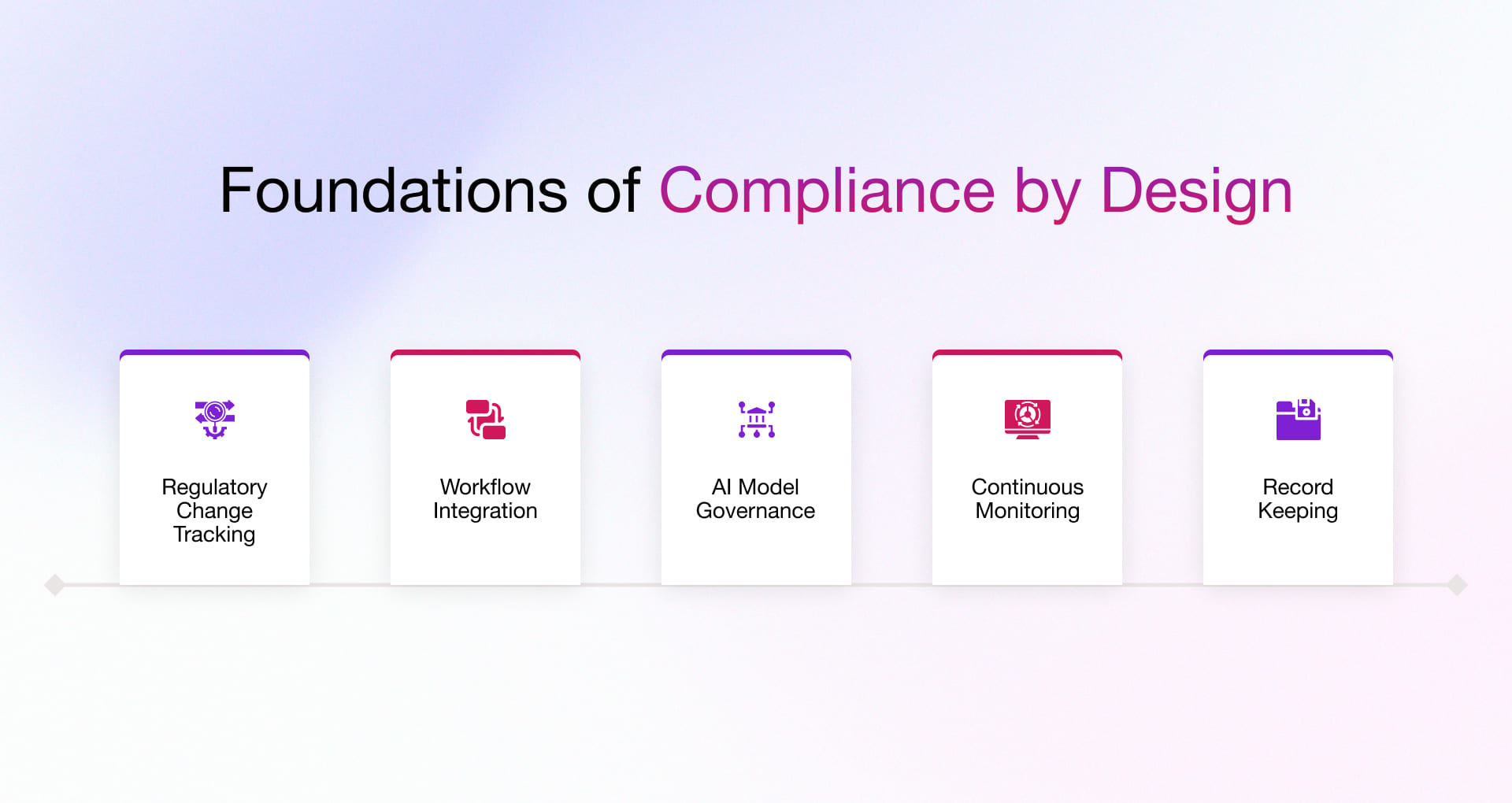
- Keeping Up With Regulatory Changes
Lending regulations change constantly. A modern platform should help teams track federal and state requirements and update policies quickly when rules change. This reduces the need for costly system updates and helps compliance keep pace with business growth.
- Building Compliance Into Everyday Workflows
Compliance works best when lenders build it into the lending process itself. The platform should automatically perform the right checks, deliver required disclosures, and apply approval rules throughout origination, servicing, and collections. Teams should not have to rely on employees to remember every requirement.
- Managing AI and Credit Decision Models Responsibly
As lenders use more automated decision-making, they need to understand how their models reach decisions. Teams should be able to track model changes, identify potential bias, explain lending decisions, and maintain the records regulators expect to see.
- Monitoring Compliance Continuously
Lenders cannot rely on annual audits alone. They need to monitor transactions, lending decisions, disclosures, and model performance throughout the year. Ongoing monitoring helps teams identify problems early and address them before they create compliance risks.
- Maintaining Clear Records
Strong record-keeping simplifies compliance. A modern lending platform should automatically record key actions and decisions, creating a clear history that teams can access during audits, regulatory reviews, and internal investigations.
How Rishabh Software Can Help Execute Your Compliance by Design Action Plan
As a lending software development company, we structure implementation into three phases that move a platform from assessment to operational compliance capability in 90 days, without requiring a full rebuild.
Phase 1: Days 1 to 30 Assessment and Prioritization
- Compliance architecture gap analysis across origination, servicing and collections
- State licensing status review and multi-state rule engine requirements mapping
- AI and model governance documentation inventory
- AML and KYC control adequacy assessment against FinCEN expectations
- Prioritized remediation roadmap weighted by enforcement risk
Phase 2: Days 31 to 60 Design and Implementation
- State-configurable regulatory rules engine integration
- Disclosure generation embedded natively in origination workflow
- Native audit trail implementation replacing reconstructed log approaches
- Fair lending monitoring integrated with continuous production decision tracking
- KYC and AML platform integration with full lifecycle monitoring capability
Phase 3: Days 61 to 90 Testing, Training and Monitoring
- Compliance control testing across active loan products and all active states
- Examination simulation and readiness validation
- Compliance team training on platform monitoring and alert management
- Regulatory change monitoring workflow activation
- Ongoing managed compliance services scoping for continuous coverage
Future-Proof Your Digital Lending Platform Starting Today
Compliance by design is not a constraint on growth. It is what makes sustainable growth possible.
The cost of examination failures, licensing actions and remediation programs always exceeds the cost of building compliance into the architecture before the first loan closes.
The market is moving toward $44.49 billion. Regulatory pressure is moving in the same direction. The platforms that capture that growth without losing it to enforcement costs are the ones treating compliance as infrastructure, not an afterthought.
Section 1071 has a hard deadline. State licensing cycles have no grace periods. AI governance expectations are already shaping examination outcomes.
Build compliance into the platform before you need it. Partner with a lending software development company that builds compliance into the platform before you need it.