
Financial institutions are expected to deliver seamless digital experiences across banking, payments, lending, and wealth management services while operating within strict regulatory and security frameworks. Every software release must support business agility without introducing operational risk, compliance issues, or service disruptions.
Many financial organizations remain constrained by legacy platforms, siloed teams, manual deployment processes, and lengthy approval cycles that slow their response to changing customer needs. As digital initiatives expand, technology teams face growing pressure to increase release frequency, improve system reliability, and maintain operational efficiency.
DevOps helps financial institutions address these challenges by bringing together development, operations, security, and automation within a streamlined delivery framework. Through continuous integration, continuous delivery, infrastructure automation, and embedded security controls, organizations can accelerate software delivery, strengthen governance, and improve the resilience of business-critical applications.
This blogpost explores the role of DevOps in financial services, its benefits, implementation challenges, best practices, and use cases that support modernization across banking and financial organizations.
Why Are Financial Institutions Moving Toward DevOps?
DevOps is a set of practices to organize processes, software delivery pipelines & operational workflows. For the financial services industry unlike other industries, technology has not evolved much. It is because many companies felt that it is too risky to embrace DevOps considering the amount of legacy code and old methodologies they still in practice.
You would agree the elevated customer experience and high-volume of transactions make the finance sector one of the busiest industries.
The new-age companies want to become more flexible to adapt to customers’ evolving demands and provide better interactions. While the companies have already begun their quest to upgrade legacy banking infrastructure. This is where DevOps has come to meet the emerging demands. This practice helps them deliver value to the market safely and efficiently with optimized expenses.
Benefits of DevOps for Financial Services Sector
DevOps combines modern development practices, automation tools, and operational frameworks to optimize the entire software delivery lifecycle. For financial organizations, where security, compliance, scalability, and faster innovation are critical, DevOps enables teams to build and deliver reliable digital solutions while reducing operational complexity. Let’s explore the key benefits of implementing DevOps in financial services sector:
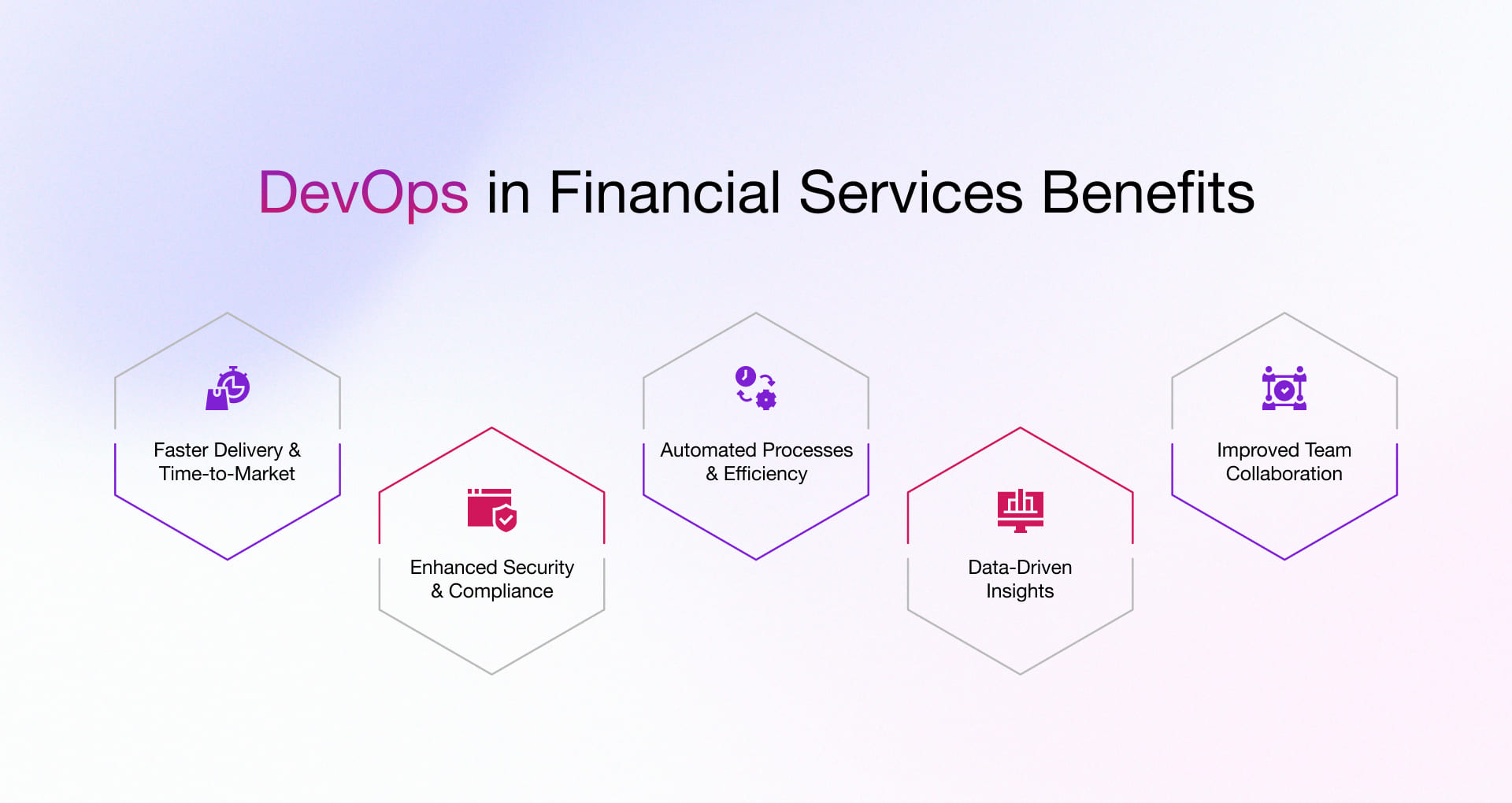
1. Faster Software Delivery and Reduced Time-to-Market
Financial institutions are constantly evolving to meet customer expectations for faster digital experiences, whether through mobile banking applications, payment platforms, or investment solutions. Traditional development approaches often involve lengthy approval cycles and manual processes that delay product releases.
DevOps enables financial organizations to accelerate software delivery through continuous integration (CI), continuous delivery (CD), automated testing, and streamlined collaboration between development and operations teams. By reducing bottlenecks across the software lifecycle, businesses can introduce new features, security updates, and improvements faster while maintaining quality and reliability.
This faster release cycle helps financial companies respond quickly to market changes, customer demands, and emerging digital opportunities.
2. Improved Security and Compliance
Protecting sensitive customer data, transaction records, and critical business systems remains a top priority across the financial services sector. DevOps supports a security-first approach through practices such as DevSecOps, automated security testing, continuous monitoring, and infrastructure as code (IaC).
By automating security checks throughout the software development lifecycle, organizations can identify vulnerabilities earlier, reduce manual errors, and maintain compliance with industry standards. This helps financial businesses strengthen their security posture without slowing down innovation.
3. Automated Processes and Increased Operational Efficiency
DevOps promotes automation across software development and infrastructure operations, helping financial organizations reduce repetitive manual tasks and improve overall efficiency.
From automated server provisioning and configuration management to testing, deployment, monitoring, and data backup processes, DevOps enables teams to create consistent and reliable workflows. This reduces operational delays, minimizes human errors, and allows teams to focus on higher-value activities such as innovation and improving customer experiences.
4. Better Prediction Through Data-Driven Insights
With automated workflows, continuous monitoring, and real-time feedback mechanisms, financial organizations gain better visibility into application performance and operational behavior.
DevOps practices help teams identify potential issues earlier, predict system requirements, and optimize application performance. This enables businesses to make informed decisions, improve service reliability, and deliver better experiences for customers.
5. Increased Collaboration Across Teams
DevOps encourages a culture of collaboration, communication, and shared responsibility between development, operations, security, and business teams.
Since many financial organizations operate across multiple locations and rely on distributed teams or external technology partners, effective collaboration is essential for maintaining operational stability.
DevOps breaks down traditional silos, improves transparency, and enables teams to work together more efficiently throughout the software delivery lifecycle. As a result, financial institutions can achieve faster innovation, smoother deployments, and more reliable digital services.
Key Challenges of Implementing DevOps in Financial Services
Like every other industry, even the financial services sector is no exception when it comes to catching up with the latest digital trends. Listed below are some of the challenges with the DevOps implementation;
- Data Privacy regulations & strong restrictions on securing the network that eliminate data leakage and hacking
- Full lifecycle governance to monitor each step of the development process
- Seamless integration with third-party applications
- Detailed auditing that does not accept defects and errors
- Diverse Access Control List Modules
Regulatory compliance and data security are of prime importance for organizations in this vertical. The immature adoption of DevOps may cause a threat to regulatory controls and governance. So, it is wise to choose an experienced software development company as your consulting partner. This would provide flexibility to adopt the latest technologies and even get familiarized with the modern software delivery practices.
DevOps Best Practices Financial Organizations Should Adopt
Successful DevOps adoption in financial services extends beyond implementing tools and automation. It requires a balanced approach that strengthens security, streamlines operations, and fosters collaboration across teams. The following practices help financial organizations build resilient software delivery processes while maintaining compliance, governance, and operational efficiency.
1. Mitigates Potential Security Hazards
Compliance and security are the two major concerns for the industry that impede modernizing legacy software development and delivery procedures. Initially, the implementation of DevOps was considered a high-security risk. Also, the enhanced speed of software releases was viewed as a major threat to governance and regulatory controls.
But the real implementation of practices allows the organizations to get rid of preconceived notions. It helps minimize potential security problems and locate issues and tackle threats more effectively. Further, it assists with frequent releases and stays up to date with the emerging market trends.
2. Business Process Automation
Leveraging DevOps in Fintech helps automate repetitive processes, yields efficiency & provides you the ability to serve your clients in a better way. Automation processes can be developed more easily than ever before. This eliminates paperwork and allows the staff to deliver great customer service.
Automating tasks across software delivery lifecycle proves effective to achieve the right resource utilization, increase in developer productivity and improved product quality. It ensures balancing responsibilities across the cross-project requirements, regular updates & entire process management at the enterprise level. This offers the business with the opportunity to speed up delivery times, ensures faster time-to-market while ensuring scalability and compliance with standards.
3. Drives Cultural Transformation
It is not just about changing technological processes. But it also alters the entire industry landscape. For the finance industry, the culture shifts to flexibility by implementing agile development’s adaptable working methodology and going away from the top-down hierarchical processes.
DevOps Use Cases in Financial Services
Now that you know the significance of implementing DevOps, let’s look at some real-world examples of how organizations have adopted and scaled the DevOps practices across their organizations. These insights will help you to explore how major companies are leveraging this practice to take their business to new heights.
Business Case 1: UK based Multinational Banking and Financial giant adopted agile DevOps working practices
The digital transformation resulted in increased developer’s morale and quality of code. It reduced delivery risk by 70% and improved the quality of customer services by 60%.
Building on similar financial services transformations, we have helped organizations modernize their technology landscape by adopting agile DevOps practices. Our expertise in legacy system modernization, process optimization, and engineering excellence enables financial institutions to improve delivery efficiency, enhance application quality, and create a foundation for continuous innovation.
Business Case 2: US-based banking and financial services corporation embrace DevOps to accelerate development cycles
By incorporating Kubernetes, the bank today runs more than 2,000 in-house applications in a metro cluster environment. The move to containers, Kubernetes and microservices architecture ushered to enormous improvements that resulted in scalable, reliable & faster development and deployment.
Business Case 3: Europe-based finance company wanted to automate the deployment of new configurations to its several customer-facing credit card websites.
Leveraging continuous integration/continuous delivery (CI/CD), the company’s application teams can now quickly make changes, test & deploy configurations. The solution resulted in a 70% faster time to market and a 50% reduction in a manual effort.
We have successfully enabled organizations to accelerate software delivery through CI/CD automation and DevOps implementation. By streamlining deployment workflows, reducing manual intervention, and improving release cycles, we help businesses achieve faster time-to-market while maintaining reliability, scalability, and operational efficiency.
If you’re still not considering DevOps adoption, then you might want to rethink as your competitors will surely leverage them to stay ahead!
How Rishabh Software Helps Financial Institutions Scale DevOps Adoption?
As a DevOps services company, we help financial enterprises to realize all the benefits of this methodology. Our proficient team possesses unmatched technical expertise across tools like Jenkins, Kubernetes & Docker to deliver a range of impeccable services that provide best-in-class customer experiences.
The team helps embed security at all stages of the delivery pipeline by breaking down the functional silos. It is by segregating massive tasks into individual components and distributing the same among collaborative teams, to ensure effective collaboration. We help reduce costs by offering better collaboration between teams and accelerate the speed at which the code can be deployed. Our experience enables us to identify the right technology stack and tools that will align with your regulatory compliance requirements.
Frequently Asked Questions
Q: What CI/CD tools do financial services companies use?
A: Financial services companies commonly use CI/CD tools such as Jenkins, GitLab CI/CD, GitHub Actions, Azure DevOps, CircleCI, and TeamCity to automate software building, testing, and deployment processes.
For banking and financial applications, these tools are often integrated with security and compliance solutions to support automated testing, vulnerability scanning, audit tracking, and controlled deployments. Organizations typically choose tools based on their existing technology ecosystem, regulatory requirements, scalability needs, and cloud infrastructure.
Q: How does DevOps improve security in financial services?
A: DevOps improves security by integrating security practices throughout the software development lifecycle through approaches such as DevSecOps. Automated security testing, continuous monitoring, vulnerability scanning, and compliance checks help financial organizations identify risks earlier and maintain stronger protection for sensitive financial data.
Q: Can DevOps help financial institutions meet regulatory compliance requirements?
A: Yes. DevOps supports compliance by creating automated workflows, maintaining detailed deployment records, enabling audit trails, and enforcing standardized processes. With practices such as infrastructure as code (IaC), automated testing, and policy-based controls, financial organizations can improve governance while continuing to deliver software faster.
Q: What are the biggest challenges of implementing DevOps in banking and financial services?
A: The major challenges include integrating DevOps with legacy banking systems, managing strict regulatory requirements, ensuring security across development pipelines, and changing traditional team structures. Successful adoption usually requires a phased implementation strategy, the right tools, skilled teams, and strong collaboration between technology and business departments.
Q: Is DevOps suitable for legacy financial systems?
A: Yes. DevOps can support legacy modernization by helping financial organizations gradually automate processes, improve deployment workflows, and integrate modern technologies with existing systems. Many institutions adopt DevOps alongside cloud migration and application modernization initiatives to improve flexibility and scalability.