Outsourcing powered the last decade. Global Capability Centers will power the next. Today, as businesses struggle with rising costs, shrinking product cycles, and the relentless pressure to digitalize, GCCs have become the digital and operational nerve centers that keep enterprises competitive.
India is the hotspot of this worldwide transition, and the rise of the mature Tier 2 cities has expanded the list of available GCC models. More options imply more possibilities, but at the same time, more risks of misalignment. The right operating model fuels speed, innovation, and efficiency. The wrong one adds cost, churn, and friction!
This blog cuts through the noise. You’ll learn what each GCC model actually delivers, when to use it, and how Rishabh Software helps businesses make smart, data-backed, and experience-driven decisions that set their GCCs up for long-term success.
Start With Strategy: Aligning the GCC to Enterprise Objectives
Every great GCC starts with a great reason. The question is simple. What must the GCC deliver that your headquarters or current vendors cannot?
Before selecting a model, leaders must define the outcomes that truly matter. This creates clarity and prevents expensive misalignment later.
Key Factors to Consider Before Choosing a GCC Model
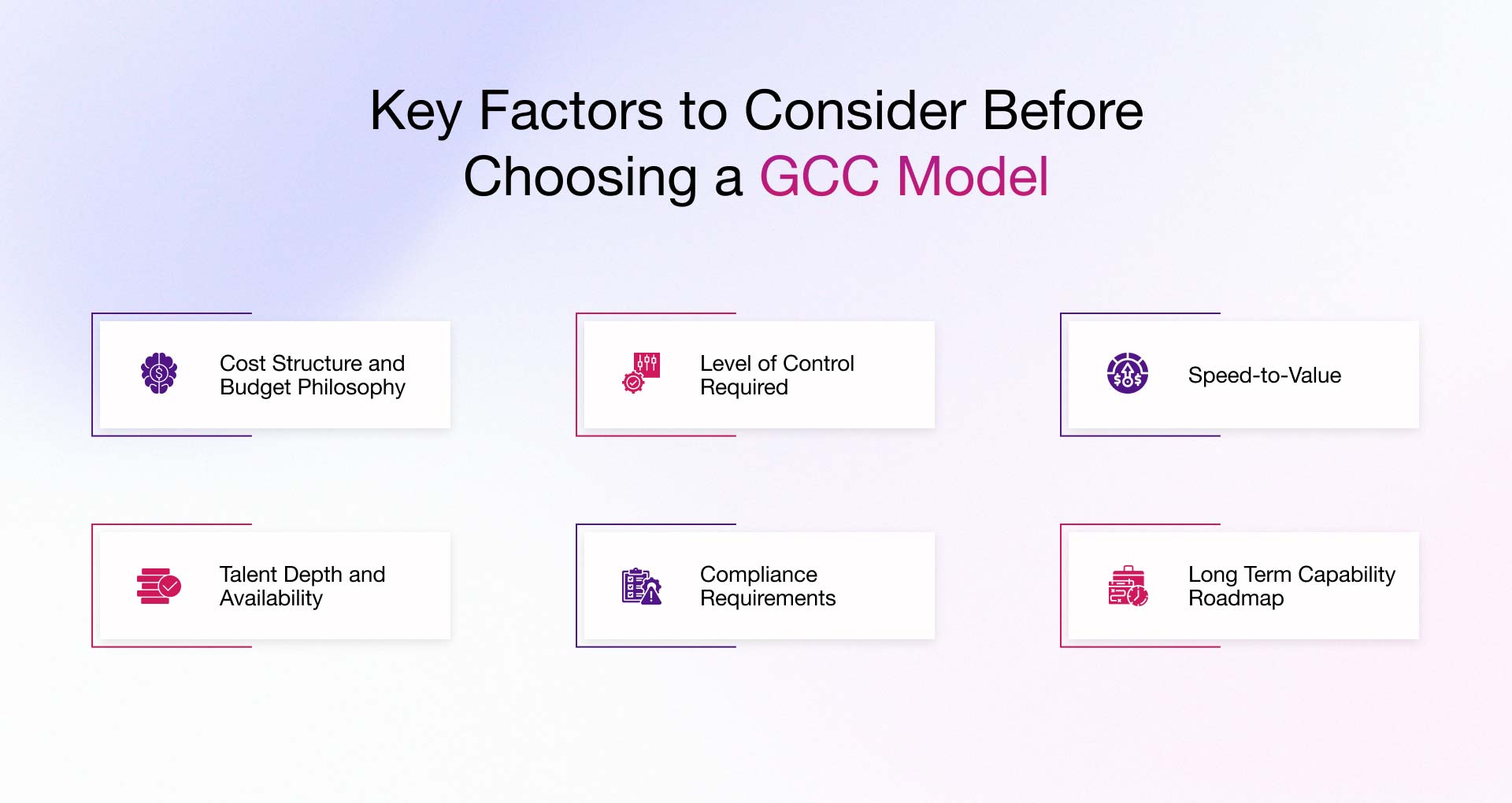
- Cost Structure and Budget Philosophy
Some models require CAPEX-heavy investment. Others allow OPEX-based entry. If the business needs a fast, low-risk option, models like GCC as a Service or Managed Engagement offer superior flexibility.
- Level of Control Required
Enterprises handling IP-heavy work, regulated data, or customer-sensitive processes often prefer Captive or BOT, where full governance sits with them. Others who want speed and delegation may prefer Managed or Hybrid structures.
- Speed-to-Value
If the GCC needs to be operational within 60 to 90 days, Captive is neither practical nor feasible. GCC as a Service or Dedicated Engagement works better for immediate value realization.
- Talent Depth and Availability
A product engineering GCC requires a different talent pool than a finance or shared-service GCC. For example, Product Engineering GCCs require specialized skills, which many Tier-2 cities now offer. Vadodara, Coimbatore, Kochi, and Jaipur are among the hubs that offer great skills in the areas of cloud, data analytics, product engineering, and automation, plus the advantage of better availability and retention.
- Risk Appetite and Compliance Requirements
Industries like BFSI, healthcare, and retail often have to deal with the strictest governance. The model should be able to handle compliance frameworks that are similar to ISO 27001, GDPR, or CCPA.
- Long Term Capability Roadmap
If the GCC expands from 20 to 500 people in three years, the model must support scalability without restructuring the entire unit.
Once leaders evaluate these factors, they can intelligently compare the models available.
Understanding GCC Operational Models
There is no single best GCC model. Each one serves a specific business scenario. The key is matching the model with your needs and goals. Below is a deeper explanation of each model with clarity on strengths, limitations, and typical use cases.
Build-Operate-Transfer (BOT)
BOT suits enterprises that want to own and run their GCC in the future but do not have the time, local experience, or internal capacity to set it up on their own. A specialist partner designs, builds, and runs the center for an agreed period, and then hands it over once it becomes stable and mature.
What you gain:
- You get fast build-out of facilities, teams, tools, and processes.
- You reduce upfront effort on legal, compliance, hiring, and vendor setup.
- You follow a clear path to 100 percent ownership at the end of the term.
- You benefit from disciplined operations and reporting during the operate phase.
- You use the partner’s playbooks for recruitment, HR, and governance.
What to plan for:
- Your internal teams must prepare to absorb the center at transfer, including leadership, HR, finance, and IT.
- You need to align culture and ways of working before and during handover.
- You must define a clear roadmap, SLAs, and RACI to avoid a complex transition.
- You should negotiate commercials and exit clauses upfront to prevent surprises.
Best suited when:
- You have a long-term India or multi-location strategy.
- You work with IP sensitive areas and want direct ownership after a few years.
- You plan to build large product engineering, analytics, or platform teams.
- You care about speed to start but you insist on greater control in the long haul.
Build-Operate-Collaborate (BOC)
BOC extends BOT by keeping the partner relationship alive even after you take legal ownership of the GCC. After transfer, the partner continues to support selected capabilities, transformation programs, or niche skills.
Why enterprises choose it:
- You share responsibility for outcomes across the entire lifecycle, not only during setup.
- You keep access to the partner’s specialists for architecture, design, DevOps, or domain expertise.
- You evolve the GCC more smoothly as you adopt new technologies and skills.
- You reduce the risk of knowledge loss when key people move or change roles.
Works best for:
- Organizations that want legal and operational ownership but still value ongoing expert support.
- Complex digital, AI, cloud, or engineering functions where long-term co-creation adds value.
- Multi-year transformation programs where the GCC acts as a strategic change engine, not just a delivery unit.
Hybrid Model
In a hybrid setup, the enterprise owns and runs some GCC functions directly, and partners manage others under clearly defined constructs such as managed services, dedicated pods, or co-managed teams.
Key advantages:
- You decide which capabilities you keep in-house and which you allow partners to manage.
- You scale in phases by starting with partner-run pods and internalizing them later if needed.
- You experiment with new domains such as AI, cybersecurity, or data platforms without large fixed investments.
- You balance cost, risk, and speed across different business lines more effectively.
Points to watch:
- You must run strong governance to avoid duplication, shadow operations, or unclear ownership.
- You need to codify decision-making and accountability across entities and locations.
- You must standardize tooling, security, and processes to maintain a single enterprise fabric.
Best fit for:
- Early-stage or evolving digital and product teams.
- Organizations that run a mixed portfolio of engineering, business operations, and shared services under one GCC umbrella.
- Enterprises that want to pilot new locations or domains before making long-term commitments.
Joint Venture (JV)
In a JV-based GCC, two or more organizations share equity, investment, and control of the center. Companies often use this model when they want to enter a new market or start large capital-intensive initiatives.
Why companies pursue JVs:
- Partners share financial exposure and operating risk.
- Each party contributes local market knowledge, global product skills, technology, or domain expertise.
- Partners build strong strategic alignment when they commit to co-invest in growth.
- Companies gain access to existing networks, distribution channels, or regulatory know-how in the host country.
Challenges to manage:
- You must design governance structures, board composition, and decision rights very carefully.
- Partners need sustained trust, aligned incentives, and clarity on IP ownership.
- You should define exit, dilution, and future funding scenarios at the start.
Dedicated Engagement
In a dedicated engagement, a partner builds and runs a fully dedicated team that works only for your enterprise. This setup often supports product engineering, QA, data, security, or cloud teams.
What it offers:
- Your work receives full focus, with no resource sharing across multiple clients.
- Your teams integrate strongly with your engineering practices, tools, and ceremonies.
- You get predictable capacity, and you can scale pods up or down with less friction.
- You access specialized skills in competitive talent markets more quickly.
When it proves useful:
- You need deep integration with product squads but prefer a partner to manage day-to-day people operations.
- You must ramp quickly, for example, to 50 to 150 engineers.
- You want a GCC-like setup without immediately creating a separate legal entity.
Managed Engagement
In a managed engagement, the partner runs the function end to end, from hiring to delivery, while you retain control over strategic priorities, budgets, and business outcomes.
Benefits:
- You carry very low operational overhead, because the partner manages HR, facilities, compliance, and daily operations.
- You fit this model well to stable, repeatable, SLA-driven work such as L1 or L2 support, standardized QA, or some business processes.
- You track performance and value more easily through clear metrics and KPIs written into the contract.
- You can benchmark costs across vendors and locations more easily.
Best applied to:
- Functions with well-defined processes and outcomes.
- Areas where you need innovation, but do not rely on that function as your primary business differentiator.
- Organizations that want to free internal leadership bandwidth for strategic programs.
Assisted Build Model
In an assisted build, the enterprise always plans to own and operate the GCC, but it uses a partner to handle the heavy lifting during setup and early ramp-up.
What the partner typically handles:
- Support for entity setup, basic compliance, and regulatory filings.
- Office space, infrastructure, IT, and workplace services during initial phases.
- Recruitment engine, employer branding, and onboarding playbooks.
- Initial policy frameworks for HR, finance, security, and procurement.
Why this model attracts enterprises:
- You keep tighter control over cost and culture than in full outsourcing models.
- You launch faster without giving up long-term ownership.
- You gain strong value in heavily regulated industries such as BFSI, healthcare, or telecom, where you must get the first year right.
Captive Greenfield Model
In a greenfield captive, the enterprise builds the GCC entirely on its own, including entity registration, facilities, talent, tools, and the operating model.
Characteristics:
- You retain maximum control over strategy, culture, processes, and the technology stack.
- You accept higher upfront capital and leadership investment.
- You spend more time to reach operational maturity, but you gain stronger alignment with enterprise standards.
Best suited for:
- Global organizations that already run mature governance and global operating frameworks.
- Highly regulated sectors with strict privacy or data residency requirements.
- Multi-year scale plans, often with hundreds or thousands of roles, where long term value justifies the initial cost.
GCC Staff Augmentation Services
Staff augmentation adds on-demand talent to your GCC or central teams, so you can accelerate ramp-up or fill specific skill gaps.
How it helps:
- You gain rapid access to specialists in AI or ML, cybersecurity, data engineering, ERP, core banking, or niche frameworks.
- You scale teams up or down based on project load without long term headcount commitments.
- You test new capabilities or technologies before you create permanent roles.
- You support global teams across time zones and release cycles more effectively.
Most effective when:
- You need rapid scaling for new product releases or transformation programs.
- You run short to medium term projects with clear objectives.
- You want to validate a new GCC location or capability before you commit to a full-scale build.
Mapping Your Business Needs to the Right GCC Platform Operating Model
Winning enterprises do not chase a model because it is preferred or popular. They choose the one that aligns with business priorities. Rishabh Software helps build GCCs that match your goals, whether cost efficiency, speed, digital capability, or innovation. Our team uses a structured mapping framework that links your business priorities to the right GCC construct, instead of forcing a one-size-fits-all choice.
When Speed to Launch Matters Most
You want to validate a location, prove value quickly, or relieve capacity pressure.
- Best fit: GCC as a Service, Dedicated Engagement, Managed Engagement. These options give you fast access to talent, facilities, and delivery capability with minimal internal overhead.
When Control is Non-negotiable
You care deeply about IP protection, culture, and long-term governance.
- Optimal choice: Captive, BOT, BOC
You retain strong influence on leadership, architecture, and process, while still using partner expertise where it adds value.
When Flexibility is the Key Goal
You want to keep options open as markets, technology, or budgets change.
- Best bet: Hybrid, Assisted Build, Staff Augmentation
You combine owned and partner-led capabilities and evolve the mix as your GCC matures.
When Long-term Capability Ownership is the Target
You plan to build deep, enterprise-critical capabilities in product, data, or platforms.
- Most aligned model: BOT that evolves into a Captive
You start with partner-led build and operations, then transition into full ownership once the center stabilizes.
When Innovation and Engineering Excellence are the Focus
You want your GCC to act as a product and platform powerhouse, not just a delivery engine.
- Appropriate match: GCC as a Service with engineering Centers of Excellence from day one
You seed the GCC with strong architecture, product, and DevOps skills, and grow it into a strategic engineering hub.
Top Trends Influencing GCC Choices in 2026 and Beyond
Several structural shifts are changing how enterprises select GCC operating models. Rishabh factors these trends into every recommendation.
- Movement from Tier 1 to Tier 2 Cities
Enterprises increasingly favor high quality Tier 2 locations such as Vadodara for better retention, lower total cost of operations, and stronger talent stability. This shift often makes hybrid or GCC as a Service models attractive in the early stages.
- GCCs as Product and Platform Engines
Newer GCCs increasingly own full product lifecycle responsibilities, from discovery to support. Models that support deep integration with product teams, such as Dedicated Engagement, BOT, or Captive, gain importance.
- AI enablement and Gen AI Adoption
Enterprises expect GCCs to drive automation, intelligence, and analytics. This creates demand for partners and models that can quickly assemble AI, data, and platform talent and build reusable accelerators.
- Outcome-focused Commercial Constructs
Leadership teams want measurable impact on revenue, cost, and customer experience, not just FTE counts. Operating models now need clear outcome-based SLAs, KPIs, and gain share structures.
- Rising Compliance and Risk Expectations
Boards focus more on data sovereignty, privacy, cyber resilience, and operational continuity. GCC models must align with global security standards and regional regulations and bake risk management into design.
These trends raise the stakes on operating model selection, which is why we always start with strategy, not with a preselected solution.
How Rishabh Software Ensures Seamless Alignment of GCC Models with Your Business
We follow a strategy-first, model-neutral approach. We do not start with BOT, Captive, or GCC as a Service. We start with your outcomes.
Our engagement philosophy rests on three principles:
- Understand your Strategic Outcomes
We clarify what success looks like for you: lower run cost, faster product delivery, better customer experience, access to scarce skills, innovation, or all of the above. - Select the Operating Model that Best Serves those Outcomes
We compare models across control, speed, risk, cost, and flexibility and then co-create a construct that fits your current stage and future plan. - Build and Run the GCC with Clear Governance and Transparent Value Tracking
We embed KPIs, reporting, and improvement routines so that you can see how the GCC contributes to business goals, not just operational metrics.
This approach keeps the focus on business value, while the operating model becomes a means to achieve it, not an end in itself.
How We Assess Your GCC Needs
Every engagement starts with a structured discovery that creates a fact base and removes guesswork from the decision.
We typically assess:
- Target Capabilities and Future Roadmap
What you need the GCC to deliver in the next 12 to 36 months across engineering, operations, analytics, and platforms. - Cost Baseline and Savings Potential
Current spend, expected run rate in the new model, and realistic efficiency gains. - Governance, Risk, and Compliance Requirements
Regulatory exposure, data residency needs, industry standards, and internal audit expectations. - Talent Availability and Scale Trajectory
Skills you need, hiring velocity, leadership depth, and potential for multi-city expansion. - Dependencies and Constraints
Legacy systems, existing vendors, internal change capacity, and integration complexity. - Timeline and Milestones
When you need the first teams live, when you expect breakeven, and when you want to hit steady state.
The outcome is a GCC blueprint that outlines the recommended operating model, capability roadmap, city strategy, facility concept, hiring plan, investment view, and implementation sequence.
Download our whitepaper on building high-performing GCCs to learn how a 90-day launch blueprint, Tier-II city strategy, and AI-first operating models can accelerate your global growth.
Our GCC Delivery Framework
Our GCC as a Service delivery framework focuses on speed, resilience, and long-term scalability. It moves from design to build to run to continuous improvement in a predictable way.
Our framework includes:
- Operating Model and Governance Design
Clear decision rights, organizational structure, and engagement model with business and technology stakeholders. - Talent Acquisition through Prebuilt Pipelines
Access to established hiring channels in Tier 2 locations, with strong focus on engineering, product, and data talent. - Secure, Compliant Infrastructure
ISO 27001 aligned environments, GDPR aware data handling, and robust cyber and access controls. - IT, Network, and Workplace Setup
Segmented networks, identity and access management, secure development practices, and modern collaboration tools. - Delivery Governance and Performance Management
KPIs, OKRs, dashboards, and review rhythms that track throughput, quality, time to value, and innovation output. - Continuous Optimization
Periodic assessments of processes, team structures, and toolchains to improve productivity and business impact. - Clear Evolution Pathways
An option to move from GCC as a Service to BOT to Captive, or other combinations, as your needs and confidence grow.
This framework ensures the GCC functions as a reliable business engine from day one and continues to mature over time.
What Makes Us a Reliable GCC Service Provider
With Rishabh Software, your GCC operates as a high performance extension of your enterprise, aligned to your strategy and built to grow with your ambition.
- Proven Experience
Over 25 years of engineering and digital delivery across multiple industries and technology stacks. - Fast Time to Value
Ability to launch a functional GCC setup in as little as 90 days in select models and locations. - Tier 2 India Advantage
Strong presence in Vadodara with access to high-quality talent, lower operating costs, and better long-term retention. - Full Spectrum of GCC Models
Support across GCC as a Service, BOT, BOC, Hybrid, Dedicated, Managed, Assisted Build, and Captive evolution. - Mature Governance and Transparency
Clear operating cadences, performance dashboards, and outcome-focused metrics that give you a direct line of sight into value. - Deep Technical Capability
Strong competencies in cloud, product engineering, AI, automation, and analytics to position your GCC as an innovation hub, not just a delivery center.