Advertising and programmatic media transactions demand a watchful eye to ensure outcome-driven execution and analytical discipline. Every bid, impression, and optimization decision is expected to contribute directly to measurable business results. In connected TV, this expectation is amplified by real-time auctions, complex data flows, and growing scrutiny around performance and measurement.
Live events in CTV, particularly sports, intensify these demands. They trigger sudden spikes in concurrent viewership and compress decision timelines, placing significant strain on data infrastructure. The events highlight this scale, with the Super Bowl 2025 drawing over 120 million viewers across linear and streaming platforms. Systems designed for on-demand streaming often struggle under these conditions, leading to latency, data loss, and inconsistent reporting. When live inventory commands premium value, such failures directly affect monetization and advertiser confidence.
This blog examines how AdTech platforms and the entire ecosystem can scale CTV data infrastructure to support live sports and peak traffic. We will also walk you through what challenges live sports streaming brings, key core platform capabilities, key choices, and lastly, the ways to scale CTV infrastructure.
Why Live Sports Push CTV Data Infrastructure to Its Limits
Before directly jumping into the solution part, let’s explore the unique challenges that live sports streaming, such as latency, real-time ad insertions, and seamless viewer experience, creates for CTV platforms, and how this emphasizes the need for AdOps leaders to focus intensely on technical precision in resolving these issues.
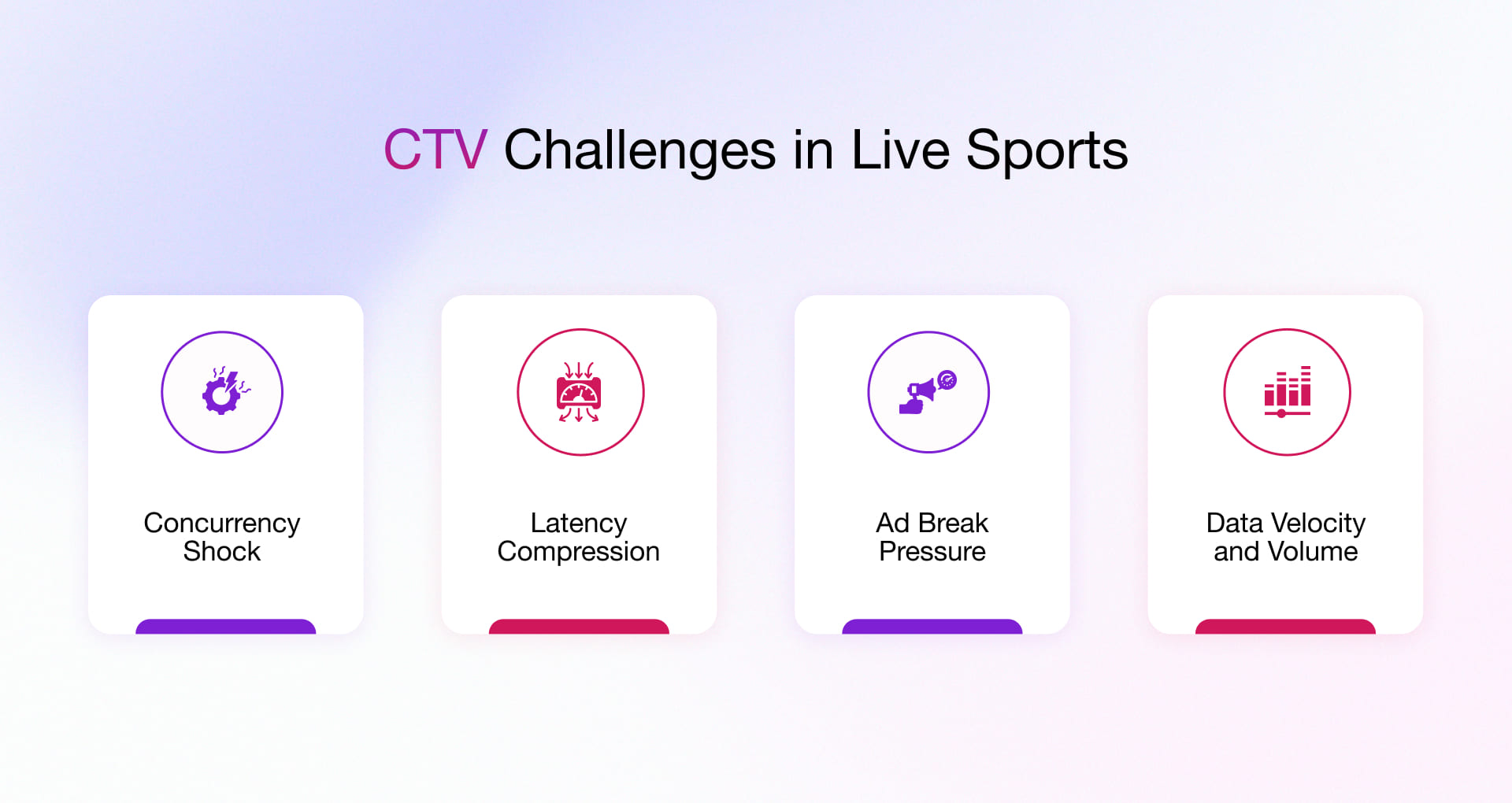
- Concurrency Shock
Live sports and major events compress audience demand into an extremely narrow time window, pushing millions of viewers to join a stream simultaneously. Traditional CTV infrastructures aren’t built to handle this kind of surge, and the cracks show quickly. The real strain comes from synchronized load, which exposes limitations across data ingestion, ad decisioning, and content delivery systems. - Latency Compression
Live environments which define “now” “in this time” sharply compress acceptable latency across the entire CTV workflow. When data processing and ad execution are not engineered for near-real-time performance, even marginal delays become visible at scale, weakening viewer experience and advertiser trust. - Programmatic Ad Break Pressure
Ad breaks represent the most operationally sensitive moment in live CTV. Platforms must execute millions of auctions and insert ads seamlessly within milliseconds, and any orchestration weakness results in revenue leakage and disrupted playback during premium inventory windows. - Data Velocity and Volume
Live sports generate sustained, high-velocity data streams that underpin measurement, pacing, and optimization. Without resilient real-time processing capabilities, CTV platforms struggle to preserve data integrity and reporting consistency under peak conditions.
Core Platform Capabilities Live CTV Events Demand
In this section, we will discuss the technical and operational capabilities that underpin reliable programmatic CTV advertising during live sports. Instead of rehashing challenges, it focuses on what systems must actually be able to do, from consistent measurement and data pipelines to stable auction execution and real-time observability.
Live Sports Streaming & Low-Latency Delivery
- Support for low-latency streaming protocols to reduce glass-to-glass delay during live events
- Edge-based content distribution to minimize round-trip time between viewers and origin servers
- Regional traffic routing to avoid congestion during peak match moments
- Adaptive bitrate streaming optimized for real-time playback
- Independent video and ad delivery pipelines to prevent reporting delays from affecting stream stability
- Failover mechanisms to maintain playback when SSAI or third-party services degrade
These capabilities ensure viewers receive uninterrupted streams even when millions join simultaneously.
Programmatic Auction & Ad Delivery Infrastructure
- High-throughput handling of simultaneous bid requests across supply side platforms and demand side platforms
- Parallel auction execution to prevent queue buildup during ad breaks
- Strict bid response time controls to reduce auction drop-off
- Server-side ad insertion optimized for live events
- Creative certification and format validation before games begin
- Support for pacing, frequency capping, and brand safety enforcement under real-time conditions
- Fallback logic for serving cached or house ads when demand partners fail to respond
This layer protects monetization by keeping auctions active, and ads render able during premium live inventory windows.
Real-Time Data Streaming & Stream Processing
- Real-time ingestion of impression, quartile, completion, and post-bid signals
- Streaming data pipelines that replace batch-based processing during live events
- Distributed stream processing for high-velocity event data
- Event enrichment in motion (device type, geo, content metadata)
- Immediate propagation of delivery metrics to pacing and optimization systems
- Backpressure handling to prevent pipeline collapse during traffic spikes
At this stage, data fragmentation becomes a major risk. Signals arrive from multiple devices, platforms, and partners in different formats and timelines. Without coordinated stream processing and schema alignment, reporting drifts and attribution breaks during peak traffic.
CTV Data Infrastructure & Data Pipeline Design
- Decoupled CTV data pipelines for delivery, measurement, and analytics
- Horizontal scaling across ingestion, processing, and storage layers
- Schema governance for consistent event definitions across devices and partners
- Timestamp normalization across CTV OEMs, ad servers, self-serving ad platforms, and analytics platforms
- Resilient storage architectures for high-frequency CTV event data
- Support for both hot (real-time) and cold (historical) data paths
Modern CTV stacks increasingly introduce agentic AI to monitor pipeline health, detect anomalies in event flow, and trigger corrective actions, such as rerouting data, replaying dropped events, or adjusting processing priorities during live matches.
Automation for Peak Traffic & Operational Resilience
- Autoscaling driven by bid volume and stream concurrency, not infrastructure metrics alone
- Automated health checks across auction services, SSAI nodes, and data pipelines
- Circuit breaker patterns to isolate failing components
- Automated traffic rerouting during regional degradation
- Pre-event synthetic monitoring to validate stream and ad readiness
- Continuous creative validation workflows
Agentic AI is increasingly used here to move beyond static automation. Instead of fixed rules, AI agents observe system behavior in real time, predict upcoming load patterns, and proactively provision resources or isolate failing services before they impact delivery.
Live Operations, Observability & Incident Response
- Sub-second telemetry across streaming delivery, programmatic auctions, and CTV data pipelines
- Unified operational views that surface QoE alongside ad performance metrics
- Continuous monitoring of fill rate, bid timeout frequency, SSAI latency, and buffering events
- Real-time alerts for pacing drift, auction degradation, and regional playback issues
- End-to-end visibility across video delivery, ad serving, and measurement layers to speed root cause analysis
- Automated rollback and recovery workflows to restore service without manual intervention
Inventory Signaling & Privacy-Safe Metadata
- Precise signaling of true live sports inventory vs layed broadcasts or replayed content
- Contextual metadata that enables DSPs to prioritize time-sensitive moments within live matches
- Privacy-safe event descriptors that comply with VPPA while still supporting demand-side decisioning
- Consistent content classification across CTV devices and streaming applications
Cloud, Data, and Technology Choices That Affect Scalability
Every live sports stream reveals whether your CTV ecosystem is built on the right foundation, supported by the right technology integration, sound architectural decisions, and strong analytical capabilities. In this section, we will discuss how to strengthen and evolve your CTV advertising ecosystem through the right cloud strategy and a refined data lifecycle, covering how data is collected, processed, and delivered to support live events at scale.
1. Cloud Strategy: Flexibility vs Lock-In
Teams must decide early whether to commit to a single cloud provider or design for portability. Single-cloud setups simplify operations but increase dependency on provider-specific services. Multi-cloud or hybrid approaches introduce complexity but offer resilience and bargaining power.
For live CTV, this choice impacts regional coverage, disaster recovery options, and the ability to shift workloads when traffic patterns change.
2. Build vs Buy Decisions in the Ad Stack
Most platforms combine in-house components with third-party services, making build or buy for AdTech platforms an ongoing decision. The challenge is knowing where to invest engineering effort and where to rely on vendors.
Common patterns:
- Build core data pipelines and business logic internally
- Buy commodity services like CDN, identity resolution, or baseline analytics
- Avoid outsourcing mission-critical workflows that affect auctions or reporting
- Over-indexing on vendors can limit customization. Over-building increases maintenance burden.
3. Data Gravity and Storage Design
As CTV data volumes grow, moving large datasets between systems becomes expensive and slow. Platforms that ignore data gravity often struggle with delayed reporting and rising cloud costs.
- Successful teams design storage around:
- regional proximity to live traffic
- separation of operational vs analytical data
- lifecycle policies that shift older data to lower-cost tiers
4. Technology Stack Consistency
Mixing too many frameworks, languages, and processing tools increases operational friction. Each additional system adds integration overhead and monitoring complexity. Mature platforms standardize on a small set of technologies for:
- stream processing
- orchestration
- telemetry
- data storage
5. Compliance and Privacy by Design
CTV ad process on live streaming event operates under growing regulatory pressure. Privacy requirements influence how metadata is stored, how identities are resolved, and how event data is shared. Designing compliance into the architecture from day one avoids expensive retrofits later, especially when expanding into new regions.
Multiple Ways to Scale CTV Data Infrastructure for Live Events
Rather than restating the problem, this section highlights concrete ways to optimize CTV data architecture, align measurement signals, and automate responses so infrastructure survives peak concurrent traffic without degrading quality or monetization.
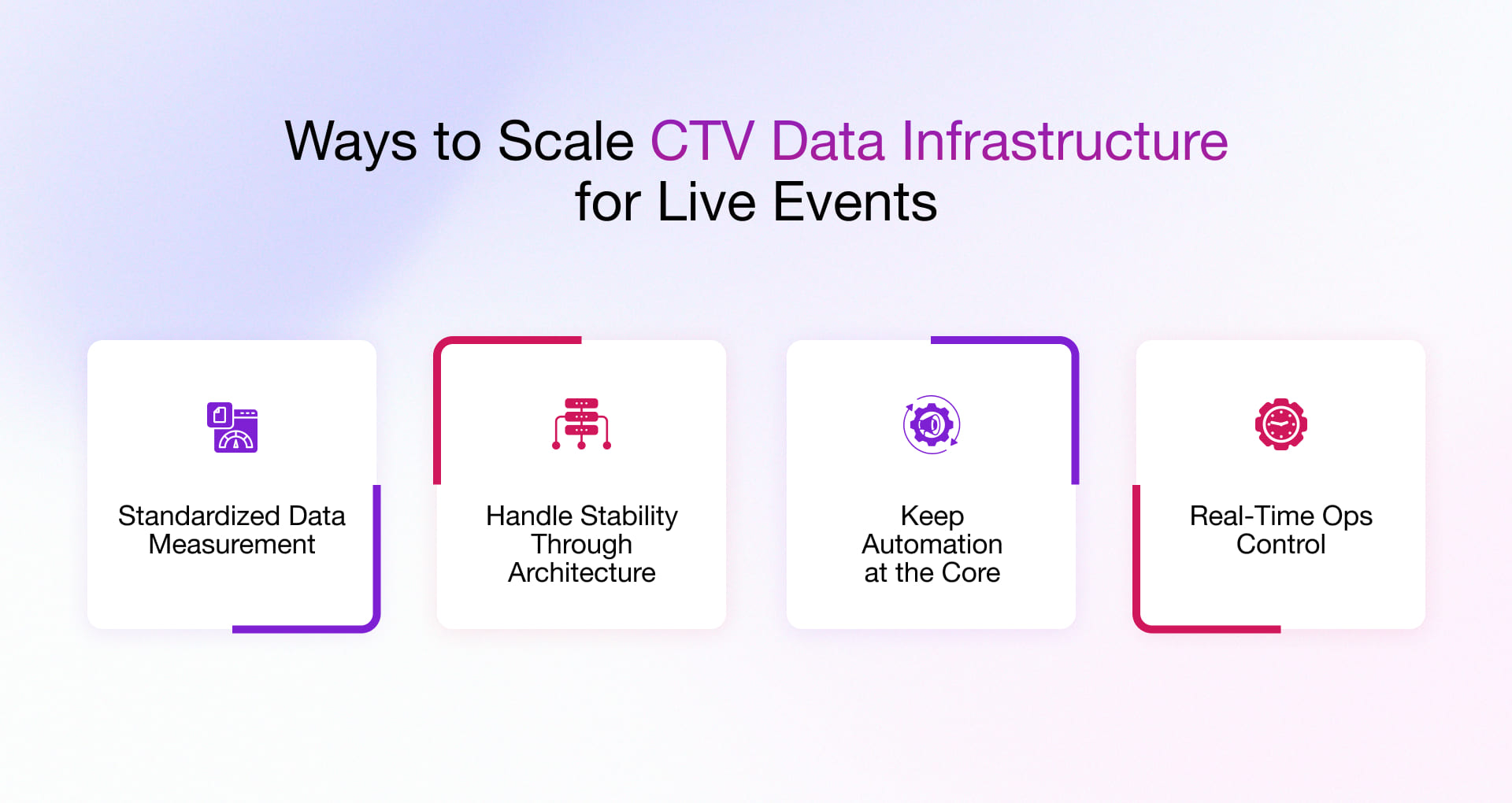
1. Handle Measurement Through Data Standardization
Live events expose data inconsistencies faster than any other CTV scenario. Impressions drift across systems, timestamps fall out of sync, and attribution breaks down when device platforms, SSPs, and analytics tools interpret events differently. During peak traffic, these gaps lead to billing disputes, delayed reporting, and lost advertiser confidence.
Teams address this by standardizing core programmatic signals across the stack. Impression events, quartiles, completions, and post-bid data are normalized before they reach analytics systems. This ensures pacing logic, frequency caps, and attribution models continue to work even when bid volumes spike. Clean inputs allow ad ops teams to trust delivery numbers during live campaigns, while buyers gain confidence that reported performance reflects reality.
Advertising impact: Stable measurement protects revenue, prevents reconciliation issues, and keeps demand partners engaged during premium inventory windows.
2. Handle Stability Through Architecture
Live CTV traffic behaves differently from on-demand streaming. During marquee events, ad servers receive millions of bid requests at once, forcing auction services and SSAI pipelines to operate at peak concurrency. Systems built as tightly coupled workflows often fail here because slow components block faster ones, and auction timeouts increase.
Resilient platforms isolate critical workloads. Auction handling, ad stitching, and measurement pipelines run independently, so congestion in one layer doesn’t cascade across the system. When third-party services slow down, circuit breaker patterns bypass them and serve fallback creatives instead of allowing the stream to stall.
This approach prioritizes viewer continuity while preserving auction flow wherever possible. Losing a single impression is preferable to triggering playback failure or losing the entire session.
Advertising impact: Higher stream stability leads to better completion rates, fewer blank slates, and stronger CPM performance during live ad breaks.
3. Automation at the Core
Live events move too fast for manual intervention. Traffic surges happen in seconds, not minutes, and programmatic systems must respond instantly. Automation is essential to protect deliveries and maintain auction participation.
Autoscaling rules tied to bid volume and request concurrency automatically expand capacity. Health checks reroute traffic away from degraded services. Creative validation workflows run ahead of major events to ensure campaigns are eligible for live auctions. These automated controls reduce last-minute failures that remove demand from high-value ad pods.
Some platforms also use predictive signals such as game state or engagement spikes to provision capacity before traffic surges, keeping bid response times within acceptable windows during critical moments.
Advertising impact: Automation preserves demand density during peak traffic, reduces auction drop-off, and prevents revenue leakage caused by operational delays.
4. Handling Live Operations Through Real-Time Visibility
Delayed dashboards are ineffective during live sports. Teams need immediate insight into delivery performance while the event is still in progress. Real-time visibility into fill rates, bid timeout rates, SSAI errors, and regional playback issues allows operators to act before impressions are lost.
Successful teams monitor ad delivery and viewer experience side by side. Metrics such as ad fill latency, exit-before-video-start, and buffer time provide early warning signs that auctions or streams are degrading. This enables rapid intervention, whether that means rerouting traffic, adjusting pacing, or addressing creative failures.
Real-time observability turns live events from reactive firefighting into controlled operations.
Advertising impact: Faster detection and response protect premium inventory, maintain campaign delivery, and improve advertiser satisfaction.
Let’s Prepare Your CTV Data Infrastructure for the Next Live Event with Rishabh Software’s AdTech Expertise
Ultimately, how you scale your CTV advertising infrastructure depends on a mix of technical realities (cloud architecture, data pipelines, stream processing) and business priorities (monetization goals, operational readiness, and performance metrics). The less time your teams spend firefighting delivery or measurement issues, the more they can focus on improving campaign outcomes, strengthening publisher relationships, and growing revenue from live inventory.
At Rishabh Software, we help AdTech teams design and build scalable CTV platforms from cloud-native architecture and real-time data pipelines to programmatic workflows and analytics. With years of experience delivering data-driven advertising solutions, our adtech engineers work closely with you to modernize CTV ecosystems and prepare them for high-concurrency live events. If you’re looking for AdTech development services provider to build, scale, or modernize your CTV advertising stack, let’s connect.
Frequently Asked Questions
Q: What “Scaling” Really Means in CTV Data Infrastructure?
The term “scaling” in CTV data infrastructure refers to the process of increasing resources according to the demands of the system and data handling. The system needs to handle increasing traffic while delivering advertisements with low delay and maintaining operational measurement systems and continuous video streaming.
Q: How does scalable CTV data infrastructure impact revenue?
Scalable CTV data infrastructure enables businesses to boost their revenue through enhanced advertising performance and better operational efficiency. The CTV stack maintains auction operations during peak traffic times which enables ad delivery to continue functioning effectively thus helping advertisers achieve their goals through increased fill rates and higher CPMs. The process enables accurate reporting and attribution which minimizes impression loss while establishing advertiser trust, thus transforming peak viewing periods into steady revenue streams.