From a “new thing” businesses were trying to figure out to now a baseline expectation for every organization, Gen AI has become a core capability expected across modern digital ecosystems. Even data backs it as 78% of global enterprises use AI in at least one of their business operations. Some reports even say that 71% regularly use generative AI.
But does every enterprise benefit through Gen AI? Well, a report even stats that almost 85% Gen AI solutions fail. Along with lack of quality data, poor integration, fragmented pipelines, and alignment issues are core reasons of incompetency.
This blog explains how each step is meticulously defined to bring the expected outcome on the table. Besides, the best practices are to avoid negligence and build a scalable solution. We have even shed light on critical challenges to be ready for during development along with their solutions.
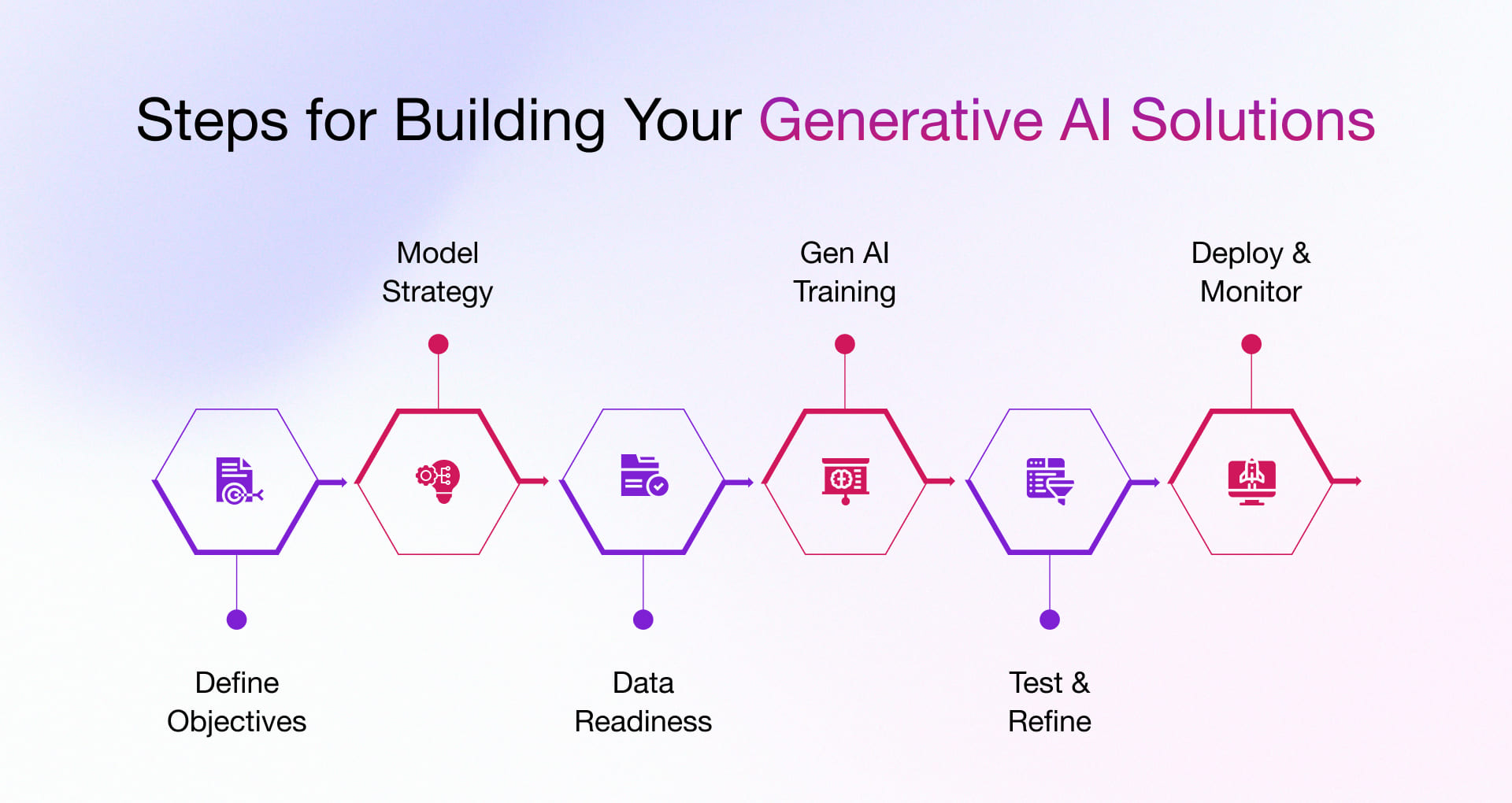
Steps for Building Your Generative AI Solutions
To build a generative AI solution, you need a clear goal, the right model, clean and relevant data, and robust training, testing, and deployment process.
Defining the Gen AI Scope and Your Business Objectives
Building a generative AI solution comes with a flood of questions, and honestly, that is usually the hardest and might take more. So, do not just think about what your generative AI model can do, but why should it exist in the first place?
Ask questions:
- What problem is it solving?
- Who is the end user?
- How will it help my target audience?
- What features are essential vs optional?
Suppose you’re developing Gen AI in healthcare. so, start by asking these questions:
- Can it accelerate drug discovery?
- Can it personalize my patients’ treatment plans?
- Can synthetic medical images improve AI-powered diagnostics?
- What administrative tasks it can automate?
- Is it cost-effective at scale?
Pro tip: Consult technology experts early. They’ll help validate feasibility, avoid poor architectural choices, and reduce downstream work.
Recommending the Best Fit Model Strategy
Now that you know what you’re building, decide how to build a generative AI model based on your use case and data availability. Here are the key types:
- Large Language Models (LLMs) – Do you want the model to understand and generate human-like text (e.g., ChatGPT, Google Gemini)? They are best for chatbots, content creation, and even coding assistance.
- Diffusion Models –Used for creating stunning, high-quality images from noise patterns. Examples include DALL·E or Stable Diffusion. These models are ideal for marketing, product design or visual content.
- Generative Adversarial Networks (GANs) – Think deepfakes, AI-generated fashion designs, or realistic virtual characters. GANs pit two AI networks against each other—one generates, the other critiques—leading to highly realistic outputs.
- Variational Autoencoders (VAEs) – Need AI to generate slight variations of an existing image or sound? VAEs are great for creating diverse but realistic samples, often used in medical imaging and speech synthesis.
- Autoregressive Models – These are the storytellers of AI. They generate sequences (like text, music, or audio) by predicting one piece at a time. The GPT series and PixelRNN fall into this category.
- Transformers – This is the tech behind LLMs! These models efficiently process massive amounts of data and generate coherent responses. They power AI-driven search engines, translations, and writing assistants.
- Flow-Based Models – If you need AI to generate crisp, high-quality images and videos, this is your go-to. These models work by learning data distributions, making them useful in creative and entertainment industries.
- Neural Radiance Fields (NeRFs) – Imagine turning a handful of 2D images into a full 3D scene—that’s what NeRFs do. Perfect for gaming, virtual reality, and even real estate walkthroughs.
Establishing Data Readiness and Governance
Before you start using Gen AI for business, remember that your model won’t work without data. Data makes the whole platform or generative model run well. So, focus on:
- Right Data Sources – Pull data from trustworthy, verified inputs like user interactions, knowledge bases, industry reports, or live data feeds.
- Quality & Relevance – Focus on clean, varied, and useful. If you keep maintaining datasets that are messy or biased, your AI will copy those problems. Bad input leads to bad output!
- Accurate Labeling – Use automatic tagging, crowd help, or AI-assisted labeling/annotation tools to speed things up.
- Cleaning Data – To make your gen AI model smarter, tidy up your data before you feed it in. Use methods like tokenization, normalization, or data augmentation to clean it.
- Balanced Splits – Separate your dataset into three parts: training, validation, and testing sets to ensure your AI learns well-rounded skills.
- Storage Planning – Ensure you have storage solutions that can grow with your AI, whether you choose cloud-based options or a data warehouse. This way, your AI will always have the right information at hand.
Avoid:
- Unverified web scrapes
- Redundant or biased records
- Feeding raw, unstructured data without preprocessing
Training Generative AI Solution for Real World Use
Training your generative AI model is like teaching a kid a new skill. It takes time, patience, and a lot of repetition and struggles as well. And let’s be honest, there are a few tantrums along the way.
- This isn’t a microwave situation. It might take hours, days, or even weeks depending on the complexity of your model and the sheer volume of data. And those estimates? Yes, they can easily double when you hit a snag.
- You’ll need a good computer, maybe even a powerful GPU, to handle the heavy lifting. Or consider cloud computing – but even then, you’ll be wrestling with configuration settings, API keys, and those lovely ‘out-of-memory’ errors.
Expect these technical aspects:
-
- Gradient Descent Issues: Your model’s learning might get stuck in a rut or diverge completely. You’ll be tweaking learning rates and optimizers like a mad scientist.
- Overfitting/Underfitting: Your AI might memorize the training data perfectly but fail miserably on new inputs (overfitting), or it might not learn anything at all (underfitting). Prepare for lots of data augmentation and model parameter adjustments.
- Data Pipeline Bottlenecks: Getting the data from storage to the GPU efficiently? That’s a whole other challenge. You might encounter I/O errors, data format incompatibility, and slow transfer speeds.
- Dependency Hell: Managing the myriads of Python libraries and frameworks? Version conflicts and dependency errors are practically guaranteed.
- Resource Management: Keep track of GPU memory, CPU usage, and network bandwidth. It’s a delicate balancing act, and one misstep can bring your training to a screeching halt.
- Model Checkpointing and Recovery: Check for power outages, system crashes, and unexpected shutdowns. You’ll need robust checkpointing to save your progress and avoid starting from scratch.
Pro tip: Use cloud-based training environments (AWS, Azure, GCP) to scale resources without investing in dedicated hardware.
Evaluating, Refining, and Validation Solution Performance
Now, you might notice that the output can be a bit hit or miss, or that the model struggles with more complex prompts. That is where you need to finetune your performance.
Take hyperparameters for example. Adjusting things like the number of layers, hidden units, or dropout rate can really be effective in how well your model performs and acts in the long run. Get those settings wrong, and you could end up with overfitting (where the model just memorizes the data instead of actually learning) or underfitting (where it misses out on capturing important patterns).
This is where thorough testing comes into the frame and plays a major role in enhancing the performance of your generative AI model. While standard metrics like BLEU[1] and ROUGE[2] are useful, true validation involves putting your model through its paces with unusual inputs, keeping an eye on bias, and fine-tuning your prompts. Keep adjusting, testing, and enhancing, because the more refined your model is, the better the results will be!
Pro tip: Think beyond technical accuracy—optimize for reliability, usefulness, and user trust.
Deploying, Tracking, and Sustaining Gen AI Solutions
Your model is all set! Inference is running smoothly, latency is minimal, and the infrastructure can grow with your needs. But remember, launch day is just the start of the journey.
Real users bring real challenges. That’s why monitoring, logging, and anomaly detection are crucial for spotting issues early on. Plus, automated retraining and feedback loops ensure your model stays on its game. Regular version updates and API tweaks help maintain top-notch performance.
As time goes on, these updates will feel like second nature. Your AI will keep learning, adapting, and making a genuine impact just like your team does.
Reminder: GenAI models require care and governance—don’t treat them like static software products.
10 Best Practices for Building Generative AI Solutions
Along with disciplined execution across data, architecture, governance, and scalability, Gen AI solution development also demands focusing on core considerations that distinguish experimentation from production-ready impact. Understand what sort of best practices we follow to make the solution driven.
Initiate with Defined Business Challenges
Each Gen AI implementation starts with a detailed understanding of the business objective and existing operational problems. Then, several use cases backed by Gen AI are identified to bring the impact in the process, irrespective of optimization, intelligent automation, or uplifting user experience. With this best practice you can stay rest assured about the solutions since it would purpose-driven and strategically aligned with measurable results.
Select the Right Model Strategy
When it comes to generative AI solution’s scalability and performance, model selection and architectural designs play a key role in defining it. Several factors such as domain complexity, data sensitivity, costing, and latency requirements are taken into account before making decisions. It even requires matching model strategies with business demands so that solutions developed remain perfectly adaptable, future-proof, and resilient.
Create a Robust Data Strategy
The success of generative AI systems depends on high-quality, well-organized data. With structured data pipelines, you can expect accuracy, relevance, and security. On the other hand, governance frameworks handle compliance and mitigate bias. Such a best practice ensures upgraded output quality and consistent AI-driven insights.
Embed Responsible and Ethical AI
The principles of responsible AI are integrated into your Gen AI solutions right from the beginning of the development. It includes protecting user privacy, highlighting bias, and maintaining transparency, and allowing human oversight. Besides prioritizing ethical considerations, your Gen AI solutions minimize risk, support sustainable enterprise adoption, and foster trust.
Develop for Scalability, Integration, and Performance
Generative AI solutions always scale immensely even if business requirements evolve. Modular and API-driven designs enable seamless integration with existing systems and maintains peak performance. It means there are a lot of AI possibilities, which can happen without hampering core operations.
Embrace Prompt Engineering and Evaluation
Prompt design requires utmost engineering discipline. The results are refined using iterative testing, validation frameworks, and version-controlled prompts. As a result, you can expect consistency, accuracy, and relevancy across use cases and user interactions.
Enable Human Intelligence Involvement
Since quality and contextual accuracy is quite important, human intelligence is prioritized. With feedback loops, it opens opportunities for continuous learning and improvement, which ensures that gen AI meets evolving user needs and business requirements. Such best practice ensures strengthening reliability and preserves human intelligence.
Secure the Entire AI Lifecycle
Security is another aspect that is prioritized and extended to data ingestion, model access, and inference workflows. Business collaborates with Gen AI development services provider to protect their sensitive information, prevent misuse, and overcome emerging threats. In return, such companies often implement safeguards to prevent theft or fraud.
Track, Measure, and Optimize Frequently
Another best practice that helps in upscaling Gen AI is tracking solution performance and recording the outcomes. The measurement includes output quality, user engagement, and cost efficiency that is continuously evaluated. It even helps in optimizing the solutions at earliest, which ensures maintain sustainability and alignment with the business objectives.
Future-Ready Planning
Generative AI solutions adapt to every evolution that you bring to the business. Since it has flexible architecture and model-agnostic frameworks, adopting capabilities like multimodal and agent-based advancement becomes easier. With such a best practice, you can expect to have AI investment skyrocketing as businesses continue to evolve with time.
Key Challenges in Building a Generative AI Solution and How to Overcome Them
Building a generative AI solution involves multiple challenges—including data quality, model complexity, evaluation uncertainty, and ethical concerns—that require thoughtful handling at every stage.
Let’s look at the most common roadblocks and how to solve them effectively.
1. Data Quality is Everything (And Often a Mess!)
You have probably heard the phrase, “garbage in, garbage out.” It’s especially true in building custom generative AI solutions. These models only perform as well as the data they’re trained on. If your dataset is inconsistent, biased, or poorly labeled, your output will reflect that, sometimes in surprising and not-so-good ways.
How to overcome:
- Requires training on a diverse and well-balanced dataset.
- Identifying hidden biases and skewed representation
- Using data augmentation or synthetic data to bridge gaps where required
Pro tip: Relying on large volumes alone is not beneficial, relevance and consistency also matter.
2. The Model Is Big… Really Big
Generative AI models, especially LLMs, can have billions of parameters and aspects. From long inference times to huge memory demands, things can quickly get out of hand especially when you’re building for real-time applications or solution.
To keep things in control:
- Model optimization techniques like distillation or quantization are the best solution.
- Using cloud-native infrastructure to scale when you need it to.
- Distributing workloads smartly to keep performance smooth.
Fact: Smaller, optimized models can often match large ones in performance, if tailored well.
3. Evaluating Outputs Isn’t Straightforward
How do you measure creativity, tone, or usefulness? Traditional metrics like BLEU or ROUGE work for grammar and structure, but fail to assess meaning, tone, and factuality.
Here are some solutions:
- Combining automated metrics with human evaluations.
- Performing A/B tests to see what resonates with real users.
- Focusing on task-specific goals rather than just numbers.
Pro tip: Aim for quality of outcome—not just statistical accuracy.
4. Edge Cases Can Break Your Model
Throw a generative model an oddball prompt like technical jargon or niche references and you might get gibberish back. These models often stumble with out-of-distribution or rarely seen inputs.
To improve adaptability:
- Using few-shot or zero-shot learning to increase flexibility.
- Fine-tuning models with updated, domain-specific data.
- Integrating retrieval-augmented generation (RAG) for extra context.
Pro tip: Connect with AI development company to test your Gen AI solution with real-world edge cases.
5. Bias and Harmful Outputs Are Easy to Miss
Even well-trained models can produce content that is biased, insensitive, or just plain wrong. It might not be intentional, but the impact is real on brand trust, compliance, and user safety.
To keep things in check
- Adding bias detection and filtering mechanisms is recommended.
- Having a system that Review outputs regularly to catch unwanted patterns.
- Building ethical review into your development process—not just at the end.
6. Privacy and Security Risks Are Real
Generative AI can unintentionally memorize personal and sensitive data from emails, internal chats, and user data regurgitate it in outputs.
So, these are some sets of aspects you must check or ask your development team to review during and after the development of GenAI solution:
- Implementing privacy-preserving techniques like differential privacy.
- Being cautious with user-generated or unfiltered training data.
- Conducting regular audits to catch leaks early.
How Rishabh Software’s Strategic Approach Accelerates Generative AI Adoption?
When it comes to Developing Gen AI solution , it does not always require building one from scratch. As an experienced generative AI consulting company, we have helped enterprises accelerate Generative AI adoption by identifying highly effective implementation paths that meet business goals, technical readiness, and long-term scalability. Here is how we enable faster time to market:
Leveraging Pre-trained Generative Models
We have hands-on experience in interacting with models from providers such as OpenAI, Google, and Meta. We enable swift adaptation and fine-tuning models to meet your particular use cases without developing from scratch.
When to use:
- Fastening up for time-to-market
- Limited training data
- Minimal infrastructure management
Integrating AI APIs and Managed Services
We help enterprises with integration of Gen AI APIs from different platforms such as OpenAI, Cohere, and Hugging Face. With this integration, you can embed intelligence into your existing apps with minimal setup.
You can integrate when:
- Need for rapid deployment
- Looking for pay-as-you-go scalability.
Implementing Open-Source GenAI Models
For organizations seeking control and customization, we help integrate and optimize open-source models and frameworks like Hugging Face and LangChain—ensuring performance, security, and scalability.
Ideal when:
- Customization and ownership are priorities.
- You operate in regulated or proprietary environments.
- You want flexibility without vendor lock-in
Frequently Asked Questions
Q: What are the key strategies for developing high-performing generative AI solutions?
For developing high-performing AI solutions, you will require strong architecture, high-quality data, and continuous optimization. Several key strategies include defining business use cases, choosing the right model & deployment approach, and maintaining a robust data and governance foundation. With structured prompt engineering, human interventions, and ongoing tracking, you can expect peak performance from your gen AI solution.
Q: How is generative AI transforming industries across the enterprise landscape?
Generative AI is responsible for driving transformation across industries. Many businesses adopted gen AI to automate their mundane tasks, accelerate decision-making process, and implement digital creativity. Also, gen AI has improved operational efficiency, uplifted customer experience, and support innovation using intelligent content generation, predictive insights, and customized engagements.
Q: How long does it take to develop a Generative AI solution or model?
A: The timeline can really vary depending on how complex the project is, the availability of data, and how much customization is needed. Generally, you might be looking at a few weeks for fine-tuning, but if you’re building a model from scratch, it could take several months.
Q: Why should you invest in Generative AI solution development?
A: Well, Generative AI can significantly boost automation, personalization, and content creation, which in turn drives efficiency and sparks innovation. It helps businesses gain a competitive advantage by facilitating smarter decision-making and enhancing user experiences.
Footnotes: