

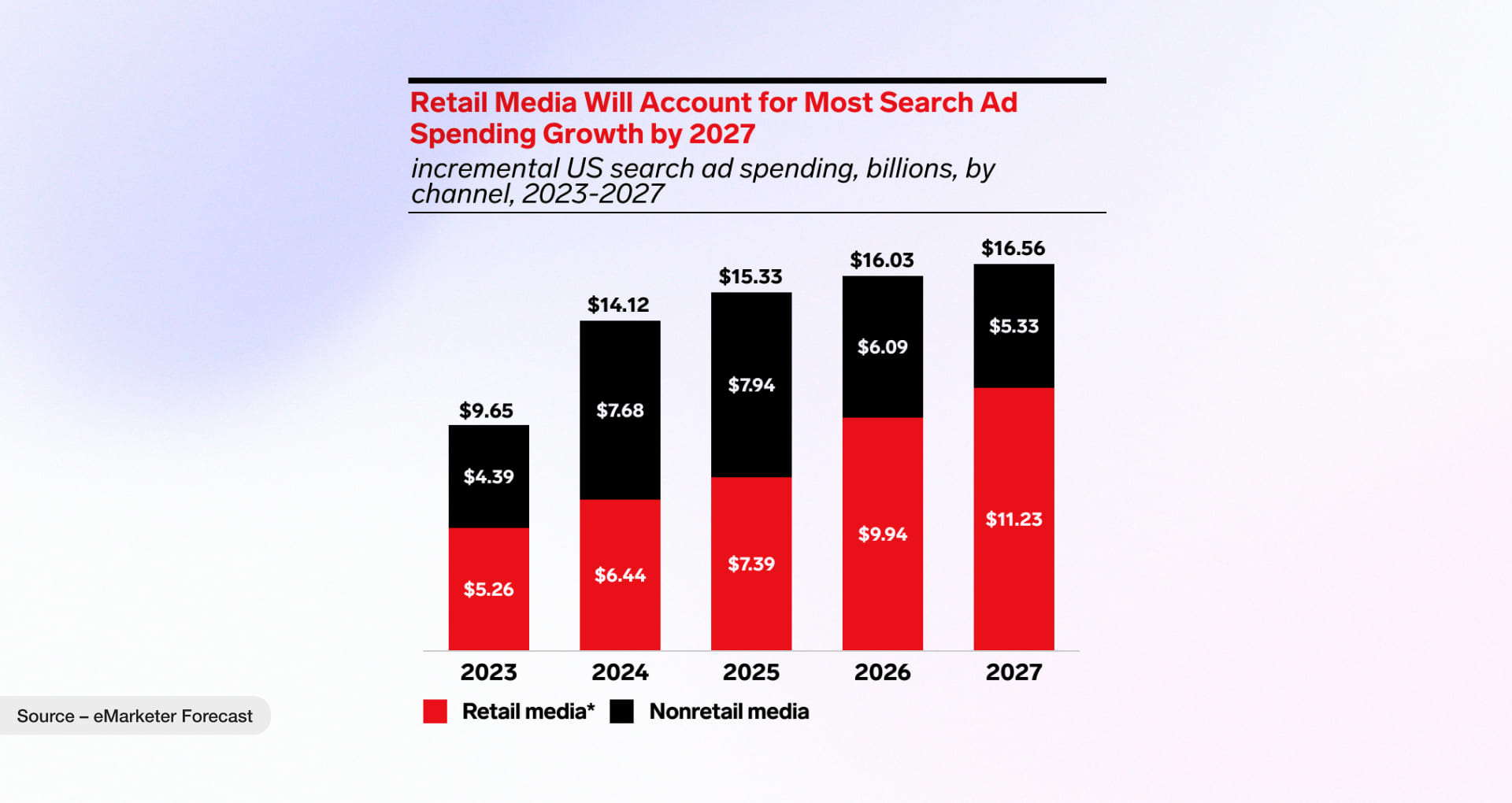
What began with Amazon’s advertising business has evolved into a playbook adopted by retailers across the globe. Networks such as Walmart Connect, Target Roundel, Kroger Precision Marketing, and Instacart Ads have demonstrated how first-party retail data can be transformed into a high-margin advertising business. Today, with more than 200 Retail Media Networks (RMNs) operating worldwide and the market projected to reach USD 56.97 billion by 2030, the conversation has shifted from building a network to scaling it effectively.
As RMNs grow, so does the complexity of managing them. More advertisers, campaigns, audience segments, and inventory signals create a growing volume of decisions. At scale, manual workflows and rules-based systems struggle to keep pace with the speed and precision required for effective retail media operations.
Vertical AI agents address this challenge by combining retail media intelligence with autonomous decision-making. For retail media networks, this means faster campaign execution, smarter inventory optimization, and the ability to scale advertiser demand without increasing operational overhead in proportion. In this blogpost, we will discuss how vertical AI agents help retail media networks scale operations, improve decision-making, and create new monetization opportunities.
Why Are Vertical AI Agents Becoming Essential for Scaling Retail Media Networks?
Retail Media Networks can no longer rely solely on manual workflows and operational headcount to support growth. As campaign volume, advertiser demand, and inventory complexity increase, vertical AI agents provide a scalable way to automate decisions, optimize performance, and improve operational efficiency.
1. Traditional RMN Scaling Has Reached Its Limits
For years, RMNs have scaled by adding operational resources, campaign managers, category specialists, optimization rules, and reporting dashboards. This approach worked when networks managed a limited number of advertisers, campaigns, and inventory sources.
But retail media has become exponentially more complex. Every new advertiser introduces campaign requirements. Every audience segment creates targeting decisions. Every SKU, promotion, inventory update, and channel multiplies the number of variables that need to be monitored and optimized. At scale, manual campaign operations, category-manager bandwidth, and rule-based bidding systems simply cannot keep up with millions of SKU × audience × channel combinations. The build-vs-buy decision for retail media network platforms is increasingly being shaped by this reality: Off-the-shelf platforms alone may not provide the level of decision automation and retail-specific intelligence required as RMNs mature.
2. From Human Workflows to Vertical AI Agent-Led Execution in RMN
This shift becomes most visible across three high-friction areas of RMN operations:
- Query-to-Campaign Agents can translate a brand’s objective into campaign structures, budgets, targeting parameters, and audience strategies in minutes rather than requiring multiple rounds of manual planning and setup.
- Inventory-Aware Bidding Agents continuously adjust bids based on stock availability, product margins, and inventory movement, ensuring media spend aligns with commercial realities rather than static bidding rules.
- Creative-Variant Agents automatically generate SKU-level creative assets and messaging variations tailored to different retailer properties, placements, and audience segments, something that would be nearly impossible to manage manually at scale.
Together, these agents will unlock the path toward faster execution, more consistent operations, and greater scale than ever before, directly implying a broader shift toward agentic AI in programmatic environments, where autonomous systems are replacing reactive, rules-based workflows across the AdTech stack.
3. The Difference Between Scaling Operations and Scaling Intelligence
A mid-sized RMN, for example, could reduce campaign setup times from two days to less than an hour using a Query-to-Campaign Agent. Similarly, inventory-aware bidding models have demonstrated the ability to improve fill rates while protecting margins by responding to real-time inventory conditions rather than relying on static optimization cycles.
| Legacy RMN Model | Vertical AI-Powered RMN |
| Human-led campaign setup | Autonomous campaign orchestration |
| Rule-based bidding | Inventory-aware bidding |
| Batch optimization cycles | Continuous optimization |
| Dashboard-driven decision making | Agent-driven decision making |
| Scale through headcount | Scale through intelligence |
The implication is clear: as RMNs grow, the challenge is no longer managing more campaigns. It is managing more decisions exponentially. Vertical AI agents provide a way to scale that complexity without scaling operational overhead at the same rate. That’s why they are increasingly becoming the foundation of next-generation retail media operations. Our AI agent development services combine AI expertise with deep AdTech knowledge to help retailers build and deploy purpose-built AI agents for retail media.
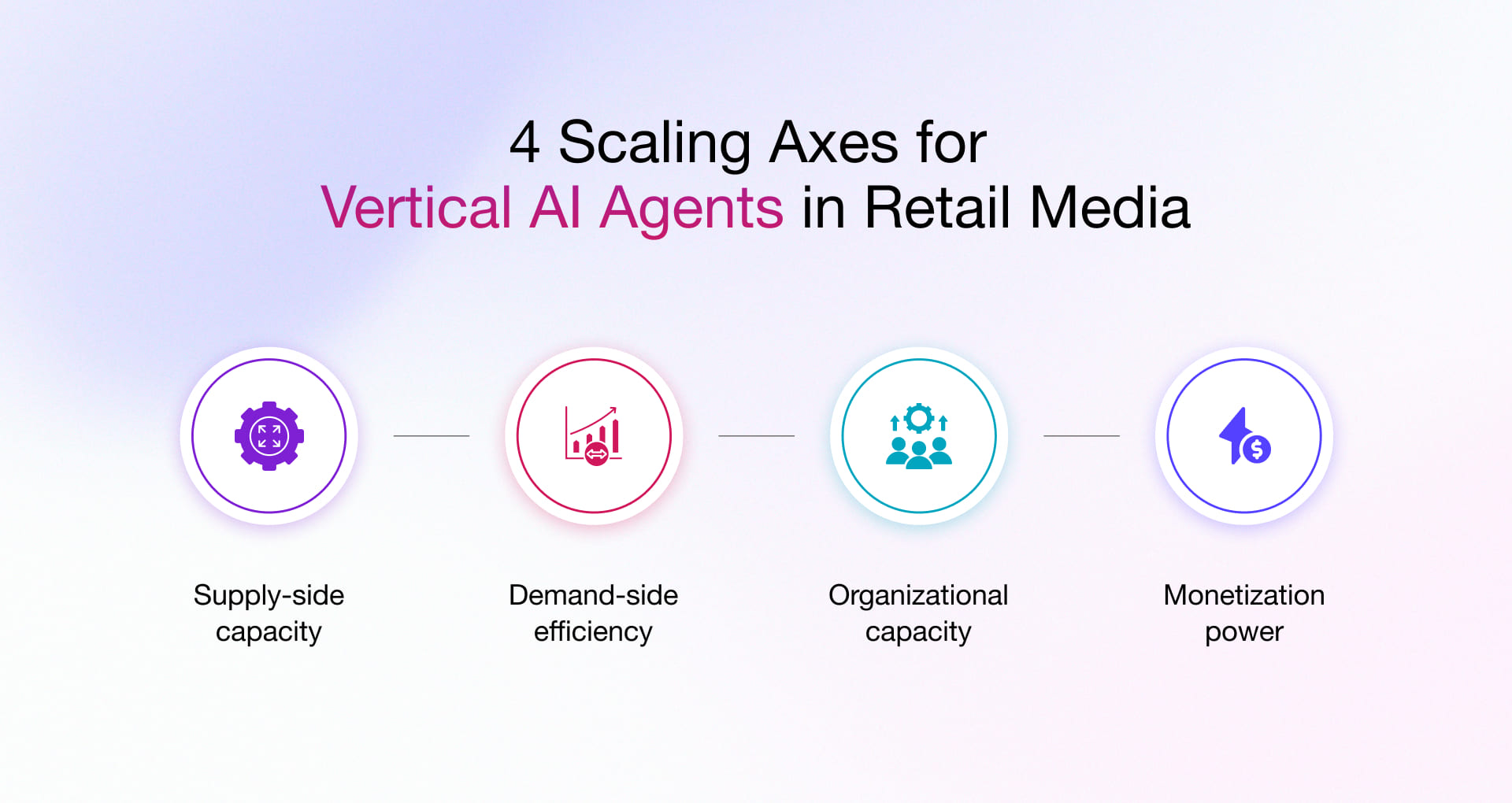
Four Distinct Scaling Axes for Vertical AI Agents in Retail Media Networks
Vertical AI agents help Retail Media Networks scale in four key areas: inventory management, advertiser operations, organizational efficiency, and revenue growth. Together, these capabilities enable RMNs to handle increasing complexity without proportionally increasing operational overhead.
Scaling Axis #1: Expanding Supply Without Increasing Complexity
Every RMN wants more monetizable inventory. More products, more placements, more channels, more retailer-owned touchpoints.
The problem is that inventory growth creates exponential complexity. Each additional SKU introduces new variables related to availability, demand, pricing, margins, and advertiser relevance.
- Traditional systems manage this through rules.
- Vertical AI agents manage it through context.
Because they continuously evaluate merchandising signals, inventory conditions, and shopper behavior, they can make inventory decisions at a scale impossible for human teams.
Scaling Axis #2: Scaling Advertiser Demand Without Scaling Operations
As retail media matures, advertiser demand becomes both an opportunity and a burden.
More advertisers mean:
- More campaigns
- More audience requests
- More optimization cycles
- More reporting requirements
Historically, RMNs responded by hiring campaign managers and operations specialists.
AI in programmatic advertising is making a direct impact, either directly or through advanced versions and substitutes like vertical AI agents, which are changing the equation here.
Instead of scaling human effort, they scale decision-making. Campaign planning, targeting recommendations, optimization, and performance analysis become increasingly autonomous.
The winners in retail media will not be the networks with the largest operations teams, they will be the networks capable of supporting more advertisers with fewer operational constraints.
Scaling Axis #3: Decoupling Revenue Growth from Headcount Growth
This may be the most overlooked scaling challenge facing RMNs.
Most networks grow revenue linearly:
More revenue → More campaigns → More people.
The result is an operating model where costs increase alongside growth. Vertical AI agents introduce a different model.
By embedding retail-specific intelligence directly into workflows, organizations can absorb increasing complexity without continuously expanding operational teams.
Scaling Axis #4: Moving Beyond Inventory Monetization to Intelligence Monetization
The most mature RMNs will eventually discover that inventory is only part of the opportunity. The greater value lies in the intelligence generated from shopper behavior, transaction patterns, category trends, and campaign outcomes.
Vertical AI agents transform this intelligence into monetizable products:
- Predictive audiences
- Dynamic pricing strategies
- Outcome-based advertising models
- Commerce intelligence services
This shifts the role of the RMN from media seller to decision engine. The next wave of retail media growth will come not from selling more impressions, but from monetizing the intelligence behind them.
How Vertical AI Agents Turn RMN Inventory into Programmable, Self-Optimizing Commerce
The vertical AI agent’s intelligence is grounded in domain knowledge of the retail media domain; these connections are not approximations. They reflect how retail media actually works, where a shopper’s last three purchase categories, their loyalty tier, and their current browsing session are all meaningful signals for a single ad decision. Let’s see how vertical intelligence turns RMN into an inventory!
Programmable Ad Inventory: What It Actually Means
- Vertical AI agents turn every placement, bid floor, audience segment, and creative assignment into a live, adjustable variable, not a fixed commitment. The inventory doesn’t just get filled. It gets continuously re-evaluated.
- A sponsored placement is won not just by the highest bid, but by the agent calculating which advertiser delivers the strongest outcome for that specific shopper query in milliseconds.
- A display unit doesn’t hold its original allocation if performance signals shift, the agent reweights impressions toward better-performing formats mid-campaign.
- An offsite campaign doesn’t wait for Thursday’s review; creative variants rotate, frequency caps adjust, and budget shifts across publisher inventory autonomously.
What Makes It Self-Optimizing
- Shopper behavioral data from the retailer’s first-party loyalty program feeds directly into sponsored search bid decisions.
- Category velocity trends inform which audience segments get weighted higher in on-site display campaigns
- First-party data in programmatic advertising shapes how off-site programmatic audiences are activated across DSP inventory.
- Campaign attribution signals close the loop back into the agent, so every outcome makes the next decision smarter.
The result: RMNs stop selling fixed space and start delivering optimized outcomes, which is where premium pricing, stronger advertiser retention, and defensible margins actually come from. This strengthens the closed-loop attribution that makes retail media advertising economically distinct from traditional AdTech.
Powering The Expansion of Retail Media Networks Through Technology-Enabled Solutions and Strategic Support
Building vertical AI agent infrastructure for retail media networks requires deep expertise across AdTech, Data Engineering, and AI/ML architecture. It’s a capability you build, where early architecture decisions define scale.
Rishabh Software has helped build AdTech platforms, including DSPs, SSPs, RTB infrastructure, and programmatic systems, with the data engineering foundations that agentic AI workflows require. Connect with us today to leverage our AdTech software development services to build centralized DOOH campaign planning platforms.
The question is how quickly you move.
Connect with our AdTech team to explore what vertical AI agent architecture could look like for your retail media network.
Frequently Asked Questions
Q: What are Vertical AI Agents in Retail Media Networks?
A: Vertical AI agents are AI systems designed specifically for retail media operations. Unlike general-purpose AI tools, they understand the signals that matter in an RMN, such as inventory availability, shopper behavior, product performance, campaign goals, and merchandising priorities. Their role is to help automate decisions that would otherwise require significant manual effort.
Q: How are Vertical AI Agents Different from Traditional Retail Media Automation?
A: Traditional automation works by following predefined rules. For example, a campaign may pause when a budget threshold is reached or increase bids when performance improves. Vertical AI agents go a step further by continuously evaluating multiple business and campaign signals together, allowing them to make more informed decisions as conditions change.
Q: Can Vertical AI Agents Support Omnichannel Retail Media Strategies?
A: Yes. As retailers expand beyond on-site advertising into off-site media, CTV, mobile, in-store screens, and other channels, managing campaigns becomes significantly more complex. Vertical AI agents can help coordinate decisions across these touchpoints, creating a more consistent experience for advertisers and shoppers.
Q: Where Can Vertical AI Agents Create the Biggest Impact within an RMN?
A: The biggest opportunities typically exist in campaign planning, audience targeting, inventory optimization, bid management, creative personalization, and performance analysis. These are areas where Retail Media Networks often face growing operational complexity as advertiser demand and inventory scale.