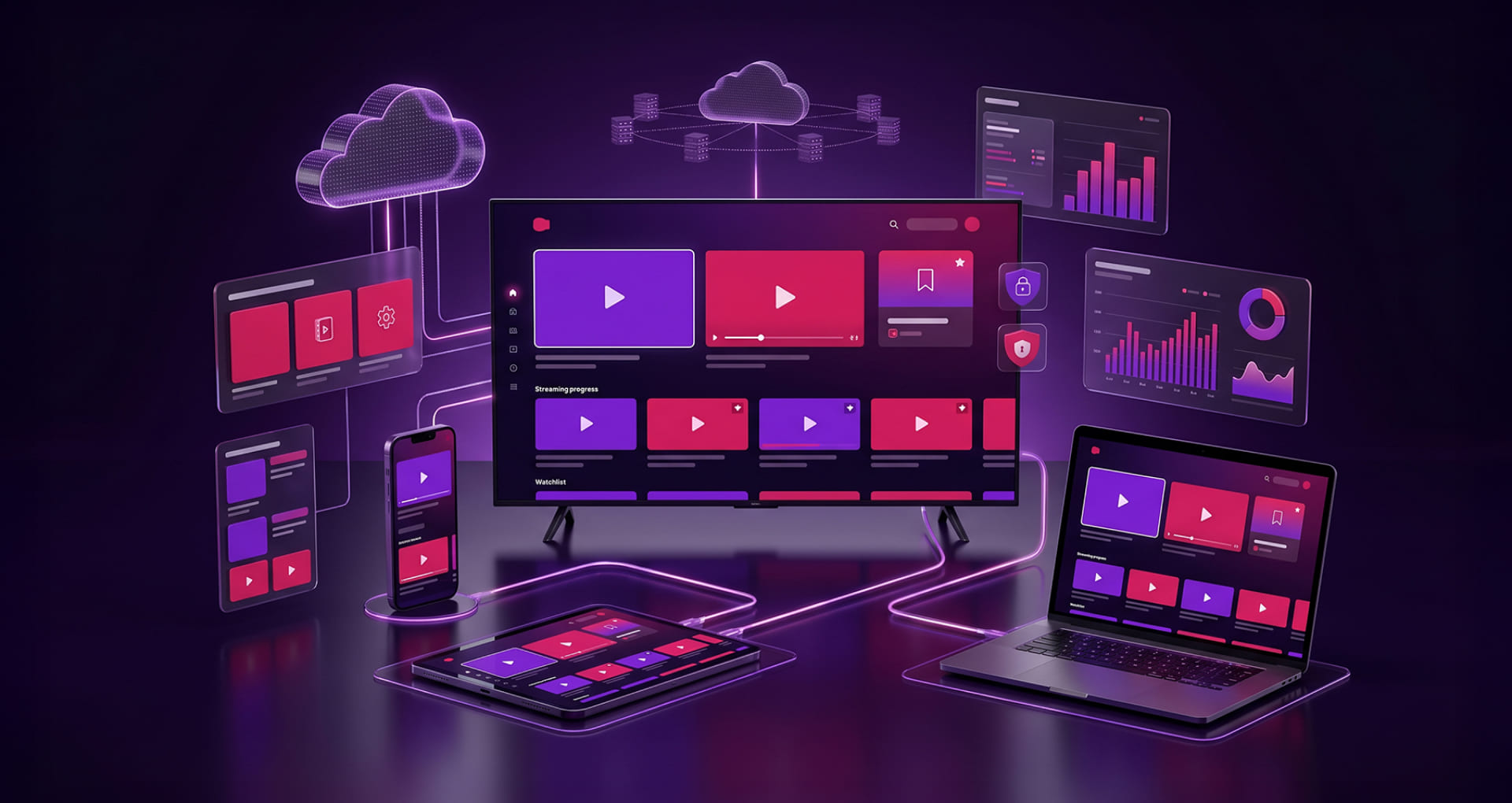

As streaming becomes the dominant screen for viewers, so the ad through ad spend like CTV now captures 38% of all TV ad spend, and CTV advertising is projected to grow 14.5% this year to reach $37.95 billion.
Programmatic CTV advertising systems designed for cookies and device IDs are now misaligned with how streaming environments expose signals and measure attention. At the same time, advertisers, ad agencies, publishers, and other AdTech-associated entities are not in wiliness to outsource control of their data. In-house AdTech platforms and first-party data strategies are emerging as the new normal. The ability to unify reach, frequency, and measurement across linear, OTT, and programmatic channels is becoming a strategic differentiator.
In this environment, privacy-first defines how signals are collected, how audiences are modeled, and how value is measured. The way teams engineer data flows in CTV will determine whether platforms sustain advertiser trust and revenue outcomes.
This blog is written for AdOps leaders who need clarity on how to adapt to this new operating model. We will explore the core principles of privacy-first design, data engineering techniques the empowering privacy first approach, and ways to implement in your CTV ad ecosystem.
Privacy-First Principles Across the CTV Landscape and Ecosystem
In streaming environments, performance is less constrained by how much data is available and more by how reliably signals can be interpreted across fragmented ecosystems. Household viewing, server-side delivery, and variable consent states introduce structural complexity. Programmatic CTV platforms that rely on identity persistence struggle to maintain consistency. Platforms that design for signal abstraction perform more predictably.
Three principles now define this shift:
- Household Intelligence Over Individual Identity.
CTV audiences are best understood at the living-room level. Abstracting exposures to households and cohorts ensures that frequency and reach are governed meaningfully, without relying on persistent device identifiers. - Contextual Signals Over Behavioral Profiles.
Content metadata, genre, device environment, and viewing patterns become the primary drivers of relevance. These signals are deterministic, scalable, and privacy-safe, enabling effective activation without personal profiles. - Consent as Engineering Input.
Regulatory frameworks such as GDPR and CCPA impose real-time constraints on data usage. Modern CTV stacks parse consent signals at ingestion, automatically routing data into appropriate activation paths. Compliance is encoded into data flows.
In practice, privacy-first advertising reshapes where and how advertising decisions are made. Targeting shifts upstream to data pipelines. Frequency becomes a modeling challenge and measurement becomes aggregation-centric. Monetization performance is determined by signal quality, not by the availability of identifiers.
How Privacy-First Data Engineering Changes Programmatic CTV Advertising
Privacy-first data engineering reorients programmatic CTV around stable, compliant signals. It does this by advancing operational shifts that affect how inventory is bought, sold, measured and how ads are targeted and delivered.
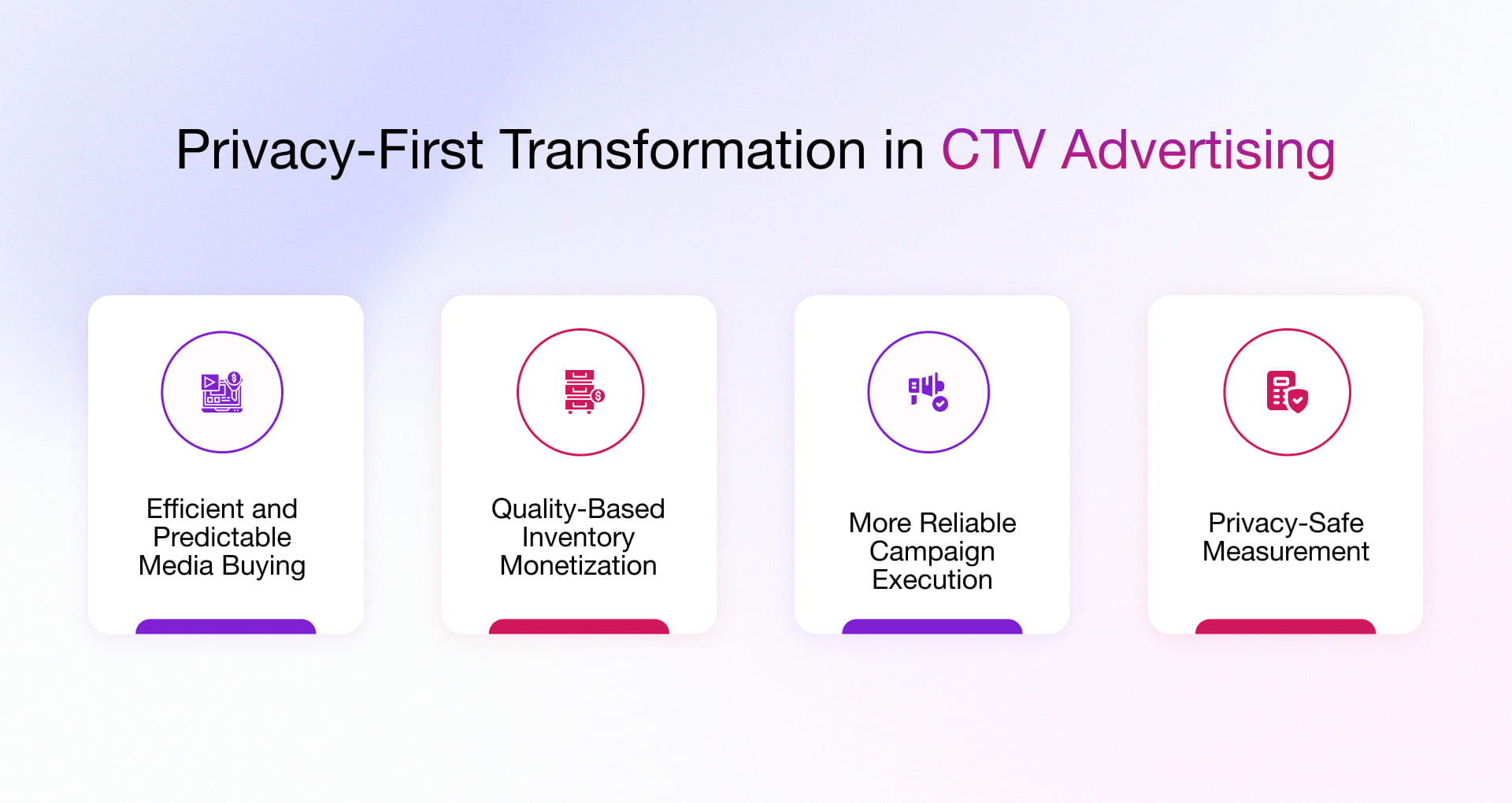
Media Buying Becomes More Efficient and Predictable
Traditional CTV advertising optimizes against past behavior. Privacy-first architectures enable buyers to act on forward-looking intent signals.
Instead of relying on individual viewing histories, demand-side platforms activate against anonymized household-level indicators derived from device environments and contextual consumption patterns. These signals are generated upstream and delivered as activation-ready features.
At the same time, data engineering teams connect household exposure data with conversion outcomes inside clean-room environments. This allows bidding models to optimize toward predicted conversion probability.
What this delivers for advertisers
- Reduced spend on already-converted or low-intent households
- More efficient budget allocation across premium CTV inventory
- Improved reach quality and campaign pacing
- Lesser wastage and higher return on ad spent
Inventory Selling Moves Toward Quality-Based Monetization
Privacy-first enable publishers and supply-side platforms to monetize inventory based on quality of viewing environment, not user identity. Data engineers normalize SSAI and bitstream metadata so every impression carries consistent information about:
- content genre and taxonomy
- device environment
- session engagement patterns
Publishers further validate attention using Automated Content Recognition (ACR), confirming that ads are actually rendered on screen rather than playing in the background. This allows sellers to package inventory into premium, high-signal tiers supported by verifiable engagement metrics.
What this delivers for publishers
- Higher bid density for premium placements
- Stronger CPM stability
- Monetization driven by content value instead of personal data
Campaign Execution Becomes More Reliable
Executing campaigns across fragmented CTV ecosystems has historically been operationally complex. Privacy-first data engineering simplifies this through Server-Side Ad Insertion (SSAI).
SSAI acts as a privacy proxy:
- consolidates tracking signals in a secure server environment
- removes device-level exposure
- delivers a single, normalized reporting stream
Engineers also implement household-level frequency management using hashed network clusters, ensuring consistent exposure control even as viewers move between apps. What this delivers for AdTech platforms
- Unified frequency governance
- Reduced reporting discrepancies
- More predictable campaign delivery across CTV environments
Measurement Improves Without Compromising Privacy
CTV measurement increasingly relies on statistical validation instead of user tracking. Modern privacy-first stacks support:
| Measurement Method | Engineering Enablement | Advertising Benefit |
| Incrementality Testing | Automated control groups created via ghost bidding | Proves true lift driven by CTV |
| Marketing Mix Modeling (MMM 2.0) | Daily ingestion of aggregated performance data | Connects CTV spend to overall revenue |
| Conversion APIs | Encrypted server-to-server purchase signals | Closed-loop attribution without exposing identities |
These approaches allow advertisers to quantify impact while remaining compliant with frameworks such as GDPR and CCPA.
Core Data Engineering Techniques Powering Privacy-First CTV Platforms
As a leading data engineering services provider, we help organizations understand the technical foundations of data engineering that enable a privacy-first advertising approach across the programmatic CTV advertising ecosystem. This section covers the core value data engineering delivers by integrating signals, connecting systems, and feeding data into critical AdTech platforms and workflows to support scalable, compliant monetization.
- Server-Side Ad Insertion (SSAI) as a Control Layer
SSAI becomes a privacy gateway. It sanitizes hardware headers, enforces consent logic, and forwards only required metadata to Ad Decision Servers. Client-side trackers are eliminated. Signal quality improves while exposure risk drops. - Household Identity Abstraction
Device identifiers are tokenized at ingestion and replaced with synthetic household or cohort IDs. Raw identifiers never propagate downstream. This enables cross-app frequency management and reach modeling without storing personal data. - Consent-Driven Data Routing
Global Privacy Platform (GPP) signals directly influence ETL workflows. If personalization is restricted, traffic is automatically routed to contextual activation paths. Compliance becomes executable logic. - Privacy-Safe Measurement
Campaign reporting enforces k-anonymity thresholds and differential privacy techniques to prevent re-identification. Attribution is handled via clean rooms using platforms like Snowflake and AWS Clean Rooms, enabling aggregated outcome analysis without data sharing. - Contextual Enrichment Pipelines
Content metadata, viewing environment, and device signals are normalized into feature stores that power targeting, optimization, and reporting without identity dependency. Together, these systems form the backbone of privacy-first CTV advertising.
Implementation Roadmap for Privacy-First Data Engineering in CTV
If we talk about data privacy data engineering then it is more than just data pipeline it is about protecting revenue, advertiser trust, and delivery performance as identity weakens.
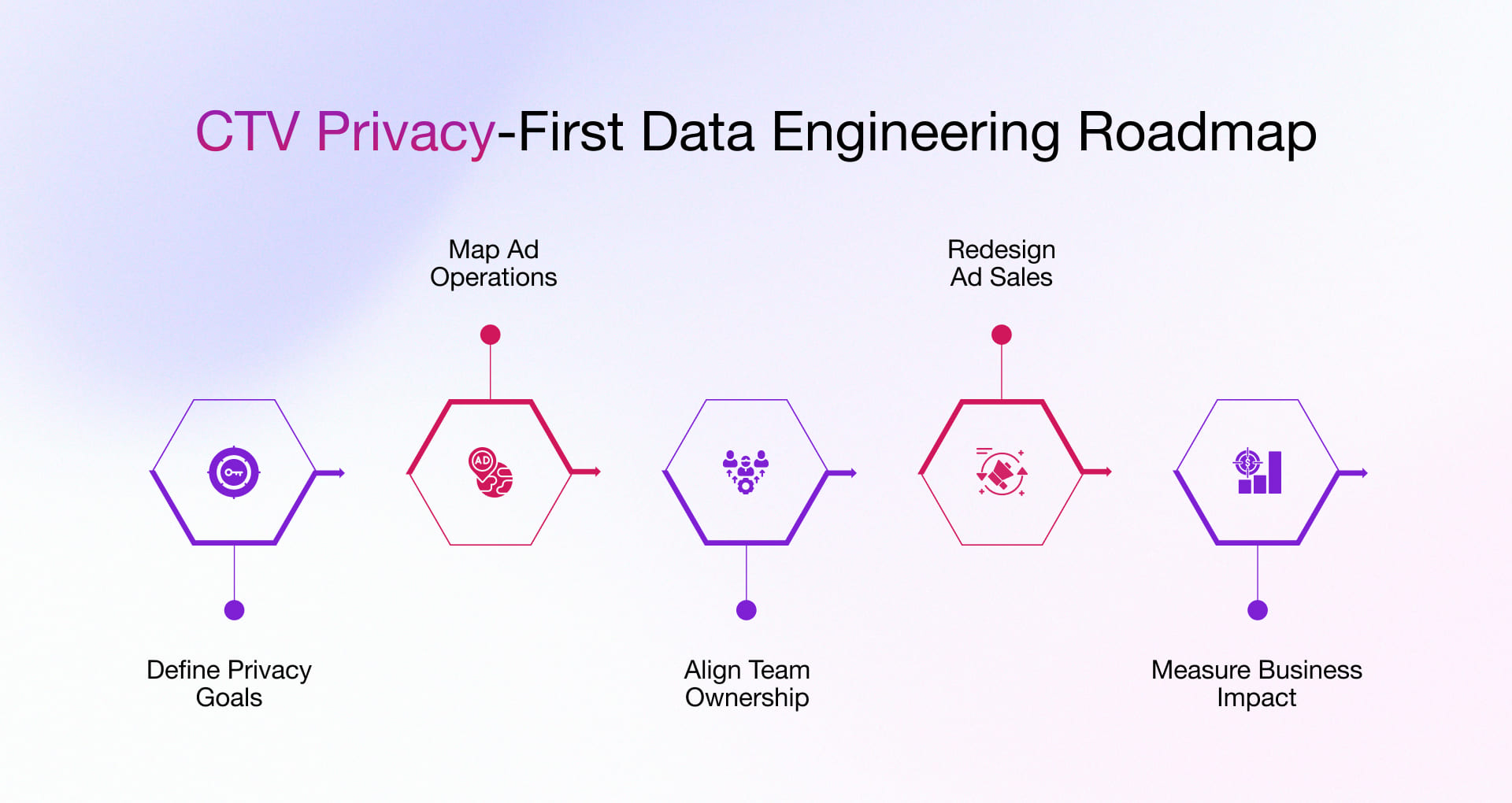
Step 1: Define What “Privacy-First Success” Means for Your Business
Leadership teams must define what privacy-first success means in measurable business terms. This includes understanding how much current revenue depends on deterministic identity, how CPMs fluctuate when signal quality drops, and which advertisers rely heavily on precision targeting versus contextual or cohort-based buying.
Key questions the C-suite should answer:
- Revenue exposure: What percentage of revenue depends on deterministic addressability (MAID-based targeting, household graphs, retargeting, deterministic attribution)?
- CPM sensitivity: How do CPMs and win rates change when signal quality drops (lower match rates, reduced addressability, higher bid shading)?
- Advertiser dependency: Which budgets require precision targeting and closed-loop measurement vs. contextual, cohort, or reach-based buying?
Step 2: Map Your Real Advertising Operations
Once objectives are clear, organizations must examine how advertising truly functions within their platform. This requires tracing the complete campaign lifecycle:
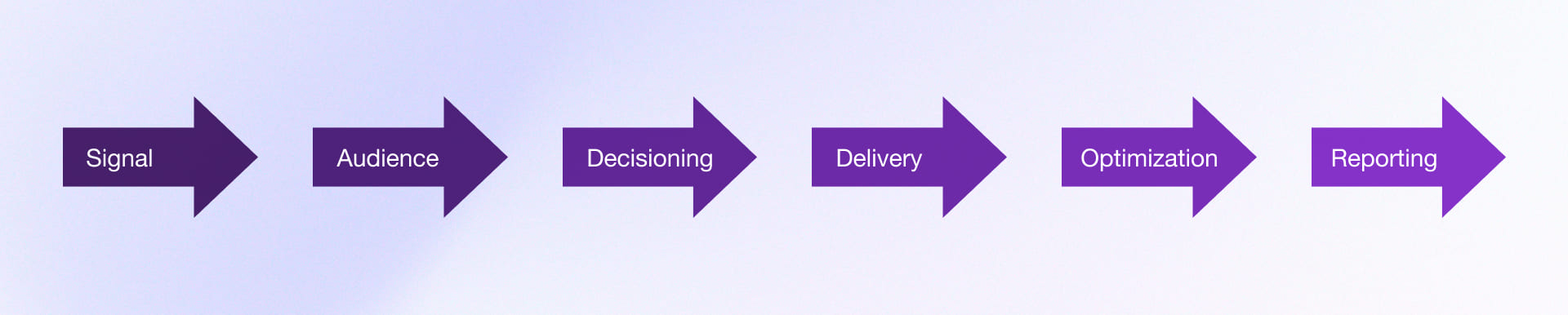
In many cases, this exercise reveals structural weaknesses. Identity logic may be fragmented across systems, consent checks applied late in the workflow, and manual interventions required to maintain delivery performance. Measurement pipelines may still rely on identifiers that are increasingly unstable or restricted.
This step is not about creating documentation. It is about identifying where privacy constraints directly affect delivery reliability and revenue performance. Only with this operational visibility can leadership prioritize meaningful changes.
Step 3: Reset Ownership Across Teams
Privacy-first data engineering cannot succeed if treated solely as an engineering initiative. Identity, data handling, and audience strategy now influence product design, monetization decisions, AdOps workflows, legal oversight, and sales commitments.
Organizations that navigate this shift effectively clarify ownership across functions. Product teams define privacy-safe audience frameworks. Engineering ensures secure and scalable data processing. Legal establishes governance boundaries. Sales aligns advertiser expectations with platform capabilities. AdOps manages campaign execution under new targeting realities.
Standards from organizations such as the Interactive Advertising Bureau provide industry guidance, but internal accountability determines execution quality. Without a clear operating model, privacy remains siloed, and commercial teams continue operating on outdated assumptions.
Step 4: Redesign How You Sell Advertising
Privacy-first transformation inevitably reshapes what can be promised to advertisers. Platforms that continue selling deterministic targeting and user-level attribution without adapting to privacy constraints create misalignment and erode trust.
Leading CTV businesses reposition their value proposition around household reach, contextual alignment, cohort-based performance, and incrementality. Campaign success metrics evolve accordingly. Sales teams are trained to communicate performance using aggregated and privacy-safe insights rather than individual tracking claims.
This commercial realignment is not cosmetic. It ensures that advertiser expectations match delivery capability, preserving long-term demand and pricing power.
Step 5: Rebuild Measurement Around Business Impact
Measurement becomes the final proving ground for privacy-first data engineering. As individual-level attribution becomes less viable, platforms must demonstrate performance through aggregated exposure analysis, lift studies, and modeled outcomes.
The focus shifts from identifying who converted to understanding what impact the campaign generated. Advertisers increasingly care about business outcomes such as reach expansion, brand influence, and sales lift. Platforms that can provide credible, privacy-safe insights maintain advertiser confidence even as deterministic signals decline.
Measurement, in this context, is no longer a reporting afterthought. It is a strategic capability that sustains commercial credibility.
Enable Privacy-First CTV Advertising with Rishabh Software
The first thing you need to know is that building privacy-first CTV advertising platforms comes with a range of complexities and requires decisive technical capabilities. It involves aligning data engineering, identity, monetization, and compliance across fragmented streaming ecosystems while still meeting advertiser expectations for reach, performance, and measurement.
Rishabh Software, a leading AdTech development company with strong data engineering capabilities, helps organizations navigate this shift by designing and implementing scalable data platforms that support privacy-safe signal processing, audience modeling, and outcome-driven measurement. With deep expertise in data engineering, cloud platforms, and AdTech workflows, we work closely with CTV and programmatic teams to modernize legacy systems, integrate first-party data strategies, and operationalize privacy-first architectures that sustain advertiser trust and revenue performance.