.NET Development Services
As a Microsoft Solutions Partner, we help enterprises build, modernize, and scale .NET applications with cloud-native architecture, system integration, and AI capabilities.
Experienced .NET Development Company for Business-Critical Applications
We build and modernize business-critical applications across web, mobile, cloud, desktop, and IoT using the .NET ecosystem. Our experience spans new product development, legacy application modernization, complex system integrations, data-intensive platforms, and multi-tenant SaaS applications.
Our web applications are built with ASP.NET Core, while .NET MAUI enables cross-platform mobile and desktop applications. We also help organizations move existing Xamarin applications to .NET MAUI and integrate .NET applications with enterprise systems, data platforms, and third-party services.
Our engineers design application architectures around workload needs rather than a fixed pattern. Depending on the requirements, we work with modular monoliths, microservices, multi-tenant architectures, serverless components, and headless applications. On the front end, we build SPAs, PWAs, MVC applications, MVVM-based applications, and other modern interfaces that work with .NET backends.
We work across the Microsoft and .NET ecosystem to develop applications for industries including Healthcare, Media & Entertainment, Fintech, and Retail. Our teams also bring experience with cloud-based applications, enterprise integrations, and AI-enabled solutions.
.NET Development Services We Offer
As a .NET development company, we deliver .NET development services across web, mobile, desktop, cloud, AI/ML, and microservices, using technologies such as ASP.NET Core, .NET MAUI, and Microsoft Azure.
Our ASP.NET engineers build highly responsive web applications that run across multiple operating systems and browsers while maintaining performance as usage grows. We customize web-based products based on your organizational requirements, such as automating internal processes or serving customers.
Portals, internal systems, and dashboards customized to your processes.
Secure APIs connecting the application with your ERP, CRM, and payment systems.
Responsive interfaces that work consistently on desktop browsers, tablets, and phones.
We build cross-platform mobile applications for iOS and Android using .NET MAUI and C#, with access to native device capabilities such as location, camera, sensors, secure storage, and network status. Applications can connect to ASP.NET Core backends for authentication, business logic, data access, and integration with enterprise systems.
iOS & Android mobile apps with native capabilities to leverage the benefits and functionalities of each platform
Cross-platform app development using .NET MAUI to attain time and cost efficiencies while reaching a wider audience
Our .NET engineers build desktop applications for business workloads that require local processing, hardware integration, and rich user interfaces. We develop new applications and modernize legacy desktop software using appropriate .NET technologies, with a focus on performance, security, and maintainability.
Legacy application modernization and migration to supported .NET releases, with phased upgrades to manage compatibility risks and minimize disruption.
Hardware and peripheral integration with printers, scanners, and other equipment used in business operations.
Application deployment and updates across managed devices to simplify maintenance and keep software current.
Our .NET development services include the creation, hosting, deployment and management of cloud-native and SaaS apps. Multi-tenant products use Azure Blob Storage for files, Azure SQL Database or Cosmos DB for transactional data, and Azure Stream Analytics where real-time reporting is required.
Cloud-native web apps and SaaS portals for a secure, user-friendly, and high-performance digital ecosystem
Azure development to build apps while taking advantage of the cloud infrastructure and cloud computing
As a .NET software development company, we design .NET enterprise applications around your business processes, integration requirements, and security needs. After assessing your requirements, we recommend the right architecture, multi-tier, cloud-native, or microservices-based, based on your workloads and operational priorities. Our solutions connect with existing enterprise systems and support business-specific workflows, access controls, and audit requirements.
Multi-tenant SaaS and line-of-business applications with configurable workflows and approval rules.
Role-based access control and audit logging to support security reviews and audit requirements.
Architecture documentation and code documentation to support maintenance, knowledge transfer, and future enhancements.
We connect .NET systems to your ERP, CRM, payment, and partner platforms through versioned APIs with monitoring and error handling to keep application data consistent and reduce manual reconciliation.
Versioned REST APIs give partners rate limits, authentication, and documented contracts.
Event-driven messaging uses retries and dead-letter queues to protect transaction data.
Third-party integrations include payment gateways, with monitoring and alerting built in.
We design microservices with ASP.NET Core around business domains, recommending them when independent scaling, separate release cycles, or team autonomy justify the added operational complexity. When distributed architecture does not provide enough value, we recommend a modular monolith with clear boundaries and the option to extract services as the product evolves.
Distributed .NET app development using .NET Aspire for service discovery, orchestration, configuration, and observability during development.
Independent service deployments that allow teams to release and scale individual capabilities.
Modular monolith architecture when a distributed design would add operational complexity without sufficient business value.
We integrate Machine Learning and Generative AI capabilities into .NET applications for intelligent document search, demand forecasting, pattern detection, and document processing. Access controls protect sensitive data, while model monitoring helps teams track performance and identify when updates are needed.
Natural-language search across internal records to help users find relevant information faster.
Forecasting models integrated with existing reports to support inventory planning and budgeting decisions.
Document classification and data extraction to reduce manual data entry and processing errors.
Model performance monitoring and retraining to help maintain prediction quality as data and business conditions change.
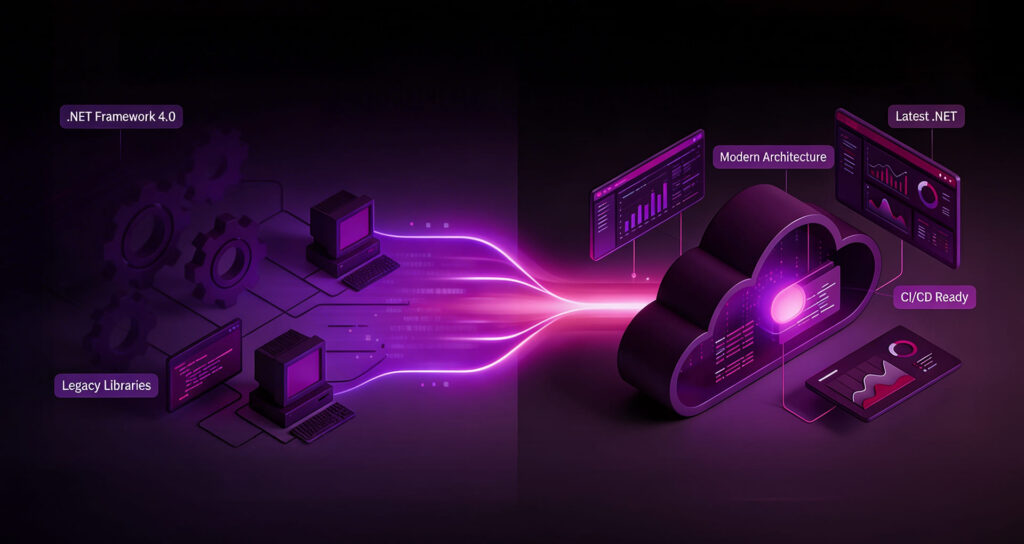
We modernize applications built on .NET Framework and older .NET releases by assessing dependencies, upgrading to supported versions, and restructuring components where needed. Phased migration and regression testing help manage compatibility risks and minimize disruption to ongoing operations.
NET Framework modernization: Upgrade legacy applications and migrate ASP.NET applications to ASP.NET Core
.NET version upgrades: Assess application compatibility and upgrade older .NET applications to the latest release.
Xamarin to .NET MAUI migration: Update dependencies, platform-specific code, and user interfaces as needed.
Cloud migration: Move on-premises applications to Azure based on business, architecture, and infrastructure requirements.
Flagship .NET Projects Delivered by Us
Discover how we have taken .NET projects from requirements to production, including the architecture decisions and delivery steps behind each result.


Review your .NET applications with a senior .NET architect and identify priorities for modernization, performance, and scalability
Tech Stack





















Client Chatter that Matters
Stop wondering, start WOWing – Work with us for results that impress!

The team maintains a high level of professionalism and is able to adapt our needs. I was challenged as a Product Owner of the cloud-based FinTech software and asked questions until requirements were fully understood. Looking forward to develop the next release with the same dedication and performance. They developed the solution using leading technologies like Microsoft and SQL Server database.
Viktor Puetzer
Moneywatch

CEO
US based Staffing & Recruitment Company
Why Choose Our .NET and ASP.NET Development Services
We help enterprises reduce delivery risk across .NET application development and modernization through experienced architects, Microsoft-certified engineers, a single accountable team, and a structured delivery approach. Our teams support projects from architecture and development through testing, deployment, modernization, and ongoing support.
Two Decades of .NET Delivery
Microsoft-Certified Engineering Team
Full-Lifecycle Ownership
Delivery Measured Against Agreed Outcomes
We choose the delivery approach based on project scope and requirements, and track progress against metrics agreed at kickoff. These may include deployment frequency, defect rates, delivery milestones, and forecast to completion, giving stakeholders clear visibility into project progress.
Frequently Asked Questions
Can you migrate our .NET 6, 7, 8, or 9 application to .NET 10?
Yes, we migrate applications from .NET 6, 7, 8, and 9 to .NET 10. The process starts with a dependency and compatibility assessment, followed by phased retargeting and regression testing, so functionality is preserved and your applications return to a supported release.
Should we migrate from .NET Framework to .NET 10, or keep the application as it is?
The answer depends on the application. As .NET Framework 4.8 remains supported as a Windows component, a stable app with no planned change and no cloud requirement can stay in place for some time. Migration makes sense when you need containerized deployment, Linux hosting to reduce license cost, higher throughput, or libraries that target only modern .NET.
How long does a .NET migration take?
A single mid-sized web application with limited Windows-specific dependencies can often be retargeted in weeks. Portfolios with WCF services, WebForms front ends, or heavy third-party component use take longer, and a phased approach with the strangler pattern typically runs across several quarters.
Do you recommend microservices or a modular monolith for a new .NET product?
For most products with a single team or a small number of teams, we recommend a modular monolith with enforced boundaries, because it keeps deployment and operations simple and preserves the option to extract services later. We recommend microservices when independent scaling, separate release cadences, or team autonomy provide a return on the added operational cost.
Which cloud platforms do you build .NET applications on?
Azure is our primary platform, and we also deliver on AWS. We use managed identity, infrastructure as code, and policy-based governance on both, and we design for portability where a client has a multi-cloud requirement.
How do you handle security and compliance in .NET projects?
We include threat modeling in design, automated dependency and container scanning in the pipeline, secrets management through Key Vault or an equivalent, and access control through Microsoft Entra ID. For regulated sectors, we map controls to the applicable framework, such as HIPAA, SOC 2, GDPR, or PCI DSS, and document them for audit.
Can you take over an existing .NET application built by another vendor?
Yes. We begin with a code and architecture review covering dependency health, test coverage, security posture, and operational readiness, then agree on a stabilization plan before resuming feature work.