Programmatic advertising has automated media transactions, and agentic AI is extending that automation across campaign workflows. According to IAB’s 2026 Outlook Study, two-thirds of media buyers are focused on agentic AI for ad buying and campaign execution. Meanwhile, U.S. programmatic advertising revenue reached $162.4 billion in 2025, up 20.5% year over year.
Yet fragmented platforms, APIs, and workflows still complicate media discovery, campaign planning, and deal execution. Ad Context Protocol (AdCP) and Agentic Advertising Management Protocols (AAMP) are emerging to enable more structured interactions between advertising agents, buyers, sellers, and platforms.
The blog post explores how the two protocols (AdCP and AAMP) differ, their role in the programmatic stack, and what AdTech businesses need to consider when preparing for agentic advertising.
Why Programmatic Advertising Needs Standards Like AdCP and AAMP?
Programmatic advertising has spent years perfecting the mechanics of buying media. It still hasn’t fully solved how intelligence moves across the ecosystem.
Where the Current Programmatic Stack Still Breaks Down
Much of today’s programmatic infrastructure still assumes that people, dashboards, or tightly coupled integrations will bridge the gaps between platforms. That assumption becomes harder to sustain as agentic AI extends across CTV advertising, mobile, retail media networks, and social platforms.
An autonomous buyer cannot rely on tribal knowledge, familiarity with individual interfaces, or a custom connector every time it encounters a new marketplace. It needs a predictable way to understand what is available, what a counterpart expects, and which actions are permitted.
This exposes a long-standing weakness in programmatic advertising: the industry standardized the auction far earlier than it standardized the surrounding conversation.
Why Existing Standards Do Not Cover the Entire Workflow
The advertising industry is not starting from zero. OpenRTB, OpenDirect, AdCOM, and other specifications already support key parts of digital advertising. They standardize processes such as real-time bidding, direct media buying, and the representation of advertising inventory, providing a foundation for interoperability across the programmatic ecosystem.
Agentic advertising introduces additional requirements. Beyond executing transactions, software agents need standardized ways to discover capabilities, interpret commercial intent, exchange instructions, coordinate workflows, and operate within defined permissions.
AdCP (Ad Context Protocol) and AAMP (Agentic Advertising Management Protocols) are emerging approaches to these requirements. They address agent-driven advertising workflows while building on or working alongside existing standards. Their approaches differ, but both reflect the industry’s move toward more interoperable, governed automation across advertising platforms.
AdCP and AAMP: Two Approaches to Agentic Advertising
AdCP and AAMP address the need for more interoperable agentic advertising workflows, but they take different approaches. Understanding their roles helps clarify how AI agents can interact with advertising platforms and existing programmatic infrastructure.
What AdCP Brings to the Stack
- The Role: Ad Context Protocol (AdCP) is an open standard developed through AgenticAdvertising.org. It enables AI agents to coordinate advertising workflows, including media discovery, campaign planning, creative-related tasks, and execution.
- Under the Hood: AdCP uses machine-readable standards such as brand.json and adagents.json to help agents identify brand requirements, discover publisher inventory, and understand which agents are authorized to represent that inventory. This can reduce reliance on bespoke integrations for every interaction.
What AAMP Brings to the Stack
- The Role: Agentic Advertising Management Protocols (AAMP), an initiative by IAB Tech Lab, establishes a framework for agent-driven buying and selling across advertising marketplaces. It focuses on how buyer and seller agents interact, negotiate deal terms, and manage their commercial relationships.
- The Function: AAMP supports structured deal negotiations, including proposals and counter-proposals, along with mechanisms for managing agreed terms and maintaining transaction records. This helps bring greater control, transparency, and accountability to agent-driven advertising workflows.
How AdCP and AAMP Are Reshaping Programmatic Infrastructure
As AI in programmatic advertising expands beyond bidding and optimization, AI agents are taking on more tasks across media discovery, campaign planning, buying, and execution. AdCP and AAMP are developing standardized ways for these agents to interact with advertising systems, building on existing programmatic standards.
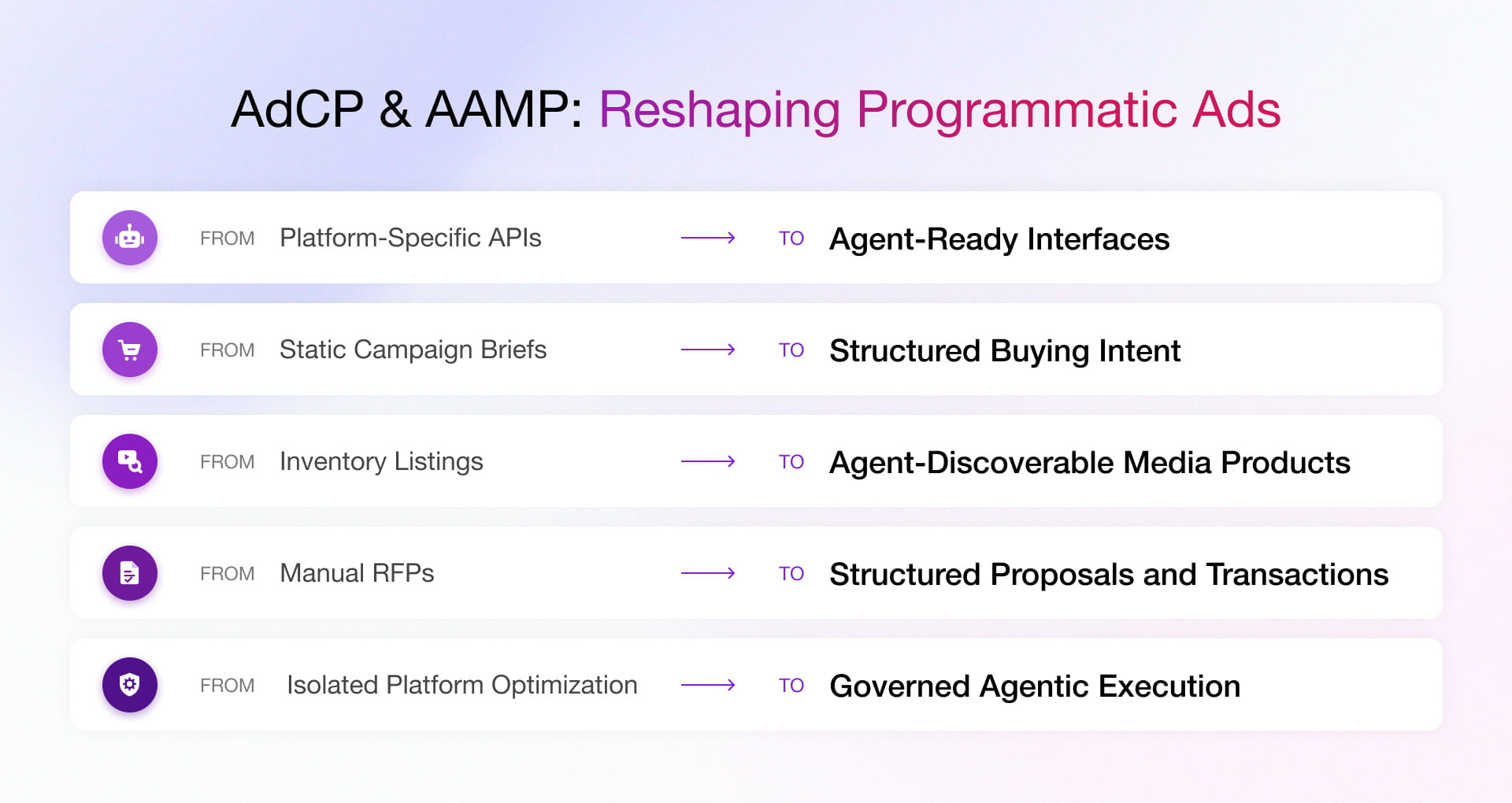
1. From Platform-Specific APIs to Agent-Ready Interfaces
Programmatic advertising has traditionally relied on separate dashboards, APIs, and integrations across demand-side platforms, supply-side platforms, publishers, and ad servers. AdCP and AAMP introduce standardized approaches that help agents discover capabilities and interact with advertising systems through defined workflows.
Instead of building a custom integration for every interaction, agents can use supported protocols and machine-readable information to identify available functions and determine how to proceed. AdCP supports structured media-buying interactions and discovery mechanisms, while AAMP builds agentic workflows on established advertising standards.
2. From Static Campaign Briefs to Structured Buying Intent
Campaign briefs typically describe an advertiser’s objectives, target audience, budget, timing, channel requirements, and measurement expectations. Translating those requirements into media plans and executable proposals often involves multiple handoffs among agencies, platforms, publishers, and measurement providers.
Agentic workflows can structure this process. Buyer agents can interpret campaign requirements, discover relevant media products, evaluate opportunities, and prepare proposals for review. AAMP 3.0’s OpenProposal specification specifically addresses the brief-to-proposal process, helping buyer and seller agents exchange and evaluate campaign opportunities in a consistent format.
3. From Inventory Listings to Agent-Discoverable Media Products
AdCP enables publishers and supply platforms to make advertising properties, inventory, and authorized selling agents discoverable through machine-readable information. Depending on the implementation, this information can help buyer agents evaluate available media opportunities against campaign requirements.
It allows publishers to declare their properties, available inventory, and the agents authorized to sell it. The result is a more structured way for agents to discover advertising opportunities beyond conventional sales portals and platform-specific interfaces.
4. From Manual RFPs to Structured Proposals and Transactions
AAMP 3.0 introduces OpenProposal, a specification designed to standardize the exchange and evaluation of proposals between buyer and seller agents. It addresses a stage of media buying that has often relied on manual RFPs, spreadsheets, emails, and repeated data entry.
With structured proposals, agents can evaluate media products and compare opportunities against campaign requirements, including relevant commercial terms. Once the parties agree, the workflow can move toward a buy commitment and connect with existing transaction and ad-serving infrastructure. The extent of automation depends on the systems and integrations involved. OpenProposal is currently in public comment through October 22, 2026.
5. From Isolated Platform Optimization to Governed Agentic Execution
Agentic advertising can extend beyond individual platform recommendations to coordinated workflows involving campaign objectives, deal terms, audience requirements, delivery signals, and measurement outcomes. Depending on their permissions and integrations, agents can monitor campaign performance, identify issues, recommend adjustments, and execute approved actions.
This is where AI in Ad Ops can move beyond isolated recommendations toward more coordinated operations across connected advertising systems. However, autonomous execution requires clear boundaries. Agent identity, authorization, approval thresholds, auditability, and human oversight help ensure that actions remain within agreed commercial and operational requirements.
AAMP addresses this through its broader work across agentic foundations, protocols, and trust and transparency, including the IAB Tech Lab Agent Registry. AdCP provides structured agent interactions and mechanisms for identifying authorized selling agents. Together with existing advertising standards, these approaches can help establish a more interoperable and accountable foundation for agent-driven advertising.
What AdCP and AAMP Mean for AdTech Businesses
AdCP and AAMP have different implications for advertisers, publishers, AdTech platforms, and product teams. Their standards can help simplify interactions between AI agents and advertising systems, but the actual benefits depend on how platforms implement them.
1. Advertisers and Agencies
Advertisers and agencies remain responsible for campaign strategy, budgets, and approvals. AI agents can take on tasks such as discovering media opportunities, evaluating proposals, and coordinating campaign activation. AdCP and AAMP can help standardize parts of these workflows, reducing manual effort across the buying process.
Key benefits:
- Faster media discovery and proposal evaluation
- Less manual work during campaign planning and activation
- Easier evaluation of buying opportunities across platforms
- More scope for AI-assisted campaign optimization
2. Publishers and Media Owners
Publishers need to make their inventory and commercial offerings easier for potential buyers to discover. AdCP supports media discovery and seller authorization, while AAMP addresses structured interactions between buyer and seller agents, including proposal exchanges. These capabilities can help publishers connect their inventory with relevant buying opportunities.
Key benefits:
- Greater visibility of eligible inventory to buyer agents
- More structured proposal exchanges with potential buyers
- Less manual effort in handling buying inquiries
- More opportunities to match inventory with campaign requirements
3. DSPs, SSPs, and AdTech Platforms
Supporting every new AI agent through a separate custom integration can add to development and maintenance costs. AdCP and AAMP offer standardized approaches to agent interactions, giving platforms a way to support compatible workflows without building every connection from scratch.
Key benefits:
- Less reliance on bespoke integrations for supported workflows
- A clearer path to introducing agent-compatible features
- Easier connections between compatible demand and supply systems
- Opportunities to develop new services for agent-driven media buying
4. Product and Engineering Teams
Supporting AI agents requires more than adding an interface to an existing platform. Engineering teams need to consider how agents discover capabilities, access data, authenticate, and act within defined permissions. AdCP and AAMP provide standards for parts of these interactions, while product teams remain responsible for the architecture and controls behind them.
Key benefits:
- Clearer requirements for agent-compatible product design
- Reusable implementations of supported protocols
- Defined permissions and approval controls for agent actions
- A foundation for extending agent integrations as needs evolve
How to Make Your AdTech Platform Ready for AdCP and AAMP
Preparing for AdCP and AAMP involves more than adding protocol support to your existing platform. It requires the right integrations, consistent data, and clear controls for how AI agents access information and execute advertising workflows.
- Assess your existing integrations. Identify how your platform handles inventory, pricing, campaign instructions, and reporting. Map the custom APIs and connectors that may need to work alongside protocol-based interactions.
- Expose the right capabilities. Determine which platform functions AI agents need to access, such as inventory discovery, proposal exchange, campaign setup, or reporting. Define how those functions will be exposed through the relevant protocol.
- Standardize your data. Align campaign, audience, inventory, and pricing data across systems. Consistent data structures make it easier to exchange information and reduce mapping issues between platforms.
- Set clear access and approval rules. Define which information agents can access, which actions they can perform, and when human approval is required. Include authentication, authorization, and audit logging in the implementation plan.
- Support existing and protocol-based workflows. AdCP and AAMP are not immediate replacements for the existing programmatic stack. Plan how protocol-enabled workflows will connect with your current APIs, buying systems, and campaign operations.
- Validate a real advertising workflow. Start with a use case such as inventory discovery or proposal exchange. Test the full process, including data accuracy, permissions, error handling, and downstream integrations, before expanding to more complex workflows.
How Rishabh Software Supports Agent-Ready AdTech Modernization
Preparing an AdTech platform for agentic advertising requires connected systems, consistent data, and clear controls for how AI agents access information and execute workflows. Legacy integrations, fragmented data, and rigid architecture can make interoperability harder for DSPs, SSPs, ad exchanges, and other platforms. For CTV businesses, programmatic infrastructure readiness is another important consideration.
As an AdTech software development company, Rishabh Software helps businesses address these engineering challenges through platform engineering, application modernization, API integration, and data engineering. These capabilities can help AdTech teams build more connected, scalable platforms and prepare their systems to support emerging standards such as AdCP and AAMP.
Frequently Asked Questions
Q. What is the difference between AdCP and AAMP?
A. Agentic advertising is supported by both AdCP and AAMP, but they originate from different organizations and frameworks. AdCP is an open protocol designed by Agentic Advertising.org that standardizes advertising workflows across AI agents and platforms; AAMP is IAB Tech Lab’s more general effort to bring agentic capabilities into the established advertising ecosystem with existing standards. The two overlap in media discovery, planning, buying, and reporting, but they are separate specifications and are not directly interchangeable.
Q. Will AdCP and AAMP replace OpenRTB, DSPs, or SSPs?
A. No. AdCP and AAMP are intended to work alongside existing programmatic infrastructure rather than replace it. OpenRTB remains important for real-time bidding, while DSPs and SSPs continue to support core buying and selling functions. AdCP and AAMP address agent-driven workflows such as media discovery and proposal exchange, with implementation depending on the systems involved.
Q. What role does AdCP play in media discovery and buying?
A. AdCP helps AI agents find relevant advertising opportunities and communicate with media platforms in a standardized way. This can simplify tasks such as discovering inventory, evaluating media options, and coordinating buying activities. The actual capabilities depend on how each platform implements the protocol.
Q. How does AAMP help automate the media buying process?
A. AAMP aims to simplify how buyer and seller agents negotiate advertising deals. Its AAMP 3.0 initiative includes OpenProposal, which lets agents exchange and evaluate media proposals in a structured format. This can reduce manual work involved in RFPs and negotiations, while allowing platforms to continue using their existing advertising infrastructure.
Q. What security and governance considerations apply to agentic advertising?
A. AI agents need clear limits on what they can access and do. AdTech platforms must define permissions, set budget and approval limits, verify agent identities, and maintain audit logs. These controls help teams track agent activity and prevent unauthorized actions. AdCP or AAMP implementation does not remove the need for platform-level security and oversight.