People move through the physical world differently than they scroll through a feed. They’re at airports, on commutes, waiting in lobbies present, attentive and not staring at a phone. That’s where digital out-of-home advertising steps in. And the analytics behind it? That’s what turns those everyday real-world moments into something brands can actually measure and improve. These days, DOOH has become a must-have in any profitable brand’s media mix. The automation, data-driven decisions and ability to swap creative on the fly have made it incredibly powerful.
The numbers back it up too. The global DOOH advertising market was worth $20.74 billion in 2024 and is expected to grow to $39.12 billion by 2030, at a CAGR of 10.7%. Like digital advertising, DOOH advertising analytics now play a decisive role in measuring campaign effectiveness, audience engagement and media performance.
Like other digital channels, analytics are now front and center, telling you what’s really resonating, how engaged people are, and how well the whole campaign is performing. It helps brands get the right message in front of the right people exactly when they’re out and about. Of course, tracking performance in DOOH works differently than your typical online ads. But things have evolved fast. Thanks to smarter AI tools, programmatic buying and better privacy-safe data, the measurement capabilities today are way ahead of where they were even a couple years back.
If you’re trying to figure out how DOOH analytics can sharpen your targeting, fix attribution and boost overall campaign results, this guide walks through the newest trends, tools, and strategies that are actually moving the needle in the industry right now.
Why DOOH? Understanding the Benefits of Digital Out of Home Advertising
DOOH helps connect brands with consumers across placements as they move throughout the day. Unlike traditional OOH, DOOH enables data-informed decisions about where, when and to whom ads are displayed. These capabilities make DOOH one of the most measurable and scalable media formats available, especially when powered by modern DOOH advertising analytics platforms.
The data helps identify areas with a high concentration of the brand’s target audience and how the messages are served across different avenues. This would support intercept, increase awareness and drive consumer interest (online or in-store). Digital advertising units include digital bulletin boards, digital signage and digital screens installed across buildings, gyms, restaurants, malls, transit hubs and more.
Key Benefits of DOOH Advertising for Modern Brands
One of the biggest benefits of digital out-of-home advertising is its ability to combine the visual impact of traditional outdoor media with the targeting and measurement capabilities of digital channels.
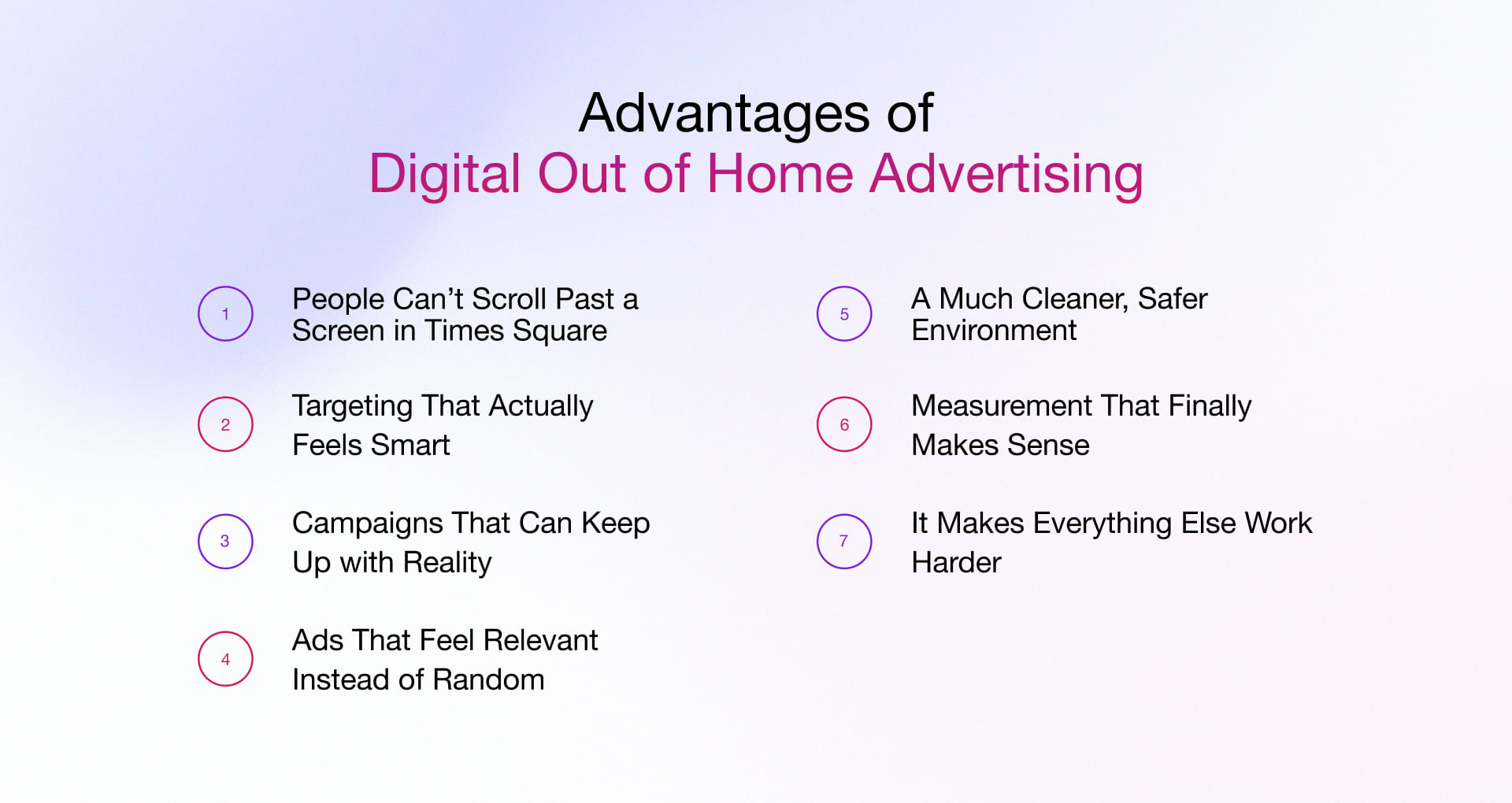
Here’s why it’s quietly becoming one of the smartest bets for brands right now.
People Can’t Scroll Past a Screen in Times Square
DOOH lives where people actually are: airports, train stations, malls, busy streets. No skip button. No ad blocker. No “I’ll just keep scrolling.” Your message hits them when they’re physically present, often with time on their hands and eyes open. That kind of captive attention has become incredibly rare.
Targeting That Actually Feels Smart
This isn’t basic demographic guessing. DOOH uses real-world signals where people are moving, what the weather’s doing, what time it is, even local events to serve ads that make sense in the moment. A warm coffee visual hitting commuters on a freezing morning isn’t luck. It’s the platform doing its job.
Campaigns That Can Keep Up with Reality
Programmatic DOOH changed the game. You can swap creative, tweak messaging, or shift budgets in hours, not weeks. Market shifts? Trend spikes? You don’t have to sit on outdated ads waiting for a new print run. You just update it. That speed used to be digital-only. Now it’s out in the physical world too.
Ads That Feel Relevant Instead of Random
With Dynamic Creative Optimization, the ad literally changes itself based on live conditions. Traffic data, weather, crowd makeup, even the score of the local game, it all feeds in. The result? Creative that feels timely and useful rather than just loud. That’s a big difference in how people respond.
A Much Cleaner, Safer Environment
Brand safety worries keep a lot of marketers up at night. DOOH cuts through most of that noise. Your ad runs on verified screens in real physical locations. No surprise placements next to dodgy content. No bot traffic. What you buy is what actually shows up.
Measurement That Finally Makes Sense
Outdoor used to be the channel people “felt” worked but couldn’t really prove. Those days are gone. Modern DOOH analytics platforms track impressions, attention time, footfall lift, audience engagement and omnichannel campaign impact in near real time.
It Makes Everything Else Work Harder
DOOH doesn’t compete with your other channels. It multiplies them. Someone sees your ad on a bus shelter, gets retargeted on their phone while walking, then spots it again on streaming that night. That kind of layered reinforcement builds memory and momentum no single channel can create on its own.
The brands getting the most out of DOOH are the ones buying presence where real life happens and they’re doing it with precision, speed and confidence.
How DOOH Analytics is Improving Advertising Performance
Brands often struggle to measure outdoor advertising performance – how it helps convert distracted, passive audiences into paying customers. How are people connecting with the messaging? Are they noticing the ads and pausing to look at them?
Advertising companies can achieve an improved return on investment (ROI) for their marketing campaigns by examining spend allocations at each phase of the advertising campaign cycle to restrict revenue leakage. A foolproof campaign strategy powered by data visualization and analytics helps uncover hidden insights and patterns for accurate decision-making. It is by analyzing how advertising activities interact with the actions and purchases. This helps track marketing campaigns and regulate their performance at each step, influencing the peaks and dips in sales.
- Advanced digital out of home analytics solutions help businesses improve audience engagement, optimize media placements and maximize campaign ROI using actionable insights.
- They enable networks to charge premium fees because advertisers are willing to pay for analytics.
- Offer competitive advantage over other networks to win more campaigns with ease.
- Drive programmatic and AI-driven campaign decisions in real-time to enable mid-flight adjustments that significantly improve campaign efficiency.
- Modern DOOH advertising analytics platforms also give advertisers, publishers and media owners a unified view of campaign performance across screens, regions and audience segments.
Analytics platforms now do more than track impressions. They measure audience attention and creative performance. They also connect DOOH campaigns with other marketing channels. Simultaneously, they support privacy-safe audience insights to help brands understand what works and where campaigns can improve. Hence, a holistic view of the campaign covers information such as inventory delivered, conversion rates, click-through rates, and action completion rates.
Essential Metrics Used in DOOH Analytics
Measuring Impressions
Impression tracking remains one of the crucial metrics in DOOH analytics as it helps advertisers estimate campaign reach and visibility across digital screens. With DOOH, the appearance of an ad on one screen is likely to reach one-to-many mediums. Several people may be likely to look at the screen at any given moment. This would imply that one play of an ad can be counted as several impressions.
Data collection would help determine the impression multiplier factors and number of impressions. Even though there are varied parameters for statistical analysis – for example, ticket sales would determine ad visibility; cameras and sensors integrated with the DOOH analytics platform would provide insights on view data and more.
Location Intelligence and Mobility Analytics
They allow companies to create an OOH advertising strategy that would focus 100% on the tastes and preferences of the end customer who passes through each point. Further, they help marketers understand consumer and shopper behavior in connection with their travel patterns and other demographics of where they live and work to drive outdoor media decisions.
- With location intelligence or location analytics, information about a point of interest – including audience saturation, specific product consumption categories, buying behavior & capability, brand affinity – helps identify the type of advertising that would offer a higher success rate for the brand’s desired audience.
- The use of mobility or foot traffic analytics helps assess consumer behavior to understand the peak hours across certain locations along with hours of demand. Businesses can define advertising strategies by segmenting audiences, informing media placements, optimizing campaigns and measuring their real-world impact on in-store visits.
Why Attention Metrics Matter in Modern DOOH Advertising Analytics
The DOOH world has moved way beyond simply counting impressions. Smart advertisers are now focusing on attention metrics, especially dwell time and attentive reach as they are the benchmarks for measuring the performance of outdoor digital advertising.
OOH has been tracking real human attention longer than any other advertising channel, and it shows.
OAAA says Nielsen found that “nearly two-thirds” of DOOH viewers engaged in at least one measured action after seeing a digital billboard and that DOOH prompts over half of consumers to take actions on mobile devices.
Dwell time simply measures how long someone stays within viewing distance of a screen. That’s why screens in airports, gyms, shopping malls and waiting areas can charge premium rates because people stick around and actually pay attention.
Attentive Reach takes it one step further. It counts how many people were genuinely focused on the ad, not just walking past. Thanks to AI-powered computer vision and eye-tracking sensors, platforms can now measure this in near real-time.
While other media channels are just starting to talk about “attention” as the new big metric, DOOH has been measuring it for years using sensors. That gives it a serious edge.
Programmatic DOOH and the Future of DOOH Advertising Analytics
Programmatic buying has completely changed the game in DOOH. Advertisers can now access thousands of screens across different networks through one platform instead of calling up individual operators and negotiating placements.
You define your target market and the system handles the rest using real-time bidding just like digital advertising.
Here’s how it works in the real world:
- You define the demographics of your audience in a DSP
- The system bids in real time for the best screens
- When you win, the creative goes live almost instantly
- Performance data flows back to you in real time
This approach cuts out the old manual hassle, makes targeting sharper, and gives you much better reporting.
How AI is Advancing DOOH Analytics
Artificial intelligence is transforming DOOH advertising analytics including predictive audience targeting to real-time campaign optimization to attention measurement.
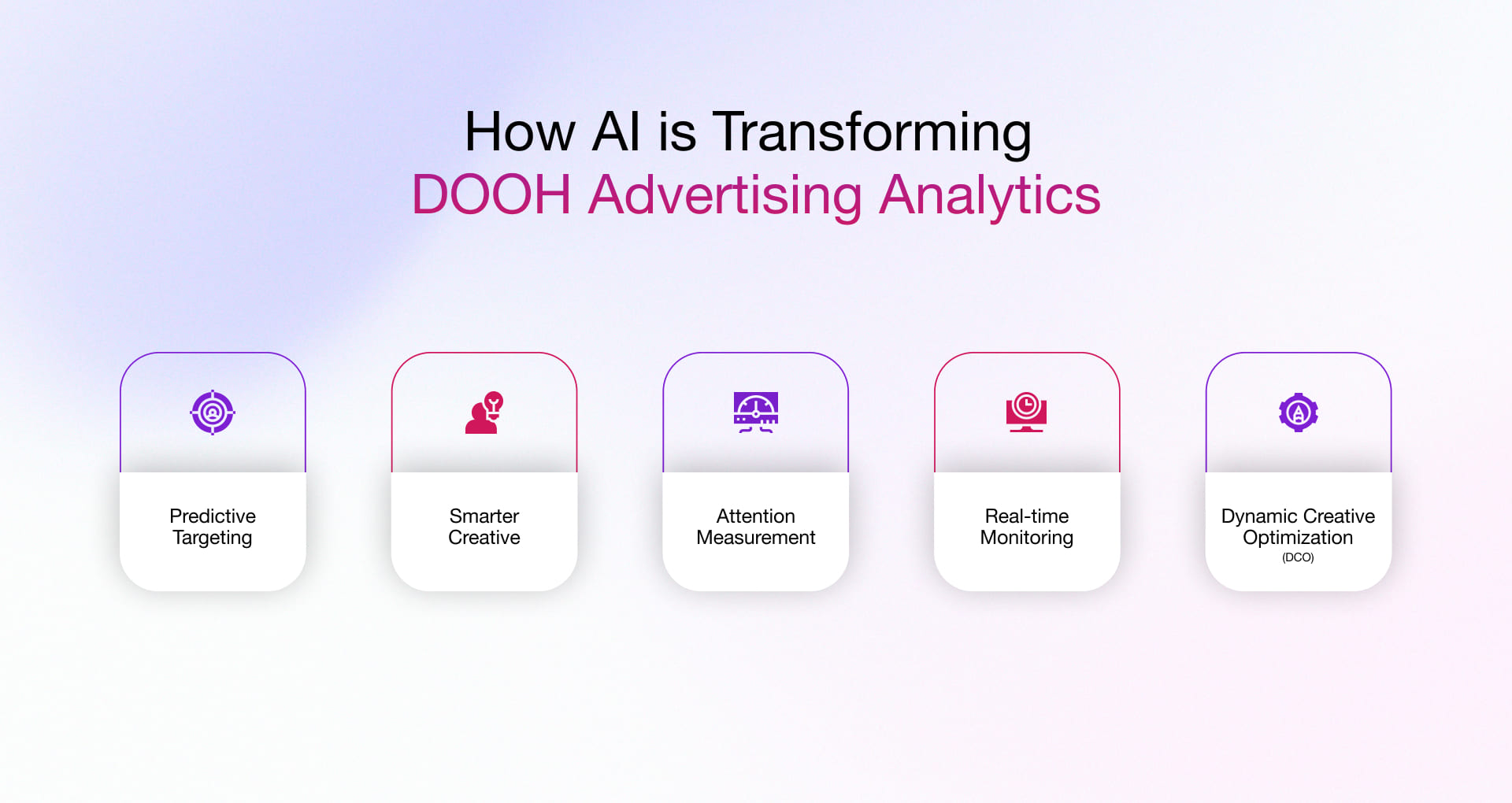
- Predictive Targeting: AI takes into consideration past foot traffic, upcoming events, weather and movement patterns to predict where your target audiences will be. This makes it easy to eliminate guesswork and place your ads where the right people are likely to be.
- Smarter Creative: Generative AI can create multiple versions of your ad, test them live and automatically push the ones that perform best to save time and money while making ads more relevant.
- Attention Measurement: Cameras and sensors on screens use computer vision to detect if someone is looking at the ad, how long they stay and how close they get. All of this can be done without identifying anyone personally.
- Real-time Monitoring: AI constantly watches campaigns and alerts teams if something goes wrong, so issues get fixed fast instead of being discovered weeks later.
Dynamic Creative Optimization (DCO)
Ads That Adapt! One of the coolest developments is Dynamic Creative Optimization is that it lets your ads change automatically based on real-world conditions.
For example:
- Show sunscreen when the UV index is high
- Switch to breakfast offers in the morning and dinner deals in the evening
- Update based on live sports scores or traffic conditions
- Tailor messages when certain audience types are nearby
Why Choose Rishabh Software to Develop DOOH Analytics?
At Rishabh Software, we provide AdTech consulting services leveraging data-driven technologies and analytics-led insights to help advertising industry clients make informed decisions regarding strategy, campaign execution, and performance measurement.
Below is a showcase of our DOOH engagements:
Case 1: Cloud-Native DOOH Aggregator Platform
Business Need:
A DOOH operator needed a unified cloud platform to manage multiple screen networks, coordinate content delivery, and centralise analytics and billing across a distributed inventory.
Solution:
Our team built a cloud-native DOOH aggregator platform on AWS that centralised campaign management, content scheduling, real-time analytics, and billing into a single unified platform – enabling the operator to scale across multiple markets efficiently.
Key Outcomes:
- 64% faster onboarding of stakeholders
- 87% reduction in manual errors
- 50% faster decision-making
Case 2: Digital Ad Booking Management System Modernization
Business Need:
A DOOH media owner needed to modernize a legacy ad booking system that was creating operational bottlenecks and limiting their ability to serve clients efficiently.
Solution:
Rishabh Software modernized the digital ad booking and management system to deliver a streamlined, scalable platform that reduced manual processing and enabled faster campaign activation.
Key Outcomes:
- 360 insights for real-time inventory status
- 50% increase in bookings of available assets
- 100% streamlining of inventory to finance management process
Case 3: Centralized DOOH Campaign Planning Platform
Business Need:
A DOOH advertising business needed a unified platform to plan, manage, and track campaigns across multiple operators and screen networks from a single interface.
Solution:
We developed a centralized campaign planning platform that streamlined the entire campaign lifecycle, right from planning and proposal to booking, execution and post-campaign analysis.
Key Outcomes:
- 3X Faster Inventory Selection & Targeting
- 40% Increase in Inventory Utilization
- 60% Reduction in Campaign Planning Time
Case 4: Real-Time Bidding (RTB) Platform for DOOH
Business Need:
A programmatic advertising platform needed a robust real-time bidding engine to support high-volume, low-latency DOOH inventory transactions.
Solution:
We developed a high-performance RTB platform capable of processing bid requests at scale with the millisecond response times demanded by programmatic DOOH ecosystems.
Key Outcomes:
- ~30 million digital auctions for OOH ads under 30 minutes with the new platform
- 50% reduction in latency with high execution times
- 100% utilization of available ad assets with hyper-precise targeting by location
Take a look at this unified DOOH platform that’s custom-built to help agencies, advertisers and media owners manage campaigns faster, improve visibility and expand operations across global markets.
DOOH Has Entered Its Performance Marketing Era
DOOH has become one of the fastest-growing segments in the global advertising industry driven by advances in digital out of home analytics, AI and programmatic technologies.
AI, programmatic buying, dynamic creative and privacy-safe audience data have collectively transformed DOOH from a blunt reach medium into a precise, measurable advertising channel.
Today, it is allowing many of the related analytics and ROI calculations to help brands justify their spending and refine the campaigns around what could engage their target audience.
Brands that build their DOOH analytics capabilities now by investing in programmatic infrastructure, AI-powered targeting and privacy-compliant data strategies will be best positioned to capture the channel’s full value.
And therefore, it should not come as a surprise why so many brands are starting to pay attention to this channel. DOOH, driven by data analytics, AI and programmatic technology, offers an engaging, measurable and brand-safe alternative to fragmented digital environments.
Frequently Asked Questions
Q: What are the advantages of programmatic DOOH for data-driven marketers who want measurable ROI?
A. Programmatic DOOH (pDOOH) offers undeniable benefits that traditional manual buying cannot match. Data-driven marketers mainly love it for these reasons:
- Audience-Based Buying: You buy based on specific audience segments instead of just locations. This means you can target people by demographics, behaviors or proximity to your store.
- Real-Time Optimization: You adjust campaigns while they are running. The system automatically shifts budget away from underperforming times, places or creatives and moves it to stronger inventory.
- Clear, Measurable Results: You receive verified impression counts, actual audience exposure data and footfall attribution. These metrics connect your DOOH spend directly to store visits and conversions.
- Flexible Budget Control: You set spending limits, control ad frequency and pay only for impressions that meet your audience criteria which makes testing and scaling much easier.
- Seamless Cross-Channel Integration: You feed DOOH performance data into your unified marketing dashboards that show exactly how outdoor advertising works alongside digital and social channels.
- Lightning-Fast Speed to Market: You launch campaigns in just hours. Programmatic platforms and dynamic creative tools eliminate the weeks of manual negotiations that old methods required.
In a nutshell, programmatic DOOH brings the precision, automation and accountability of digital advertising to the massive real-world reach of physical screens. Marketers who want smart and measurable out-of-home campaigns choose pDOOH.
Q. Is DOOH advertising compliant with privacy regulations like GDPR and CCPA?
A. Yes. Modern DOOH platforms use aggregated and anonymized data to understand audience behavior without identifying individual people. They rely on signals such as location, time of day, weather and audience trends instead of tracking personal information. This approach helps advertisers run relevant campaigns while meeting privacy requirements like GDPR and CCPA.
Q. Can DOOH advertising be integrated with mobile, social media, and CTV campaigns?
A. Absolutely. Many brands use DOOH alongside mobile, social media search and Connected TV to create a consistent customer experience across channels. For example, someone who sees your ad on a digital billboard may later see related messages on their phone or TV. You can track performance across all channels and get a clearer picture of campaign impact using modern analytics tools.