AI is everywhere in advertising conversations right now. In day-to-day Ad Ops, however, the reality is less seamless. IAB’s State of Data found that only 30% of agencies, brands, and publishers had fully integrated AI across the media campaign lifecycle, while half still lacked a clear AI roadmap. The gap becomes easier to understand when you look at how Ad Ops actually works. Campaign setup happens in one system, delivery is monitored in another, reporting sits elsewhere, and reconciliation often finds its way back to spreadsheets. Teams spend a surprising amount of time simply connecting the dots, leaving plenty of room for delays, errors, and revenue leakage.
AI becomes interesting here for a different reason. Not because it can make another dashboard smarter, but because it can take some of that operational drag out of the day. Spot a setup issue before launch. Flag a campaign that is quietly falling behind. Help someone understand why delivery dropped without opening five tools and three reports. Even take some of the boring reconciliation work off the team’s plate. Of course, an AI advertising platform still depends on the same fundamentals: usable data, connected systems, reliable tracking, and clear operational controls. Simply switching on an AI tool does not fix fragmentation underneath it.
So, this blog gets into the practical side of it: where AI earns its place in Ad Ops, what needs to be in place first, and how to know if the ROI is real.
Where Ad Ops Teams Lose Time, Accuracy, and Revenue
Ad Ops has a strange kind of complexity. No single task looks terribly difficult, yet the whole operation can become heavy once campaign volume grows and data starts traveling across OMSs, ad servers, SSPs, reporting tools, and billing systems. The friction usually shows up in three places.
Time Gets Eaten Up Between Systems
- Campaign information rarely lives in one place
- Teams spend hours pulling reports, matching IDs, checking delivery, and moving data around
- Repetitive handoffs slow campaign setup and troubleshooting
- Spreadsheet work quietly becomes part of the operating stack
- More campaign volume usually means more manual coordination too
For publishers and media businesses, this becomes especially visible when inventory and monetization workflows depend on a supply-side platform (SSP) alongside the broader AdTech stack.
Accuracy Slips in the Small Details
- Dates, goals, creatives, targeting, pacing, tracking, and billing fields all need to stay aligned
- Different systems use different naming conventions, schemas, and metric definitions
- Manual entry and repeated QA create more chances for mismatches
- Small configuration errors can travel downstream before anyone spots them
- Reporting discrepancies make it harder to know which number is actually the right one
Revenue Loss Rarely Arrives with a Big Warning
- Underdeliver often becomes visible after it has already affected campaign commitments.
- Inventory decisions based on weak or stale forecasts can hurt sell-through
- Unresolved delivery discrepancies can delay billing or create leakage
- Slow issue detection gives teams less room to recover campaign performance
- The bigger problem is not missing data. It is missing the right signal at the right time
This is also why programmatic deal health monitoring is becoming more important: teams need to identify delivery and revenue risks while there is still time to act.
Where AI Can Make the Biggest Difference Across Ad Operations
AI becomes useful in Ad Ops when it starts taking work out of the operating loop, not when it simply adds another dashboard or recommendation layer. The real value of AI in programmatic advertising or AdOps define by how quickly a campaign can move from setup to delivery, and how little manual digging is needed when something goes off course.
AI as a Pre-Launch Control Layer
AI can help inspect campaign configuration against booking data, creative requirements, delivery goals, targeting rules, and historical setup patterns. Instead of an Ad Ops person checking every field one by one, the system can surface what looks incomplete, inconsistent, or just a little off.
As AI-powered ads become more common, this control layer can also help validate the operational details surrounding an AI-powered ad creative before it enters a live campaign.
- Validate campaign inputs before trafficking
- Flag missing or mismatched creatives and parameters
- Compare setup against order or OMS data
- Detect unusual configurations based on past campaign patterns
- Send only exceptions for human review
AI Turns Campaign Monitoring into Exception Management
AI can continuously read pacing, delivery, inventory, and revenue data and identify where attention is actually needed. Instead of checking twenty dashboards, the team gets a smaller set of problems worth opening.
Across AI programmatic advertising workflows, this is particularly valuable because the same campaign may generate signals across a demand-side platform (DSP), exchange, publisher environment, and analytics stack.
- Detect underdeliver or sudden delivery shifts
- Spot abnormal impression, fill-rate, or revenue movement
- Compare current behavior with historical campaign patterns
- Prioritize issues by urgency or likely revenue impact
- Surface related signals across connected AdTech systems
AI Can Shorten the Distance Between a Problem and Its Fix
Once an issue is found, AI can bring together campaign configuration, delivery data, logs, historical behavior, and related system events to narrow down what probably caused it. From there, it can recommend the next action or trigger a predefined workflow.
That could mean opening a QA task, routing an exception, preparing reconciliation data, generating a campaign summary, or passing a low-risk action through an API. This is where AI for advertising becomes operationally useful.
From AI Assistance to Agentic Ad Operations
Most Ad Ops implementations will begin with AI assisting people: detecting an anomaly, explaining a delivery change, summarizing performance, or recommending what to investigate next. The next stage is allowing AI to coordinate bounded actions across connected systems.
This is where agentic AI in performance marketing becomes relevant. Instead of performing one isolated task, an AI agent can interpret live signals, select a next step, use an approved tool or API, and evaluate the outcome.
For Ad Ops, that might mean an agent identifying an underdeliver pattern, checking related targeting and inventory signals, preparing a recommended correction, and routing that action for approval.
Campaign budgets, inventory controls, commercial commitments, and revenue-impacting decisions need permissions, audit trails, confidence thresholds, and human escalation. An artificial intelligence advertising campaign should not mean handing every decision to a model. The stronger approach is to automate low-risk work while keeping human oversight around commercially sensitive actions.
What It Takes to Build an AI-Ready Ad Ops Function
Putting an LLM interface over fragmented campaign data does not make the operation AI-ready. Usually, it just makes the fragmentation easier to ask questions about.
IAB found that nearly two-thirds of surveyed advertising professionals pointed to data quality, data protection, and fragmentation across tools as major AI adoption barriers. A structured AI readiness assessment can therefore be useful before teams start automating operational workflows.

Start With Trusted, Connected Data
Campaign, delivery, inventory, revenue, and billing data need a common structure that AI services can reliably work with.
That can involve:
- normalized campaign and deal identifiers;
- common metric definitions;
- streaming or near-real-time data pipelines;
- historical datasets for forecasting and anomaly models;
- data quality checks before information reaches the AI layer.
Build an Integration and Orchestration Layer
The AI needs a safe path into the AdTech stack. APIs, event streams, queues, workflow engines, and service-level permissions can connect the intelligence layer with the OMS, ad server platform, SSP, analytics stack, ad exchange, CRM, or billing platform.
This is also where observability matters. Teams need to know which system supplied the data, which model made a recommendation, what action was triggered, and whether it worked.
Use the Right AI for the Right Job
| Need | Better Fit |
| Fixed campaign validation | Rules engine |
| Underdeliver prediction | Machine learning |
| Anomaly detection | ML/statistical models |
| Natural-language investigation | GenAI/RAG |
| Multi-step operational workflow | AI agent + APIs |
| High-impact decision | Human approval |
The architecture gets stronger when AI is treated as a toolbox rather than one very large hammer.
How Do You Measure the ROI of AI in Ad Ops?
Start before building. Pick one workflow and establish what it costs today. How many campaigns go through it? How much operator time does it consume? How often do errors occur? How long does issue detection take? What revenue risk sits behind those delays?
Then measure across three buckets.
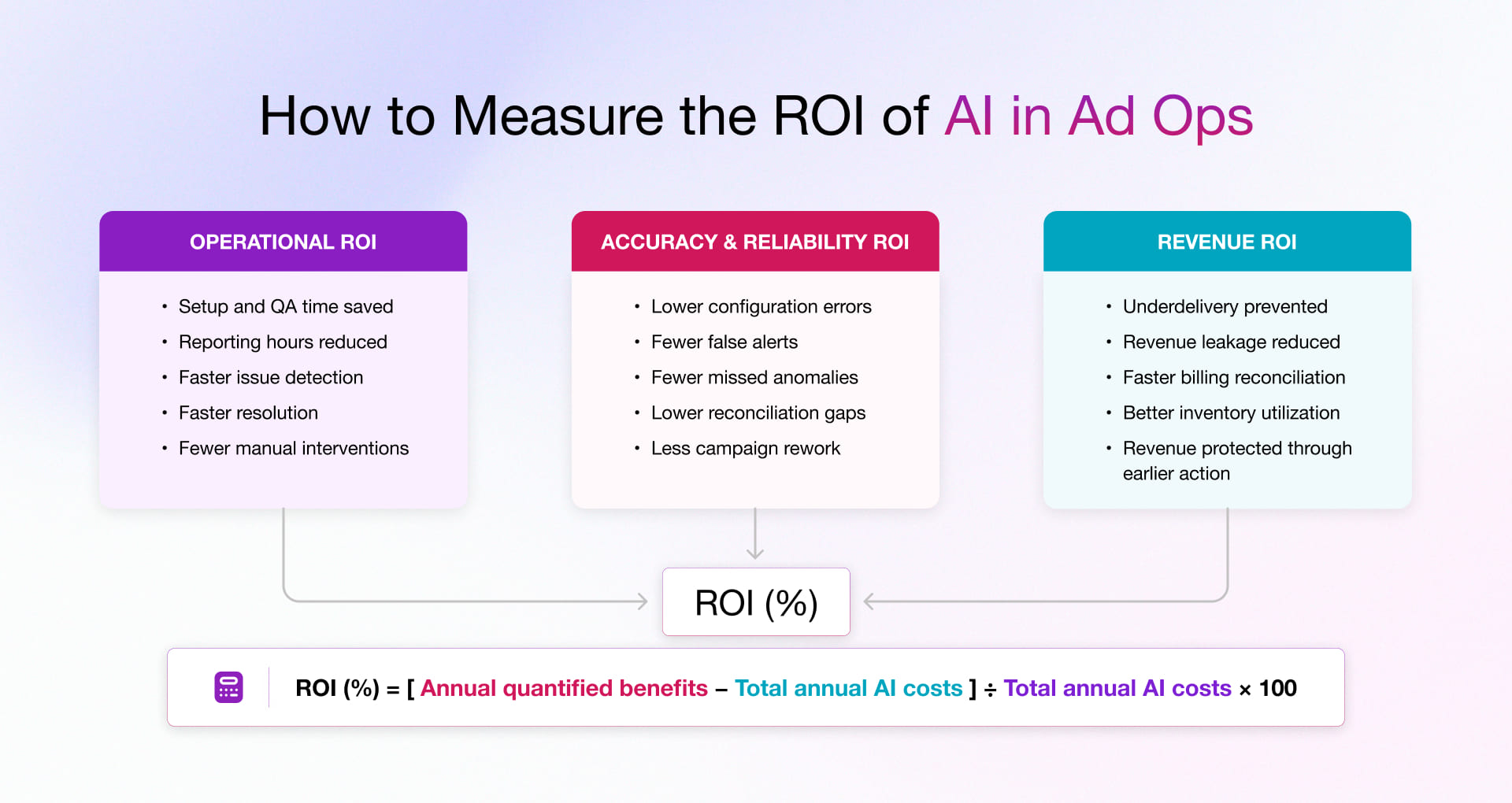
Operational ROI
Track:
- time spent on campaign setup and QA;
- reporting and reconciliation hours;
- mean time to detect an issue;
- mean time to resolution;
- manual interventions per campaign.
Accuracy and Reliability ROI
Look at:
- configuration error rate;
- false alerts;
- missed anomalies;
- reconciliation discrepancies;
- percentage of campaigns requiring rework.
Revenue ROI
Connect operations to commercial outcomes:
- underdeliver prevented or recovered;
- reduction in revenue leakage;
- faster billing reconciliation;
- improved inventory utilization;
- revenue protected through earlier intervention.
A simple model can help:
ROI (%) = [(Annual quantified benefit – Total annual AI cost) / Total annual AI cost] x 100
Total cost needs to include more than model/API fees. Data engineering, integration, cloud infrastructure, monitoring, model maintenance, and human review all belong in the calculation.
And start small. One measurable workflow with a clear baseline is much easier to defend than an ambitious “AI transformation” where nobody quite remembers what success was meant to look like.
Build AI-Driven Ad Operations with the Right Technology Partner
AI for Ad Ops sits at the intersection of AdTech software development, data, integrations, and AI/ML. That mix matters because the problem rarely ends at choosing a model.
At Rishabh Software, we build and scale custom AdTech platforms, including DSPs, SSPs, ad servers, exchanges, DOOH aggregator platform and CTV solutions, with experience across 100+ advertising-platform integrations.
Our experience covers real-time data engineering, campaign infrastructure, AI/ML engineering, automated QA, monitoring, and integration with existing AdTech ecosystems. We have also applied this thinking in production.
For a US-based AdTech company operating across CTV, mobile, and programmatic channels, we built an AI-powered deal health platform that unified multiple data sources, scored active deals, detected anomalies across the bid lifecycle, and surfaced explainable insights.
The starting point does not have to be an agentic platform. Sometimes, it is a single operational workflow where better data, the right AI approach, and sensible automation can remove significant manual effort.
Frequently Asked Questions
Q: What is AI for Ad Ops?
A: AI for Ad Ops is the use of machine learning, GenAI, anomaly detection, predictive models, and AI agents inside advertising operations workflows. Common applications include campaign QA, delivery monitoring, troubleshooting, forecasting, reporting, reconciliation, and workflow automation.
Q: Will AI replace Ad Ops teams?
A: Not in the useful version of this story. AI is better suited to repetitive checks, pattern detection, investigation support, and bounded workflow execution. Ad Ops specialists still bring campaign context, commercial judgement, exception handling, and control over decisions with real revenue impact. Google similarly describes the direction as a collaborative relationship between human expertise and AI systems.
Q: Where should an Ad Ops team start with AI?
A: Start with a workflow that is repetitive, measurable, and already has usable data. Pre-launch QA, underdeliver detection, anomaly monitoring, reporting, or deal-health analysis are practical candidates. Establish the existing time, error, and revenue baseline before automating it.
Q: Does an AdTech platform need perfect data before using AI?
A: Perfect, no. Trustworthy and sufficiently connected, yes. The system needs consistent identifiers, clear metric definitions, reliable historical data, and controls around data quality. Without those, AI often adds a smarter interface to the same old uncertainty.
Q: What is the difference between AI automation and agentic Ad Ops?
A: AI automation usually performs a defined task, such as detecting anomalies or generating a report. An agent can work across multiple steps, use connected tools, reason about the next action, and execute approved tasks. The second needs much stronger permissions, observability, governance, and human controls.