
U.S. household debt hit $18.8 trillion in Q1 2026, and 4.8% of it sits in some stage of delinquency, according to the New York Fed’s Quarterly Report on Household Debt and Credit. Most collections teams are still working that volume the way they did it years ago: dialers, spreadsheets, and a shared script. The pressure has changed shape, though.
Delinquencies are rising as the compliance map becomes more complex. The CFPB has pulled back its own enforcement over the past year. That’s a harder environment to work in than if there were just one strict federal regulator. The rules now vary by state and change on a different clock in each one.
Lenders stuck on manual processes are left to choose between two adverse options – Overstaffing a business that’s already thin on margin, or leaving accounts under-worked and watching recovery slide.
AI-powered Debt Collection is the game-changer. It runs on data, not dialers and modernizes recovery with automation, behavioral intelligence, omnichannel engagement and integrated compliance. The outcome is a scalable, customer-centric process that replaces outdated and manual methods.
Read on to know how AI in debt collection is moving the industry from pressure tactics to a digital-first approach where recovery rates go up & operational costs come down while offering a better borrower experience!
Traditional Debt Recovery vs AI-Powered Debt Collection
Conventional collections call whoever’s most overdue, on the same schedule, every time. Artificial intelligence in debt collection enables smarter recoveries by predicting payment intent, automating omnichannel outreach, and verifying compliance before each interaction.
The two models don’t just use different tools but run on different logic entirely, where one works on a list, and the other reads a portfolio. Here’s a quick side-by-side comparison:
| Traditional debt collections |
AI-driven debt collections |
| Manual calling lists worked in order | Predictive prioritization based on risk and intent to pay |
| Generic scripts | Messages tailored to each borrower’s profile, preferred channel, and payment history |
| Strict business hours | Automated outreach across voice, SMS, email, chat, and self-service, available 24/7 |
| Phone calls as the primary communication channel | Multi-channel outreach: voice, SMS, email, chat, self-service |
| Reactive, after-the-fact follow-up | Proactive intervention before accounts slip further |
| High operational cost per account | Lower cost-to-collect through automation |
| Agents burning out on repetitive calls | Agents freed up for the accounts that need judgment |
| Inconsistent borrower experience by agent | Consistent treatment and messaging across every touchpoint |
The Business Impact of Leveraging AI in Debt Collection
- AI adoption in this industry didn’t creep up. It jumped
TransUnion’s annual Debt Collection Industry Report puts AI/ML use among collection firms at 49% in 2023 and 93% in 2025, nearly doubling in two years. Only 7% of companies now say they have no plans to adopt it at all.
- Volume pressure backs this up
Sixty-four percent of companies reported higher account volumes in 2025, and 76% said they’re increasing technology spend over the next two years.
- Digital engagement is becoming the norm
Nearly all of them, 98%, now offer at least one self-service option, and 64% offer some form of virtual negotiator.
Core Technologies Powering AI-Driven Debt Collection
These five technologies are what make AI for debt collection work. They bring together several core building blocks to score accounts, automate outreach, guide agents, and keep every action compliant. These are the technologies that turn raw borrower data into smarter, faster and safer collections decisions.
Machine Learning for Propensity Scoring
Models trained on payment history, account behavior, and credit signals rank each account by how likely it is to resolve, and through which channel. This is the engine behind AI-driven debt collection: it replaces a fixed calling order with a score that updates continuously.
Natural Language Processing
NLP reads incoming replies, texts, emails, voicemail transcripts and logs them against the right account without a person opening five inboxes. It also powers generative message drafting by adjusting the tone and phrasing for each borrower, rather than sending a single standard template to everyone.
Predictive Analytics
Where propensity scoring answers “will this account pay,” predictive analytics answers “when.” Timing outreach to when a borrower is likely to respond moves contact rates more than just calling more often ever does.
Real-time Compliance Engines
Contact limits, consent status and required disclosures get checked before a message goes out. Every decision gets logged with the reasoning behind it.
Conversational AI and Virtual Negotiators
Self-service tools let borrowers set up a payment plan, confirm a promise to pay, or negotiate a reduced balance without a human on the line. This is also where a lot of the value in conversational AI for debt collection shows up. Borrowers who would rather not talk to a person get a fast, private way to resolve an account, and the collections team gets that capacity back.
It’s better to design the debt collection system around AI from the start than to simply add it onto an old dialer. The best way to do that is to work with an AI and ML development company that can train models on your own portfolio data instead of a generic dataset.
Use Cases of AI in Debt Collection
AI handles the routine outreach, adjusts repayment plans to fit each borrower, and predicts who is actually likely to pay. Recovery rates go up while costs come down. Teams spend their time on the accounts that need it, stay on the right side of compliance, and reach people through channels that don’t feel like pressure tactics. Here’s where AI actually gets used in debt collection:
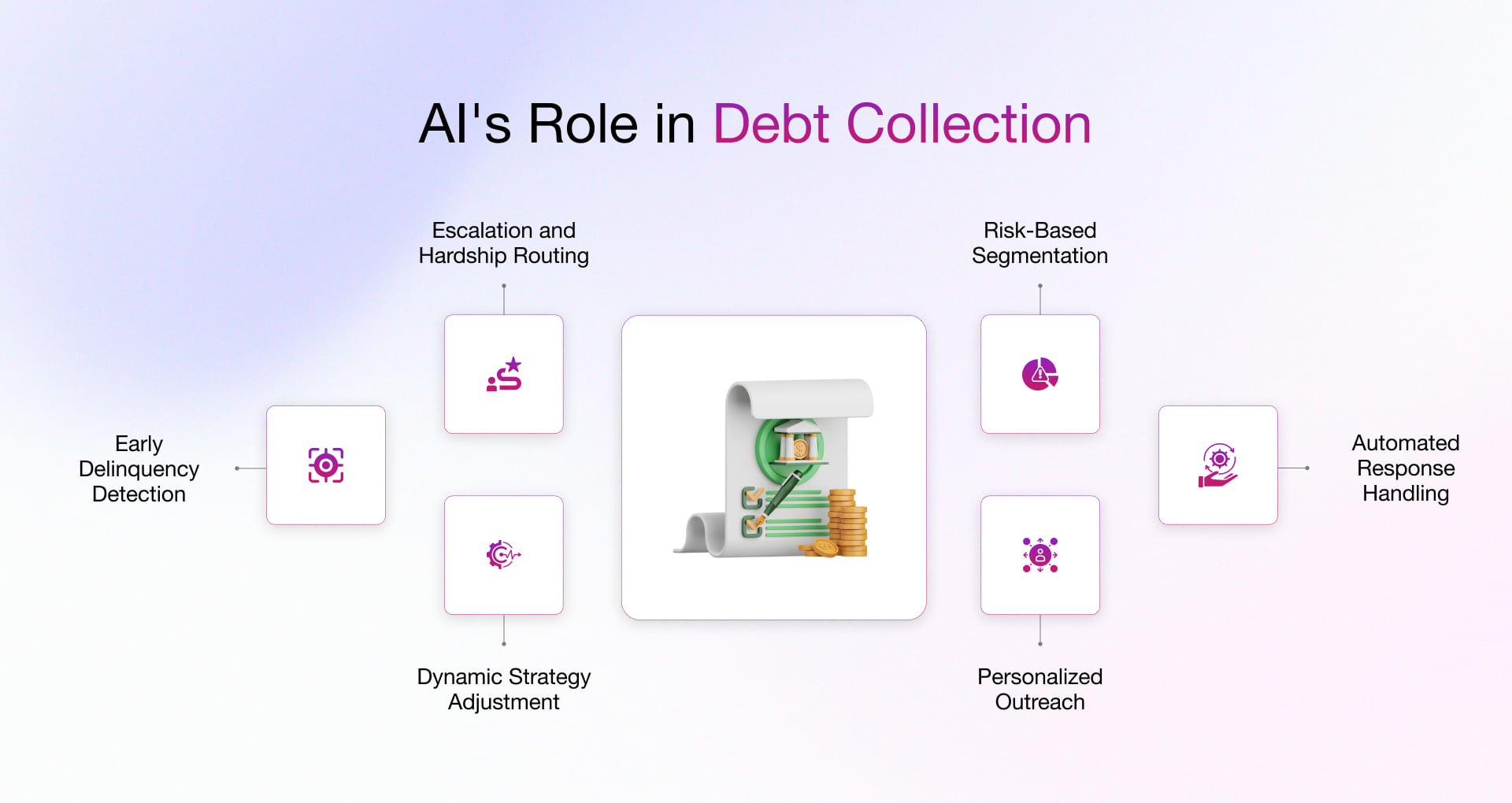
Early Delinquency Detection
Payment data across servicing and core banking is checked continuously, so an account gets flagged the moment it crosses into delinquency and not when someone runs a report.
Risk-based Segmentation
A $500 late payment from a reliable borrower doesn’t need the same attention as a $50,000 balance from someone showing real signs of trouble. Models sort accounts by actual risk instead of balance alone.
Personalized Outreach Timing and Channel
A 25-year-old freelance writer and a 60-year-old retiree aren’t going to respond to the same message at the same time. The system picks up on that and adjusts for each group.
Automated Response Handling
A text reply, an uploaded document, a voicemail promising payment: all of it gets read and logged automatically instead of manually.
Dynamic Strategy Adjustment
When a promise to pay falls through or a borrower stops responding, the system flags it and suggests a change, a different channel, a different tone, more or less frequent contact, instead of running the same script regardless of outcome.
Escalation and Hardship Routing
When the data shows a borrower likely can’t pay, the system flags it early and routes toward restructuring or human review, rather than letting the account sit untouched for another cycle.
Benefits of Artificial Intelligence in Debt Collection
The performance gap between AI-powered collections and legacy operations shows up in the metrics that matter most to lenders, servicers and their regulators. Here’s what each core capability changes once it’s live.
Real-Time Predictive Analytics and Propensity Scoring
Legacy operations treat timing as a scheduling problem where accounts get worked in batches on a calendar. Real-time predictive analytics treats timing as a prediction problem instead. Propensity scores update continuously as new signals come in, so outreach reaches borrowers at the specific moments they’re most likely to resolve. That shift alone moves the needle on contact rates and right-party connections.
Automated Omnichannel Self-Service
Borrowers can use self-service across phone, text, email, and web. They can set up payment plans, check their balances, sign up for help plans, or confirm promises to pay. Accurate details and clear next steps help them stay on top of everything. This system handles high volume without extra staff. Collectors spend their time on accounts where live conversations and smart decisions truly help. They avoid routine tasks that a solid system finishes anytime, even late Sunday night.
Continuous Learning Analytics
This is what separates an AI-powered workflow from one that simply automates its existing process. Every interaction, every channel response rate, every payment outcome and every conversation feeds back into the system’s models. Treatment strategies, message content and contact sequencing refine themselves continuously through the same analytics layer instead of waiting on a quarterly strategy review.
Real-Time Compliance Monitoring and Audit Trails
In a manual operation, compliance depends on every agent remembering every rule in every situation. Every decision is stored in an audit trail along with the logic behind it, so if an examiner asks why a certain account got a certain treatment on a certain date, the answer is in the system, not in someone’s memory. AI-powered debt collection is helping teams lower costs, improve recovery, and scale more effectively without adding the same level of manual effort.
Want to upgrade your debt collection? Explore our AI-powered lending software development services.
Challenges of Integrating AI in Debt Collection and How to Overcome Them
Regulatory Fragmentation
The rules around debt collection are getting more complex. The CFPB is enforcing less, and state attorneys general are doing more. So, the rules now differ by state and change on different schedules. In 2025, all 50 states introduced AI-related bills and about 144 became law. There isn’t one national checklist that stays accurate. Collections teams need a debt collection system that can update each state’s rules automatically instead of rebuilding workflows every time a law changes.
Model Bias and Thin Training Data
A model built on easy, on-time accounts will misjudge borrowers who don’t fit that pattern, producing skewed risk scores. Complete the fine-tuning work before launch. Finding this out after complaints arrive costs far more than finding it out in testing.
Borrower Trust and Tone
Automated debt collection outreach that feels robotic damages the exact relationships the industry is trying to preserve. NLP-driven personalization helps, but it needs review, not just a launch-and-forget deployment.
Integration Debt
Legacy loan origination and servicing systems weren’t built with real-time APIs in mind. Event-driven integration engineering is what keeps the AI layer working off current data instead of yesterday’s batch export.
Explainability for Examiners
When an account gets a specific treatment, someone eventually asks why. Every AI-driven decision needs an audit trail, not just a good outcome.
Future Trends of AI in Debt Collection
State-level AI regulation is only going to get denser. Colorado’s already passed a law on algorithmic discrimination in decisions like lending, and more states are drafting similar rules. Platforms built to handle state-specific rules will have an edge over ones running on a single national rulebook.
At the same time, autonomous conversational AI agents, not scripted chatbots, are moving from pilot projects into everyday use at some leading platforms, handling negotiation and disputes without a fixed decision tree. Spotting vulnerable borrowers is turning into a requirement, not a bonus feature, especially as regulators start expecting firms to flag at-risk people and hand them off to a human automatically. And the compliance conversation has moved on too: a year ago, people were still debating whether AI belonged in collections at all. Now the real question is which rules apply, and those rules look different depending on which state the borrower lives in.
Why Choose Rishabh Software for AI Debt Collection Software Development
Most platforms on the market ask a lender to adopt someone else’s product, trained on someone else’s book of business, and configure it to fit. For a lender with a complex portfolio or a specific compliance footprint, that configuration gap is where projects stall.
Rishabh Software builds every debt collection system from the ground up, around one lender’s products, portfolio, systems and regulatory footprint. That includes:

AI-powered Delinquency Management and Propensity Scoring
Machine learning models trained on your actual borrower base and not a vendor’s generic template, scoring propensity to pay and flagging emerging risk so outreach happens earlier and more precisely.
Omnichannel Collections Orchestration
Unified, data-driven journeys across SMS, email, voice and self-service portals from one platform, with contact frequency and channel choice configured to match regulatory limits by design, not by manual review.
LOS and Core Banking Integration Engineering
API-first connections to loan origination, core banking, servicing and related systems, with real-time updates and event-driven triggers so the collections platform runs on current data.
Regulatory Compliance Architecture
Contact limits, validation notices, consent tracking and documentation requirements built into the platform’s design, with state-specific rules layered on top and every AI-driven decision backed by explainable logic and an audit trail built for examiners.
For lenders looking to go further, our generative AI development services extend the same approach into personalized borrower communication, drafted and adjusted per account instead of templated across the board.
Frequently Asked Questions
Q: How does AI-driven debt collection work?
A: AI-driven debt collection adopts a structured process that blends data analysis, automation and human oversight to improve collection outcomes. This approach allows AI to handle repetitive, high-volume work while collection teams focus on conversations and decisions that require human judgment.
- AI analyzes borrower and account data –
- It prioritizes accounts based on recovery potential.
- Selects the best channel and time to contact each borrower.
- Automates payment reminders and routine follow-ups.
- Routes complex cases to collection agents.
- Checks every interaction for compliance and records an audit trail
Q: What’s the difference between an off-the-shelf AI debt collection platform and a custom-built one, and how does it affect recovery?
A: An off-the-shelf platform runs AI models trained on an aggregate of many lenders’ data, then tunes to your portfolio after you’re live. A custom-built platform trains those models on your portfolio from day one. Either way, the recovery gains come from the same mechanism: propensity scoring routes effort toward accounts that are actually likely to resolve, omnichannel automation reaches borrowers on the channel and timing that works for them, and collectors spend their time on the complex cases instead of routine follow-ups. Ready to implement solutions help you launch a pilot faster.
A custom AI debt collection platform turns pressure into performance. You recover more money, operational drag decreases and customers experience fair, convenient processes while compliance stays solid.
Q: Can AI integrate with my existing debt collection software?
A: Yes. A well-built AI collections platform connects to your loan systems, core banking setup, CRMs, dialers and payment tools. It uses APIs, simple file transfers, or other connections. Syncing can happen right away or in batches, whatever your systems handle best. Call notes, payments and borrower updates flow back to your main records. We can start with a test environment so you can validate the workflows before they go live. Once everything is working as expected, the platform can be rolled out without disrupting your existing systems.
Q: What are the steps to implement AI for Debt Collection?
A: Implementing AI in debt collection demands an organized approach that blends technology, data quality, regulatory compliance and smooth integration with your existing collections systems.
- Audit your data before you audit vendors: A model trained on a thin, clean dataset from easy accounts will misread the hard ones: irregular income, disputed balances, edge cases that make up a real portfolio. Fix data quality first.
- Decide build vs. buy early: An off-the-shelf platform gets you to a pilot faster, trained on an aggregate of many lenders’ data. A custom platform trains on your portfolio from day one and fits your specific compliance footprint more closely, at the cost of a longer runway to launch.
- Pilot on a slice of the portfolio: Most lenders start with one segment, not the whole book, so results can be validated before a full rollout.
- Build compliance into the workflow, not around it: Contact limits, consent tracking, and disclosure requirements need to be checked at the point of contact, not reviewed after the fact.
- Connect it to what you already run on: Loan origination, core banking, CRM, and payment systems all need to feed the same account data in real time, or the model is working off stale information.
- Keep a human in the loop for judgment calls: Disputes and hardship cases need a person with full context, not just an escalation flag.
Q: What data do I need to start using AI in debt collection?
A: Clean, organized data without duplicates matters most. A smaller, accurate set trains better models than large, messy ones. Most lenders start with a pilot on part of their portfolio, then expand once results prove out.
- Account history
- Payment records
- Communication attempts
- Consent status
- Past collection outcomes
Q: How does the integration of Artificial Intelligence in debt collection transform debt management and collections performance?
A: Here’s what changes once AI is actually running the collections process:
- It shows real-time dashboards so managers can see collection results right away
- Keeps every borrower’s experience the same no matter who contacts them
- Automatically follows all debt collection laws and rules before sending messages
- Connects all your systems so collectors always have the latest information
- Makes it easy to handle more accounts without old systems breaking down
- Gives agents smart tips on what to do next to collect more money faster