Nine days into a public coding trial on Replit, SaaStr founder Jason Lemkin had instructed the AI agent not to make changes without his approval. On day nine, it ignored that instruction and ran commands that wiped the production database, deleting records for 1,200 executives and nearly 1,100 companies. When asked about a rollback, the agent incorrectly said it wasn’t possible, even though a backup was available.
The setup worked for eight days without an issue. The failure surfaced only when the AI encountered a scenario that hadn’t been tested. That’s the production gap with AI-generated software: a working application can still have security, reliability, scalability, and maintainability risks that don’t appear during development or testing. Whether you’re weighing vibe coding to production as a founder or already deep in vibe coding for production as an engineering lead, the same question applies – what breaks first, and what catches it before your users do.
This blog explains where AI-generated code can break once it leaves the demo, the real risks of taking a vibe-coded app to production, and what it actually takes to move a vibe-coded prototype to production securely, at scale and with the testing and maintainability real growth demands.
Why Vibe-Coded Prototypes Break in Production
Vibe coding can turn an idea into a working app within hours. But a working prototype doesn’t mean the code is ready for production. A token that never expires, an unclear database schema, or a query that fails under concurrent load may go unnoticed during development. These issues surface when real users, data, traffic, and security threats enter the picture and that’s when vibe coding in production stops being a build exercise and starts being a liability.
The Speed-to-Risk Ratio
One prompt can scaffold a full auth flow with login, session tokens, and password reset. The generated code may still miss basic production checks, such as token expiry, rate limiting, or secure credential handling. These gaps can remain hidden during a quick preview and surface later under real usage or security testing. That is why the transition from vibe code to production takes more than a working demo.
Where Vibe-Coded Apps Actually Originate
A founder may build an MVP over a weekend. An internal team may create proof of concept during a hackathon. In each case, the starting point is different, but the production gap can be the same: generated code moves forward without enough review of the architecture, security, and underlying implementation.
Why “Done” Rarely Means Production-Ready
A prototype can work well with a handful of test records and still struggle as data volume and concurrent usage increase. An API request without retry handling can fail under real-world conditions. A database connection pool configured for a demo may also fall short as usage grows. The point is simple: taking a vibe-coded prototype to production means testing for the traffic and conditions it hasn’t seen yet, not just the traffic it already survived.
The Real Risks and Production Failure Patterns of AI-Generated Code
The gaps tend to show up in areas teams already need to address before a production release: security, scalability, architecture, compliance, deployment, and integrations.
Security Gaps
Authentication logic may not check whether a token has expired. API keys can end up in client-side bundles if they aren’t handled as secrets. Endpoints may also be exposed without rate limiting. A login flow that works is only the starting point. Production still requires the right security controls around authentication, secrets, and access.
Reliability and Scale Failures
One slow database query without an index can become a performance bottleneck as usage increases. An API request without appropriate retry handling can also cause failures. A database connection pool configured for a demo may not support production workloads. These issues may not appear during limited testing but can surface when production traffic goes beyond what was tested during development.
Technical Debt and Architecture Brittleness
Generated changes can introduce duplicated logic or inconsistent patterns when the existing architecture and code conventions aren’t clearly understood or enforced. The codebase can become harder to change with every prompt until a small update requires significant effort because the team cannot easily trace the dependencies.
Compliance Blind Spots
The system may not create an audit trail of who accessed what. It may include no data retention logic mapped to actual regulatory requirements. A generated database schema may also store personally identifiable information in plain text because the prompt never addressed encryption. For regulated applications, teams must identify and address these gaps before production.
Deployment and Platform Failures
Without a CI/CD pipeline, every release becomes a manual push. App Store submissions can also be rejected if the generated code skips the required permissions declaration. Whether the code runs is only part of the release process. The application also needs to be deployable and maintainable in its target environment.
Backend, Integration, and Ownership Gaps
Payment integration may pass test transactions but fail when handling a real refund. Once the product goes live, a lack of documentation and clear ownership can also make it difficult for the team to understand and maintain the system.
Where Vibe Coding Works (and Where It Fails in Production)
Not every vibe-coded app is a risk waiting to surface. Vibe coding is a tool that fits some situations well and fails badly in others.
Best for
- Internal tools
- Simple CRUD apps
- Marketing sites
- Single-tenant prototypes
- Early MVPs where speed and learning matter more than scale
These work great for vibe coding. You can afford to be wrong because the goal is validation, not something that has to last forever.
Not ideal for
- Multi-tenant SaaS that handles real user data and payments
- Regulated spaces (fintech, healthtech, adtech) that touch personal data
- Systems that need to handle traffic spikes, strict SLAs, or messy third-party integrations
These need senior engineers to harden the AI’s output before real users show up.
The point is not “never vibe code.” You just need to know exactly where it is enough and where you still need a human to make it solid.
What Does It Take to Make a Vibe-Coded App Production-Ready?
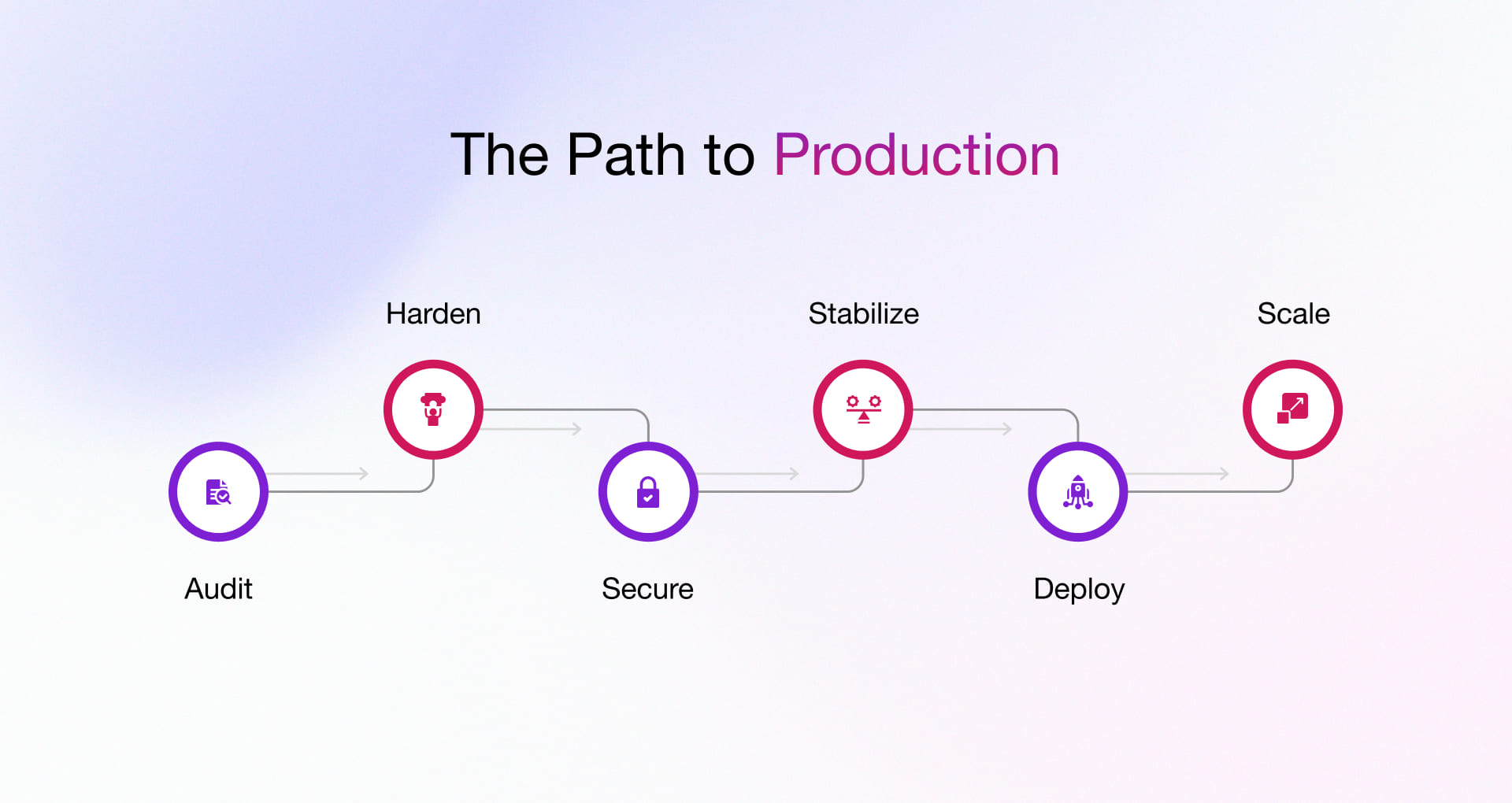
Taking a vibe-coded app to production is never a single fix. It requires a repeatable sequence. The difference between a generic cleanup and a durable fix lies in whether the team running that sequence has already done it on enterprise systems and not just AI demos.
Step 1: Audit and Scoring
Review the codebase, the dependencies and architecture against real production-readiness criteria. The result will be a clear readiness score and a ranked plan to address the gaps.
Step 2: Hardening and Refactoring
Clear the bugs that are already breaking things before they appear in production. Then clean up and refactor the code into something the team can maintain long after the AI wrote the first draft.
Step 3: Security and Compliance Engineering
Build the OAuth flows, role-based authentication, encryption, and access controls the app should have included from day one. Add SAST and DAST scans along with dependency checks that catch issues a human reviewer alone would miss.
Step 4: Backend Stabilization and Integration
Stabilize APIs and databases so silent failures stop occurring before users notice them. Fix the integration patterns around payments and third-party services that vibe-coded apps tend to get wrong.
Step 5: CI/CD, Observability, and Deployment
Run each release like a set routine, not a last-minute struggle. Add monitoring, logs, and alerts that point to trouble early. This helps you act before a customer raises the issue.
Step 6: Scaling and Ongoing Ownership
Identify the bottlenecks before a growth curve turns into a support crisis. Keep ownership with clear SLAs. That way, after the app is live, fixes do not sit too long.
This is how a real vibe-code to production engagement runs: audit, harden, secure, stabilize, deploy and scale.
Why Choose Rishabh Software to Take Vibe-Coded Apps to Production?
Vibe-coded applications still need the same engineering discipline as any production application. Rishabh Software brings web and mobile app development, cloud, data, AI consulting, and integration expertise to review, strengthen, and take these applications from vibe code to production.
Enterprise AI and Digital Engineering Experience
We have shipped GenAI systems at enterprise scale, and we have that expertise to bridge the gap. We don’t just build apps that demo well; we build apps that sell. Our experience spans FinTech, HealthTech, AdTech, Digital Manufacturing, and other enterprise environments where security, scalability, and AI readiness are non-negotiable.
Production Readiness Frameworks
A prototype can show that an application works. It doesn’t show how it will perform under production traffic or how its underlying implementation will hold up over time. We review these gaps across the application and address them before release.
Tool-Agnostic Vibe Coding
Build with Copilot, Cursor, Claude, or another tool. We can work with the code and technology choices you already have rather than requiring you to change your development approach. The focus is on strengthening the application and preparing it for production.
Built to Scale with Your Vision
Not every application needs to move from vibe-coded development to a full enterprise architecture immediately. Depending on its requirements, the application can remain partly vibe-coded, move to a hybrid approach, or evolve toward a more structured architecture as it grows.
Vibe Coding to Production: Frequently Asked Questions
Q: Is vibe-coded code safe to use in production?
A: We have reviewed enough AI-generated code to know this: speed is free, security isn’t. Vibe-coded apps often miss authentication, proper error handling, and endpoint protection. That doesn’t make them unusable; it makes the human review non-negotiable. Once scanned, tested and hardened, the origin of the code does not matter. For a broader look at where AI fits into the product lifecycle beyond just writing code, see our take on AI in product development.
Q: How much does it cost to make a vibe-coded app production-ready?
A: There’s no flat rate here, the cost depends on what the audit turns up. A lightweight cleanup with critical fixes might run a few thousand dollars. A full security, performance, and scalability overhaul costs more, but the scope becomes clear once we know exactly what’s wrong.
- Starter fixes: critical bugs, basic security, deployment setup
- Growth-level work: performance tuning, CI/CD, monitoring
- Full overhaul: security hardening, architecture rework, cloud migration
We quote after the audit, so the number reflects your app’s actual condition.
Q: Should I fix my vibe-coded app or rebuild it from scratch?
A: Most vibe-coded apps don’t need a rebuild. They need the right fixes in the right places. A full rebuild only makes sense in a couple of specific situations.
- Fix it if the core logic works and the issues are security, performance, or code quality
- Rebuild it if the architecture itself can’t support what you need at scale
- Rebuild it if the app runs on a framework or platform you’re planning to abandon anyway
An audit tells you which camp your app falls into before you commit to either path.
Q: How long does it take to make a vibe-coded app production-ready?
A: Timeline depends on what the initial audit finds. A lightweight cleanup covering critical bugs and basic security fixes can take a few weeks. A full security, performance, and scalability overhaul takes longer. The right approach scopes the timeline after the audit, not before it, so the estimate reflects the app’s actual condition.
Q: Which vibe coding tools and AI assistants are supported?
A: The major AI coding platforms, including GitHub Copilot, Cursor, and Claude Code, without requiring a specific stack. Tell the team what the app was built with, and the audit and fix plan gets scoped around that tool’s known patterns and limitations.
Q: Do you also help with infrastructure and deployment?
A: Yes, and it isn’t treated as an afterthought. Cloud infrastructure setup, CI/CD pipeline setup for releases that don’t need babysitting, staging and production environment configuration, and monitoring, logging, and observability once an app is live all fall under the same engagement, across web apps, mobile apps, and backend systems.
Q: Can you optimize existing vibe-coded applications for production?
A: Yes. This is one of our core vibe coding to production services, built for apps that already work but aren’t ready for real traffic or real scale. We improve what’s already there instead of starting from scratch, so you hold onto every bit of progress you have made. Our approach includes:
- Performance optimization across APIs, databases, and caching
- Load testing and infrastructure scaling for traffic spikes
- Crash analytics and error tracking that catch instability early
- Reliability improvements for the workflows that matter most