CTV advertising is shifting from reach-focused campaigns toward measurable outcomes. The global CTV ad solutions market is expected to grow from USD 6.72 billion in 2026 to USD 20.03 billion by 2035, at a CAGR of 10.3%. As investment grows, advertisers need measurement that connects impressions with business outcomes.
A Connected TV (CTV) measurement solution brings exposure and outcome data together, connecting TV impressions with website visits, app installs, purchases, and store visits. The complexity starts when these signals sit across different screens and systems. Data from demand side platforms, publishers, ad servers, and apps must be brought into a consistent measurement layer before performance can be assessed. Reliable CTV measurement depends on how well data is captured, connected, and standardized across the stack.
The key question is whether an existing CTV measurement platform can support these requirements or whether deeper integration, platform extension, or custom development is needed.
How CTV Measurement Platforms Enable Cross-Platform Attribution
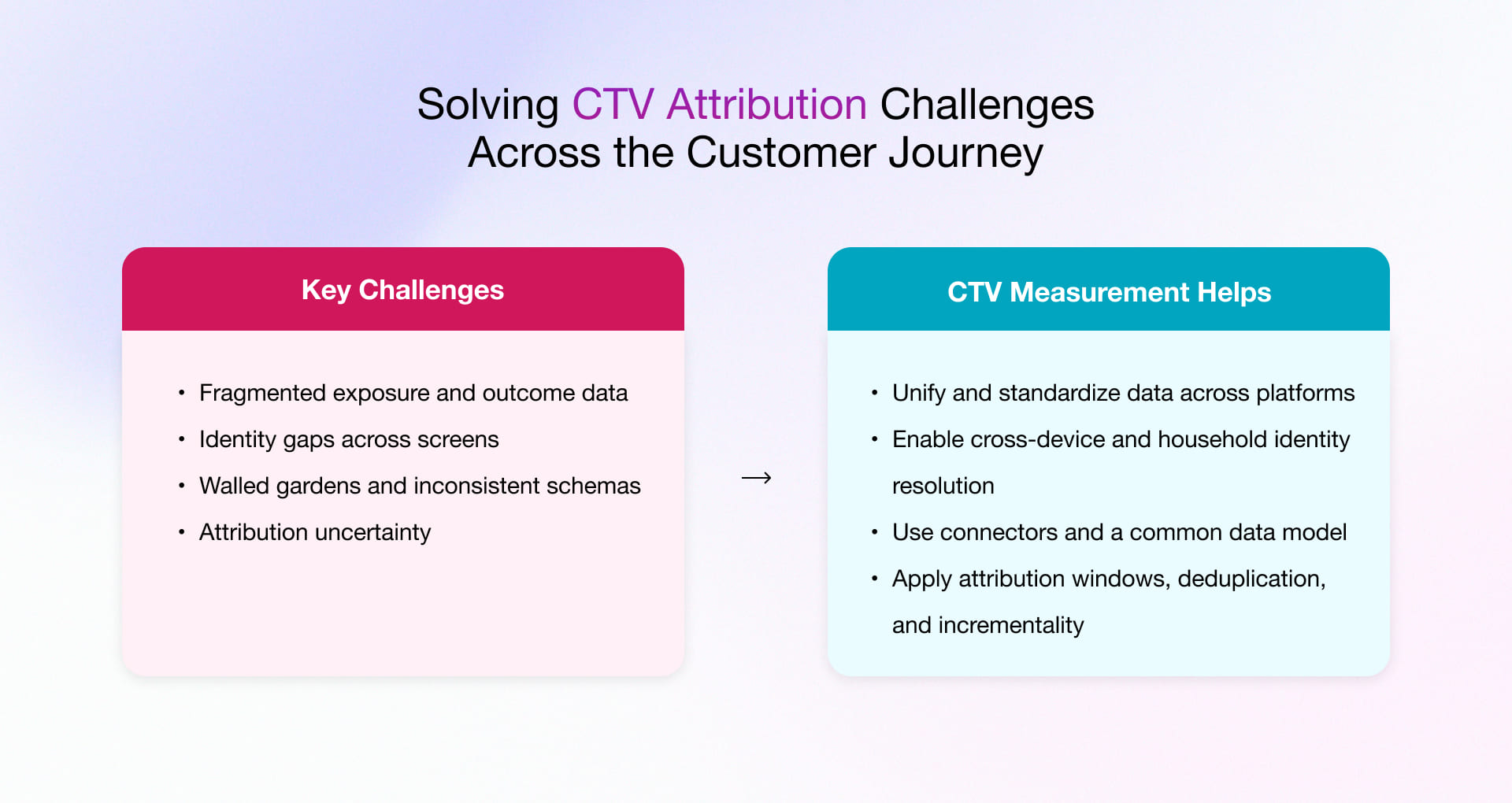
Cross-platform attribution becomes difficult when exposure, identity, platform, and outcome data sit across different systems. A CTV impression may be captured by a DSP or publisher, while the resulting app install, website visit, purchase, or store visit is recorded elsewhere. More data or dashboards alone cannot resolve these gaps. CTV measurement depends on connecting and standardizing these signals so they can be evaluated as part of the same customer journey.
Fragmented Exposure and Outcome Data
The challenge in CTV measurement is often not a lack of data, but a lack of connectivity between signals. An impression sits with a DSP or publisher, delivery data with the ad server, app activity with an MMP, and the eventual purchase somewhere else. These signals become useful for measurement when they can be connected and evaluated as part of the same journey.
That requires looking at the measurement stack from the inside out. APIs, log ingestion, event pipelines, and normalization bring exposure and outcome data into a common structure. SSAI or DAI events also need to retain campaign and creative context. With stronger data centricity, CTV data infrastructure, and advanced analytics built on top, CTV teams can make better decisions with data instead of piecing together disconnected reports.
Identity Gaps Across Screens
CTV exposure is often associated with a household or device, while downstream activity may be tied to a specific device, browser, app account, or other identifier. This creates a measurement challenge: how can a downstream action be connected to the CTV exposure when the identifiers do not directly match?
Cross-device and household identity resolution can help establish these connections using available deterministic and probabilistic signals. A CTV measurement platform may also integrate with identity providers and MMPs to connect TV exposure with web or app activity. How these signals are collected, matched, and governed matters because identity resolution must account for privacy requirements and the limitations of the available data.
Walled Gardens and Inconsistent Schemas
The challenge starts with limited visibility. Walled gardens control how much campaign and audience data leaves their environment, while DSPs, publishers, SSPs, and ad servers can all report the same campaign in different ways. For CTV teams, that makes cross-platform comparison harder and can potentially leave gaps in attribution.
When measurement is carried out across several platforms, connectors, schema mapping, and reconciliation help bring those inputs into a more consistent model. A CTV measurement platform can align identifiers, event definitions, and reporting fields before the data moves into attribution and analytics.
Attribution Uncertainty
A conversion after an ad is not automatically proof that the ad caused it. CTV makes that harder because one household can see several impressions across different publishers before taking action.
Attribution windows and deduplication help control which exposures qualify for credit. Confidence rules narrow the weaker matches. Incrementality goes one step further by testing whether the campaign created additional impact, rather than simply appearing somewhere before the conversion.
How CTV Measurement Works: From Ad Request to Measurable Outcome
CTV measurement brings together signals across the ad delivery and measurement lifecycle:
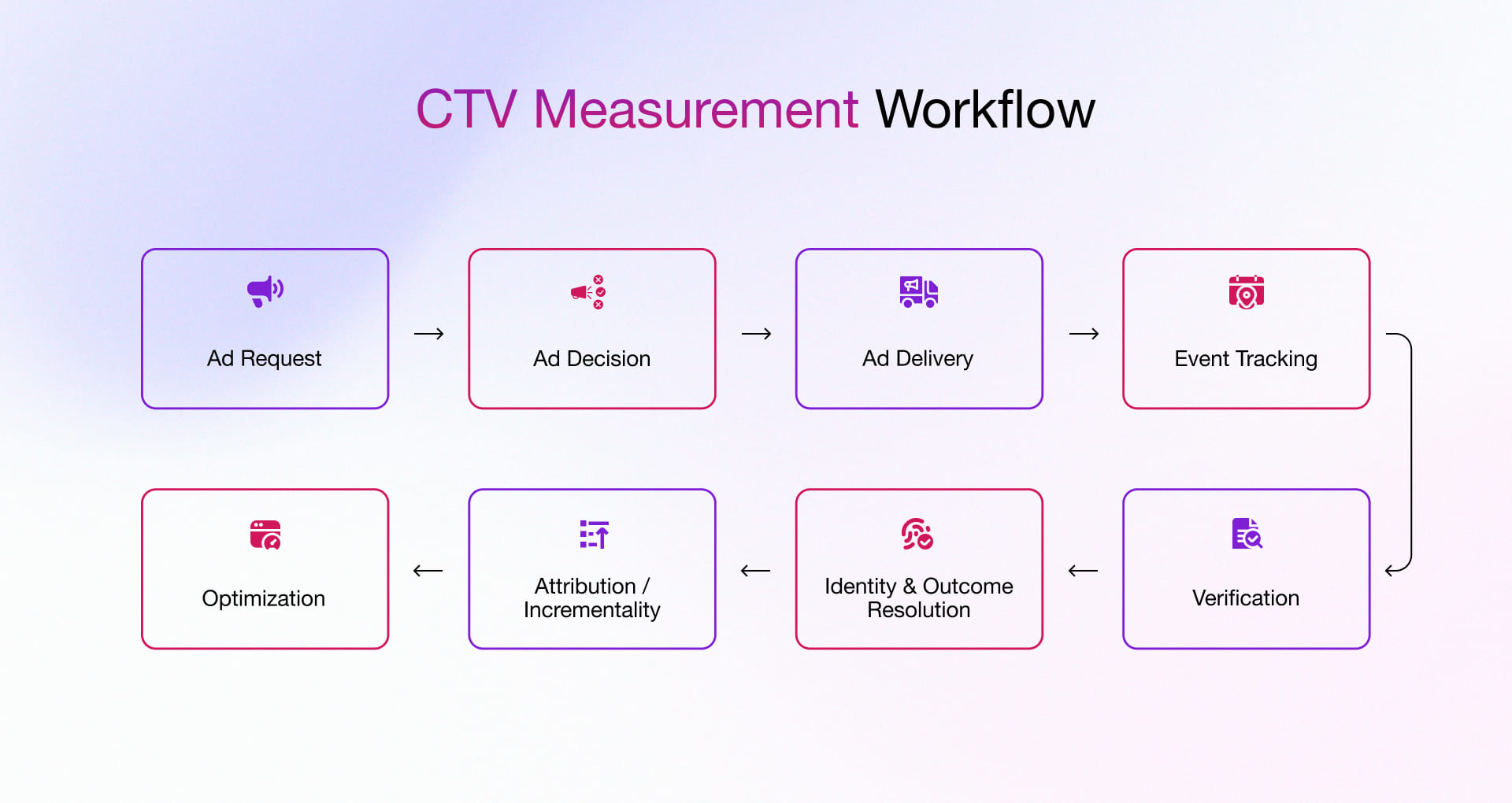
- Ad Request: The CTV app, device, or playback environment sends an ad request into the relevant ad-serving or programmatic infrastructure.
- Ad Decision: The ad-serving or programmatic stack determines which eligible ad is selected for the available impression.
- Ad Delivery: The selected creative is delivered to the CTV environment through client-side or server-side ad insertion, depending on the implementation.
- Event Tracking: Impression, quartile, completion, and other measurement events are captured and sent to the relevant measurement systems.
- Verification: Measurement and verification systems assess delivery, completion, viewability where supported, and invalid-traffic signals to determine whether the impression met defined quality criteria.
- Identity and Outcome Resolution: Available household, device, or other identity signals are used to connect CTV exposure with downstream web, app, or offline outcome data.
- Attribution: The measurement system applies defined attribution windows, rules, and deduplication logic to assign credit across eligible exposures.
- Incrementality: Where an appropriate test design is available, treatment and control groups or other experimental methods are used to estimate incremental impact.
- Optimization: Measurement results can inform targeting, frequency, creative, and media-planning decisions for subsequent campaign activity.
CTV Measurement Solution Capabilities in Practice
Capability lists are easy. Real CTV journeys are not. What happens when the ad runs on TV, the install lands on mobile, the campaign stretches across several buying environments, and the final outcome is a store visit? This is where a CTV measurement solution has to prove its usefulness in practice.
Cross-Device Attribution for Mobile App Conversions
A CTV impression can lead to an app install much later on another device. MMP integrations bring install and post-install events back into the measurement flow, while household or device resolution helps connect them with the original exposure. Google DV360 supports CTV cross-device conversion measurements across mobile and web environments.
Cross-Platform Conversion Attribution Across CTV, Web and Mobile
The same campaign journey can stretch from the TV screen to a browser or mobile app. Impression ingestion, identity matching, conversion feeds, and deduplication help keep that journey intact. Google Floodlight is one example of this kind of cross-environment conversion measurement.
Unified Measurement Across Multiple DSPs and CTV Platforms
Running CTV across several buying and publishing environments creates overlap quickly. API and log ingestion, ID normalization, taxonomy mapping, and a shared data layer help align those views. Google’s Cross-Media Reach reporting is one industry reference point for incremental and deduplicated reach across TV and digital.
Creative-Level Measurement and Performance Intelligence
Campaign totals can hide what is happening at the creative level. CTV teams need to connect creative ID, duration, format, placement, frequency, and completion with outcomes. The IAB Tech Lab Ad Creative ID Framework reflects the industry’s move toward more consistent creative identification across screens.
Incrementality and Lift Measurement
Attribution shows what followed an exposure. Lift asks what actually changed because of it. Holdouts and treatment-control approaches help separate attributed conversions from incremental impact. Google Conversion Lift applies this same experimental principle.
Extending CTV Attribution With Location Intelligence
For a retailer, the measurable outcome does not have to end at a website purchase. Privacy-friendly location data can add visitation signals and help teams look at exposure-to-visit patterns, foot traffic, and other real-world outcomes. Unacast provides location and visitation data that can be brought into these workflows.
This is also a capability Rishabh Software is taking forward through its strategic partnership with Unacast. Announced in July 2026, the partnership combines Unacast’s location intelligence with Rishabh Software’s AdTech, data, analytics, AI, and cloud engineering to build audience measurement, omnichannel attribution, and location-intelligence solutions that connect digital engagement with real-world outcomes.
Build or Integrate: Which CTV Measurement Approach Fits Your Stack?
The choice between building and integrating depends on what already exists in the measurement stack and where the gaps remain. An MMP, identity provider, data warehouse, or location partner may already cover part of the requirement, while proprietary data models or attribution workflows may require deeper engineering. The practical question is which capabilities you can integrate and which you need to keep under your control.
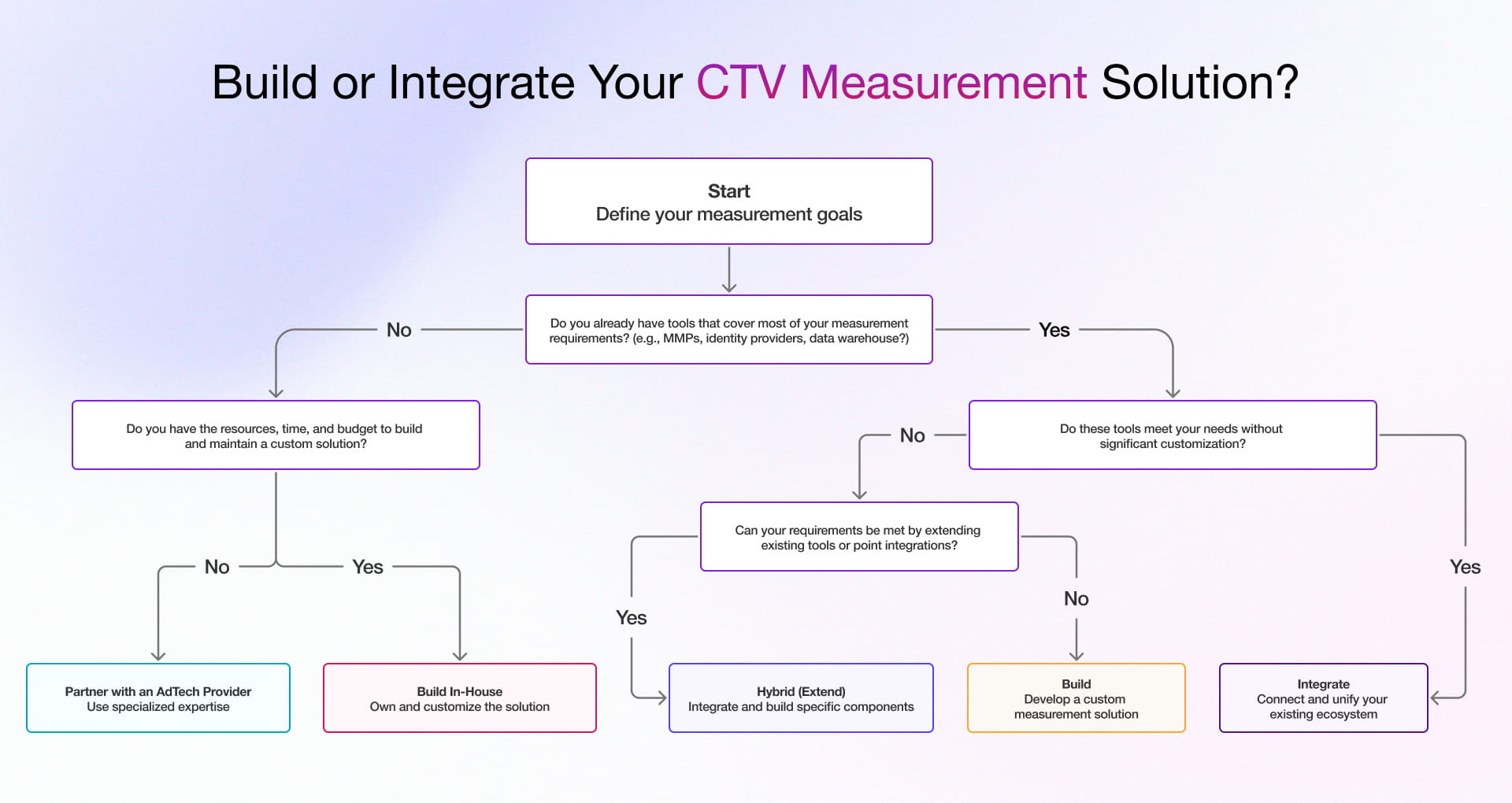
Build when:
- Measurement is part of the product or proprietary IP
- A proprietary attribution methodology is required
- Existing platforms cannot support the required data models or workflows
- The company needs control over the measurement layer
- Integrations themselves become strategically important
Integrate when:
- The required capability already exists
- The requirement is standard
- Speed to market matters
- Third-party data or identity providers already solve the core requirement
- Differentiation lies elsewhere
Integrate When the Measurement Pieces Already Exist
Many CTV teams already have parts of the measurement stack in place. An MMP captures app events. Identity providers support cross-device matching. Warehouses hold campaign data. Location or outcome partners add another signal.
The gap is often connectivity. APIs, event pipelines, identity mapping, and server-side integrations bring these systems into a common measurement flow. When standard integrations cannot support proprietary schemas or deeper platform connections, teams may need custom AdTech software development to extend the measurement stack.
Build When the Measurement Framework Needs More Control
A custom CTV measurement solution becomes relevant when measurement is part of the product itself or when existing platforms cannot support the required workflows.
The build can focus on:
- Event ingestion: DSP, publisher, ad server, MMP, web, and offline signals
- Identity resolution: Household and cross-device matching using available deterministic and probabilistic signals
- Data normalization: A common model across CTV platforms and source systems
- Attribution logic: Custom windows, deduplication, confidence rules, and channel-level touchpoints
- Creative measurement: Creative ID, version, duration, placement, frequency, and outcomes
- CTV-specific workflows: SSAI/DAI events, reach and frequency, co-viewing considerations, and cross-screen measurement
- Measurement APIs: Outputs for analytics, optimization, activation, or proprietary products
Where Rishabh Software Fits
For teams that need more than standard integrations, Rishabh Software can support the engineering layers around CTV measurement. This can include data pipelines, identity integrations, cross-screen measurement, SSAI/DAI workflows, cloud infrastructure, and integrations across CTV, ad servers, DSPs, SSPs, and outcome data sources.
The goal is not to replace a measurement vendor that already meets the core requirement. It is to integrate with the existing stack, extend it where gaps remain, or build proprietary measurement capabilities where they provide product value.
Frequently Asked Questions
Q: What is a CTV ad measurement platform?
A: A CTV ad measurement tool connects ad exposure with outcomes such as app installs, website visits, purchases, or store visits. It helps CTV teams see what happened after an impression and how that activity can be attributed across screens.
Q: How does CTV measurement differ from traditional TV measurement?
A: Traditional TV measurement is largely built around program and audience estimates, while CTV can capture more granular signals from digital ad delivery. CTV measurement can connect ad exposure with device, household, web, app, and other outcome signals, depending on the available data and measurement setup. This makes it possible to measure reach, frequency, conversions, and attribution across screens, although identity, co-viewing, and platform-level data limitations still affect how accurately those connections can be made.
Q: How do CTV platforms measure reach and frequency?
A: CTV platforms measure reach by estimating the number of unique households, devices, or viewers exposed to an ad, while frequency measures how often those audiences were exposed. Because CTV is often viewed on shared screens, co-viewing can affect reach calculations. Measurement platforms use available device, household, and audience signals to deduplicate exposure and estimate reach and frequency across CTV and other digital channels.
Q: How can you improve data quality across CTV measurement pipelines?
A: Start with cleaner inputs. Standardize schemas, normalize campaign and creative IDs, validate events at ingestion, and watch for missing, duplicate, or delayed records. Better data upstream gives the attribution layer a much stronger base.