The digital economy runs on data, and moving it from one system to another remains one of the most underestimated challenges in enterprise IT. Whether you are upgrading platforms, consolidating systems post-merger, shifting to the cloud, or re-platforming across cloud environments, migrations are where things go sideways. Complex dependencies, high data volumes, and the pressure to keep operations running in parallel leave very little room for error.
Your data is your organization’s digital foundation that includes operational insights, customer relationships, and financial records. When you choose to upgrade systems, consolidate platforms, and move from on-premise to the cloud or from one cloud to another, successful data migration is critical to keeping your business running smoothly.
According to Wifitalents, 60% of migration failure in the SME sector is attributed to lack of capital for dual-running environments. This is why you need a strategic data migration checklist. In this blog, we have outlined a stepwise approach to building one, factors to consider when choosing the right data migration strategy, best practices for successful deployment, and how to execute a seamless migration with zero disruption, complete compliance, and a future-proofed data strategy.
How to Build a Successful Data Migration Strategy?
Most migration problems don’t start during execution; they start weeks earlier, when planning gets rushed or skipped altogether. The steps below reflect how experienced migration teams actually approach this: methodically, with each phase setting up the next.
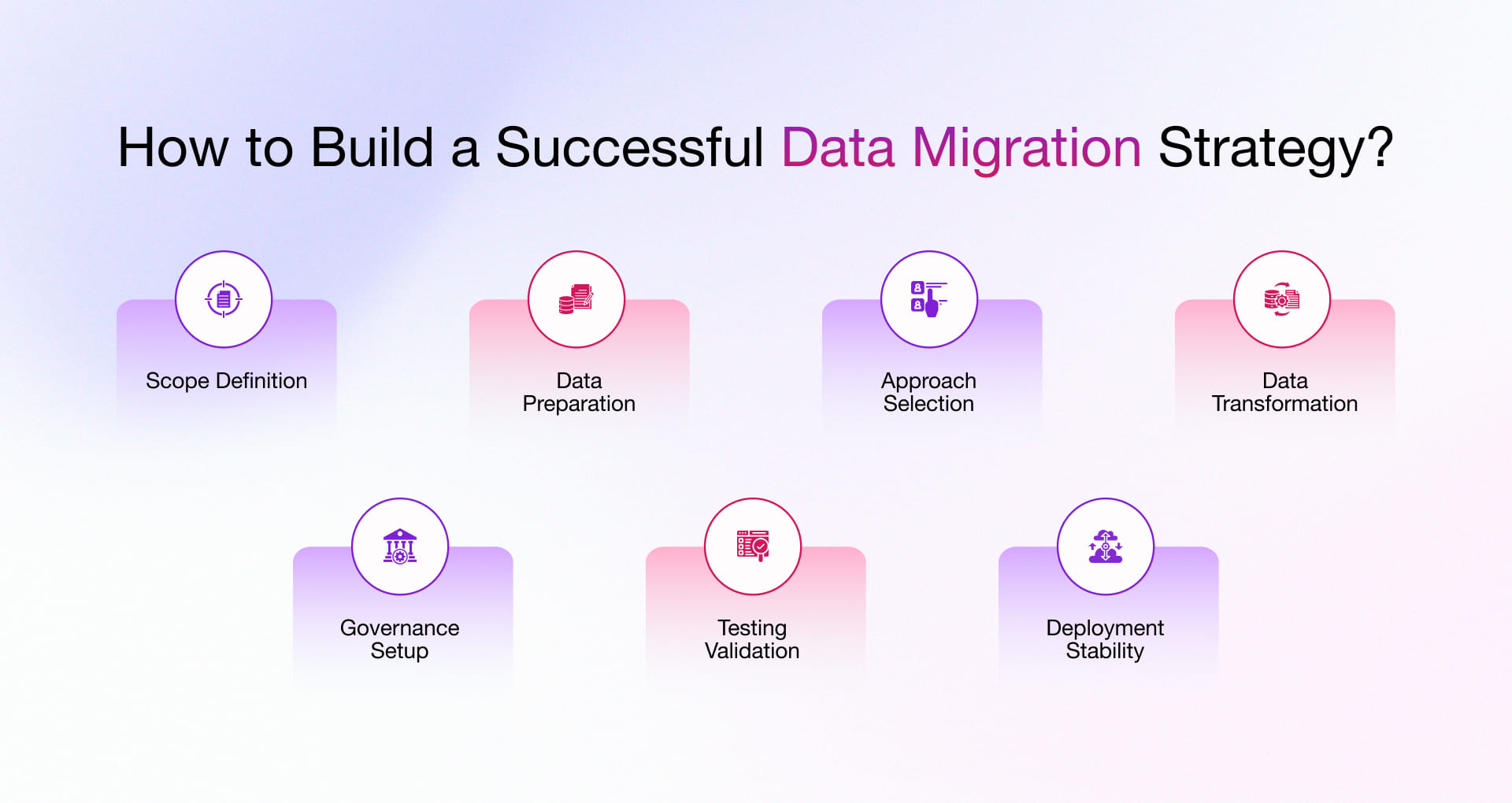
1. Define Business Objectives and Migration Scope
Let us begin by clarifying the intent of data migration. Why do you want to undertake migration: are you planning to adopt cloud-based services? Do you want to shift from an on-premises legacy system? Or is it planning to consolidate scattered data platforms into a single source of truth? Getting such clarity helps with seamless decisions moving forward.
This step aims to define:
- Expected business outcome and measurable success criteria
- The specific datasets and systems within scope
- Regulatory, compliance, and security considerations
Proper planning prevents scope drift and ensures migration remains anchored to the defined business objectives.
2. Evaluating, Filtering, and Preparing Data
When preparing for data migration, a comprehensive data assessment is undertaken to identify redundancies, obsolete, and inconsistent data from the system.
Activities included in this step:
- Evaluate data accuracy through profiling
- Identify duplicates and anomalies
- Cleanse and standardize data
Tip: Establish data backup and recovery mechanisms to protect against potential loss during migration and ensure business continuity in case of rollback requirements.
3. Determine the Migration Approach
Choosing the right migration approach demands evaluating timelines, balancing risks, and ensuring operational continuity. Different data migration strategies, such as parallel, phased, or big-bang, ETL-based, lift-and-shift, and hybrid are used based on system complexity and business constraints.
This decision is influenced by the following factors:
- Downtime acceptability
- Interdependencies between platforms
- Resource availability and project timelines
When the approach is selected after evaluating crucial factors, data migration progresses in a controlled and predictable manner. And given the impact this decision has on risk, timelines, and continuity, leveraging modernization services makes it easier to evaluate and select the most suitable approach.
4. Design Data Mapping, Transformation, and Target Readiness
Both legacy and modern systems have different structural and semantic levels, which is why data mapping and transformation logic play crucial roles. Data mapping is where most migrations silently fail, not due to tooling, but due to misaligned business logic. With the successful execution of this step, data remains consistent, usable, and contextually accurate after migration.
Key considerations at this step include:
- Mapping relationships between storage systems or platforms
- Explicitly mentioning transformation and validation rules
- Alignment of the existing dataset with the destination system’s architecture
Besides, it is equally important to prepare the new system, application, or platform with infrastructure readiness, storage capacity, and system compatibility to accommodate data without performance issues or scalability concerns.
5. Establishing Governance & Ownership
Another step of the data migration process includes establishing governance that defines responsibilities across technical and business teams. This initiative may fail if there is a lack of ownership and unclear decision-making structures.
It includes:
- Defining approval workflows and escalation paths
- Aligning stakeholders across IT, operations, and business units
- Assigning data owners
With strong governance, there is a high chance of mitigating risk and eliminating misalignment.
6. Iterative Testing & Validation
Testing is a crucial step that ensures migration reliability. Several validation cycles are required to ensure:
- Accuracy and completeness
- Data consistency across systems
- Alignment with business rules
Tip: Ensure technical validation and business-level verification to confirm that the migrated data meets operational needs.
7. Handling Deployment and Post-Migration Stability
Deployment does not end with migration; it also includes post-migration tracking to ensure zero disruption. The plan includes rollback strategies, contingency measures, and communication protocols.
Post-migration, monitoring is essential to:
- Identify and fix data discrepancies
- Ensure uninterrupted system performance and stability
- Support user adoption and operational continuity
Along with monitoring, optimizing data processes is also mandatory to achieve the optimal, long-term value of migration.
6 Types of Data Migration Strategies
The selection of the right data migration strategy includes balancing risk, timelines, and business continuity. Each approach comes with its own trade-offs, making it essential to align the strategy with your data landscape, operational constraints, and long-term objectives.
1. Big Bang (All-at-once)
Ideal Fit
- Contained systems that hold necessary components like data, metadata, user authentication, or a database environment
- Lesser interdependencies make it easy to migrate without disrupting system operations
- Environments with high downtime tolerance
Execution Approach
- The entire dataset is migrated in a single event, preceded by extensive pre-validation, testing, and data cleansing.
Key Benefits
- Shorter migration timeline
- Minimizes complexity during migration
- No dual environment maintenance
Potential Risk
- Migration failure causes massive downtime
- Reverting to the old system is time-consuming in case of failure
How Data Migration Experts Mitigate Risks
- Multiple dry runs (mimicking migration process) before actual cutover (Production-Like Conditions) to avoid failure
- Clearly defining rollback pathways in case of failure
- Focusing only on the discussed data, systems, or functionality that needs to be migrated.
Business Benefit
- Minimized operational complexity, saving IT resources and avoiding complex data sync efforts.
- New system usage immediately after the complete migration ends.
2. Trickle (Phased-Wise)
Ideal Fit
- Benefits optimally to large enterprises
- Deeply connected ecosystem
- Less downtime tolerance environment
Execution Approach
- Both source and destination systems remain active while migration happens into smaller phases with incremental data movement.
Key Benefits
- Uninterrupted business operations
- Incremental approach in resolving issues without migration disruption
- Lower immediate risk during execution
Potential Risk
- Difficulty in managing consistency across systems
- Longer timelines and increased coordination
- Long-term project management effort
How Data Migration Experts Mitigate Risks
- Running parallel operations in case new systems encounter issues, the old system remains active for business.
- Ensure continuous synchronization (Data Consistency), eliminating data drift between source and destination systems
- Data migration leverages automated scripts and tools to verify data accuracy.
Business Benefit
- Eliminates operational disruption due to both source and destination system working in parallel
3. Parallel Approach
Ideal Fit
- Best suits in highly regulated or risk-sensitive environments where validation remains uncompromised
Execution Approach
- Data is copied from old to new systems and both operate in parallel, mirroring and comparing outcomes. Once the auditor provides sign-off, the old system is discontinued.
Key Benefits
- Reduced risk of failure with strong fallback capability
- Real-time data integrity validation
- Minimal-to-no downtime with uninterrupted business continuity
- Seamless transition
Potential Risk
- Potentially leads to inconsistencies while maintaining data integrity in both old and new systems
- High risk of slow performance or system failure due to both source and destination systems working together, overloading the servers
- High risk of cyberattacks and sensitive data leakages due to the extended transition phase compared to the Big Bang and Trickle approach
How Data Migration Experts Mitigate Risks
- Migration experts undertake data profiling to navigate the data structure, define dependencies, and create mapping documents before actual execution.
- Duplicates are removed, and only quality data is left
- Use of automated tools to perform validation that compares the accuracy of the source and destination systems
Business Benefit
- Zero downtime
- Strong fallback capability reduces the risk of failure and consequences
- Thorough validation and meticulous testing
- Peak performance and high-volume handling
4. Lift and Shift Approach
Ideal Fit
- For organizations looking to move quickly to the cloud without redesigning data structures
Execution Approach
- Copying data and app from existing environment and pasting them to new system/platform.
Key Benefits
- Minimal existing process disruption
- Rapid migration
- Lesser upfront effort
Potential Risk
- Existing inefficiencies are carried to new ecosystem
- Limited-to-no improvement in data quality or usability
- Requires follow-up transformation initiatives
How Data Migration Experts Mitigate Risks
- Initiating data rationalization before actual migration to remove all the redundancies
- Clear path for post-migration optimization
Business Benefit
- Cost-effective and low-risky
- Quick access to the cloud environment
- Improved security due to cloud model
5. ETL-Based Approach
Ideal Fit
- For the organizations looking to improve data quality, structure, and usability especially for analysis and modern data platforms
Execution Approach
- Data is systematically extracted, transformed, and loaded into the destination system with defined rules covering structure, quality, and relationships.
Key Benefits
- Better data quality
- No duplication or inconsistency
- Better alignment with modern system architectures
Potential Risk
- Dependency on accurate transformation logic
- Demand detailed understanding of source data
- Take more than usual time for preparation and execution cycles
How Data Migration Experts Mitigate Risks
- Strong data mapping frameworks
- Constant validation during transformation
- Collaboration with business stakeholders
Business Benefit
- Peak performance and scalability
- Cost optimization and higher ROI
- Improved operational efficiency and automation
6. Hybrid Approach
Ideal Fit
- For the organizations looking for different approaches for different systems, data types, and business requirements
Execution Approach
- The combination of strategies are implemented across different workloads. For example, lift and shift for a few systems while Big Bang for another set of data.
Key Benefits
- Flexible in adapting different requirements
- Balanced risk and execution agility
- Customized to business priorities
Potential Risk
- Difficult in executing multiple approaches
- High governance requirements
- Increases planning complexity for different approaches
How Data Migration Experts Mitigate Risks
- Segments all system and data domains systematically
- Centralized governance and decision-making
- Alignment across all migration tracks
Business Benefit
- Minimize downtime
- Cost-effective
- Better flexibility and control
How to Choose the Right Data Migration Strategy for Your Business?
Several factors contribute to deciding which strategy works best for a data migration initiative. In real-world environments, decisions are mostly a combination of constraints such as system interdependence, data volume, quality, complexity, migration frequency, and more. Considering the factors on both sides, the decision to choose the data migration strategy is made.
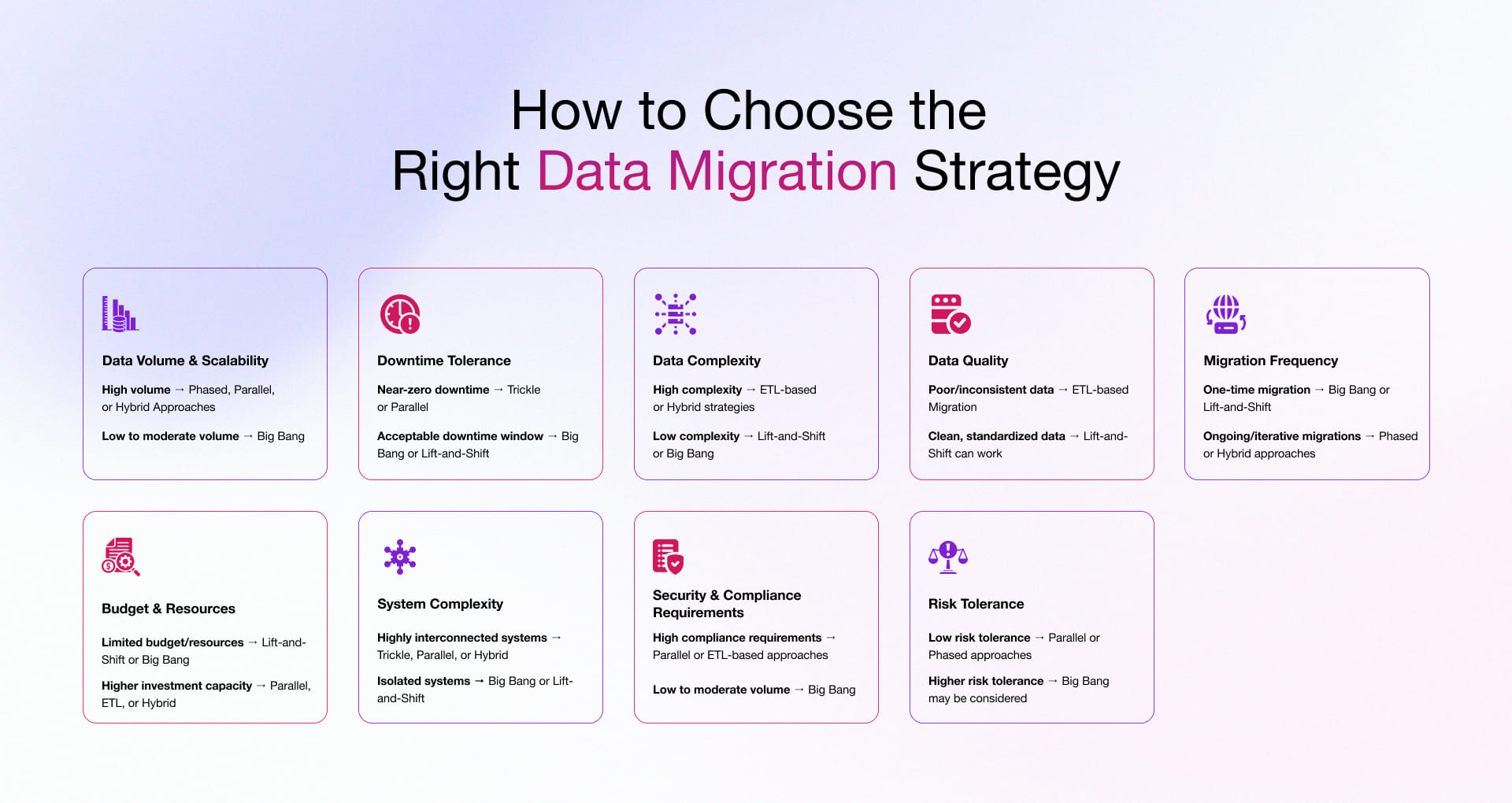
Data Volume & Scalability
Large data volumes increase migration time, infrastructure load, and failure impact.
High volume → phased, parallel, or hybrid approaches
Low to moderate volume → Big Bang
The larger the dataset, the more important it is to distribute migration and validate incrementally.
Downtime Tolerance
This is often the primary decision driver.
Near-zero downtime → Trickle or Parallel
Acceptable downtime window → Big Bang or Lift-and-Shift
If downtime directly impacts revenue or operations, avoid single-window cutovers.
Data Complexity
Includes interdependencies, formats, and transformations required.
High complexity → ETL-based or Hybrid strategies
Low complexity → Lift-and-Shift or Big Bang
Complex data environments require structured transformation and validation, not just movement.
Data Quality
The current state of your data determines whether transformation is necessary.
Poor/inconsistent data → ETL-based migration
Clean, standardized data → Lift-and-Shift can work
Migrating poor-quality data without remediation leads to compounded issues post-migration.
Migration Frequency
Whether this is a one-time initiative or part of an ongoing transformation.
One-time migration → Big Bang or Lift-and-Shift
Ongoing/iterative migrations → Phased or Hybrid approaches
Repeated migrations require repeatable, controlled processes, not one-off execution.
Budget & Resources
Different strategies demand different levels of investment and expertise.
Limited budget/resources → Lift-and-Shift or Big Bang
Higher investment capacity → Parallel, ETL, or Hybrid
Lower upfront cost often comes with higher long-term trade-offs.
System Complexity
Number of systems, integrations, and dependencies involved.
Highly interconnected systems → Trickle, Parallel, or Hybrid
Isolated systems → Big Bang or Lift-and-Shift
More dependencies increase the need for controlled, staged migration.
Security & Compliance Requirements
Critical for regulated industries and sensitive data environments.
High compliance requirements → Parallel or ETL-based approaches
Standard requirements → broader flexibility in strategy
Validation, traceability, and audit readiness become non-negotiable in such cases.
Risk Tolerance
Defines how much uncertainty the business can absorb during migration.
Low risk tolerance → Parallel or Phased approaches
Higher risk tolerance → Big Bang may be considered
The chosen strategy should reflect business risk appetite, not just technical feasibility
Best Practices to Build a Successful Data Migration Strategy
These data migration strategies and best practices ensure success by maintaining predictable, controlled outcomes aligned with business expectations.
Audit and Clean Data Before Migration
Data auditing and cleansing should be undertaken before migration to ensure only governed data is transferred to the new system. Unrefined data carries the risk of inconsistencies and duplications, and upon transferring, it amplifies the risk of deterring outcomes.
Define Clear Mapping Rules
Now begin with defining clear data mapping and transformation rules. It assures that data maintains structure, meaning, and relationship across systems. Such clarity is essential to avoid reporting errors and operational inefficiencies. A well-defined data mapping seamlessly migrates data and aligns with objectives.
Test (multiple stages)
Testing between migration stages helps identify discrepancies and remove them before they cause disruption. Iterative testing is performed to detect and resolve issues early, which eliminates strategy failure risks. It builds confidence in data accuracy and enables transition during cutover.
Backup Everything
Establishing robust fallback mechanisms and backup systems is equally important to safeguard against unpredictable failures during migration. Unexpected issues may show up anytime pre- or during migration, and having the ability to quickly restore systems promises uninterrupted operations and reduces reputational and financial risks.
Monitor Post-Migration
Tracking new system performance in terms of data consistency and user interaction is equally essential as it helps identify issues early, enabling rapid stabilization. Continuous tracking ensures migration delivers sustained value.
Data Migration Challenges and How to Overcome Them
Data migration involves practical challenges that can impact execution and outcomes. Identifying these challenges early and addressing them proactively is key to ensuring a controlled and successful migration.
Data Synchronization Gaps in Ongoing System
Challenge: Source system remains active throughout migration, making data synchronization complex, especially in voluminous transactions.
Solution: By implementing change data capture that monitors and mirrors incremental updates from the old to the new system. Such practice ensures both environments remain aligned throughout the migration process. It prevents data lag and inconsistencies and enables swift transition without hampering live operations.
Performance Constraints During Large-Scale Transfers
Challenge: Another challenge high-volume data creates is bottlenecks in network bandwidth, processing capacity, and storage I/O, or delays in migration timelines.
Solution: This issue is resolved by adopting parallelized data transfer and distributed processing approaches to efficiently handle voluminous workloads. By breaking down data into easily manageable phases and optimizing throughput guarantees stable and rapid migration.
Undocumented Data Dependencies
Challenge: Data often interacts with multiple systems, APIs, and workflows not completely documented. Missing such dependencies results in failures after migration.
Solution: It requires performing data lineage analysis to bridge relationships across systems and identify hidden dependencies. It enables more informed planning while ensuring all the interconnected components are accounted for.
Partner With Rishabh Software to Seamlessly Migrate Your Data
With 20+ years of experience across cloud, legacy, and hybrid environments, our data migration experts have worked with all kinds of complexity that derails migrations, undocumented dependencies, multi-system consolidations, and compliance-heavy data landscapes.
As an AWS Select Tier Services Partner and Microsoft Cloud Solution Provider, we bring both the credentials and the hands-on experience to back it up.
We take end-to-end ownership from migration assessment and approach selection through execution, validation, and post-migration stabilization. If you are planning a 2026 migration initiative and need assistance aligning with your business goals and tailoring it to your ecosystem, connect with us to leverage our results-oriented data modernization services.
Frequently Asked Questions
Q: How do I know if my data is secured during migration?
A: Data is secured when encrypted in transit and at rest, access is restricted via role-based controls, and audit logs monitor all data transitions. Regular validation checks and compliance with standards further ensure robust security.
Q: Can you give me a list of reasons when data migration fails?
A: Common reasons include:
- Incomplete understanding of data and dependencies
- Poor data quality
- Inadequate testing
- Incorrect mapping or transformation logic
- Lack of rollback mechanisms
- Underestimating time and resources
- Weak governance and stakeholder alignment
Q: What is included in the data migration plan?
A: Data migration plan typically includes:
- Migration scope and objectives
- Data assessment and mapping rules
- Chosen migration approach
- Risk mitigation and rollback strategy
- Testing and validation processes
- Timeline, resources, and governance structure
Q: What is zero-downtime data migration?
A: Zero-downtime migration is an approach where data is moved without interrupting business operations, typically using real-time synchronization methods so both old and new systems run concurrently until final cutover.