
A study by IEOM Society International indicates that eliminating paper from the Production Floor can save over “21 minutes per production time/cycle” and reduce the consumption of daily paper usage. This is not limited to administrative impact. It directly affects production capacity, product quality, and delivery timelines.
In many manufacturing environments, paper-based workflows such as manual quality checks, paper-driven setups, handwritten batch records, Gemba boards, and the printing of Excel files are still common. Some manufacturers even have WhatsApp groups where they post or take notes on the production process. These 21 minutes per cycle often lead to unplanned downtime, operator wait time, and data-entry errors.
That is where paperless manufacturing changes the dynamics. It benefits by:
- Enabling real-time workflows instead of delayed and manual updates
- Improving equipment performance through better data availability
- Reducing quality issues caused by manual recording errors
- Providing better control over work in progress, scrap, and changeover activities
In this blog post, we will discuss how moving to a paperless Production Floor environment can improve throughput, reduce operational waste, strengthen traceability, and create a foundation for MES-level visibility without adding headcount or new capital. But it starts with noticing operational use cases and pain points. Therefore, look at where the paper-based trails are the most.
Production Floor Use Cases and Pain Points That Make Paperless Manufacturing a Priority
Production floor operations often rely on paper forms, whiteboards, standalone spreadsheets, and verbal communication across planning, assembly, quality, maintenance, material tracking, and compliance. These disconnected, manual processes create significant friction by limiting real-time visibility, slowing decision-making, increasing the risk of errors, and making traceability and accountability difficult.
Before investing in digitalization, organizations should identify where these paper-based workflows are causing delays, data inconsistencies, rework, or compliance risks. These are the areas where paperless manufacturing can deliver the highest impact.
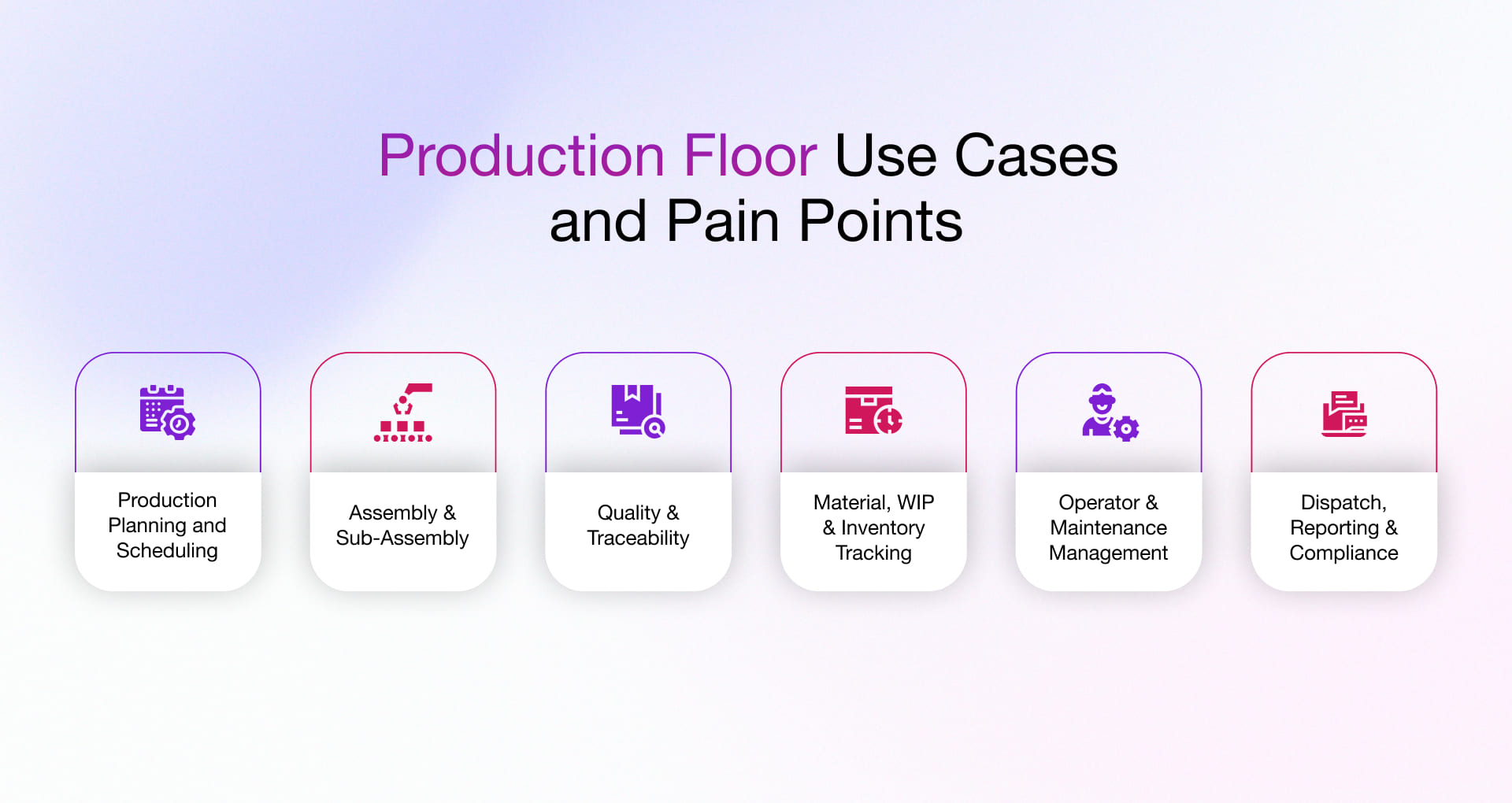
1. Production Planning and Scheduling
Planners often rely on Excel spreadsheets and paper travelers to schedule work orders, with limited real-time visibility into capacity and bottlenecks. When this is digitized, work orders, job status, and line output are visible in real time, so teams can reduce wait time, stay on track, and report more accurately at the source.
2. Assembly and Sub-Assembly Operations
Operators often rely on printed SOPs and laminated instructions, while BOM verification, kitting, and routing are handled manually. This leads to wrong-part assembly and rework. Digitized work instructions and station-level validation help standardize execution, capture torque and fastening data, and improve first-pass yield without requiring full automation.
3. Quality Management and Traceability
In-Process Quality Checks (IPQC), First Article Inspection (FAI), Non-Conformance Reports (NCR), and rework logs are typically stored on paper or in disconnected Excel files, delaying defect visibility and weakening batch or serial traceability. A paperless setup captures quality data at the source, links it to jobs and lots, and makes it easier to spot trends early and stay audit-ready.
4. Material, WIP, and Inventory Visibility
Gate passes, manual WIP tracking, and end-of-shift scrap tallies leave planners with limited visibility into the true status of materials and orders. Digitized material movement, WIP dashboards, and traceability workflows keep system records aligned with shop floor reality, enabling more accurate planning and faster exception handling.
5. Operator, Maintenance, and Shift Handover Processes
Skill matrices, job allocation, breakdown reporting, and PM schedules often live in Excel, Whiteboards, WhatsApp, or logbooks. Low-code floor apps and downtime/maintenance workflows improve accountability, reduce escalation delays, and create a searchable history of who did what, when, and why.
6. Dispatch, Reporting, and Compliance
Dispatch checks, packing instructions, and labeling are spread across paper, email, and spreadsheets, while supervisors spend 30 to 45 minutes compiling shift reports and teams scramble during audits. Centralizing records and approvals in a paperless system reduces report preparation time, simplifies audits, and ensures everyone works from a single source of truth.
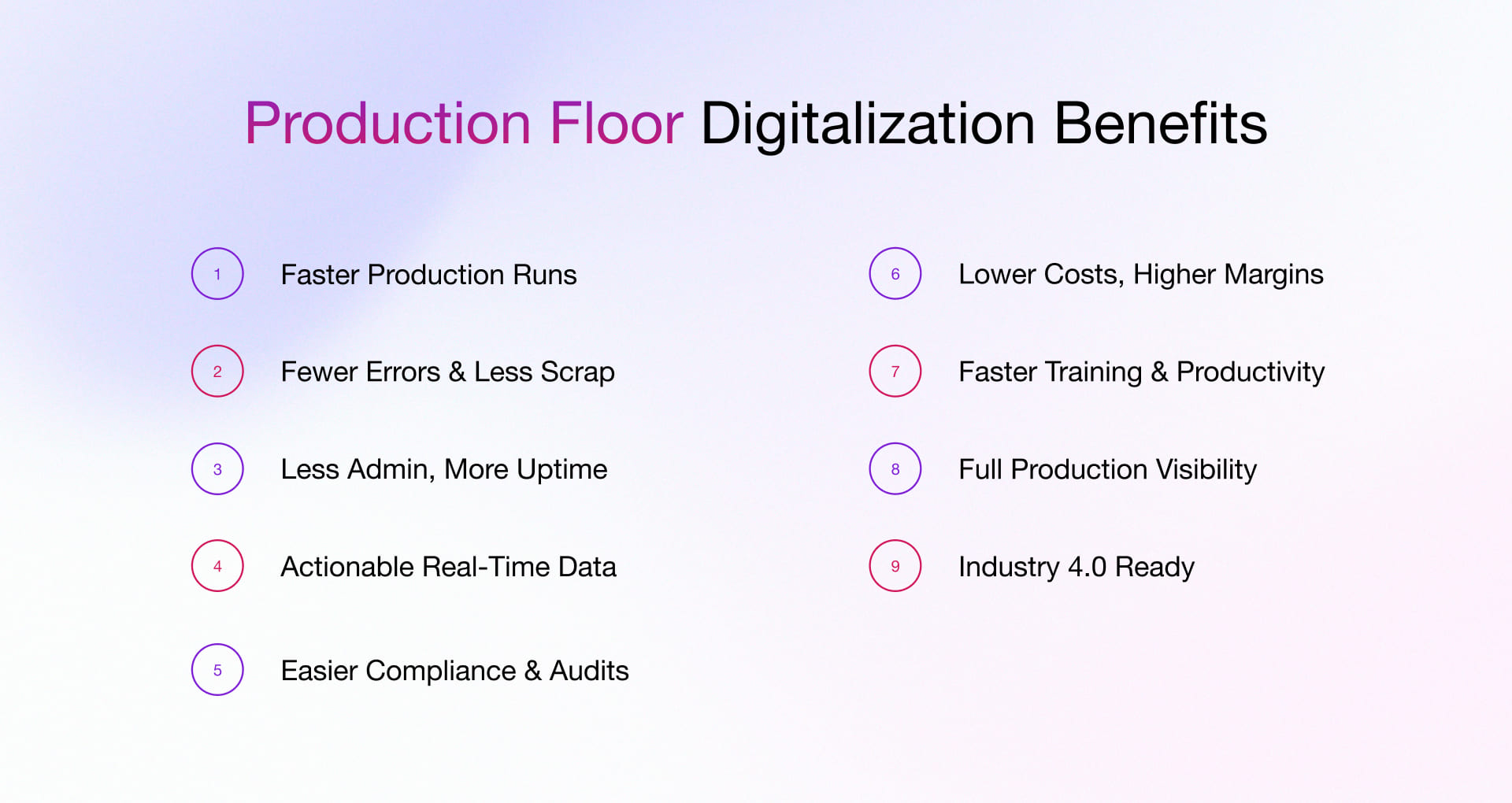
Paperless Manufacturing: Top 09 Benefits of Digitalizing Your Production Floor
These benefits show how a paperless production floor enables faster production, fewer errors, reduced administrative effort, simpler audits, and better real-time visibility. Each benefit is linked to key metrics, including OEE, scrap rates, lead times, and overall margins.
1. Production Runs Faster (No Paper Delays)
On the paper-based Production Floor, critical information is often delayed by manual handling and approvals, slowing cycle times and reducing productivity.
On a paper-based Production Floor, critical information is often delayed due to manual handling and approvals. This slows down cycle times and reduces overall productivity.
By replacing setup sheets with digital work orders and clear work instructions, information such as routes, drawings, and checklists is available at the point of use. Operators do not need to wait or switch between systems.
This helps keep production moving, leading to shorter cycle times, improved equipment performance, and more consistent on-time output.
2. Fewer Mistakes, Lower Scrap
Manual data entry, such as job numbers, batch details, and process parameters, increases the risk of errors. This often leads to defects, rework, and quality issues.
By removing paper from the Production Floor and capturing data digitally at the point of work, as a manufacturer, you can reduce manual entry and improve data accuracy. This creates a more reliable flow of information across production and quality processes. According to Dassault Systèmes, this approach can help reduce waste by up to 25 percent.
3. Less Admin, More Machine Time
Operators are still spending significant time maintaining paper logs and reports. In many cases, hundreds of documents are processed daily to support a limited number of production orders. The IEOM study highlights this imbalance, in which large volumes of paperwork are required to move just a small number of orders through the plant.
By replacing paper with digital forms and automated data capture, it is very convenient to reduce manual efforts. This allows operators and supervisors to focus more on core activities such as machine setup, changeovers, and problem-solving. As a result, existing capacity is better utilized without adding new resources.
4. Real‑Time Data You Can Actually Use
Paper-based workflows delay information, leading to slow decisions, downtime, and inventory issues.
With digital data capture, tablet-based digital apps, and real-time dashboards, production, downtime, and work in progress become visible as they happen. This allows planners and production teams to identify issues early and resolve them within the same shift instead of reacting days later.
5. Easier Compliance and Audits
Paper-based data collection leads to outdated, disorganized, and hard-to-retrieve records, while the absence of a centralized digital system results in reactive compliance and poor data integrity, which often leads to violating ALCOA+ principles.
With electronic batch records, industrial handheld, e-signatures, and integrated document control, records are structured and easy to access. This ensures audit-ready documentation, reduces compliance risk, and removes the need for last-minute audit preparation.
6. Lower Costs, Higher Margins
Paper may seem low-cost, but manual handling, errors, and delays increase the cost per order.
By moving to digital workflows with integrated systems and automated reporting, these extra handling and re-entry efforts are reduced. This leads to less waste, more usable output from the same resources, and better margins per order.
7. Easier Training and Better Team Productivity
Operators often spend time managing paperwork rather than focusing on core tasks, thereby affecting overall productivity.
With clear digital work instructions, guided checklists, and standardized forms, training becomes more consistent and easier to scale. This helps teams get up to speed faster and improves day-to-day productivity on the Production Floor.
8. Better View of Your Whole Production Floor
A paper-heavy Production Floor often relies on whiteboards, spreadsheets, Gemba boards, and reports that quickly become outdated.
With integrated systems, you get a live WIP, queues, and performance KPIs visible in a unified system. This ensures that operations, planning, and management teams work with the same current information instead of outdated reports.
9. Ready for Industry 4.0
Paper-based data limits system connectivity and makes it difficult to use data for timely decisions and improvements.
By digitizing Production Floor processes and connecting them with industrial handhelds or digital apps core systems, you create a reliable data foundation for better planning, maintenance, and performance tracking.
This is why moving to a paperless Production Floor is an important step toward a more connected and efficient manufacturing operation. If you are exploring how to get started, the right approach can make the transition practical and scalable.
Why Choose Rishabh Software for Implementing Paperless Operations in Your Manufacturing Plant
Partnering with a prominent services provider in digital manufacturing is essential to take the paper out without disrupting what is already working. At Rishabh Software, we start with your value streams, constraints, and existing ERP setup. We then extend your systems to better support Production Floor operations. We design and implement paperless workflows, integrations, and applications that fit your plant, not the other way around.
As your reliable digital manufacturing solutions provider, we help you:
- Replace critical paper with work orders, work instructions, QC check sheets, and downtime logs with role-based digital screens and e-forms at the point of use, so operators always work with the latest information.
- Connect machines, sensors, MES, and ERP, so order status, production counts, and quality results flow automatically, giving decision-makers real-time visibility instead of delayed reports.
- Build analytics and KPI dashboards on top of your production and quality data, so you can see bottlenecks, scrap drivers, and OEE trends and act on them, not just report them.
- Automate approvals, escalations, and notifications that currently depend on manual follow-ups, freeing your supervisors and engineers to focus on operations.
Frequently Asked Questions
Q: Do we need to replace our existing system to go paperless?
A: No. A practical paperless strategy usually extends existing ERP, MES, QMS, or line-of-business systems with a digital layer for Production Floor workflows, data capture, approvals, and traceability, rather than replacing everything.
Q: What areas of manufacturing should we digitalize first?
A: We begin with high-impact, paper-heavy processes where inefficiencies are most visible:
- Production workflows: Work orders, job travelers, and routing
- Quality management: IPQC, FAI, NCR, rework tracking, and calibration records
- Production Floor data capture: Downtime logs, machine performance, operator inputs
- Inventory & material tracking: Batch records, material movement logs
These areas typically deliver quick wins in efficiency, accuracy, and visibility, making them ideal for pilot initiatives.
Q: Can we start small before scaling plant-wide?
A: Yes. Many manufacturers begin with one line, one department, or one workflow, then scale after proving the impact on cycle time, visibility, traceability, or reporting effort. That phased approach reduces risk and supports faster adoption by operators, supervisors, and plant leadership.