The era of web apps, then mobile apps and now AI-driven systems have dramatically expanded the volume and variety of data sources organizations must manage. And such abundance of data sources brings an opportunity for organizations to extract customer insights, optimize operations, and build a strong competitive edge. However, many organizations still face challenges to extract meaningful information because of scattered data or trapped in silos, eventually resulting in inconsistent reports and slow query performance.
At parallelly, the data volume grows exponentially. 230-240 zettabytes in 2026 predicted by digitialisationworld. The cloud data warehouse market is forecasted to grow at a 6.6% CAGR from USD 23256.4 Million in 2025 to USD 24791.33 Million in 2026. And being data-driven organization is quite a mandatory factor, which is around 72% of organizations adopted for intelligence and reporting.
That is where data warehousing implementation becomes utmost important. By consolidating data from data sources into a centralized, unified, structured, and analytics-optimized platform, a data warehouse offers organizations with a prominent foundation for reporting, advanced analytics, and strategic decision-making.
This blog covers need for data warehouses, the latest trends shaping modern implementations, and the platforms commonly used for warehousing. It also outlines a practical implementation plan, key components of data warehouse architecture, the roles involved in implementation projects, and best practices for building scalable systems. We have shed light on common implementation challenges with solutions and conclude with the business benefits of a well-implemented data warehouse.
Need For Data Warehouse Implementation?
Mission-critical systems like ERP, CRM, and more are the backbone of any business. They utilize relational databases for data storage. But as companies scale with acquisitions & mergers or expand into new verticals, visibility becomes an increasing issue. The task of retrieving data from disparate systems & analyzing it is highly time & resource intensive. This visibility issue gradually starts hampering further business growth. Here comes the need for the implementation of a Data Warehouse System.
According to industryresearch,
- Enterprises invest heavily in data warehouses with 72% reporting reduction in operational costs.
- Banks leverages data warehouses to evaluate their 52 billion annual transactions.
- Ecommerce businesses monitor real-time data from 1.5 billion global shoppers.
- Healthcare benefits with data warehouses and improving treatment insight for over 200 million patients.
Data Warehouse Implementation Trends
Organizations no longer depend on traditional, monolithic architectures, instead they are adopting advanced, flexible approaches to build scalable and efficient analytics platforms. Here are the following trends that highlights the key shifts in molding how data warehouses are designed, implemented, and optimized.
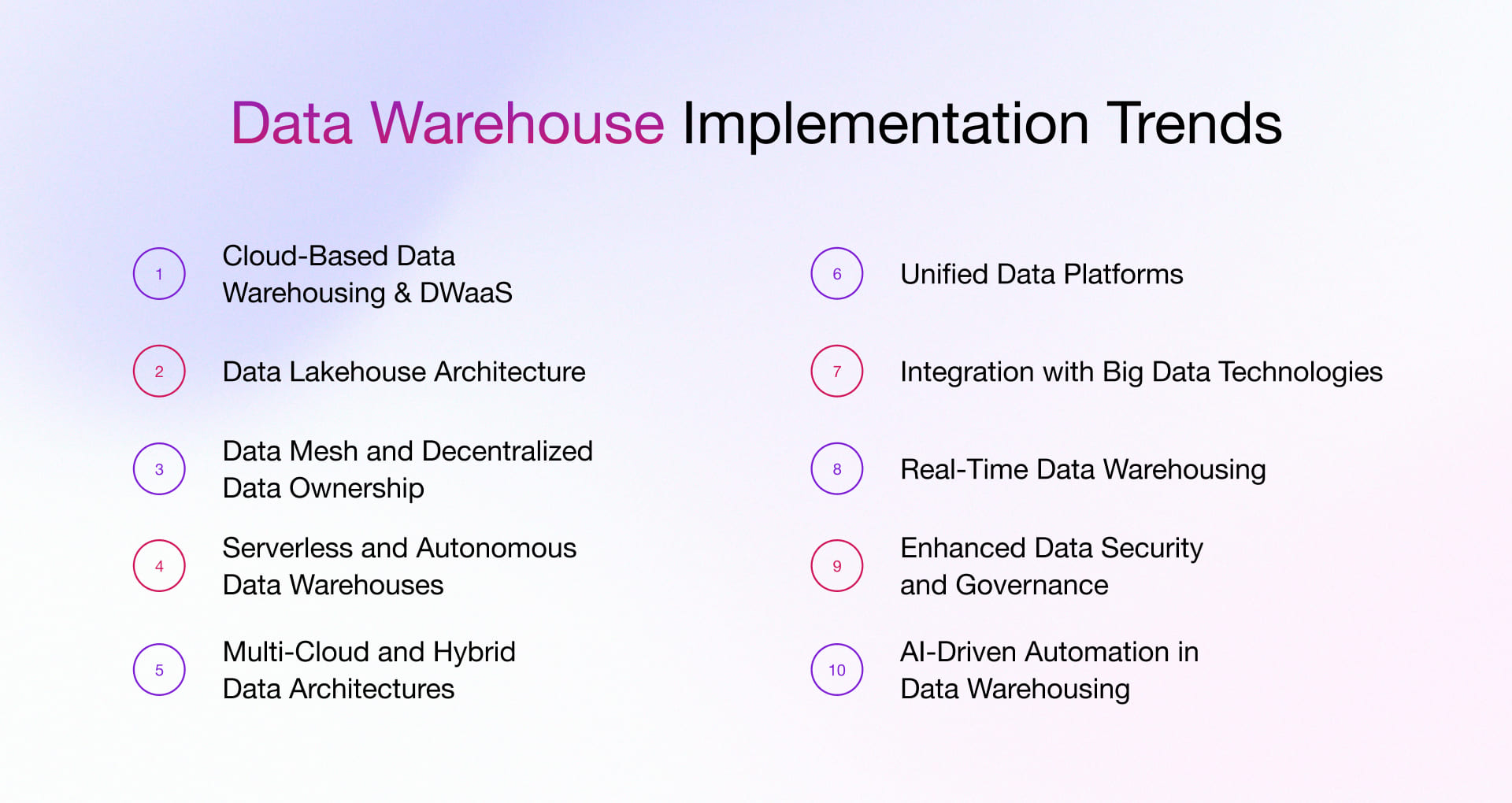
1. Cloud-Based Data Warehousing & DWaaS
One of the data warehouse implementation trends with high demand is adopting cloud-native data warehouse. It enables scalability, flexibility, and cost efficiency. Cloud warehouses allow businesses to scale and process data independently without hampering each other and pay per usage.
Key characteristics are:
- No manual dependency for scaling
- Access across the globe
- Pay per use pricing
- Minimal infrastructure requirements
2. Data Lakehouse Architecture
Data Lakehouse Architecture enables organizations to process structured, semi-structured, and unstructured data within a unified platform. Organizations that depend on large datasets in analytics and data warehouse implementation in data mining projects benefit the most through Data Lakehouse architecture. Also, it simplifies data warehouse implementation while keeping data platform separate by supporting machine learning workloads and analytics.
Key benefits include:
- Less data duplication
- Single source of truth for structured and unstructured data
- Support for analytics and machine learning workloads
3. Data Mesh and Decentralized Data Ownership
Another trend on the list is data mesh that helps in overcoming advanced data security challenges through decentralized ownership. It shifts traditional data warehouse implementation approach by shifting responsibility from centralized data teams to domain-specific teams. Organizations adopt domain-specific data architectures to improve accountability, scalability, and rapid access to insights.
Key benefits include:
- Rapid development of data products
- Domain-backed data ownership
- Better scalability
4. Serverless and Autonomous Data Warehouses
Serverless technologies are how to implement data warehouse platforms since they are removing the dependency for manual infrastructure management. Such autonomous data warehouses enable automatic query optimization, workload handling, and resource scalability on demand. Such capabilities minimize operational complexity during data warehouse implementation steps that allow teams to aim at data modeling and analytics rather than system administration.
Key capabilities include:
- No manual dependency for backups and patching
- AI-backed optimization
- Self-scaling infrastructure
- Automatic tuning
5. Multi-Cloud and Hybrid Data Architectures
Organizations opt for multi-cloud or hybrid data warehouse strategies to eliminate single vendor dependency and increase reliability. Such approach enables workload distribution across multiple cloud vendors, improve disaster recovery strategies, and support global compliance requirements.
Business benefits include:
- Data recovery management
- Compliance across regions
- Workload portability and distribution
6. Unified Data Platforms and the Modern Data Stack
Organizations, previously, used to process data ingestion, transformation, storage, and analytics into disparate systems. But with unified data platforms, everything falls under a single ecosystem. And such shift toward a modern data stack eliminates the dependency from scattered tools and simplify data warehouse implementation. It enables seamless data workflows and rapid access to insights.
Key capabilities include:
- Simplifies data management.
- Reduces tool fragmentation.
7. Integration with Big Data Technologies
To manage large databases and complex workloads, organizations have started implementing Big Data technologies. Now, distributed processing frameworks are basic in modern architecture as it enables analytics, predictive modeling, and machine learning on massive datasets. It reflects a shift towards combining data warehousing with big data capabilities for advanced use cases.
Key capabilities include:
- Predictive modeling integration
- Enabling distributed processing frameworks
8. Real-Time Data Warehousing
Faster insights mean success and competitive edge, which was not possible with traditional warehouse that relied on batch processing. Real-time data pipelines enable organizations to collect events from apps, digital platforms, and connected devices. Such capability allows companies to respond quickly to operational iterations and customer behavior.
Business benefits include:
- Enhanced operational efficiency
- Immediate detection of disaster
- Better customer experience through customization
9. Enhanced Data Security and Governance
With data warehouses becoming the central repository for enterprise analytics, security and governance are receiving increased attention. Modern data warehouse implementation plans incorporate strong access controls, data lineage tracking, and regulatory compliance mechanisms. These capabilities help organizations maintain trust in their analytics environment while protecting sensitive data.
Business benefits include:
- Safeguards your organization’s crucial data
- Better operational efficiency with unified data
- Governed analytics
10. AI-Driven Automation in Data Warehousing
AI embeds into modern data platforms to automate tasks like data preparation, anomaly detection, and query optimization. Such capabilities make data warehouse implementation simple and improve operational efficiency. AI-driven automation reduces the difficulties that come with managing large-scale data environments.
Business benefits include:
- Automation of demand
- Overcomes manual dependency and challenges
Data Warehouse Platforms We Recommend
Choosing the right platform is critical to data warehouse implementation, as it determines scalability, performance, and integration capabilities. Organizations can choose from modern data warehouse tools depending on data volume, existing systems, and long-term analytics goals to ensure a scalable and efficient data environment.
1. Snowflake
Best for: sharing data, multi-cloud environments, and scalable analytics
How it benefits business:
- Execute secure data sharing between partners, customers, department without duplication
- Enables businesses to scale compute and storage independently while optimizing costs
- Help organizations to not dependent on single vendors by supporting multi-cloud deployment
- Suitable for companies to build modern data platforms and collaborative analytics environments
2. Amazon Redshift
Best for: enterprises already leveraging AWS infrastructure
How it benefits business:
- Enables end-to-end data pipelines while swiftly integrating with AWS services
- Handles large-scale analytical workloads seamlessly
- Supports organizations running data lakes on Amazon S3
- Suitable for businesses developing analytics solutions within the AWS environment
3. Google BigQuery
Best for: serverless analytics and large datasets
How it benefits business:
- Removes dependency on infrastructure management through serverless architecture
- Enables high-speed analytics on petabyte-scale data
- Easily integrates with machine learning tools for advanced analytics and AI development
- Help organizations fetching insights from large datasets
4. Azure Synapse Analytics
Best for: companies using Microsoft Technologies
How it benefits business:
- Easily integrates with Microsoft tools like Dynamics 365, Power BI, Azure Analytics Services
- Allows data warehousing and big data analytics into a unified platform
- Make analytics ecosystem easier for enterprises already leveraging MS ecosystem
- Implements rapid development of enterprise reporting and analytics solutions
5. Teradata Vantage
Best for: Large scale enterprise analytics ecosystem
How it benefits business:
- Offers advanced workload management for complex queries
- Often used by large enterprises in finance, telecom, and retail
- Supports large-scale operational and strategic analytics
- Created for high-performance enterprise-level analytics
Data Warehouse Implementation Plan
Here’s a step-by-step data warehouse implementation process based on our experience developing custom DWH solutions across multiple industries. It covers all phases of DWH development – from the consultation to the support & maintenance.
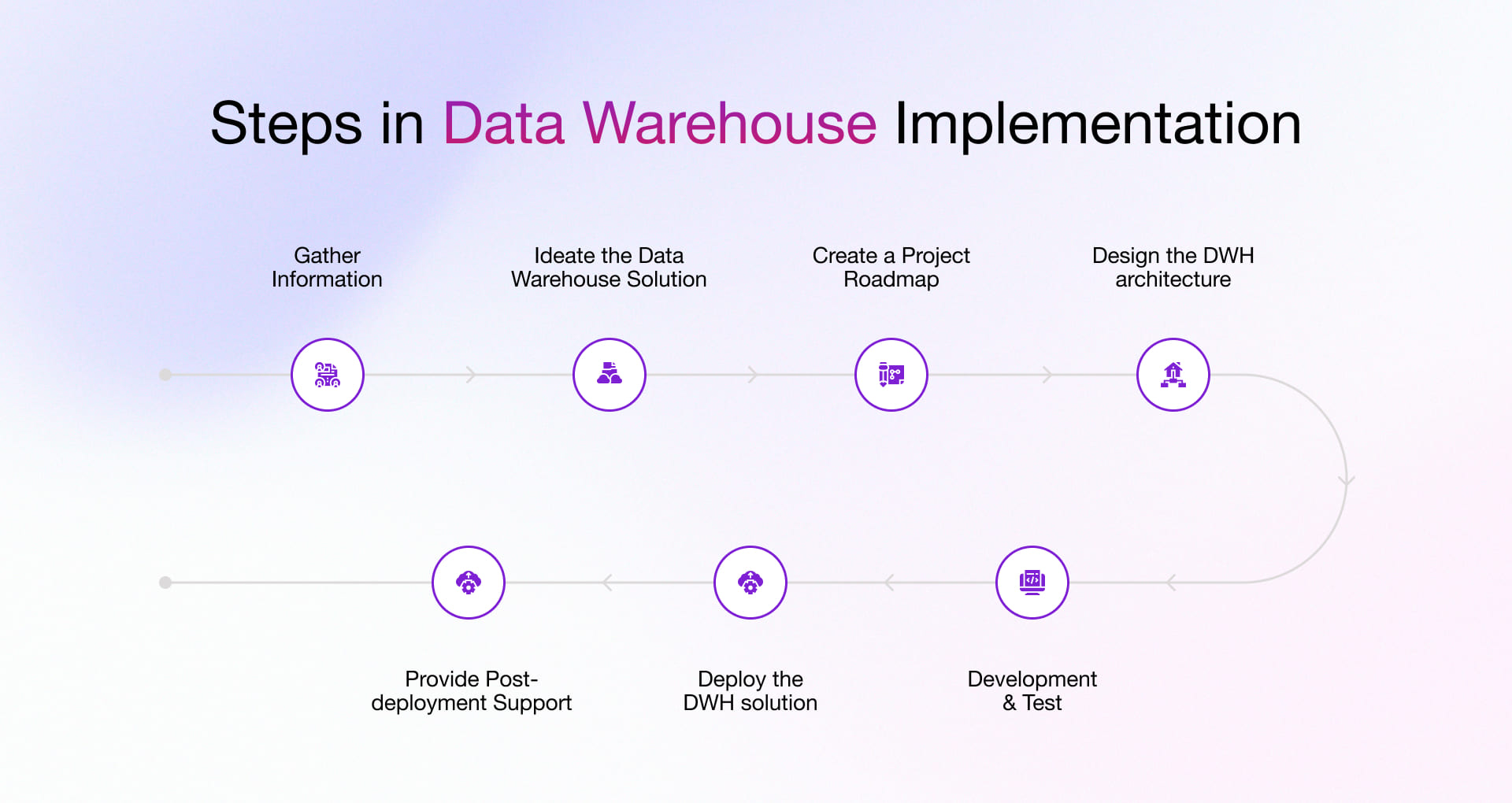
The steps for implementing a data warehouse include the following:
- Gather Information
- Ideate the Data Warehouse Solution
- Create a Project Roadmap
- Design the DWH architecture
- Develop & Test
- Deploy the DWH solution
- Provide Post-deployment Support
Read our blog on data warehouse development if you want to create one from scratch. However, some steps may vary depending on project complexity, data quality, data analytics objectives & more.
Components of Data Warehouse Implementation
A standard DWH is based on an RDBMS server which acts as a central information repository. It is surrounded by data warehousing components to make the entire environment functional, manageable & accessible.
The core components of a data warehouse architecture include:
- The Data Source Layer
- The Data Staging Layer
- The Data Storage Layer
Each layer performs specific functions and uses a particular set of Software. To understand each layer in detail, read here.
Benefits of Data Warehouse Implementation
Data warehousing provides immense advantages to companies of all sizes. Here are some of them:
- Better decision making: Improved analytics & business intelligence capabilities with ready access to all the data in one place & a variety of querying tools to generate ad-hoc reports quickly
- Accurate data management and delivery: One of the essential advantages of using a data warehousing system. It helps store all types of data from different sources onto a single base that can be used for analysis purposes.
- Reducing costs: Helps avoid duplication of work, enables reducing the cost & supports increasing the efficiency of the organization
- Saving time: Users save time previously utilized in retrieving data from multiple sources & the total turnaround time for analytics & reporting.
Guidelines for Data Warehouse Implementation
Being a significant component of a data engineering project, it is more likely to meet roadblocks. However, an experienced tech partner like Rishabh Software can help you navigate through them & support you with the right solution for your business.
Based on our experience, here are some of the proven practices for data warehousing implementation:
- Get management support – DWH development could be both time-consuming & resource-intensive process; it is better to take it up after receiving a sustained commitment from the management team.
- Joint management by IT & business teams – The data warehouse project requires considerable research & coordination with different departments & business units to understand their analytics & reporting expectations, existing processes & more. The input of business professionals immensely helps the IT team to make the design workable & reliable.
- Align project strategy with business goals – Before starting the project, define the objectives & expected outcomes clearly. Check if they will contribute to your business goals, and create the project strategy accordingly.
- Accurate cost estimation & plan – All the stakeholders must understand the extent of expenditure & benefits associated with the data warehouse project. It helps avoid misunderstandings & conflicts of interest as the project progresses.
- Develop incrementally – Incremental & iterative development is usually beneficial in building a data warehouse solution as the final requirement specification is precise. You could start by creating & implementing a data mart for a particular department or business area. Later, build similar systems for other sections within the organization. All data marts can then extract information from the data warehouse.
- Built-in flexibility – The data warehouse architecture should be such that it is adaptable to changes in the future. The organization may need to alter the design of the data warehouse if the business model changes.
- Training – The data warehouse users must be aware of its capabilities & features. They should get adequate training to make the best use of it.
Common Challenges in Implementing a Data Warehouse (with Solutions)
Though Data warehouse implementation provides ample benefits to businesses, it still has several challenges that businesses must be aware of beforehand. We have listed them along with their effective solutions. And not only challenges, but we have also even mentioned the root causes to be prepared for long-term.
1. Data Quality Issues
Why does it fail?
- Irregular data formats
- Data duplication
- Inconsistent Values
- Obsolete information
How does it impact?
- Improper analytics
- Inaccurate decision-making
How to overcome it?
- Executing data cleansing
- Establishing data quality standards
- Continuous data quality tracking
2. Integration Complexity
Why does it fails?
- Unorganized data formats
- Incompatibility
- Irregular updates
How does it impact?
- Incomplete data
- Inaccurate insights
How to overcome it?
- Create a comprehensive integration strategy.
- Use ETL tools that support multiple sources
3. Scalability & Performance
Why does it fail?
- Complex queries
- Insufficient hardware
- Rapid data growth
How does it impact?
- Sluggish reporting
- User frustration
- Slow query response times
How to overcome it?
- Design with scalability in mind from the beginning
- Implement data partitioning
- Opt for cloud-driven solutions
4. Cost & Resources
Why does it fail?
- Underestimating infrastructure cost
- Expensive licensing models
- Ongoing maintenance costs
How does it impact?
- Overly budget
- Difficulty managing ROI
How to overcome it?
- Meticulous planning and budgeting
- Opting for cloud solutions
- Resource optimization at regular intervals
5. Resistance to Adopt/Change
Why does it fail?
- Lack of system understanding
- Incomplete user training
How does it impact?
- Low utilization of resources
- Reduction in ROI
How to overcome it?
- Implement change management
- Provide thorough training and support
6. Defining Clear Business Requirements
Why does it fail?
- Poor IT-business communication
- Changing business requirements
- Inadequate stakeholder interaction
How does it impact?
- Minimal adoption of change
- misaligned warehouse capabilities
How to overcome it?
- Detailed requirement collection
- Including key stakeholders
- Establishing clear success metrics
7. Data Governance & Security
Why does it fail?
- Falling short of clear data ownership
- Irregular data policies
- Changing privacy regulations
How does it impact?
- Data leaks
- Compliance challenges
- Weak data lineage monitoring
How to overcome it?
- Establish data governance framework
- Executing role-based access controls
- Proactive on data protection laws
8. Handling Schema Changes
Why it fails?
- Evolving business processes
- Introduction of new data sources
- Changing analytical requirements
How does it impact?
- Hampers existing reporting
- Potential data irregularities
How to overcome it?
- Creating flexible schemas
- Implement version control
- Thorough testing processes
9. Balancing Real-Time and Batch Processing
Why does it fail?
- Varied analytical requirements.
- Limitations of traditional ETL
How does it impact?
- Insufficiency in offering up-to-date data
How to overcome it?
- Opt for hybrid processing approach
- Implement change data capture
10. Technological Advancements
Why does it fail?
- Ever-evolving tech changes
- Introducing new data types and sources
How does it impact?
- Less competition
- Incapable of using new tech
How to overcome it?
- Create flexible architecture
- Tech stack assessing at regular intervals
- Opt for modular approaches
Typical Roles in Data Warehouse Implementation Projects
- Project Manager – Leads the IT team, delegates responsibilities, defines DWH project objectives, manages its scope, timely & quality execution, and overall communication.
- Business Analyst – Analyzes & documents requirements, roadblocks, technical limitations, processes, systems, integrations, and more
- DWH System Analyst – Analyzes the quality, volume & dependencies of data sources, provides recommendations to improve data storage, analytics & reporting; and ensures data security & the integrity of data extraction.
- DWH Solution Architect – Designs the data warehouse architecture and creates solutions to match your business requirements best while working on the latest DWH tech.
- Data Engineer – Prepares data for operational or analytical uses by developing data models, structures, flows and more. Builds data pipelines linking different sources to the data warehouse and creates the ETL/ELT processes.
- Quality Assurance Engineer – DWH quality assurance also covers organizational roles & structures over the technology. This engineer analyzes requirements and plans & manages DWH tests, test cases & test data.
- DevOps Engineer – Creating CI/CD pipelines for data releases, managing updates into the database layer, automating processes like data fetching, discovering data changes, updating the DWH, and monitoring DWH security & performance.
Why Partner with Rishabh Software for Data Warehouse Implementation?
We provide a full suite of data warehouse development services that cover migration, design & development, modernization, and support. Our multidisciplinary team is highly skilled & experienced in data modeling, management & governance, and business intelligence.
Here’s a use case from our experience;
Case Study: Data Warehouse Solution for Hospitality Business
Our client, a US-based hospitality giant, used many applications (PMS, POS, analytics, inventory, and more) to manage business data. They wanted to create a data warehouse as the single version of the truth. It would help stakeholders derive valuable insights.
Our team provided consultation, gathered requirements & created a detailed project roadmap. Our data warehouse development process included the following:
- We identified data sources that were more than 20 and understood data models for connected applications.
- Our team created an Operational Data Store (ODS) & implemented a data pipeline to access data from transactional resources.
- We developed ETL processes and an API layer.
- Further, we built an analytical layer, created data marts, and mapped the integration need from third-party applications.
- Our team developed Business Intelligence capabilities using Microsoft SQL Server Analysis Services (SSAS) and Power BI.
- We conducted a comparative analysis and deployed the DWH on the Microsoft Azure Cloud platform.
The DWH solution included features like:
- Improved Business Intelligence
- Intuitive dashboards and easy access to reliable, high-quality data
- Scalable data reporting with a minimal total cost of ownership (TCO) footprint
- Support to drive focused sales & marketing initiatives with the right insights with the centralized data repository.

Key takeaways;
- 50% increase in workflow efficiency
- 40% reduction in data quality issues
- 99% accuracy of business understanding available on-the-go
Concluding Thoughts
A data warehouse benefits companies of all sizes; however, small & mid-sized organizations do not recognize it now. Businesses can gain a competitive edge by discovering the hidden patterns & opportunities in their existing data. They can better predict future trends by leveraging data analytics & reporting capabilities & plan accordingly.
While data warehouse implementation is complex, it doesn’t have to be with an experienced & skilled tech partner guiding you throughout the process. They can help you avoid pitfalls & navigate challenges along the way while delivering a fully functional DWH solution that meets your business needs.