Enterprise modernization is no longer optional. Boards expect it, markets demand it and AI initiatives depend on it.
But most enterprises cannot afford a reckless “move everything to the cloud” strategy. Core systems still power revenue, compliance obligations are non-negotiable and latency-sensitive workloads cannot tolerate instability. Every migration decision carries financial and operational accountability. For enterprises running mission-critical infrastructure, hybrid cloud migration is often the most controlled path forward. It allows modernization without forcing unnecessary risk onto systems that the business depends on daily.
As per Gitnux reports, 89% of organizations now operate in hybrid cloud strategy. The real question is no longer whether migration to hybrid cloud the right direction is. The real question is whether your organization can execute it without downtime, compliance gaps, budget overruns, or operational instability.
In this blog, we break down the architectural models, migration approaches, governance priorities, and practical execution steps enterprises need to implement hybrid cloud the right way, without putting performance, compliance, or business continuity at risk.
Why Enterprises Choose Hybrid Cloud Migration for Secure, Scalable Modernization
Large enterprises are not adopting hybrid cloud because it’s trending. They are doing it because it solves real business problems.
Hybrid cloud supports phased modernization without forcing a risky, all-at-once transition. It allows organizations to keep critical systems stable while upgrading what needs to evolve. More importantly, it addresses deeper operational and financial pressures, from compliance demands to cost control and infrastructure flexibility. For many enterprises, hybrid cloud migration is a deliberate strategy to modernize with control.
- Flexibility and Agility: Business conditions change fast. Demand fluctuates. Regulations evolve. New digital initiatives emerge. Hybrid cloud implementation allows enterprises to place workloads where they perform best and scale when needed without rebuilding everything.
- Risk Mitigation and Compliance: Sensitive data and regulated workloads cannot be exposed to unnecessary risk. Migration to hybrid cloud lets enterprises modernize applications while keeping critical systems in controlled environments. Phased migration reduces disruption and limits failure impact.
- Cost Optimization and Resource Efficiency: Running large data centers requires heavy capital investment. Hybrid cloud deployment model balances this by using cloud resources for peak demand and new workloads. This improves utilization and creates a more predictable shift from CapEx to OpEx. A report even supports by stating that around 25-30% cost savings were noticed by large-scale enterprises, driven by optimized workload distribution and reduced reliance.
- Innovation and Speed to Market: Enterprises need to move faster, but they cannot afford to destabilize core systems in the process. Hybrid cloud migration gives teams room to innovate. They can build, test, and scale new services in the cloud while keeping backend operations steady on existing infrastructure. That balance protects business continuity while accelerating product development.
- Vendor Neutrality and Strategic Flexibility: Relying entirely on one provider limits long-term options. Hybrid cloud transformation reduces concentration risk and preserves negotiating leverage. It keeps architecture adaptable as business and vendor landscapes change.
- Performance and Latency Optimization: Some workloads require low latency or proximity to users. Others benefit from cloud scalability. Enterprise hybrid cloud migration allows placement based on performance needs, not assumptions.
- Business Continuity and Disaster Recovery: Distributing workloads across environments improves resilience. Hybrid disaster recovery strategy supports replication and failover strategies that reduce the impact of outages.
It gives enterprises flexibility, control, and resilience without forcing an all-or-nothing transformation.
Hybrid Cloud Migration Challenges Enterprises Must Solve Early
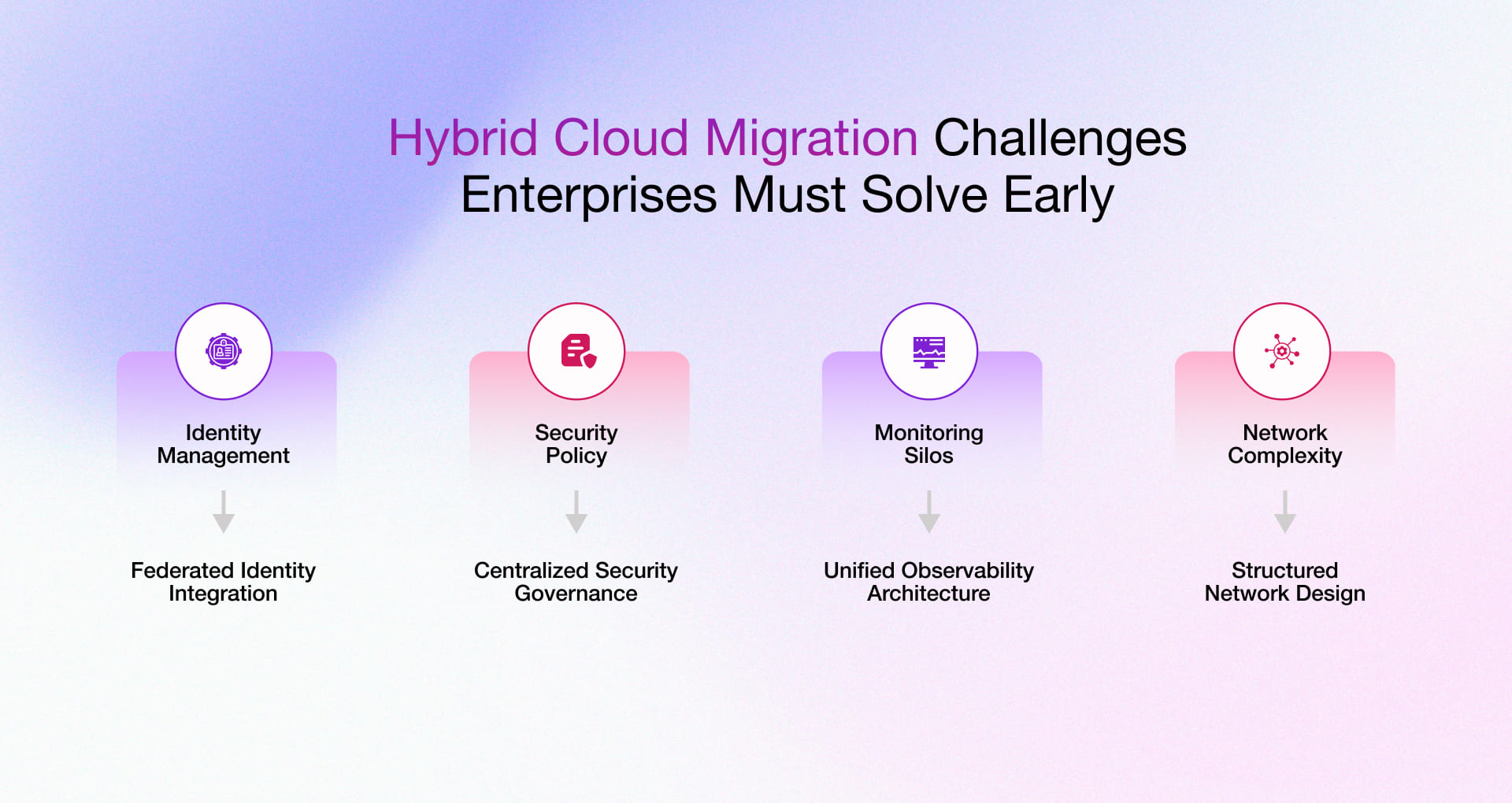
Hybrid cloud migration introduces architectural flexibility, but it also increases complexity as there are both on-premises infrastructure and public cloud environments. Without cloud consulting expertise, enterprises face governance gaps, security inconsistencies, and operational blind spots.
The risks are rarely dramatic on day one. They compound over time. Here are the most critical challenges enterprises must address early:
Cross-environment Identity Management
Hybrid cloud environments work well with unified identity governance across on-premises and public cloud. Disconnected access control models increase the risk of privilege sprawl, inconsistent role definitions, and audit gaps.
Effective Solution:
It requires implementing federated identity integration with centralized role-based access, enforce least-privilege policies, and standardize authentication across environments. Here, identity should function as the unified control plane across hybrid infrastructure.
Inconsistent Security Policy Enforcement
Both on-premises and cloud security operate differently. With alignment issues, configuration drift, encryption inconsistencies, and patch management gaps can emerge across environments.
Effective Solution:
Here, policy-as-code frameworks and centralized security governance tools adoption enforce regular encryption standards, network policies, and compliance controls.
Monitoring and Observability Silos
When there are fragmented tracking systems, it reduces the visibility across hybrid workloads. Also, where there are separate on-prem tools and cloud-native monitoring platforms, it creates blind spots in performance monitoring and incident identification.
Effective Solution:
In such scenario, it is ideal to implement unified observability architecture to consolidate telemetry, logs, and metrics across infrastructure. With correlating data across public and private environments, enterprises can expect response time improvement and operational transparency.
Networking and Interconnect Complexity
Hybrid cloud environments work well when there is stable connectivity between public cloud and on-prem environment. With poor routing, overlapping IP ranges, or unmanaged interconnect costs introduce delays and instability.
Effective Solution:
Using standardized network architecture, implementing structured IP planning, and dedicated connectivity with AWS Direct Connect or Azure ExpressRoute helps with predictable performance and cost control.
Hybrid Cloud Migration Strategies to Modernize Infrastructure Without Disruptions
Selecting the right migration model is a critical component of a broader enterprise cloud adoption strategy aligned with business objectives and risk tolerance. Those organizations that extend their on-prem infrastructure into cloud-based platforms must align their migration models with operational risk tolerance and long-term platform strategy. Each approach serves a different purpose. The key is knowing when speed matters more than optimization, and when long-term transformation justifies deeper change.
Lift and Shift (Rehost)
The first hybrid cloud strategy on the list is Lift and Shift (Rehost) that when operations demand agility and risk containment. All the heavy workloads are migrated from on-premises infrastructure to cloud-based platforms at minimal architectural modification.
Such an approach is favorable for:
- Legacy apps on the verge of hardware refresh cycles
- Disaster recovery replication targets
- Apps with limited external dependencies
- Short-term data center exit initiatives
With cloud rehosting strategy, organizations experience accelerated migration timelines and minimal refactoring efforts. If workloads are right-sized post migration, then this strategy remains cost-optimized and offers performance gains as well.
Re-platforming
This strategy enables targeted optimization while retaining core application architecture. Enterprise is opting for this migration strategy leverage managed services and improve operational efficiency without investing heavily into redesigning.
Expect typical enhancements like:
- Migrating datasets to Amazon RDS, Amazon EKS, Amazon S3, Amazon Kubernetes Services, and Azure SQL
- Moving storage to managed object storage devices
- Implementing container orchestration platforms
- Introducing automated scaling configurations
While maintaining architectural familiarity and improving resilience, this model overcomes infrastructure management overhead. Re-platforming is often chosen when modernization is in demand, but application redesign is not feasible.
Refactoring (Re-architecting)
This strategy consists of redesigning your existing application to align with cloud-native architecture principles. Workloads demanding long-term scalability, performance elasticity, or architectural modernization works well with this approach.
There are several refactoring initiatives, including:
- Decomposing monolithic apps into microservices
- Implementing serverless architecture
- Adopting containerized deployment models
- Integrating managed identity and security services
While refactoring offers benefits like agility and cost elasticity, it demands thorough planning, development roadmap, and governance maturity. For hybrid infrastructure, refactored workloads often live by rehosted or re-platformed systems.
A practical example of this approach is the modernization of a digital ad inventory management platform. In this scenario, Rishabh Software transitioned legacy components to a modular, scalable cloud architecture while retaining core on-premises systems. The modernization improved real-inventory monitoring and performance, indicated how hybrid approach can optimize business operations without complete system rewrite.
Phased Migration Approach
There is no single strategy for all workloads. A phased migration model divides workloads based on business impact, technical complexity, and compliance sensitivity.
A structured phased approach consists of:
- Infrastructure and dependency mapping
- Workload segregation by risk and modernization
- Pilot migrations in controlled environments
- Incremental extension into AWS or Azure landing zones aligned with enterprise governance and identity frameworks.
- Cost and performance validation
With this model, organizations can expect seamless operations without disruption and allow governance frameworks to mature alongside infrastructure changes.
Migration strategies are never selected in isolation. Enterprises adopt a combination of rehosting, re-factoring, and re-platforming under a phased roadmap typically guided by an experienced Azure consulting company or AWS cloud partner to ensure architectural alignment and compliance discipline throughout execution.
A Phased Hybrid Cloud Migration Roadmap to Reduce Risk and Downtime
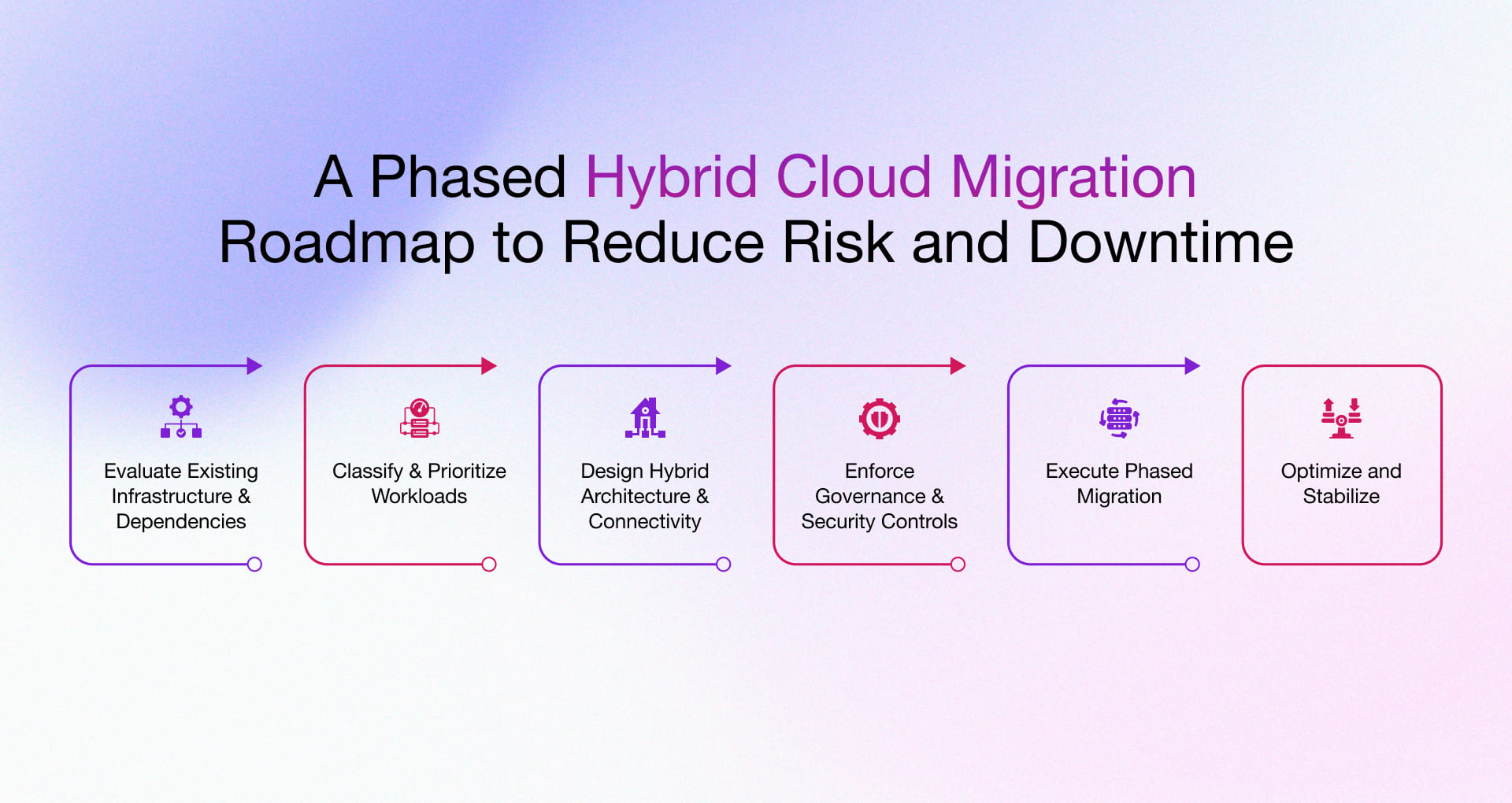
Successful hybrid cloud migration is driven by structure, not speed. Enterprises that follow a phased roadmap reduce operational risk, protect uptime, and maintain governance throughout the transition.
Below is a practical roadmap used in large-scale hybrid transformations
Evaluate Existing Infrastructure & Dependencies
To execute hybrid cloud migration in your existing environment, it must begin with structured cloud readiness assessment of following factors:
- Application-to-database dependencies
- Dataflows and authentication systems
- Compliance-bound workflows
- Latency-sensitive systems
- Network topology and IP structure
How does it impact enterprises:
With the mentioned evaluation, you can expect to experience zero sequencing errors, eliminate downtime, and peak performance.
Classify & Prioritize Workloads
In this step, it becomes important to categorize workloads based on their suitability. Classifying each one on scalability, compliance sensitivity, and modernization potential and determining whether lift & shift, re-platforming, or refactoring is essential or not. Therefore, you must initiate with low-risk systems and then gradually progress towards mission-critical workloads.
Rishabh Software undertook an e-learning platform modernization project involved classifying and prioritizing workloads that enables critical user experiences to scale on cloud while retaining stable backend services.
How does it impact enterprises:
When you classify workloads, it eliminates operational exposure, benefits incremental modernization, and develops internal confidence before executing full-scale migration.
Design Hybrid Architecture & Connectivity
Another major step is ensuring your architecture is reusability, which easily connects on-prem infrastructure with cloud environments. For this, you must check for secure network connectivity, API integration, standardized protocols, and governance-aligned architectural frameworks.
Secure hybrid connectivity can be established using cloud services like AWS Direct Connect or Azure ExpressRoute to ensure hassle-free performance and private network integration between on-premises and cloud environments.
A Veterinary practice management solution is a prime example that was designed with hybrid architecture principles to ensure seamless data synchronization between on-prem and cloud platforms.
How does it impact enterprises:
When you follow this step, it guarantees stable communication, minimizes post-migration tasks, and maintains governance consistency across platforms.
Enforce Governance & Security Controls
When planning for embedding governance and security, it must happen before scaling workloads and not afterwards. It initiates with implementing AWS IAM, Microsoft Entra ID to make sure consistent role enforcement across hybrid environments.
- Centralized RBAC policies
- Policy-as-code enforcement
- Automated compliance validation
- Unified logging and audit tracking
How does it impact enterprise
In early governance enforcement, you can expect audit readiness, prevent security drift across environment, and ensure intact compliance posture throughout the migration.
Execute Phased Migration
Since it is a large-scale migration, it must be incremental. Under organized surveillance, the workloads are migrated into controlled phases:
- Performance baselines
- Cost behavior
- Operational impact
- Rollback preparedness
How does it impact enterprises:
With phased migration, your business operations remain functioning while disruption risks become zero and enable validation at every migration stage.
Optimize and Stabilize
To keep your migration efficient and outcome-oriented, you must leverage managed cloud services to make sure for the following factors:
- Performance optimization
- Compliance posture
- Resource utilization
- Cost governance
How does it impact enterprises:
With this optimization, your hybrid environment remains efficient, compliant, and aligned with changing business priorities.
Best Practices for Hybrid Cloud Migration That Drive Long-Term Success
A roadmap defines the steps; it does not guarantee the outcome. What determines long-term success is how the environment is managed after workloads move. Governance, cost control, identity discipline, and operational visibility determine whether hybrid cloud migration becomes an asset or a burden.
Enterprises that see lasting value treat the migration process as a starting point and not the finish line.
Align Deployment Strategy with Business Objectives
Architecture should follow business priorities. Before making deployment decisions, define:
- Which workloads drive revenue
- Which systems are compliance-sensitive
- Which applications require high scalability
- Which environments demand low latency
Workload placement must support measurable outcomes, not just technical preference.
Automate Data Governance and Lifecycle Management
Hybrid environments increase data movement. Without automation, governance quickly breaks down.
Best practice includes:
- Defined data ownership
- Centralized access control
- Automated backup and recovery
- Lifecycle policies for cost control
Automation reduces human error, protects compliance posture, and controls storage growth.
Standardize Security and Compliance Controls
Security cannot differ between environments.
Establish:
- Unified identity and access management
- Encryption standards across platforms
- Centralized logging and audit visibility
- Continuous compliance validation
Consistency prevents configuration drift and reduces audit exposure.
Continuously Optimize Cost and Performance
Hybrid cloud environment is dynamic. Costs and performance profiles change over time.
Monitor:
- Resource utilization
- Cost allocation by workload
- Performance baselines
- Compliance metrics
Ongoing optimization ensures the environment remains efficient, resilient, and aligned with evolving business needs.
Hybrid Cloud Use Cases by Industry: Real-World Enterprise Applications
Hybrid cloud adoption varies by industry based on regulatory exposure, latency requirements, operational footprint, and data sensitivity. In regulated and infrastructure-heavy sectors, hybrid architecture enables controlled modernization while preserving operational continuity.
Banking
Financial institutions operate under strict regulatory mandates related to data residency, audit traceability, and risk management. Core banking systems often remain tightly integrated with legacy infrastructure and cannot be fully relocated without operational and compliance risk.
- Core transaction systems remain on-prem
- Disaster recovery extends to AWS or Azure regions
- Risk analytics and fraud detection workloads run in scalable cloud environments
- Customer-facing digital applications leverage elastic cloud compute
Hybrid architecture enables modernization of digital services without disrupting regulated core systems.
Healthcare
Healthcare organizations manage protected health information (PHI) subject to strict compliance frameworks. Many hospital systems operate legacy clinical applications integrated with on-prem data centers.
- Electronic health record (EHR) systems remain on-prem
- Secure backups and disaster recovery replicate to AWS or Azure
- AI-driven diagnostics use AWS AI services or Azure Cognitive Services while protected health records stay on-premises
- Secure identity federation ensures controlled access across systems
Hybrid models allow data protection compliance while enabling advanced analytics and telehealth scalability.
Retail
Retail enterprises require dynamic scalability for e-commerce platforms, seasonal demand spikes, and real-time inventory management. However, backend ERP and point-of-sale systems often remain tightly coupled with on-prem infrastructure.
- Core inventory and ERP systems operate locally
- E-commerce platforms scale elastically on AWS or Azure
- Customer analytics and personalization engines run in cloud environments
- Backup and resilience extend across regions
Hybrid enables burst scalability without rearchitecting foundational retail systems.
Manufacturing
Manufacturing environments rely on latency-sensitive operational technology (OT), industrial control systems, and factory-floor applications. These systems cannot tolerate network delays introduced by full cloud relocation.
- Production control systems remain on-prem
- IoT data streams process locally before cloud ingestion
- Predictive maintenance analytics run on AWS or Azure
- Enterprise reporting and supply chain visibility extend to cloud platforms
Hybrid supports real-time operational stability while enabling advanced analytics and cross-site visibility.
To better understand with practical example, you can go through the modernization of legacy ERP and manufacturing executing system of an apparel enterprise. Rishabh Software undertook the evaluation and ensured seamless migration and dependency mapping before cloud transition.
Costly Hybrid Cloud Migration Mistakes Enterprises Make and How to Avoid Them
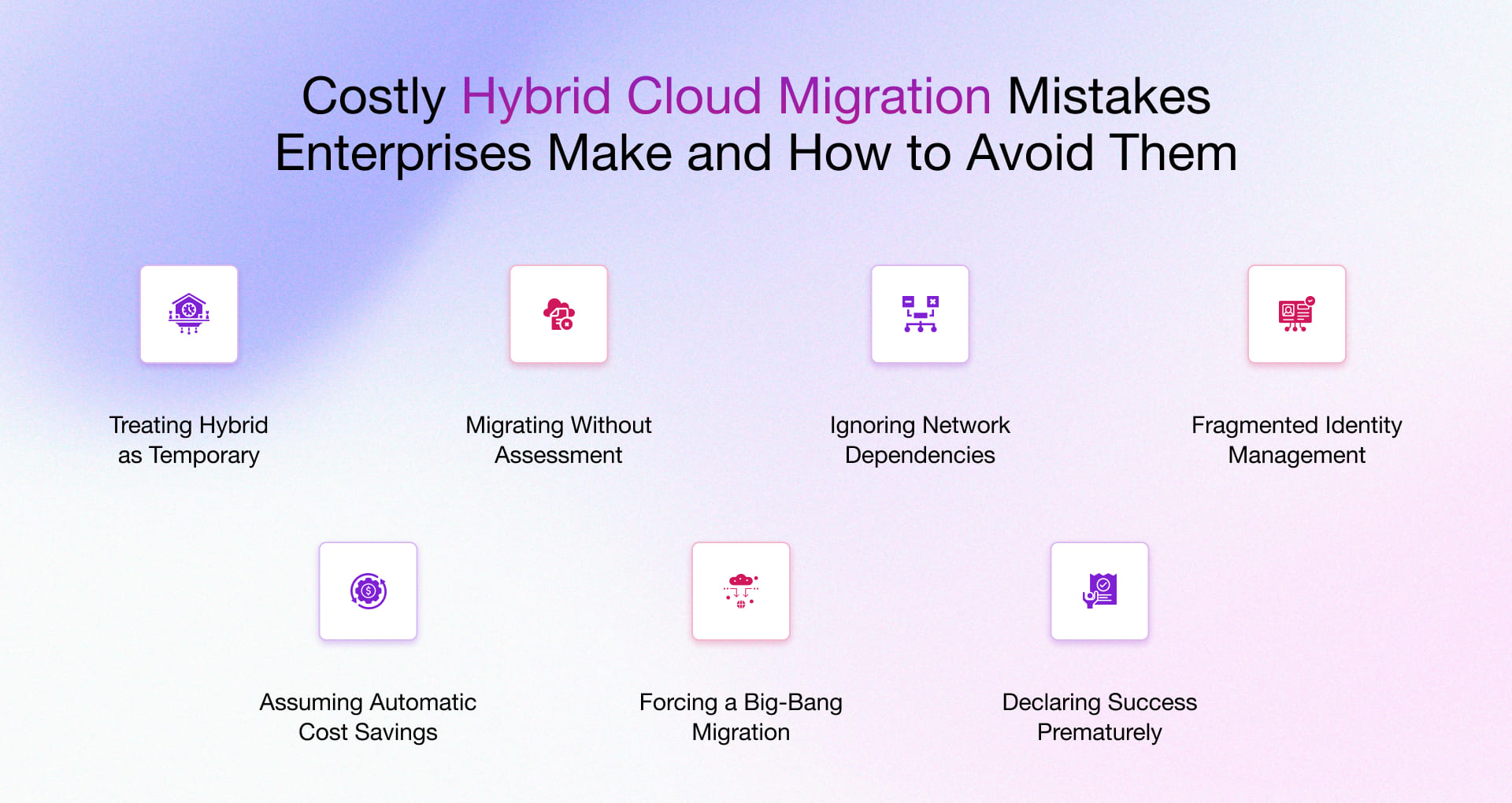
Hybrid cloud migration looks straightforward in planning decks. In execution, it exposes gaps fast. Costs rise quietly, performance dips without warning and teams spend time fixing instead of building. The cloud is rarely the problem; poor decisions are. Here’s where enterprise leaders miscalculate.
1. They Treat Hybrid cloud migration as Transitional
Leadership approves migration to hybrid cloud as a stepping stone. Investment in automation and governance gets delayed. Months later, it remains but controls are weak and visibility is limited. If it is on your roadmap, design it as a sustainable model. Build policy, monitoring, and cost controls into the foundation.
2. They Move Before They Understand
Applications rarely stand alone. They depend on shared databases, identity systems, and undocumented integrations. When teams migrate without full dependency clarity, disruption follows. Demand deep discovery before execution. If the architecture is unclear, delay the move because speed without visibility creates rework.
3. They Underestimate Network Impact
Slow speeds, constant outages, and angry user complaints often come down to terrible network planning. Hybrid setups demand a thoughtful network design. You need to engineer routing, bandwidth, IP structures, and secure connections well in advance. If the network is an afterthought, your operations team will definitely feel it.
4. They Allow Identity to Fragment
Separate access systems across on-prem and cloud create governance gaps. Permissions expand, audit complexity increases and risk compounds quietly. Unify identity and access control early with one access model and one visibility layer.
5. They Assume Cloud Lowers Costs Automatically
Cloud gives flexibility but it also enables waste. Unwatched environments quickly rack up oversized resources and unnecessary data transfer bills. You need financial oversight from day one, right alongside the technical work. Keep a close eye on costs and constantly check what you’re actually using.
6. They Push for a Big-Bang Migration
Executive pressure often pushes for speed, but trying to move everything at once just exposes you to massive risk. When something goes wrong, the fallout spreads everywhere. A phased approach keeps things stable. Test and validate each small wave before you expand the scope.
7. They Declare Success Too Early
Hitting “go-live” isn’t the finish line. What happens *after* migration decides whether your hybrid cloud actually helps your bottom line or drains it. Performance tweaks, cost alignment, and checking for compliance need constant attention. Make sure you budget for this stabilization period and hold your teams responsible for optimizing everything.
Hybrid cloud truly pays off for leaders who plan carefully. Done right, it makes your business stronger, helps you control spending, and gives you more operational room to maneuver. Rush it, and you’ll create a long-term headache that costs far more than the initial migration ever did.
Why Choose Rishabh Software as Your Trusted Hybrid Cloud Migration Partner
As an AWS Select Tier Services Partner and Microsoft Partner in the Cloud Solution Provider Program (CSPP), Rishabh Software blends deep cloud platform expertise with governance discipline to deliver secure, scalable, and resilient hybrid environments. Our hybrid cloud practices is purpose-built for enterprise modernization, backed by structured cloud migration consulting services that align architecture, compliance, and operational continuity.
We help enterprises:
- Designing secure hybrid architectures connecting on-prem systems with AWS and Azure
- Standardizing identity, security, and governance from day one
- Optimizing workloads for performance and cost efficiency
- Maintaining operational stability during and after migration
As an experienced AWS development company, Rishabh Software delivers secure and scalable cloud architectures across complex enterprise environments.
With 20+ years of global delivery experience and enterprise engagements across AdTech, FinTech, healthcare, digital manufacturing, and digital platforms, our teams understand how mission-critical systems operate in real-world environments.
If you are evaluating a hybrid cloud migration strategy and need architectural clarity before committing budget, speak with our cloud architects. Enterprises choose Rishabh Software when downtime is not acceptable, compliance cannot slip, and migration must be done right the first time.
Frequently Asked Questions
Q: How do you decide which workloads should stay on-premises vs move to the public cloud in a hybrid model?
A: We follow a practical approach place workloads based on:
- Data sensitivity & compliance requirements
- Latency and performance requirements
- Integration dependencies
- Cost forecasting
- Scalability patterns
A workload assessment matrix or scoring model will provide a detail about how enterprises determine placement without complicating governance.
Q: What are the hidden costs of hybrid cloud migration that enterprises often overlook?
A: Apart from infrastructure costs, organizations often neglect following costs:
- Dats egress charges
- Interconnect and networking costs
- Monitoring and observability tool duplication
- Identity and access management complexity
- Hybrid security architecture implementation
- Ongoing integration maintenance
Q: How does hybrid cloud application migration impact compliance and data sovereignty requirements?
A: Hybrid cloud enables regulated industries to:
- Storing confidential and regulated data on premises
- Processing of non-sensitive workloads in public cloud
- Maintain regional data residency
However, governance frameworks and centralized policy enforcement must be implemented to avoid compliance drift across the environment.
Q: What are the biggest governance challenges in hybrid cloud environments?
A: Hybrid cloud increases complexity in:
- Access control standardization
- Policy consistency across environments
- Tracking visibility gaps
- Shadow IT expansion
- Configuration management
Without unified governance, hybrid environments can bring in operational silos and not flexibility.
Q: How can enterprises avoid security blind spots during hybrid cloud application migration?
A: Security blind spots usually arise due to following reasons:
- Fragmented tracking tools
- Misconfigured APIs
- Inconsistent identity policies
- Poor workload segmentation
A Zero Trust architecture, centralized logging, and unified observability are critical during migration planning.
Q: Is hybrid cloud app migration suitable for legacy applications that cannot be fully modernized?
A: Yes. Hybrid cloud is ideal for legacy systems that:
- Does not refactor immediately
- Demand tight integration with on-premises infrastructure
- Depends on older databases or hardware
Organizations can gradually upgrade their legacy systems while maintaining operational continuity.