
Everyone thinks a production line fails when a machine breaks. It doesn’t.
It fails when a quality hold sits in someone’s inbox for 2 days. When a work order is manually entered into three systems, each version differs slightly. Nobody notices the mismatch until the shipment is already late.
No alarm sounds. No dashboard flashes red. The machines keep running and the floor looks busy, but the plant quietly loses manhours, accuracy and trust. Those losses never show up until the month-end numbers come in low. Meanwhile, manual work creates idle machines, extra admin costs, downtime from mixed signals, wasted inventory and poor resource use. Not to mention compliance risks and data security problems.
Manufacturing Workflow Automation plugs that leak to help factories move from constant firefighting to smooth & swift operations! However, it only works if it’s flawlessly integrated into the systems already running your plant.
This blog takes a deep dive into the real-world problems that manual processes create on the shop floor, the different types of automation that actually work in the manufacturing sector, and the use cases where manufacturing process automation delivers the fastest ROI.
The Business Case for Manufacturing Workflow Automation in Modern Factories
Most plants currently run on tribal knowledge.
- The scheduler knows which machine is down
- The quality lead remembers which supplier’s last three shipments caused problems
- The maintenance tech knows that certain valve needs checking every Tuesday because he’s the one who always does it
None of that knowledge sits in a place where a system can act on it. None of it reaches the ERP, or the people running the plant, until someone types it in by hand, usually days later. That’s the real gap driving the digitalization push in manufacturing right now: shop floor to top floor.
The ERP records every transaction with total accuracy. It just can’t see what’s really happening on the production line, in the warehouse, or on that machine that’s about to break down. Shift logs, nonconformance reports, work permits, and bills of materials are still floating around in siloed spreadsheets. The system of record was built to capture data, not to act on it.
On the floor, everything shifts once manufacturing workflows get automated!
Manufacturing workflow automation puts that knowledge into rules, on a connected digital layer sitting above the ERP rather than replacing it. The ERP stays right where it is; stable, compliant and doing its job as the official record.
Raise a nonconformance on Line 3? It routes straight to the quality lead within fifteen minutes and not when someone checks their email.
A purchase order crosses a certain threshold? It goes to the plant manager for sign-off automatically, instead of waiting for someone to remember to walk it over.
Machine hits its maintenance interval, or a sensor pattern says it’s about to fail early? A work order opens before it fails!
Every team works off its own version of the truth.
- Quality leaders feel it during audits when they dig through old email chains and paper NCRs to figure out who approved what and when.
- Supply chain teams feel it every time a stock mismatch shows up on the floor instead of in the system, hours earlier than it should have.
- Plant and maintenance leaders feel it hardest of all: a plant stuck on reactive maintenance is always paying for a failure it could have seen coming, and that’s exactly the gap digitalization is meant to close.
- Operations directors feel this change the most. Their job is to see the whole floor at once, but data silos across MES, ERP, and CRM make it nearly impossible.
If you want to understand in detail how ERP+1 closes integration and visibility gaps in manufacturing, explore How ERP+1 Overcomes ERP Challenges in Digital Manufacturing.
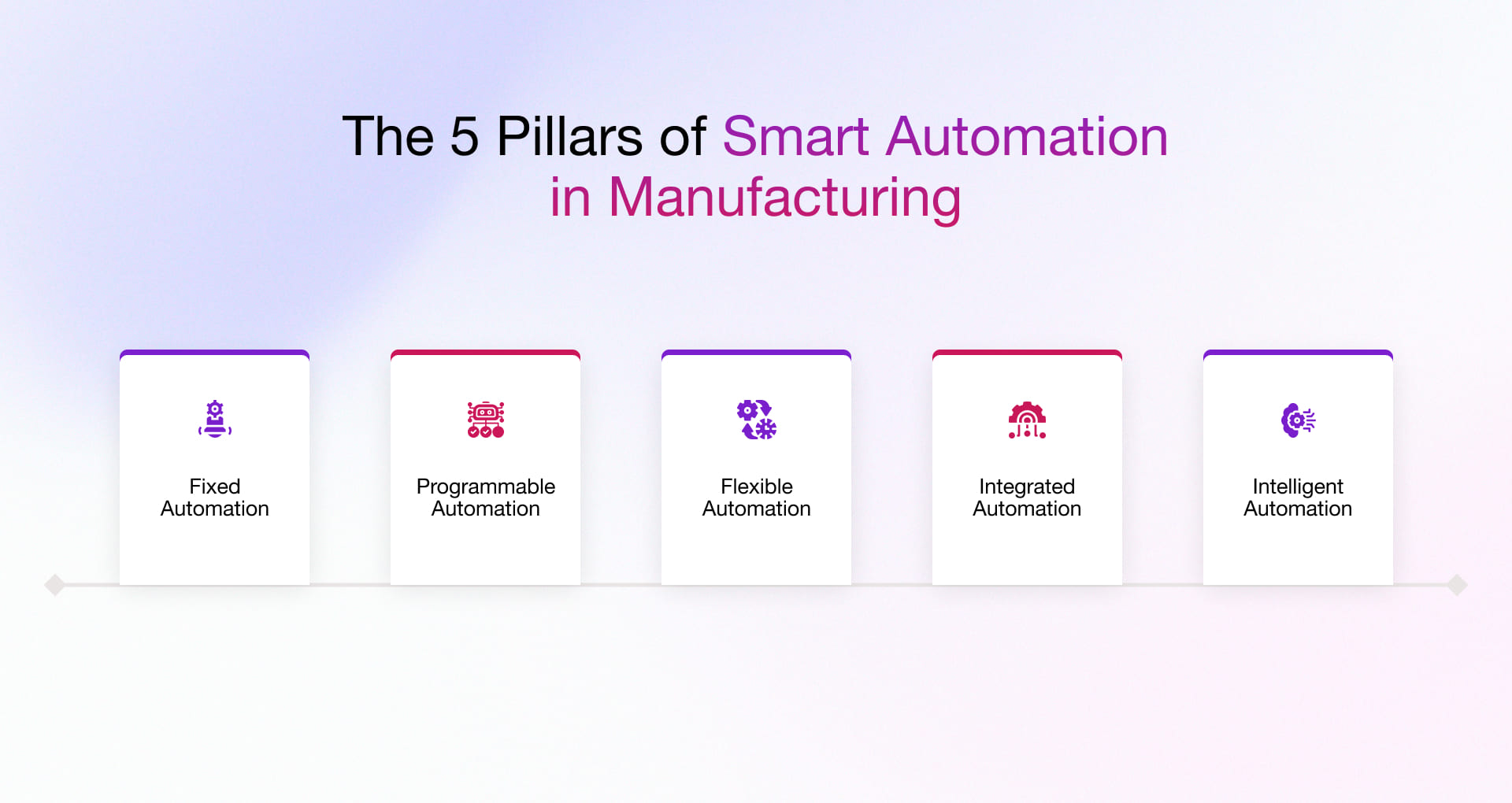
Top 05 Types of Automation in Manufacturing
To understand what is workflow automation in manufacturing, it’s important to know that modern factories use different types of automation where each type is designed to improve specific production, quality, maintenance and operational workflows.
1. Fixed Automation
Fixed automation handles high-volume repetitive tasks. Dedicated assembly lines built for one product that run the same motion continuously keep costs low per unit, but it’s rigid. Retooling for a new product means real downtime.
2. Programmable Automation
Programmable automation, like CNC machining, runs from instructions you can change. It manages batches of different products, though each switch needs setup time.
3. Flexible Automation
Flexible automation takes the manufacturing process to a level above. It switches between product variants with almost no manual work, which matters a lot for plants running mixed models against shifting demand.
4. Integrated Automation
Integrated automation connects the machines themselves to the systems that track them: ERP, MES and the workflows moving information between departments. A change on the floor shows up in planning right away, and the other way around, too.
If you’re looking at how ERP and MES modernization improves visibility, reporting, and workflow orchestration, this apparel-industry case study on Modernizing Legacy ERP and MES System for Apparel Industry is a useful reference.
5. Intelligent Automation
Intelligent automation adds real decision-making on top. It flags a failing bearing before it breaks down. It adjusts quality tolerances automatically using live sensor data. This is also where generative AI in manufacturing starts to prove useful. It builds maintenance schedules, spots defects and tweaks workflow steps on the fly when things on the floor don’t go as planned.
Most plants do not stick to just one type. They usually run two or three kinds at the same time. A solid workflow automation layer matters because it connects the fixed and programmable machines. Everything then shares the same clear picture that smarter automation needs.
Key Technologies Powering Modern Manufacturing Workflows
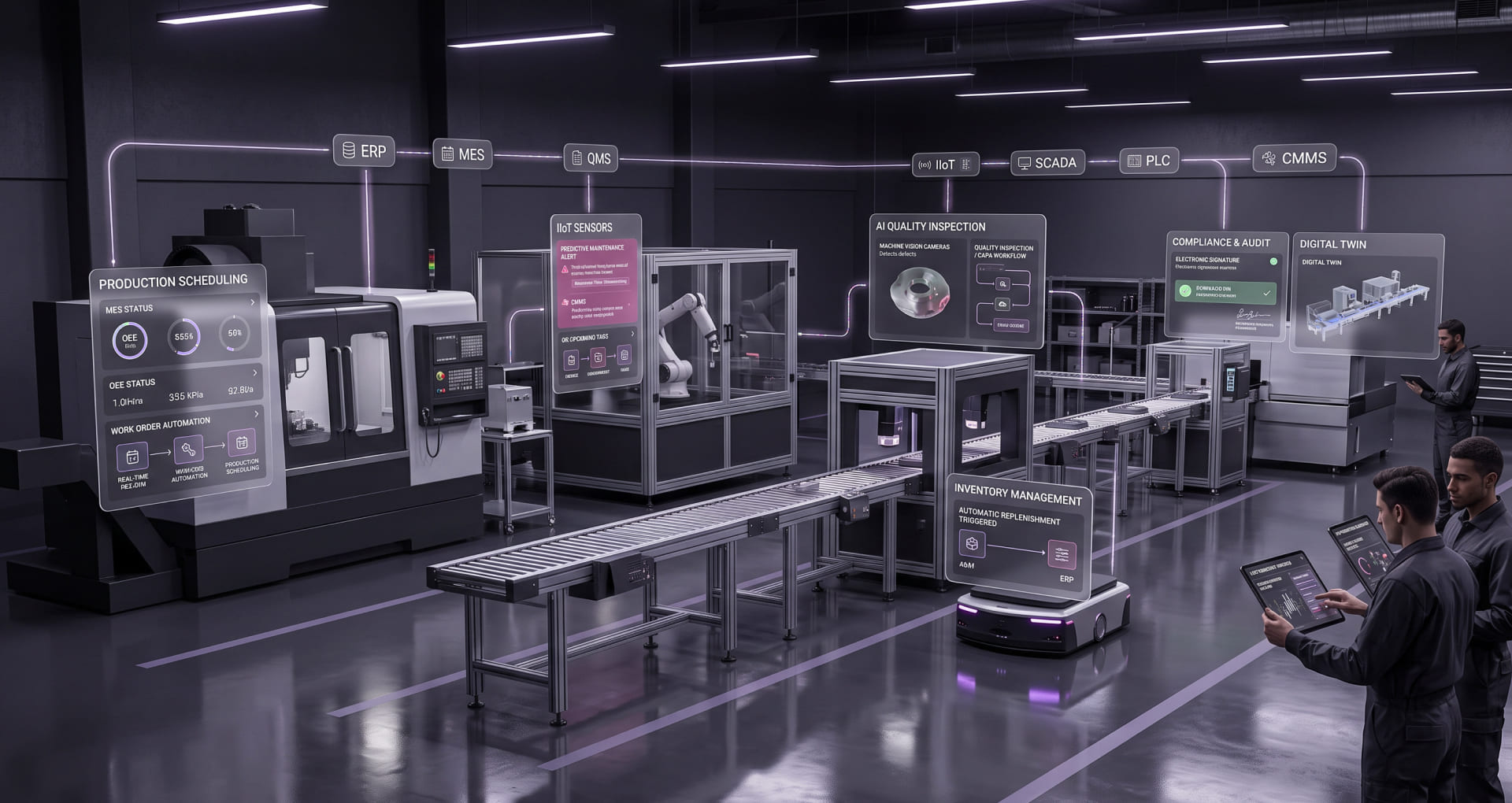
Automation in the manufacturing industry delivers maximum value when machines, people and enterprise systems work together through a unified workflow. That’s why, effective manufacturing workflow management builds on established standards and emerging technologies:
- ISA-95 gives the layered architecture blueprint that links enterprise (Level 4) with shop-floor (Level 3) systems.
- IIoT and edge computing push sensor data from machines to where it’s needed in real-time.
- SCADA and PLCs help watch over and govern the physical processes.
- CMMS, PLM, and a digital thread support end-to-end traceability, without the usual gaps.
- Digital Twin and OEE tracking let you try out scenarios in simulation and then quantify overall equipment effectiveness, more or less on demand.
- RFID, barcode, AGVs and machine vision cover warehouse automation as well as inspection and quality routines.
A well-built workflow layer ties all that together into smoother and consistent processes.
High-Impact Manufacturing Workflow Automation Use Cases
The ROI shows up in clear places. Listed below are the key benefits of automation in manufacturing:
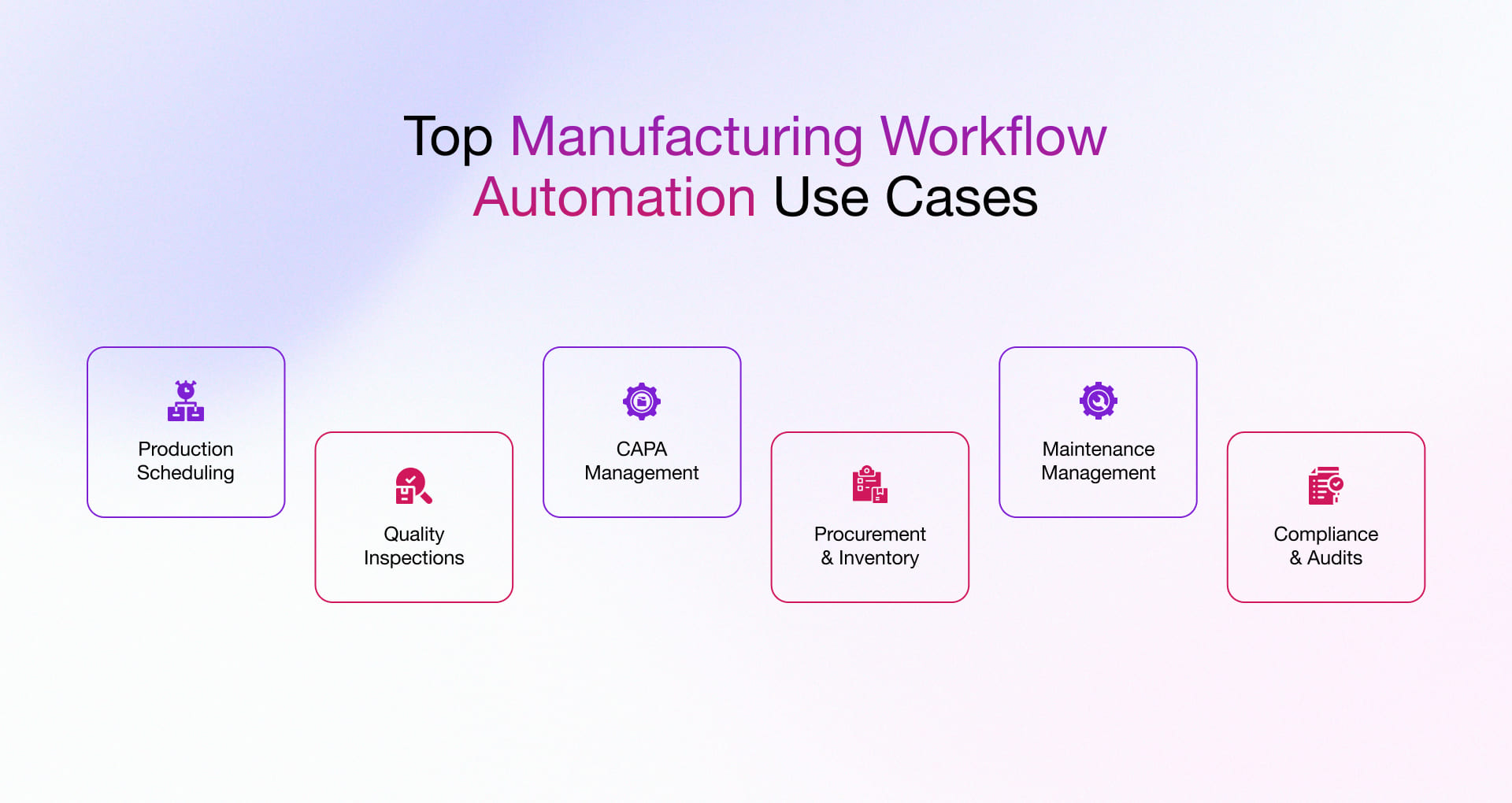
- Production scheduling and work order routing deliver fast wins because jobs move to the right machine and person automatically without manual reassignment.
- Quality inspections flag a defect, and the workflow sends it straight to the owner with all context attached.
- CAPA workflow in manufacturing gains even more. These corrective and preventive actions involve multiple steps and approvers, and manual tracking easily gets lost.
- Procurement and inventory replenishment keep the floor connected to actual stock levels instead of yesterday’s numbers.
- Maintenance requests and downtime escalation shorten the gap between spotting a problem and fixing it.
- Compliance documentation builds itself as the workflow in manufacturing runs instead of getting rebuilt before audits.
ROI, Cost Savings and Operational Impact of Manufacturing Workflow Automation
The clearest signs of value show up in plain numbers:
- Labor hours saved on routing and re-entry
- Fewer errors and less rework
- Faster cycle times
- Fewer missed handoffs or downtime incidents
- Compliance gains show up more quietly.
This is where digitalization stops being a side project and starts paying for itself. Once your plant data flows into one connected layer instead of sitting in separate systems, you stop asking “what happened last week” and start seeing “what’s happening right now, and what’s likely to happen next.”
That shift from looking backward to seeing ahead is what Industry 4.0 comes down to on a factory floor. It is the plant catching a problem before it costs a shift, rather than after.
The right way to measure is to track cycle time, rework rate and average approval time for a few weeks before you start. Compare the same numbers three months later. Anything else is just a guess wearing a metric’s clothes.
Most plants see the first real gains within months, especially when the rollout starts with one high-friction workflow instead of trying to automate everything at once. Get that one workflow running efficiently, prove the value, then expand. That approach is faster and a lot less risky than a single large rollout that tries to fix the whole plant in one go.
How Rishabh Software Helps Automate Manufacturing Workflows
Most plants do not need a full rip-and-replace. They need someone to walk the floor, spot the workflow draining the most time, and fix that one first. We do exactly that with our digital manufacturing services and solutions. We use a step-by-step rollout instead of one big push that stalls halfway.
Our Step-by-Step Approach
We start with system assessment and map your current workflows against your actual ERP, MES, QMS and shop floor systems. This helps us find stalled approvals, manual data re-entry, and visibility gaps between departments.
Next, we handle customization and integration. We build workflow modules around how your plant really operates. We connect them to your existing ERP and MES, so changes are automatically updated everywhere.
Data migration and cleansing follow. We clean duplicates and fix inconsistent formats. We migrate the data, so you start with trustworthy numbers.
Training and ongoing support close it out. We train the daily teams. We stay for support after go-live so the floor actually uses the new system.
Modernize Manufacturing Workflows with Confidence
If your plant still depends on emails, spreadsheets, and manual approvals to keep production moving, you may be losing valuable time well before machines even start to slow down.
As a digital manufacturing company, Rishabh Software helps manufacturers automate day to day workflows, connect ERP, MES, and QMS systems, and push clearer visibility across production, quality, maintenance and compliance while minimizing operational risk. Request a workflow assessment to spot which manufacturing process, will give the quickest return on automation.
Success Story: ERP Modernization for a German Manufacturing Group
A prominent German manufacturing group found itself stuck with its 20-year-old legacy ERP platform, which was taking a toll on its expanding operations. The data was inconsistent, security was outdated, and support felt rather limited, causing daily hassles not only for the IT folks but also for the teams running plants and reporting.
Challenges
- Inconsistent data formats that led to planning errors
- Outdated security that left business data at risk
- Limited vendor support raises operational risks
- Integration problems that slowed cross-department work
Our Tactical Approach
- Thorough review of the existing architecture to find inefficiencies.
- Developed custom modules using JSP, Spring MVC, Hibernate, jQuery, MySQL, and Java 6, tailored to their manufacturing needs.
- Carefully migrated data while focusing on accuracy, removing duplicates and fixing inconsistencies.
- Provided hands-on training sessions and ongoing maintenance support.
Quantifiable Outcomes
- 76% of routine tasks automated to eliminate duplication of efforts
- 22% lower operational costs with better resource utilization
- 38% improvement in response time leading to a boost in customer satisfaction
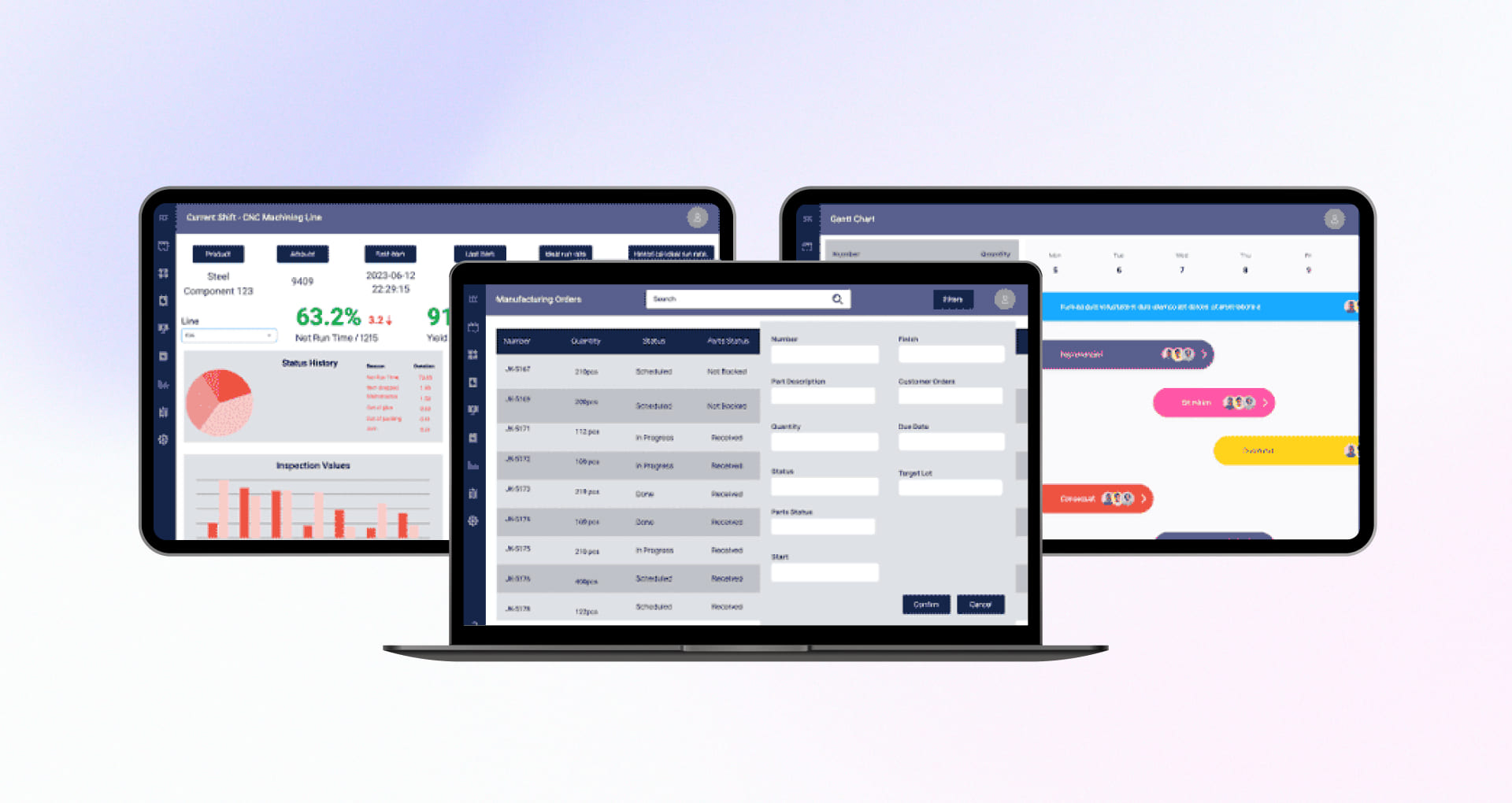
The modernized ERP system now gives real-time visibility, supports faster production workflows and improves equipment maintenance through better monitoring and scheduling.
Frequently Asked Questions
Q: What are the signs that a workflow needs automation in the manufacturing industry?
A: The warning signs are often operational rather than technical. If you regularly encounter any of the following, it’s likely time to automate:
- Approvals that stall with no one noticing
- Multiple versions of the same spreadsheet are in play
- Defects that take hours to reach the right person
- Audit prep that means rebuilding history from scratch
If any of the above hit home, the workflow already costs more than fixing it would.
Q: What should manufacturers automate first?
A: Manufacturers should start with production scheduling and quality nonconformance handling. These areas deliver the quickest and most visible gains. They touch the floor every single day, and the manual way of doing them causes the most pain.
Q: How do these tools integrate with ERP and MES?
A: These tools integrate with ERP and MES through APIs and webhooks. Data moves in both directions. A change in the workflow updates the ERP or MES right away. A change in those systems then triggers the next workflow step automatically. No one has to type the same information twice.
Q: What should a manufacturing workflow automation platform include?
A: The right platform should go beyond digitalizing processes. It should connect people, systems, and data to keep manufacturing operations moving efficiently.
- A real workflow builder with a strong rule engine that actually acts on the data, not just collects it in forms.
- Role-based approvals so only the authorized staff can access, view & manage mission-critical tasks.
- Smooth integration with your ERP and MES through reliable connectors and APIs.
- Live dashboards that show what’s happening on the floor in real-time for enhanced responsiveness.
- Full mobile access so people can use it while walking the plant.
- Automatic escalation that triggers alerts in case of long-pending tasks.
Q: How to implement manufacturing workflow automation?
A: This phased approach minimizes risk compared to big-bang projects:
- Map workflows against ERP, MES, QMS, SCADA, and shop-floor realities. Identify high-friction points.
- Start with pain areas like quality or scheduling for quick wins.
- Define API/webhook connections to IIoT, PLCs, and existing systems.
- Build and test a focused module with real data.
- Roll out incrementally, measure baselines (cycle time, rework, approval speed), and expand.