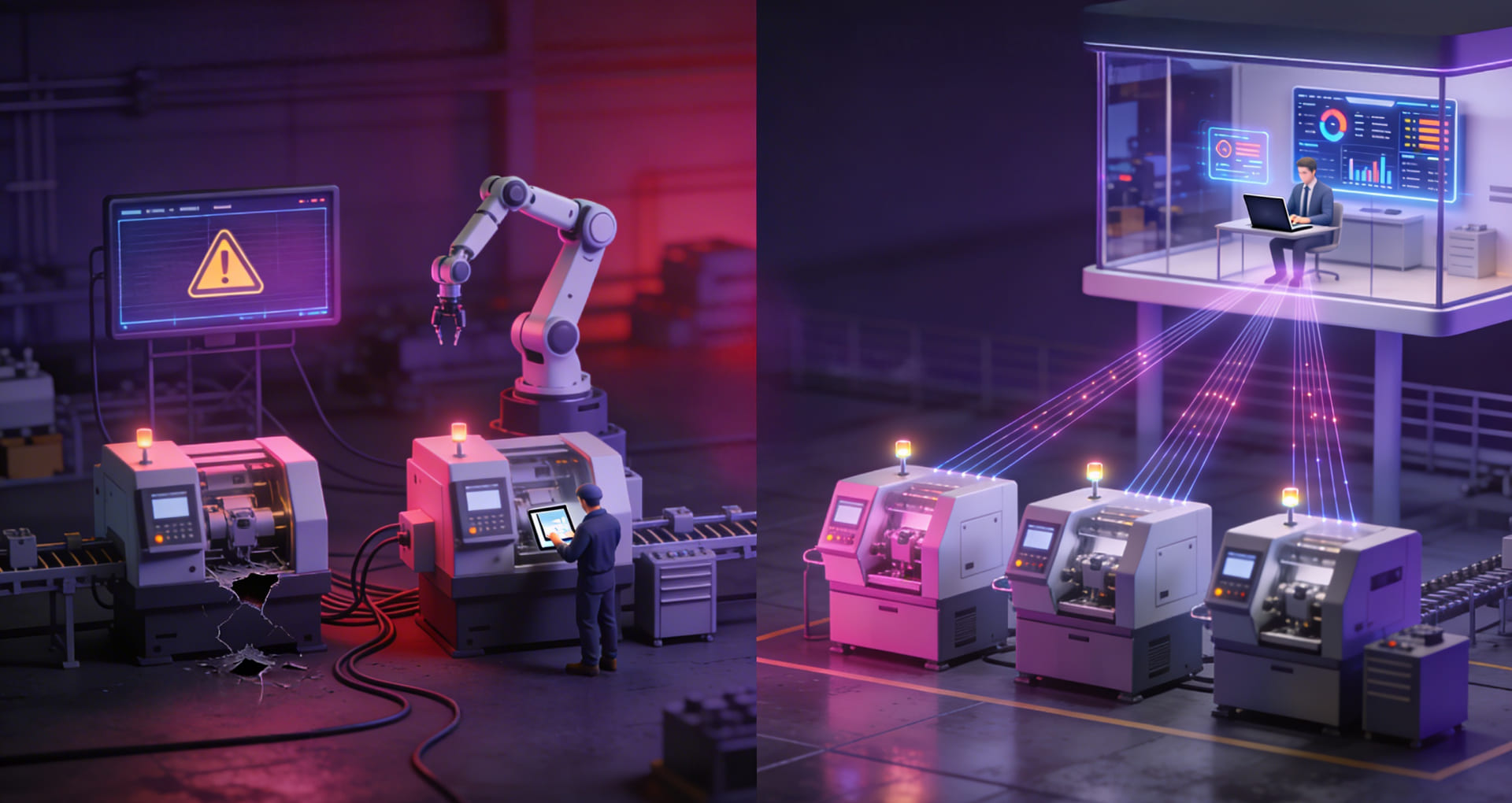

ERP has been the backbone of manufacturing operations for decades, serving as the system of record for finance, procurement, and planning. However, at the shop-floor level, where decisions are time-critical and data is continuously generated, ERP begins to show clear limitations.
Most ERP platforms were not built for environments driven by real-time machine data, connected assets, and dynamic production conditions. As a result, manufacturers often operate with limited visibility into live operations, delayed decision cycles, and workflows that struggle to keep pace with production variability.
These gaps become more evident during ERP implementations, upgrades, or when integrating with MES, IoT platforms, and other plant systems. ERP remains critical, but it is no longer sufficient as the control layer for modern digital manufacturing.
This is where the ERP+1 approach becomes relevant.
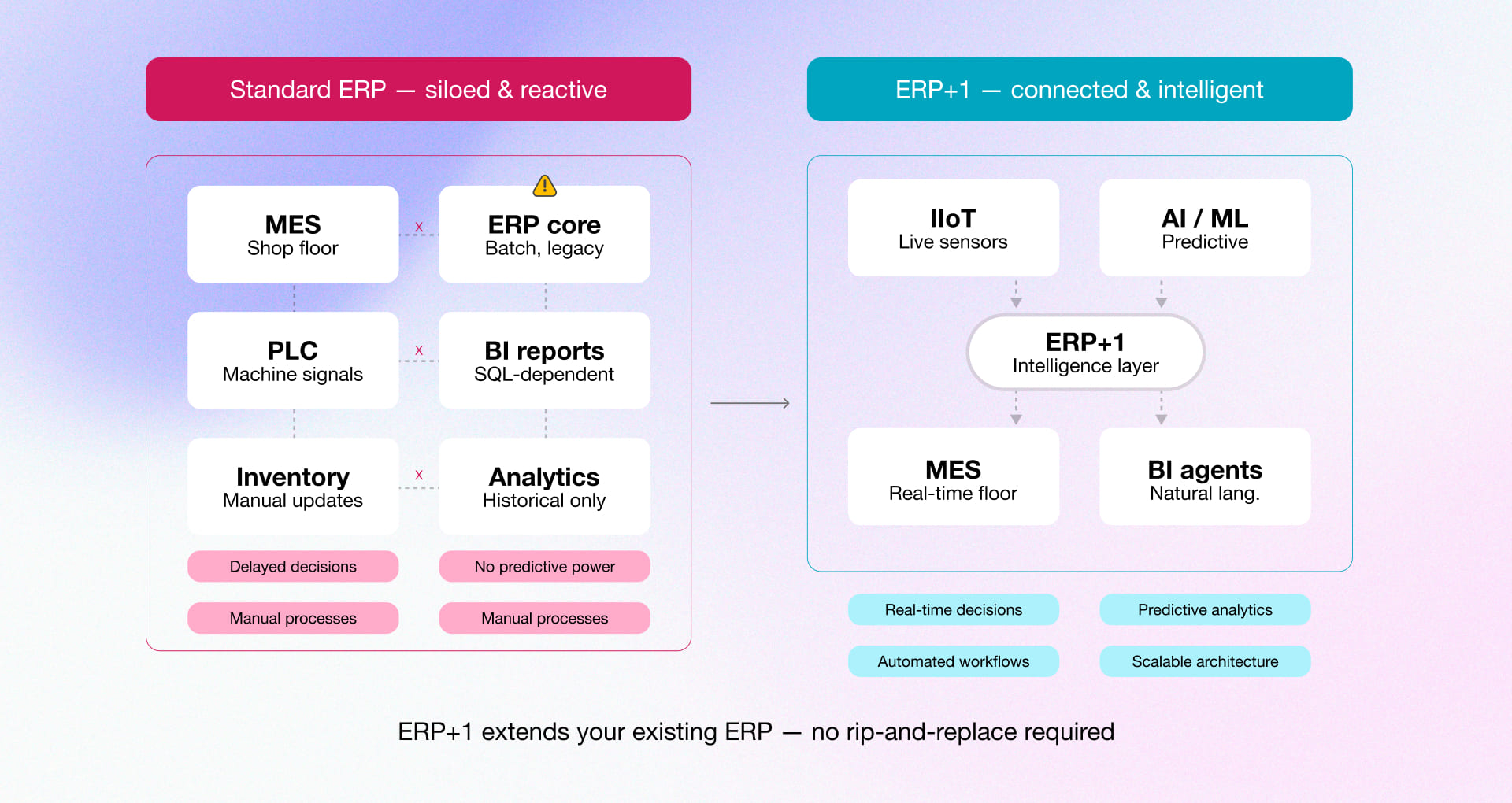
Rather than replacing ERP, ERP+1 extends it by introducing a connected intelligence layer that integrates shop-floor systems, enables real-time data flow, and supports AI-driven decisioning, process orchestration, and more autonomous operations.
In this blogpost, we will walk you through the key ERP challenges manufacturers continue to face and how ERP+1 addresses them in a practical, scalable way without disrupting existing ERP investments.
7 Critical ERP Challenges in Industrial Operations and How ERP+1 Addresses Them
Modern industrial environments demand personalization, efficiency, and peak performance. ERP standardizes processes across functions, but it often becomes a constraint when manufacturers try to drive real-time and data-led operations.
As digital manufacturing evolves, these limitations become more visible. ERP+1 addresses these gaps by extending ERP with a connected, intelligence-driven layer enabling faster decisions, better coordination, and more responsive operations.
1. Delayed in Decision Making
ERP Challenge: ERP systems rely on batch processing, creating a lag between shop-floor events and system visibility. This delay limits early detection of issues such as downtime, performance drops, or production deviations that impact responsiveness and throughput.
ERP+1 Solution: By integrating with IIoT, MES, and real-time analytics platforms, ERP+1 enables live visibility into production, equipment, and inventory. This allows teams to act on issues as they occur—shifting from delayed responses to real-time decision-making.
2. Modern Technology Integration Gaps
ERP Challenge: Most ERP systems are legacy-bound and not designed to natively support AI, advanced analytics, or IIoT. This creates integration gaps, leading to siloed systems and outdated or inconsistent data across operations.
ERP+1 Solution: ERP+1 connects ERP with AI tools, IIoT platforms, analytics engines, and custom applications through API-led integration. This enables seamless data flow across systems, improving visibility, enabling automation, and supporting faster, data-driven decisions.
3. Lack of Shop-Floor Digitalization
ERP Challenge: In many plants, shop-floor systems operate in isolation from ERP, creating a disconnect between production and enterprise operations. This limits visibility into machine status, output, and line performance—often requiring manual intervention to assess what’s happening on the floor.
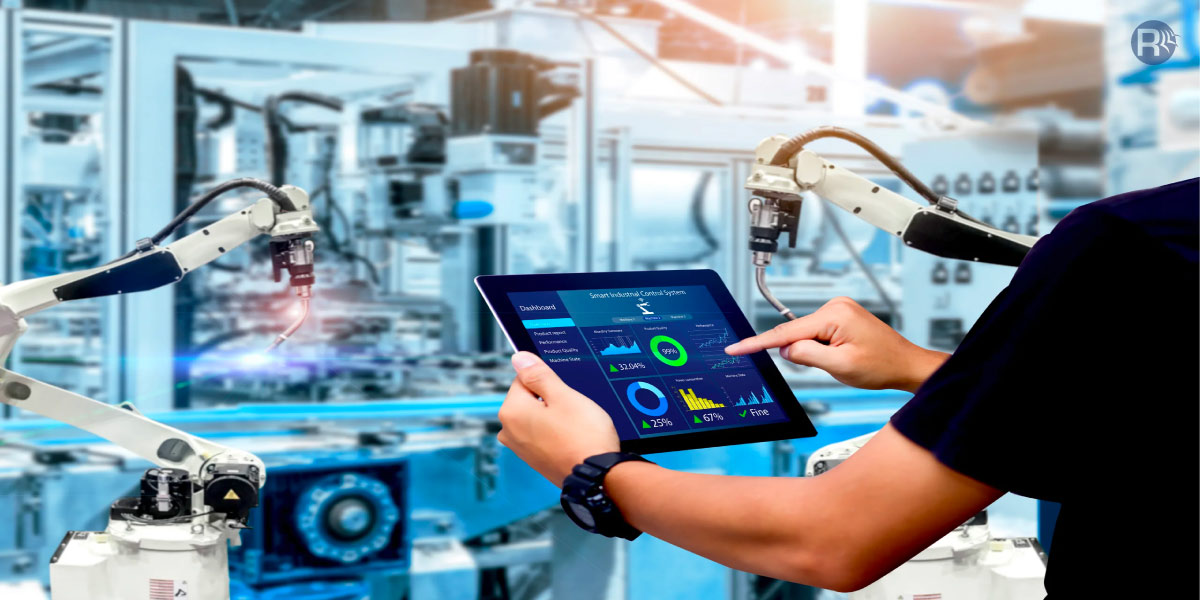
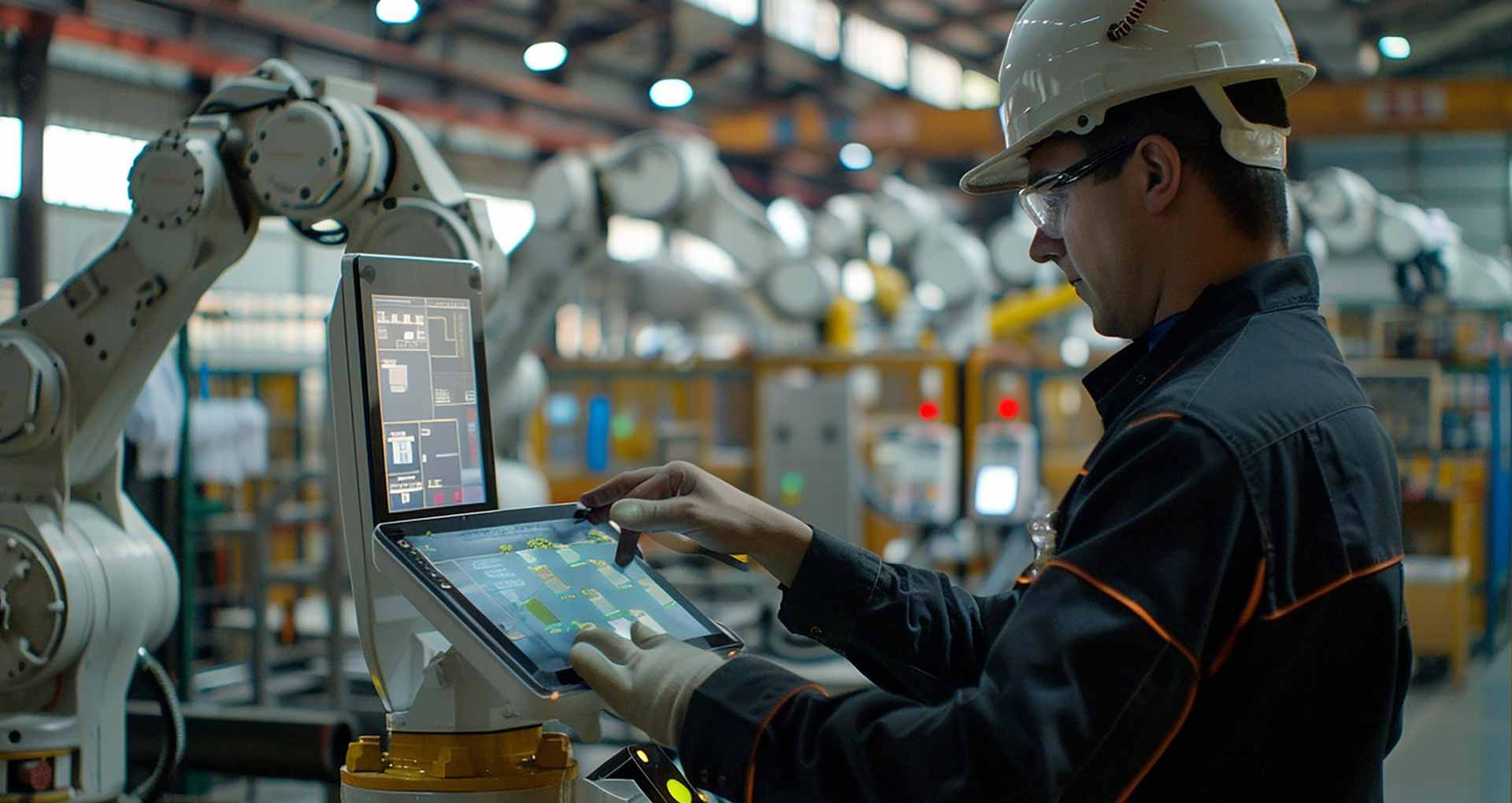
ERP+1 Solution: ERP+1 connects ERP systems with PLCs, MES systems, and IIoT-enabled equipment via IoT gateways and event-driven data pipelines. Machine signals and production data are captured in real time and streamed to operational dashboards.
This enables continuous visibility into equipment health, early identification of bottlenecks, and better control over production workflows.
In one engagement with a pharma manufacturer, we implemented an IoT-based refrigeration monitoring solution to track temperature-controlled environments in real time. By connecting sensors and streaming data into a centralized layer, the client gained continuous visibility and tighter control over compliance-sensitive operations.
In another case, we addressed fragmented data across multiple systems by implementing a centralized data warehouse. By consolidating data from various touchpoints, the client improved reporting accuracy and enabled more reliable, analytics-driven decision-making.
4. Dependency on Data Experts
ERP Challenge: Accessing insights from ERP often requires SQL queries or support from data analysts, especially for cross-functional reporting. This dependency slows decision-making and limits business users’ access to data.
ERP+1 Solution: ERP+1 introduces AI-powered BI agents that enable business users to access insights through intuitive dashboards and natural-language queries, without relying on SQL or data teams.
Integrated with existing ERP systems, this approach democratizes data access and accelerates decision-making across functions
5. Personalization & Upgrade Constraints
ERP Challenge: ERP systems are often heavily customized to meet specific business needs. Over time, these customizations make upgrades complex, slow, and costly, limiting the organization’s ability to adopt new technologies and evolve.
ERP+1 Solution: ERP+1 introduces an innovative layer on top of the existing ERP, allowing new features, integrations, and workflows to be built without altering the core system. This reduces upgrade friction and preserves ERP stability.
In our engagements, we optimized and modernized the client’s legacy ERP system to improve performance, scalability, and maintainability. By organizing the architecture and improving system efficiency, the organization was able to uplift their ERP capabilities without replacing their entire platform.
6. Limited Analytics and Predictive Capabilities
ERP Challenge: Existing ERP systems focus historical reporting and transactional data, making interpretation, operational visibility, and decision making a reactive process. With such a process, an organization would never be able to generate predictive analytics. According to reports, ERP implementation failures occur in 50-75% of cases, mainly due to latency issues.
ERP+1 Solution: ERP+1 ensures easy integration with advanced analytics platforms and Machine Learning models. Doing so consolidates your existing ERP data with predictive analytics tools, identifies potential issues, and optimizes operational planning.
7. Scalability Constraints
ERP Challenge: Many ERP systems are built on monolithic architectures, making them rigid when adapting to new business requirements or integrating modern technologies. This limits scalability and slows down innovation.
ERP+1 Solution: ERP+1 introduces a modular, decoupled architecture that allows organizations to extend capabilities through digital applications, workflows, and integrations without impacting core operations. This enables scalable growth and faster adoption of new technologies.
Digital Manufacturing Ecosystem Where ERP+1 Creates the Most Impact
Modern manufacturing environments require tightly connected systems, real-time data flow, and the ability to act on insights at speed. Traditional ERP environments alone cannot support these demands at the execution level.
ERP+1 extends the ERP landscape by introducing an innovation layer that enables connected operations, real-time intelligence, and integration across critical manufacturing systems.
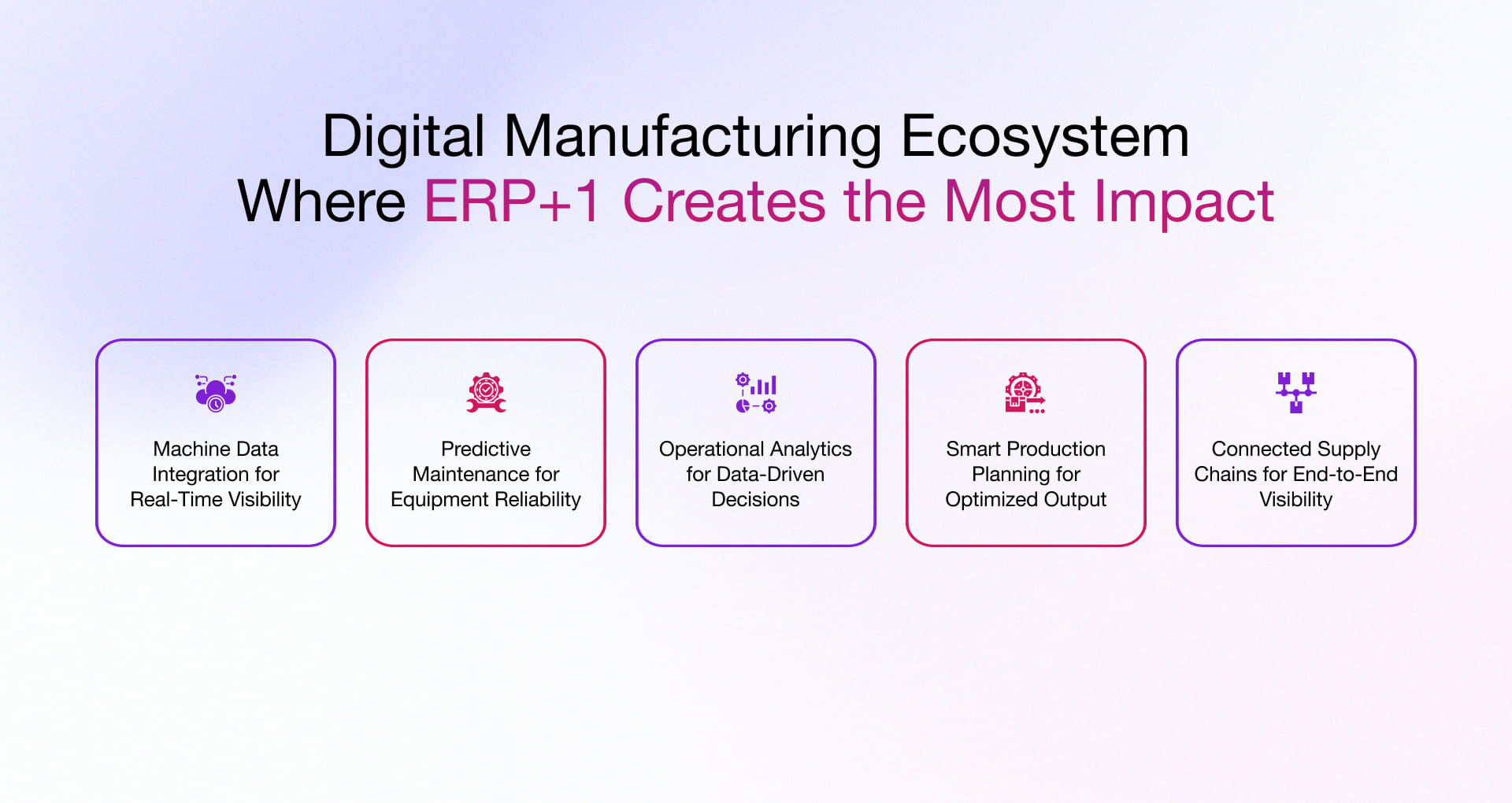
1. Machine Data Integration for Real-Time Visibility
Modern manufacturing runs on machine data. Yet in many factories, this data never reaches enterprise systems in real time. It is one of the persistent ERP challenges production teams have been facing for decades. And such events not only paralyze operational ecosystems but also pose a challenge for production teams when it comes to decision-making.
ERP+1 bridges this gap by integrating ERP with shop-floor systems through IIoT gateways, APIs, and streaming pipelines. This enables real-time visibility into production performance, equipment utilization, and emerging bottlenecks, allowing teams to act faster and maintain tighter control over operations.
2. Predictive Maintenance for Equipment Reliability
Unplanned equipment failures remain a major cost driver in manufacturing. Traditional ERP systems lack the capability to predict failures, leaving teams reactive and exposed to unexpected downtime.
ERP+1 addresses this by integrating machine data with AI-driven analytics to continuously monitor equipment health. Predictive models detect anomalies—such as abnormal vibration or temperature patterns—well before failure. This allows maintenance teams to proactively schedule interventions, reducing downtime and improving overall equipment reliability.
3. Operational Analytics for Data-Driven Decisions
Many manufacturers generate large volumes of ERP data but struggle to derive actionable insights. Native ERP reporting is largely limited to historical analysis, offering little support for real-time operational intelligence.
ERP+1 addresses this by integrating ERP with modern analytics platforms and unified data environments such as data lakes or warehouses. This enables advanced analytics across production, inventory, and workflows. The result is faster, more informed decision-making driven by real-time and contextual insights.
4. Smart Production Planning for Optimized Output
Production planning becomes increasingly complex as manufacturers balance demand fluctuations, machine availability, and supply chain constraints. It was a time-consuming process with ERP, as it cannot respond effectively.
ERP+1 integrates real-time operational data with AI-driven planning models. Manufacturers can optimize production schedules, make optimum utilization, and reduce delays.
5. Connected Supply Chains for End-to-End Visibility
Limited supply chain visibility remains a persistent challenge of enterprise resource planning in manufacturing environments. Though an ERP system handles procurement and inventory, it often falls short of real-time information across supplier networks and logistics systems.
ERP+1 plays a crucial role in ensuring supply chain platforms, logistics systems, and partner ecosystems remain connected across data ecosystems. It enables end-to-end visibility and rapid response to supply chain disruptions.
Why Rishabh Software is a Trusted Partner for ERP+1 Digitalization and Legacy Modernization
ERP systems will continue to play an integral role in unifying core business processes and ensuring centralized data management. But with ERP+1 as an extended innovation layer or beneficial services, organizations can automate mundane tasks, enable predictive intelligence, and scale digital environments.
Rishabh Software promises to digitalize, modernize, and extend your existing ERP environments through a proven, structured ERP+1 approach. Our expertise includes:
- Industrial system integration
- Data platform integration
- Digital manufacturing solution development
In one engagement, we worked with a German-based manufacturing enterprise that had been running a legacy ERP system for over two decades. The organization faced scalability limitations and delays in accessing actionable insights.
We assessed the existing landscape, identified integration and modernization opportunities, and implemented a scalable, secure, and connected ERP environment. This enabled real-time insights, improved reporting, workflow automation, and more streamlined equipment maintenance.
If you are looking to modernize your ERP or need a partner to adopt an ERP+1 architecture to support digital manufacturing initiatives, we can help you design and implement a roadmap aligned with your operational priorities.
Frequently Asked Questions
Q: What is ERP+1 architecture, and how does it help modernize ERP?
A: ERP+1 is an extension layer built around existing ERP systems. It integrates technologies such as AI, IIoT, analytics platforms, and modern data pipelines without replacing the ERP core. This approach enhances ERP capabilities by enabling real-time insights, advanced analytics, and improved system connectivity while preserving existing processes.
Q: How can organizations modernize ERP without replacing it?
A: ERP modernization can be achieved by integrating existing systems with modern technologies using APIs, cloud platforms, and integration layers. By connecting ERP with data platforms, analytics tools, and shop-floor systems, organizations can address current limitations and introduce digital capabilities without disrupting ongoing operations.
Q: How does ERP+1 support predictive analytics and real-time decision-making?
A: ERP+1 connects ERP data with machine data, analytics engines, and AI models to enable continuous data processing and analysis. With real-time data from IoT sensors and integrated analytics platforms, teams can identify patterns such as potential equipment failures, demand shifts, and production inefficiencies, supporting faster, more informed decisions.