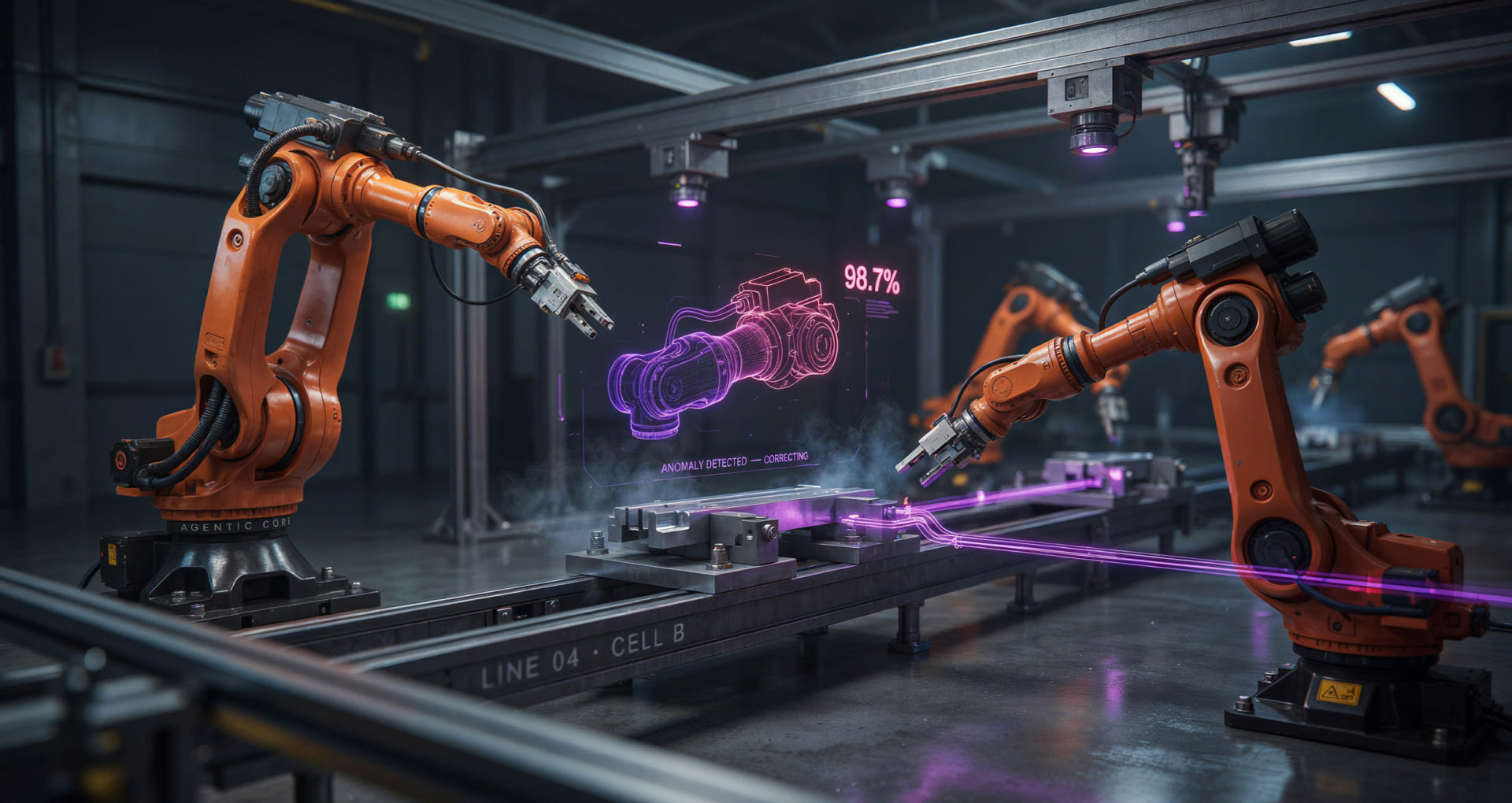
Intelligence maturity has extended to another level in manufacturing with the agentic AI adoption. Manufacturers have already moved from reactive maintenance to predictive insights and adaptive operations. Now, Agentic AI in manufacturing takes this progression further with core enabler capabilities like decide, act, optimize, learn, and self-driven goal achievement. Not in a particular area but wholesome coverage.
Statistics clearly demonstrate the unstoppable growth of agentic AI in the manufacturing industry. Here is what the data reveals: the global market for agentic AI in manufacturing will reach USD 16.79 billion by 2030. Vision means moving in a single direction: embracing everything that improves business revenue with agentic AI and leaving behind anything that holds the business back.
In this blog, we explore the core capabilities of agentic AI for smart manufacturing, its business benefits and real-world use cases, how it differs from traditional and generative AI, and the practical steps manufacturers can take to implement it responsibly and measure its impact.
Core Capabilities of Agentic AI in Manufacturing
It is not one or two strengths, but a combination of advanced capabilities that has put agentic AI in the spotlight today. Manufacturing has already seen automation, traditional AI, generative AI, and other digital technologies reshape operations. What makes agentic AI different is its ability to move beyond isolated assistance and work toward defined outcomes. Here are the core capabilities that make it particularly relevant to modern manufacturing.
- Real-Time Perception and Context Awareness: AI agents continuously read machine, process, quality, and enterprise signals, turning fragmented plant data into an operational picture they can actually act on.
- Goal-Driven Decision-Making: Rather than responding to isolated prompts (like Gen AI), agentic AI works toward defined outcomes it could be protecting throughput, reducing downtime, maintaining quality, or keeping production on schedule.
- Multi-Agent Collaboration: Specialized AI agents can work across production, maintenance, quality, and supply chain, coordinating decisions that would otherwise require multiple teams and handoffs.
- Tool Use and Workflow Execution: AI agents do more than recommend the next step; within approved boundaries, they can use MES, ERP, CMMS, QMS, and other tools to support manufacturing workflow automation.
- Human-on-the-Loop Governance: Agentic AI can handle routine decisions at speed while keeping operators, engineers, and managers in control when safety, quality, compliance, or business risk demands human judgment.
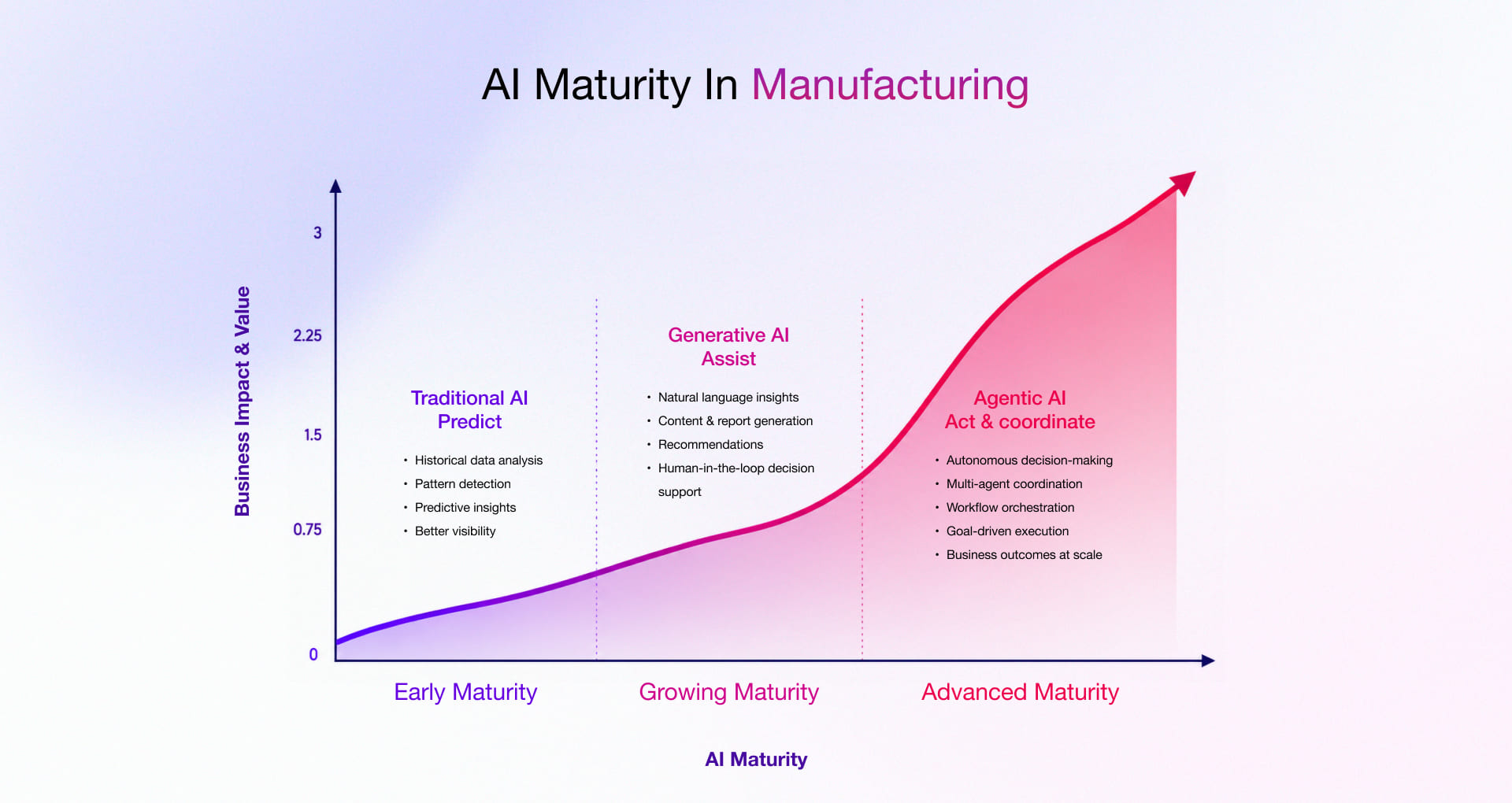
Agentic AI vs. Traditional AI and Generative AI in manufacturing
| Dimension | Traditional AI | Generative AI | Agentic AI |
| What it does | Spots patterns, predicts outcomes, and flags what may happen next. | Creates, explains, or summarizes information when asked. | Works toward a goal, decides the next step, and helps move the work forward. |
| Role in manufacturing | Acts like an analyst, helping teams understand what is happening. | Acts like a copilot, helping people troubleshoot, document, or make sense of information faster. | Acts more like an orchestrator, coordinating actions across systems and workflows. |
| Human involvement | People review the output and decide what to do next. | People prompt it, check the response, and usually take the next action themselves. | Handles more routine steps on its own, while people stay involved where safety, quality, or business risk matters. |
| How it connects | Usually works within one model, machine, dataset, or use case. | Often connects to enterprise knowledge and apps, but still relies heavily on user prompts. | Can work across MES, ERP, CMMS, QMS, SCADA, WMS, and other systems to complete a workflow. |
| Manufacturing example | Predicts that a motor may fail soon. | Explains why it may fail and summarizes the maintenance procedure. | Checks the motor history, confirms spare availability, finds a maintenance window, prepares the work order, and asks for approval if needed. |
| Where the value comes from | Better visibility and earlier prediction. | Faster knowledge work and decision support. | Faster action, fewer handoffs, and less manual coordination across the plant. |
Benefits of Agentic AI in Manufacturing Success
Agentic AI and its contribution to the manufacturing industry go far beyond the automation capabilities of generative AI, traditional AI, and other alternatives. What makes agentic AI different and significantly more outcome-driven is its ability to act as a virtual agent or collaborator that interprets real-time operational data, evaluates changing conditions, recommends actions, and coordinates workflows across production, maintenance, quality, supply chain, and customer operations.
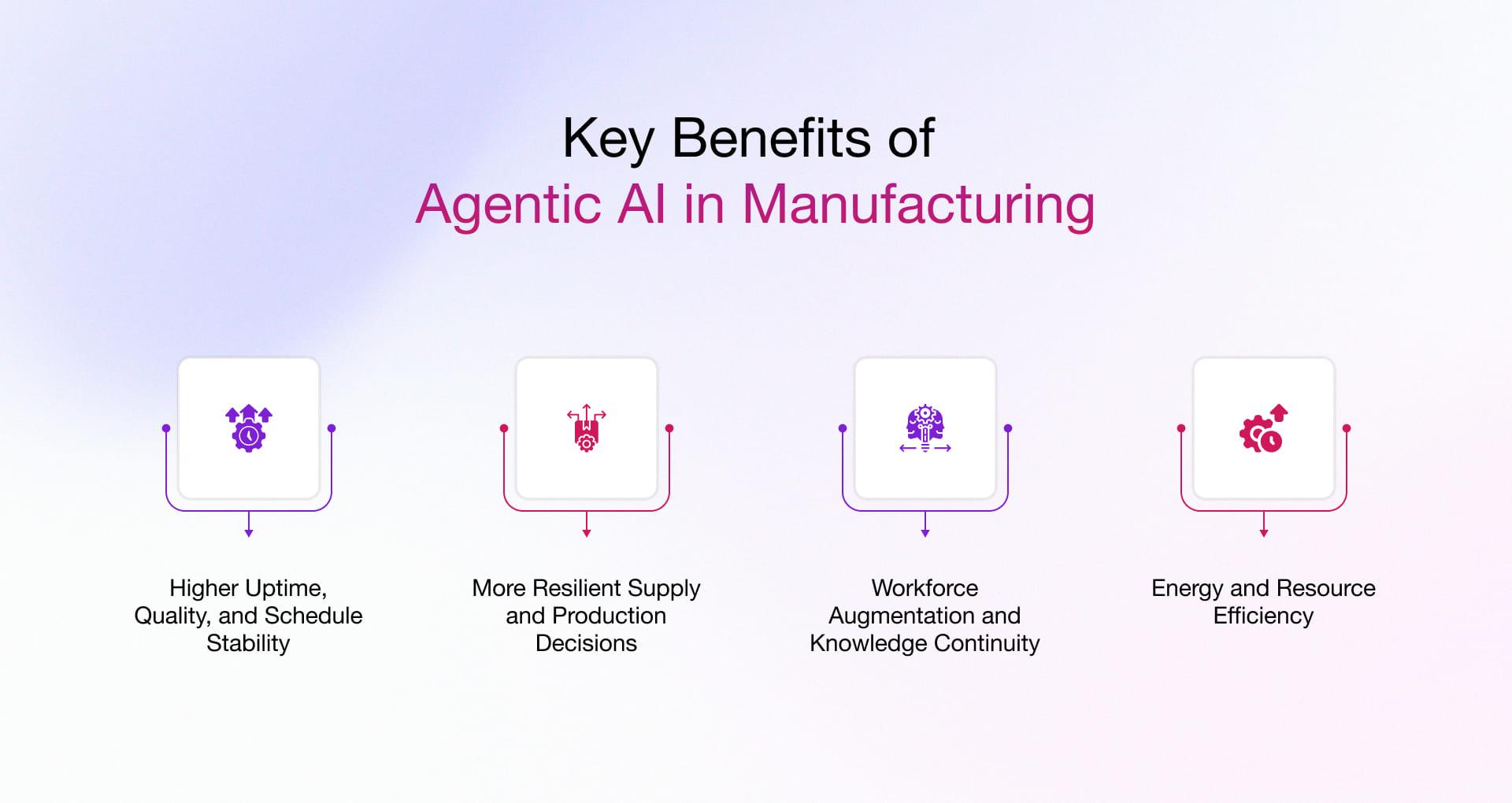
1. Higher Uptime, Quality, and Schedule Stability
Downtime and defects are expensive largely because most systems only notice them once something has gone wrong. Agentic AI works earlier than that. It’s constantly cross-referencing sensor data, maintenance history, current line conditions, quality records, and the production schedule to catch risk while it’s still small, then it suggests something concrete: run an inspection, adjust a parameter, hold a maintenance window, loop in the reliability engineer. What makes this actually useful, rather than just another alert feed, is that it checks those suggestions against the production plan before making them.
2. More Resilient Supply and Production Decisions
Supply and production planning breaks down fast when a few things hit at once: demand shifts, a supplier is late, a machine is maxed out, a shift is short a few people, a top customer needs priority. Agentic AI does the connecting. It weighs the constraints against each other and surfaces an option that actually fits the goals in play, not just the loudest signal.
3. Workforce Augmentation and Knowledge Continuity
A surprising amount of what keeps a plant running well never gets written down anywhere. When that knowledge stays in someone’s head, retirements and turnover turn into real operational risk. Agentic AI gives that knowledge somewhere to live, pulling together standard procedures, maintenance records, past incidents, and live machine data into something the whole team can actually ask questions of. This isn’t about replacing the people who know the plant, it’s making sure what they know doesn’t leave with them.
4. Energy and Resource Efficiency
Wasted energy, excess material, idle equipment, unnecessary process variation, these are hard to get a handle on mostly because the data explaining them is scattered across separate systems, and usually only gets looked at after the waste already happened. Agentic AI watches equipment loads, process conditions, demand, idle time, and utility use as it happens and flags where things can tighten up.
Agentic AI Use Cases in Manufacturing Businesses to Implement Effectively
Businesses continue to talk about and experiment with Agentic AI. Some are achieving the outcomes they expected, while others are struggling because their decisions have led to disappointing results. Manufacturers, business leaders, teams, and all associated entities need to understand that Agentic AI for smart manufacturing does not fit everywhere. Its true potential can be unlocked when its use is thought through in the right direction, integrated in the right manner, and aligned with clearly defined outcomes.
1. Production and Operations Optimization
A production scheduler’s job gets harder every time a machine slows down mid-shift, because by the time anyone notices the drag, it’s already rippled into the next three work orders. An agent watching line performance doesn’t wait for that lag. It catches the slowdown as it happens and rebalances work across the remaining lines on its own, no meeting, no manual reshuffle.
Real-world example: GE Appliances has deployed more than 800 AI agents across manufacturing, logistics, and supply chain operations to support faster decision-making and operational insights.
2. Predictive Maintenance and Asset Reliability
Agentic AI takes AI in predictive maintenance a step further: it scores the risk, checks technician availability, books the maintenance window, and generates the work order, all before anyone’s shift starts. That’s the difference between a dashboard and something that actually clears your inbox.
Real-world example: Tata Steel uses specialized AI agents for areas including predictive asset maintenance across its global operations.
3. Quality Management and Defect Prevention
A quality manager reviewing inspection logs after the fact is already too late, the batch has shipped. Agentic systems sit earlier in the process. When a vision system on the line flags a defect, the agent halts the affected station, reroutes material to a line that isn’t compromised, and logs the deviation for the audit trail, in the same few seconds it took to detect the flaw.
Real-world example: Schreiber Foods is expanding Agentic AI across its operations, including food-safety workflows, where agents are being applied to operational signals and enterprise processes.
4. Supply Chain and Inventory Coordination
Sourcing teams usually find out about a supplier delay when it’s already a production problem. An agent tracking supplier performance and demand signals together catches the disruption earlier and acts on it, resequencing the line so vehicles or units that don’t need the delayed part keep moving instead of the whole floor stalling.
5. Workforce Assistance and Knowledge Management
The most useful knowledge in a plant usually lives in one senior technician’s head, and it walks out the door when they retire. Agentic AI for manufacturing change what that knowledge access looks like for everyone else: a new operator facing an unfamiliar fault can ask a question in plain language and get guidance pulled from how similar cases were actually resolved before, not a static PDF manual.
Real-world example: Schaeffler piloted an AI agent that connects ERP, SCM, MES, and machine data, allowing factory workers to ask questions and troubleshoot issues using natural language.
6. Energy and Resource Optimization
Idle equipment running overnight, a batch scheduled during peak utility rates, small process variation that adds up across a month, none of it looks urgent enough for a person to chase individually. An agent tracking utility loads and idle time continuously doesn’t have that problem, it powers down what isn’t needed and shifts energy-heavy runs to a cheaper window without anyone having to remember to check.
How to Measure the Success of Agentic AI in Manufacturing Industry
Agentic AI creates value only when AI agents improve how the plant actually runs. This directly aligns with the fact that measuring means not just looking at numbers, but also understanding how the respective agent performs and what changes positively because of it.
So, if you, as a manufacturing business, want to ensure whether your adoption of Agentic AI use cases in manufacturing is driving ROI or simply failing under your eyes, here are the key measures:
- Operational Impact: Lower downtime, faster recovery, better schedule adherence, higher throughput, and fewer quality disruptions.
- Decision-to-Action Speed: How quickly an AI agent can move an issue from detection to recommendation, approval, and execution.
- Agent Effectiveness: Task completion rate, recommendation accuracy, first-time resolution, and successful workflow execution.
- Human Effort Reduced: Fewer manual handoffs, less time spent searching systems, and lower coordination effort for planners, engineers, and operators.
- Business Value Created: Maintenance savings, lower scrap and rework, reduced energy use, better asset utilization, and productivity gains.
- Control and Reliability: Escalation quality, override rate, policy compliance, and whether the agent stays within defined operational guardrails.
Note: These success metrics for Agentic AI adoption are not limited to those mentioned above; they may vary depending on your adoption of Generative AI in manufacturing.
Agentic AI for Smart Manufacturing: Challenges and Tips
Nothing comes easily, or as we can say, “Rome wasn’t built in a day.” The same quote applies here. If your business needs Agentic AI or you are about to adopt it for any aspect- predictive maintenance, seamless and strong supply chain management, effective cost-saving purposes, or any other use case- challenges come built in. Here, are some key challenges and their solutions to help you address them.
- LLM reliability. Large language models still hallucinate and vary run to run, which matters when the output is a work order on a live machine, not a chat reply.
Fix: keep a human approval gate on anything with real equipment or safety consequence until the agent has earned a track record.
- Architecture complexity. Wiring memory, planning, and multiple agents together across a plant is real engineering, not a toggle you switch on.
Fix: pick one bounded workflow, prove it works, then widen the scope. Don’t try to wire the whole floor on day one.
- The role of humans. The goal isn’t a plant with nobody watching, it’s freeing people from status-chasing and re-keying logs so they can catch an agent that’s confidently wrong.
Fix: decide upfront which calls the agent owns, which it flags, and which stay with a person, as a design choice, not something discovered mid-incident.
Your Agentic AI Journey Starts with Rishabh Software
Agentic AI delivers the most value when it is grounded in the realities of manufacturing operations. Rishabh Software brings together digital manufacturing solutions, manufacturing data, MES, ERP, and connected shop-floor systems to create the digital foundation AI agents need to understand operational context, reason across workflows, and take action within defined boundaries. As an experienced AI agent development company, we combine AI/ML expertise with workflow orchestration, tool integration, human approval, and governance to help manufacturers move from AI-assisted decisions toward intelligent, outcome-driven operations.
Whether you are evaluating your agentic AI pilot or looking to take an existing POC into production, the right starting point is a clear understanding of your workflows, systems, data, and operational guardrails. That is where Rishabh Software can help turn agentic AI from an emerging technology into a practical manufacturing capability.
Frequently Asked Questions
Q: What Is Agentic AI in Manufacturing?
A: It is AI that does more than give answers. It can take a goal, work through the steps, make decisions, and act across manufacturing systems. In short, it moves from “here’s what I found” to “here’s what I did about it.”
Q: Is agentic AI only for large manufacturers?
A: No. Large manufacturers may have more systems and data to connect, but the value of Agentic AI depends more on the use case than company size. Smaller manufacturers can start with focused applications such as maintenance coordination, production planning, supplier management, or workforce support and expand as the value becomes clear.
Q: How Does Agentic AI for Manufacturing Work?
A: Agentic AI works by connecting AI agents with manufacturing data, systems, and tools such as MES, ERP, sensors, maintenance platforms, and supply chain systems. The agent continuously reads what is happening, reasons against a defined goal, decides the next best action, and either executes it or asks for human approval when required.
Q: What’s the difference between agentic AI and AI agents in manufacturing?
A: An AI agent is the individual doer. Agentic AI is the bigger setup that lets one or more agent’s reason, coordinate, and take action. Think of AI agents as the team members, and Agentic AI as the way the team gets work done.