
Programmatic advertising has made it easier for advertisers to access publisher inventory through automated buying. However, publishers don’t always sell their ad inventory directly to advertisers. Multiple platforms, exchanges, and resellers can be involved in the process, adding fees at different stages. This makes it harder for advertisers to understand where their money goes and how much publishers actually receive.
Agentic media buying brings AI agents into this process. These agents can discover available inventory, compare supply paths, evaluate buying options, negotiate deals, and execute transactions with varying levels of human supervision. But there is an important question: Will agentic media buying make the process more efficient if AI agents continue to use the same fragmented supply paths as traditional programmatic systems?
Simply automating media buying won’t eliminate unnecessary intermediaries or improve supply transparency. DSPs, SSPs, retail media networks, and other AdTech platforms need the right infrastructure to support AI-driven inventory discovery, supply path evaluation, and controlled transactions.
What does this mean for existing programmatic platforms? Let’s look at the architecture, technical capabilities, and modernization steps needed to prepare for agentic media buying.
Why Supply Path Optimization Becomes a Business Priority in Agentic Media Buying
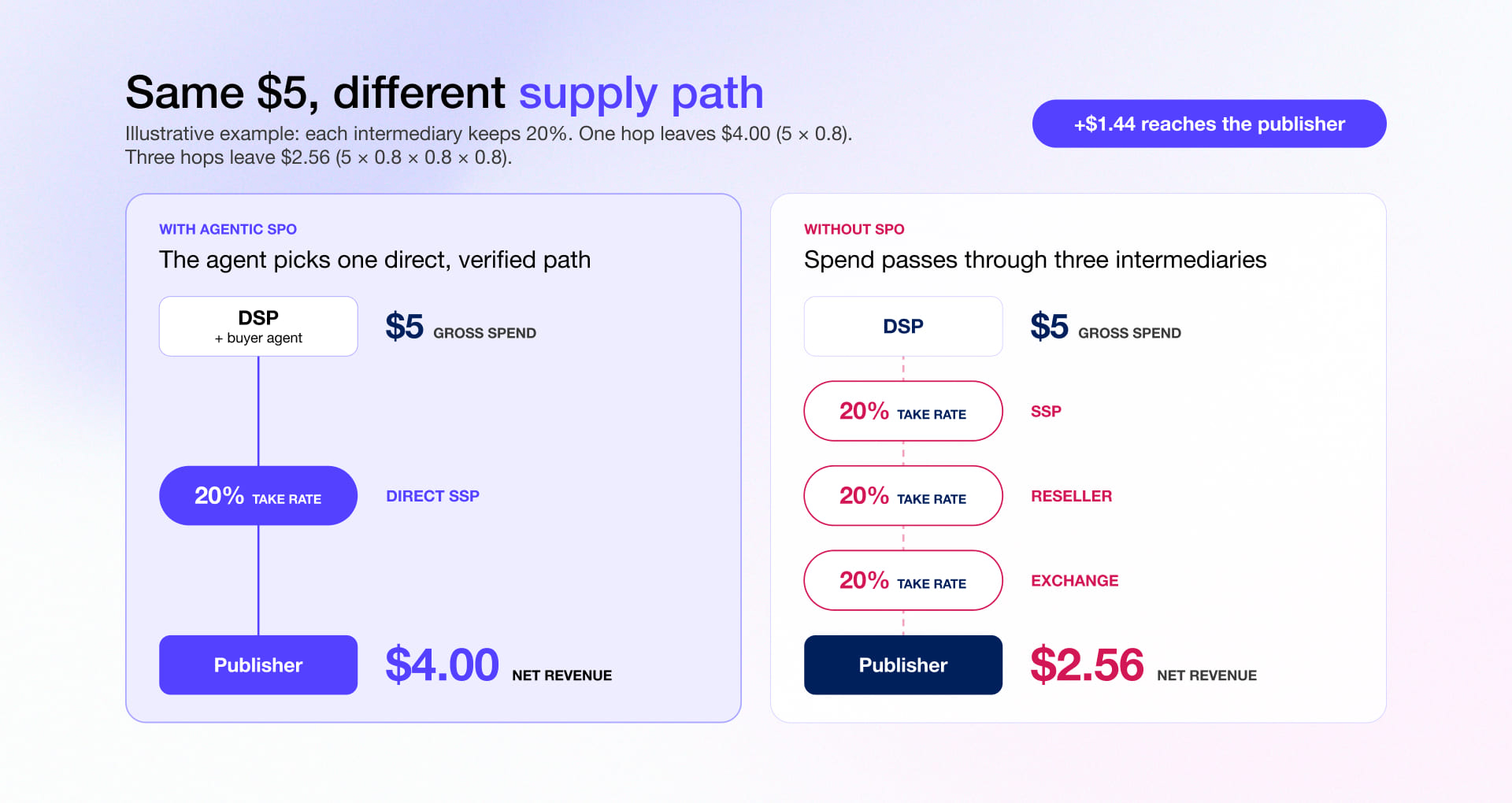
Choosing the right supply path in agentic advertising is directly proportional to how effectively your money is being utilized, rather than simply adding more costs and allowing ad spend to go to waste, because every dollar deserve best outcomes.
When supply path optimization is at the core of your strategy and is managed well, it can give you visibility from the initial bid to the final impression, including where the impression travels, which route it takes, and who is involved at each stage.
Let’s see the core business aspect where they are keeping SPO in agentic media buying:
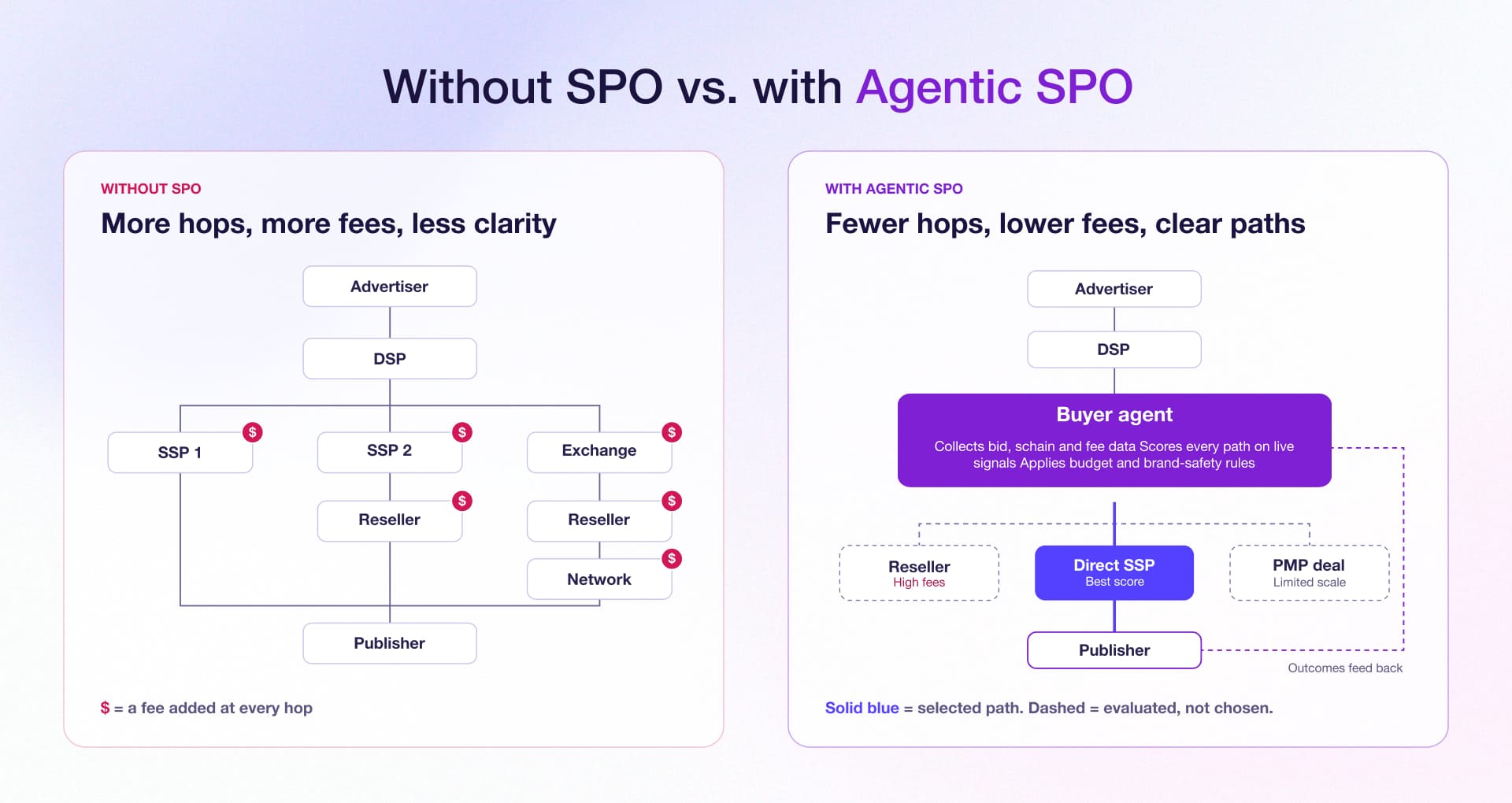
Reducing Unnecessary Intermediaries Without Compromising Inventory Quality
The more intermediaries a supply path picks up, the harder it becomes to track what each one adds to the transaction and what it costs. Whether your business falls under the advertiser category or the publisher, cost and complications are almost same.
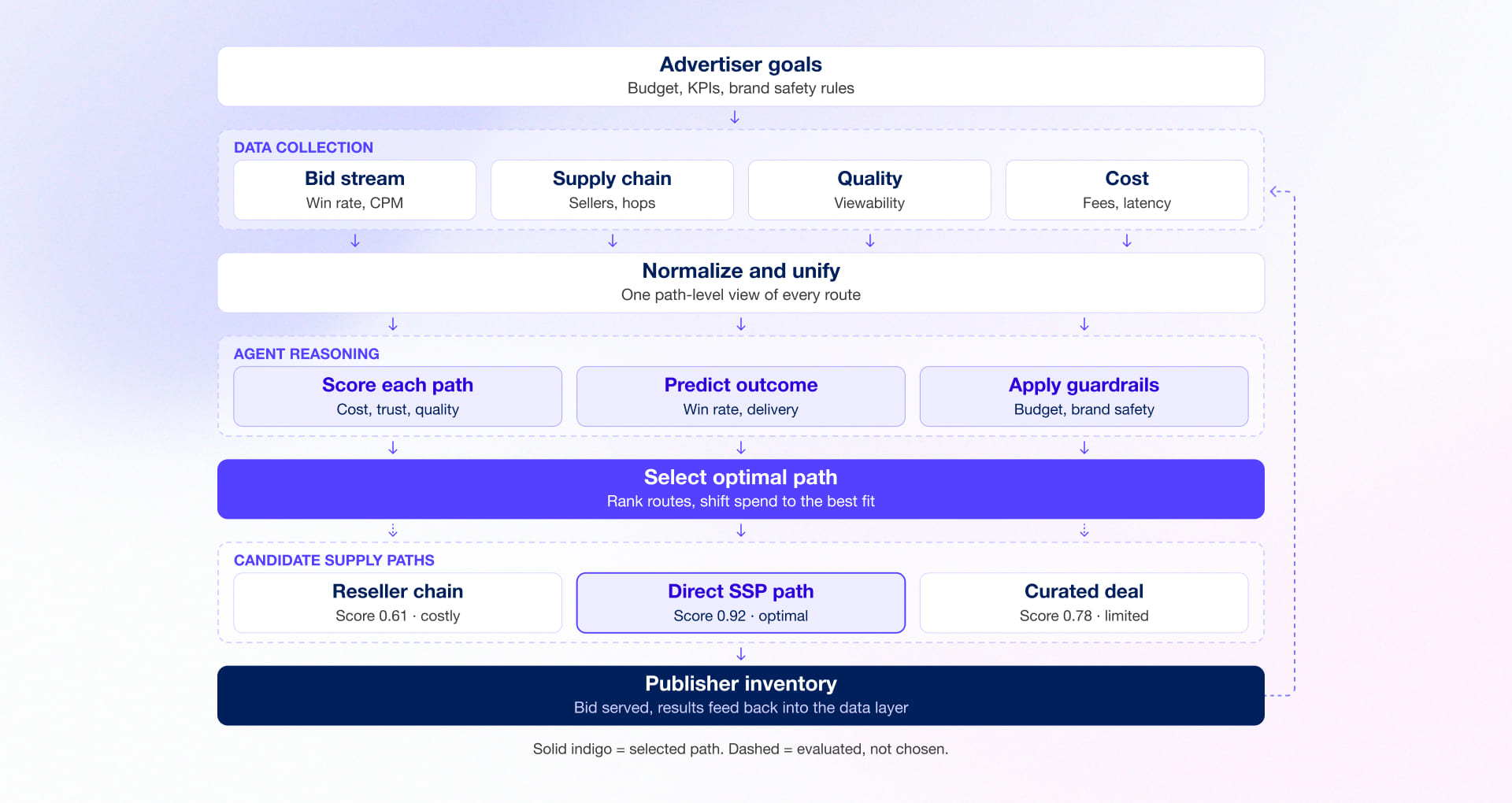
An agentic buying system needs to look beyond the available bid price. When the same publisher inventory is offered through multiple SSPs, the buyer agent can evaluate these overlapping routes using seller identity, intermediary fees, supply path length, win rates, and inventory quality signals. It can then rank the available paths against campaign requirements and flag duplicate or low-value routes.
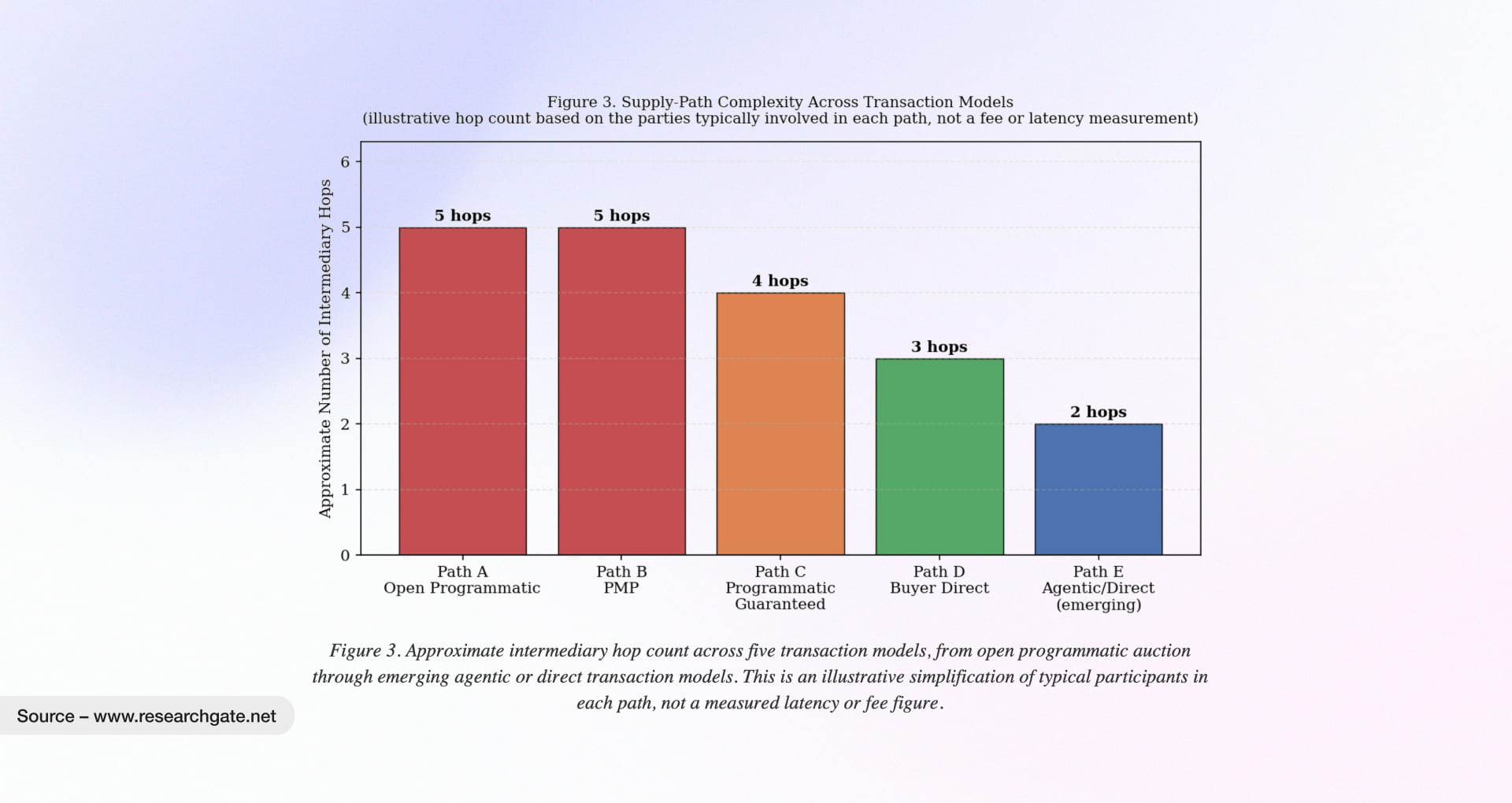
The selected route preferences can feed into the DSP’s bidding logic, where low-latency execution applies those decisions during real-time auctions. This way, agents can reduce unnecessary supply hops without excluding publishers or inventory sources that bring genuine audience reach and value.
Improving Supply Transparency and Inventory Access
An agent cannot make a reliable buying decision with only a bid price and an inventory ID. It needs to understand who owns the inventory, who is selling it, and how the impression reaches the buyer.
This is where supply-chain data becomes important. Agents can use the OpenRTB SupplyChain Object (schain) to inspect the seller nodes attached to a bid request, then cross-check seller identities against sellers.json and authorized selling relationships through ads.txt. This helps identify undisclosed intermediaries, unauthorized sellers, and incomplete supply paths.
Once this information is available in a structured, machine-readable format, buyer agents can apply seller allowlists, preferred supply routes, and inventory quality rules before passing eligible opportunities into the bidding process. They can also use auction outcomes and performance data to reassess which supply partners deserve preference.
What Must Change in Your Supply Path Architecture to Support AI-Led Buying?
1. Inventory Findability and Accessibility
Publishers and supply-side platform need to provide clear and structured data so that their inventory can be easily found by AI media buying agents. This includes data on ad format, inventory, audience, floor price, availability and deals. With API and standardized metadata, the buyer agent can easily search for the required information, comparing inventory across multiple sellers to check that it fits the campaign criteria. If data is inconsistent or incomplete this can impact the inventory selected.
2. Direct Communication Between Buyers and Sellers
Buyers using agentic buying can communicate directly with sellers using the existing programmatic infrastructure and emerging standards such as AdCP and AAMP. The platforms will need to provide the ability to interact with the buyer and seller agents, providing features to help find inventory, negotiate deals and establish transaction terms. This provides new ways for buyers to access inventory whilst also providing sellers with more ways to offer their inventory.
3. Control Over Pricing, Budgets, and Buying Decisions
If using autonomous or AI in media buying there should be rules in place at the campaign and platform level to ensure control. Advertisers should be able to set limits on how much they want to spend on their campaigns, set maximum bids, define what sellers they wish to buy from, exclude certain inventories and define deal preferences. This should be passed through to the Demand side platform to be used in bid evaluation and bidding. There should also be processes in place on the platform for any transactions above a set threshold.
4. Transparency Across Automated Media Transactions
With automated transactions there needs to be some way of showing where the inventory has come from, who has been involved and how much it has cost. The OpenRTB SupplyChain Object (schain) can provide details on who has been involved in the bid request. The seller.json can provide details on the seller entity and ads.txt can show authorized sellers. DSPs can use this alongside bidstream data and auction data to understand the inventory path, identify hidden/sellers that aren’t authorized and understand any costs incurred by intermediaries.
How to Validate and Control Supply Paths in AI-Led Media Buying
AI in ad operation is normal, but an AI agent overtakes the overall process of programmatic advertising. An AI agent can identify a promising supply path and negotiate a competitive deal, but the final purchase depends on more than its recommendation. The platform must establish who is authorized to sell the inventory, whether the agent has permission to commit the budget, and whether the transaction has already been processed. These checks become particularly important when agents operate across multiple sellers and buying platforms without constant human supervision.
Seller Authorization and Supply Chain Relationships
The cheapest supply path isn’t always the most trustworthy. Multiple resellers often offer access to the same inventory. Cross-checking ads.txt, sellers.json, and OpenRTB SupplyChain (schain) records helps verify seller relationships, identify intermediaries, and flag questionable routes before a purchase.
Establish Buying Permissions and Approval Boundaries
A million-dollar media budget isn’t a blank cheque for an AI agent. Spending caps, approved seller lists, and pricing limits define what agents can purchase independently. High-value deals, unfamiliar sellers, or unusual pricing trigger human approval before money is committed.
Prevent Duplicate Transactions and Handle Execution Failures
One buying decision should not result in two bills. A network timeout can leave an agent uncertain whether an order succeeded. Idempotency keys, transaction tracking, and reconciliation checks help prevent duplicate orders and confirm the actual purchase status before another attempt.
How to Modernize an Existing DSP or AdTech Platform for Agentic Supply Paths
Most DSP / AdTech platforms have existing integrations with SSPs, data on inventory and logic on how to buy. The key thing to consider is whether your platform can support decisioning by AI agents with no risk of increasing cost, quality or governance issues.
There are some straightforward steps you can take to ensure your platform is ready.
Audit Existing SSP Integrations, Inventory Metadata, and Supply-Path Visibility
Before you even let your AI Agent touch your platform, you should understand what you have in your supply chain. Most platforms will have some level of data but often it will be split across many different areas.
Supply Chain Mapping: Have a list of all your SSPs, exchanges, direct publisher links, resellers and private marketplaces. Understand what integration type there is, the relationship, what inventory is available and historic performance.
Cleaning up your data:
- Seller ID and publisher ownership
- Inventory types and geography
- Minimum price, deal terms, fees and take rates
- Brand safety, latency, win rates and historical performance.
You’ll likely find there are gaps in your data. For example, there may not be seller IDs, deal terms are out of date, publisher names are inconsistent, unclear fees or visibility in reporting. All of these will cause issues when buying manually but will be problematic when attempting to use an AI Agent.
Introduce a Decisioning and Policy Layer Without Replacing the Existing Buying Stack
Now your supply data is cleaner, create a layer of decisioning and policy to control how your AI Agents can use the data. Allow the agent to recommend what inventory to buy, what routes to use and what deal to go for, but leave the execution to your platform.
Ensure the agent is only using logical decisioning. Give it access to relevant inventory, authorized sellers, price caps, budgets, historical performance and inventory availability. Leave your purchase, billing, fraud detection and reporting as they currently are.
Enforce the policies and use another checklist to make sure all commercial and operational rules are in place, ensuring your agent cannot operate outside these rules.
- Approved Sellers & Inventory Types
- Budget Cap, Pacing & Price Range
- Minimum Quality & Brand Safety
- Approval on high value deals or new supply relationships
- Automatically pause on repeated transaction failure.
Ensure the agent has the right permissions. For example, one agent could recommend a PM deal but require a trader to activate. Another agent could have permission to extend an existing deal within price ranges.
Using this method gives you are more control, if anything goes wrong you can pause/disable actions taken by the agent.
Pilot Agent-Negotiated Deals with Controlled Activation and Rollback
Don’t go straight into full automation. Start small by targeting one advertiser segment, a few approved publishers, one inventory type or one geography. Avoid high-budget campaigns and those with poor data.
The purpose of the pilot is to test whether the agent can identify useful opportunities, negotiate within the defined rules and complete the process without creating operational problems.
Run this in phases:
- Agent identifies an opportunity and recommends a deal.
- Policy layer checks this against commercial and purchase rules.
- Authorized person approves, changes or declines.
- Deal is activated with a small budget/volume.
- Platform will monitor the deal for delivery, cost, quality and exceptions.
To make sure the processes are all set to efficiently handle any issue. Automatically pause deals if they exceed cost/quality thresholds. Alert the operations team. And if possible, revert to a previous approved route. Keep a log of any activations, changes or interventions and also know who can re-enable the agent.
The aim is to prove that the agent can negotiate and that buying deals through an agent can generate value.
Measure Path Quality, Transaction Reliability, and Governance Effectiveness
Just because your agent successfully bought a deal doesn’t mean it made a better decision. Compare the routes that the agent chose against the existing routes, manually negotiated deals or similar inventory groups.
- Check how good the supply path is: Look at your effective CPM, visibility of fees, win rates, fill rates, viewability, invalid traffic, latency, duplicate inventory and campaign performance.
- Check that your transactions are successful: Look at how many deals were successfully activated, how many failed API calls, timeouts, duplicate purchases, discrepancies, time to approval and manual intervention.
- Check your governance: How many deals were blocked, policy breached, declined, attempted by unauthorized sellers, budget issues and rolled back.
Engineer the Next Generation of Agentic Media Buying with Rishabh Software
At Rishabh Software, we combine strategic consulting, roadmap development, and hands-on engineering to help AdTech businesses turn agentic media buying initiatives into measurable business outcomes. Our dedicated AdTech Software Development team supports everything from straightforward integrations to complex programmatic advertising workflows, with a focus on delivering early value and long-term scalability.
Through comprehensive supply-path assessments and AI readiness assessment, we identify modernization opportunities and build stronger data foundations backed by our expertise in data engineering, cloud modernization, AI agent development, and platform integration. This end-to-end approach helps businesses modernize existing DSP and SSP infrastructure, improve supply-chain transparency, and implement agent-driven buying capabilities with greater efficiency and control.
What We Bring to Agentic Media Buying:
- AdTech platform engineering: Experience building and scaling DSPs, SSPs, ad servers, ad exchanges, RTB infrastructure, and CTV platforms across display, mobile, video, and OTT.
- AI agent engineering: Development of production-ready agents using LLMs, RAG, function calling, tool orchestration, multi-agent workflows, and human-in-the-loop controls.
- Platform modernization: API development, legacy system integration, data pipelines, cloud-native architecture, and gradual modernization of existing buying systems.
Frequently Asked Questions
Q: How can a platform prevent duplicate purchases when an agent retries?
A: Each request made by the agent will be assigned a unique ID. This will ensure that if the agent retries, the platform will know to return the original response. There are further measures to protect against this, including budget management functionality, transaction status management, and duplicate request detection.
Q: How can a team audit which supply path an agent selected?
A: A log will be created for each agent decision. The log includes the agent usage, campaign, seller, any intermediaries, fees, policy checks, approvals, route taken, transaction ID, and delivery status. This lets teams trace not just what was bought, but why and under whose approval.
Q: How can DSPs and SSPs prepare their platforms for agentic media buying?
A: DSPs will need to make sure that their data and buying controls are machine-readable. This includes inventory metadata so it is clear what is available, authorization from the seller, transparent fees, policy controls, and audit logs.
SSPs need to ensure that seller information, deal terms, inventory, and supply paths are accurate. Both DSPs and SSPs should have secure APIs, approval processes, tracking, and rollbacks