
Performance marketing has always been built around a simple principle: pay for measurable outcomes and optimize to generate more of them. As defined by the campaign objective, the outcome could be a click, an app installation, a qualified lead, customer acquisition, or a completed purchase. However, measuring an action doesn’t necessarily indicate whether it created desired business value or whether the defined budget should continue flowing to the same campaign, audience, or channel.
For example, your campaign’s click may never lead to any buying intention. An app install might never become an active user. A campaign might get leads, but it will not add desired value to the sales pipeline. Likewise, a low-cost acquisition might bring in a customer who cancels before you have recouped the cost of acquiring them.
This is where Agentic AI changes the optimization model. Agentic AI fixes this by linking campaign choices to real results down the line, such as conversion rates, retention rates, revenue, profit margins, and lifetime customer value.
The IAB’s 2026 Outlook Study found that two-thirds of buyers are now prioritizing agentic AI specifically for ad buying and campaign management, with cross-platform measurement increasing to 72% of buyers from 64% the year before, as teams try to connect autonomous execution back to verifiable outcomes.
This blog discusses how agentic AI in performance marketing changes the optimization, what technology you need to support it, and a clear plan to go from just tracking paid actions to using controlled and autonomous optimization.
How Agentic AI Changes Performance Marketing Optimization
Rule-based automation and agentic AI both aim to reduce manual work, improve productivity, and increase efficiency, but they operate on different logics. AI in programmatic advertising and overall performance marketing, or else we can say rule-based system executes a fixed instruction when a condition is met.
An agent perceives live campaign signals, reasons about the objective it has been given, decides on an action within defined constraints, and then observes the result before deciding again. It is a continuous plan-decide-act loop rather than a single trigger-response event, and it is what enables agentic AI systems in programmatic CTV to make consistent decisions across inventory that traditional automation cannot fully account for.
In practice, this loop lets agents take on tasks that used to require constant manual oversight:
- Creating and testing ad variations
- Adjusting bids, pre-bids, and budgets
- Finding profitable audiences
- Monitoring campaign performance
- Generating reports and recommendations
- Following up with leads
The difference between the two approaches becomes clearer side by side.
| Dimension | Traditional Rule-Based Automation | Agentic AI |
| Decision logic | Fixed if-then rules set in advance | Reasons against a goal using live signals |
| Scope of action | Single metric, single channel | Cross-channel, cross-signal coordination |
| Response to new patterns | Requires manual rule updates | Adapts within defined guardrails |
| Human role | Sets rules, reviews exceptions | Sets objectives and constraints, audits outcomes |
| Reporting | Static dashboards, scheduled pulls | Continuous monitoring with generated recommendations |
| Failure mode | Executes a bad rule indefinitely | Bounded by guardrails, escalates uncertainty |
From Cost per Action to Value per Action
The impact of agentic AI becomes clearer when applied to common performance marketing models.
| Model | Traditional Optimization Focus | Common Blind Spot | What an AI Agent Adds |
| CPC | Cost and volume of clicks | Clicks with limited conversion intent | Connects click sources with downstream conversions and reallocates spend |
| CPI | Cost and volume of installs | Installs that do not activate or retain | Uses activation and engagement signals to assess source quality |
| CPL | Cost and volume of leads | Leads rejected by sales or CRM qualification | Connects campaigns with qualified pipeline and lead outcomes |
| CPA | Cost of customer acquisition | Customers with poor retention or profitability | Evaluates acquisition cost against margin, retention, and customer value |
What Agentic AI Can Do Across the Performance Marketing Lifecycle
Agentic AI adds intelligence and continuity across the full performance marketing lifecycle. Let’s understand how:
- Diagnose
The agentic AI in performance marketing observes campaign, attribution, CRM, and revenue signals, then reasons about why performance changed. It can distinguish between creative fatigue, audience saturation, tracking issues, poor lead quality, and rising media costs, rather than just reporting a metric decline.
- Design
The agent converts business goals into an actionable decision framework. For example, it may be instructed to reduce the cost per sales-qualified lead while maintaining lead volume, within daily budget limits, and in accordance with campaign restrictions.
- Deploy
Before launch, the agent checks tracking events, campaign configurations, audience rules, budget caps, platform permissions, and approval workflows. It can flag missing or inconsistent settings before they affect live campaign performance.
- Optimize
The agent monitors live performance, selects the next-best action, and either recommends or executes it. This may include adjusting bids, reallocating budgets, rotating approved creative, excluding weak inventory, or escalating a high-risk decision for human approval.
- Institutionalize
The agent records actions, outcomes, approvals, and experiment results as reusable decision context. These learnings help it improve future recommendations and prevent the system from repeating unsuccessful actions.
The lifecycle becomes:

The Technology Foundation Needed for Agentic AI-Led Performance Marketing
Agentic AI cannot operate reliably as a standalone layer on top of fragmented campaign dashboards. What it actually requires is a connected architecture consisting of data engineering, AI/ML models, cloud infrastructure, platform integrations, workflow automation, and governance.
Cloud infrastructure: Agents need elastic compute to process bid requests, campaign signals, and audience data at RTB speed. This is typically built on AWS, Google Cloud, or Azure, using containerized services and infrastructure-as-code to deliver the scalability and reliability that continuous, always-on agent execution demands, rather than the batch-processing patterns legacy marketing stacks were built on.
The AI/ML layer: Agentic systems combine several model types working together: predictive models for bid and budget forecasting, reinforcement learning for sequential decisions like pacing, and large language models for reasoning through ambiguous signals and generating creative variants or reports in natural language. The value comes from how they are orchestrated against a shared objective.
Advanced Data Engineering & Integration: The foundational data architecture must ingest, clean, and unify disparate data streams into a single high-velocity repository. This involves deploying modern real-time data pipelines that stitch top-of-funnel ad engagement data together with bottom-of-funnel CRM pipeline data and ERP financial realities, providing the agent with an accurate, real-time environment to reason against. Applying privacy-first data engineering for programmatic CTV advertising and performance marketing ensures overall control and governance into the architecture from the outset.
Microsoft platform layer: For enterprises already standardized on Microsoft, Azure AI Foundry provides the model orchestration and grounding layer for building and governing agents at scale, while Microsoft Copilot Studio extends agentic capabilities into conversational and workflow-driven tools that marketing and operations teams can use directly. Microsoft Power Platform components like Fabric and Power BI sit underneath as the unified data and reporting layer, giving agents a single, governed source of campaign and conversion data to reason over instead of fragmented exports across platforms.
The AdTech integration layer: This is where most performance marketing technology stacks actually break down. Agents need direct, low-latency access to demand-side platforms, data management platforms, and identity resolution systems, and a common protocol for communicating with each other and with external ecosystem agents. IAB Tech Lab’s 2026 roadmap is building toward exactly this, extending OpenRTB with Agentic Advertising Management Protocols and an Agentic Real-Time Framework, alongside open-source Buyer Agent and Seller Agent SDKs, so autonomous systems across the supply chain can transact without fragmenting into incompatible, proprietary formats.
This is the same multi-agent architecture pattern already proving out in adjacent AdTech use cases, from vertical AI agents scaling retail media networks to an agent-driven ad fraud detection platform, and it is what keeps agentic optimization auditable rather than a black box.
Implementation Roadmap: From Paid-Action Tracking to Agentic Optimization
Agentic AI for performance marketing should be introduced progressively. Giving an AI agent control over campaign decisions before establishing reliable tracking, connected data, and clear guardrails can create faster decisions without necessarily improving campaign performance or ROI.
A practical roadmap for performance marketing moves through four levels: connected measurement, diagnostic intelligence, governed recommendations, and bounded autonomous execution.
Stage 1: Map the Performance Marketing Ecosystem
Start by identifying the platforms, data sources, workflows, and stakeholders involved in planning, activating, measuring, and optimizing performance campaigns.
Performance Marketing Ecosystem Mind Map
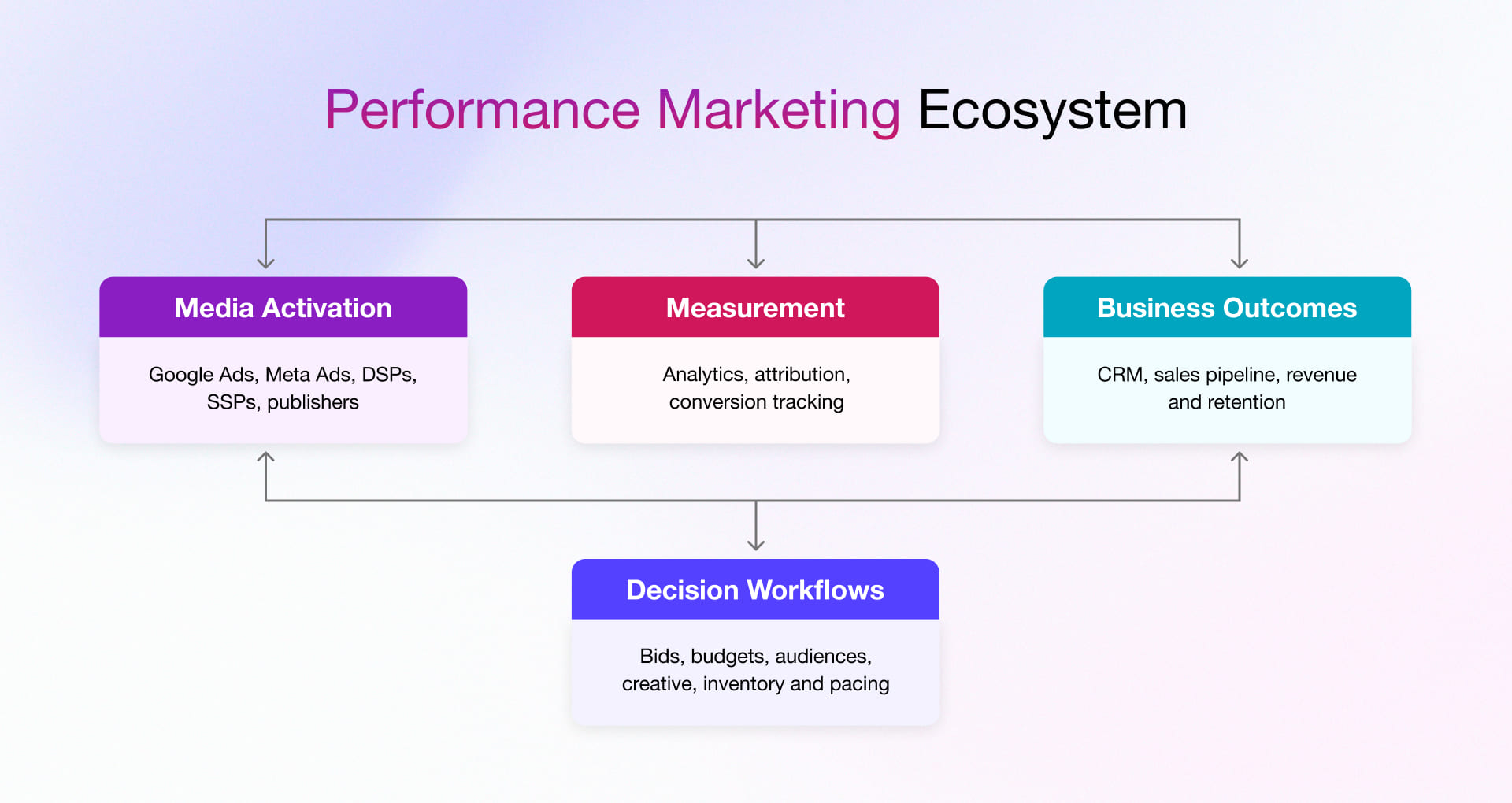
This exercise reveals data fragmentation in programmatic ads, where decisions are delayed, and where teams depend heavily on manual analysis.
The output should be a clearly defined decision gap, such as delayed budget reallocation, weak lead-quality visibility, slow campaign-health diagnosis, or inconsistent inventory evaluation.
Stage 2: Select the Right Agentic AI Use Case
Do not attempt to automate the complete ecosystem at once. Select one use case that is measurable, data-supported, and valuable enough to justify implementation.
A simple decision matrix can help prioritize the options.
The ideal first use case should have:
- A clear business owner
- Reliable input data
- A frequent decision cycle
- A measurable outcome
- A reversible action
For many organizations, monitoring and diagnosis are safer starting points than autonomous budget management.
Stage 3: Build the Data and Decision Foundation
Once the use case is selected, connect only the systems and signals required to support that decision.
For example, a lead-quality optimization agent may require campaign spend, conversion source, CRM lead stage, sales acceptance, opportunity value, and historical conversion quality.
The implementation flow at this stage is:
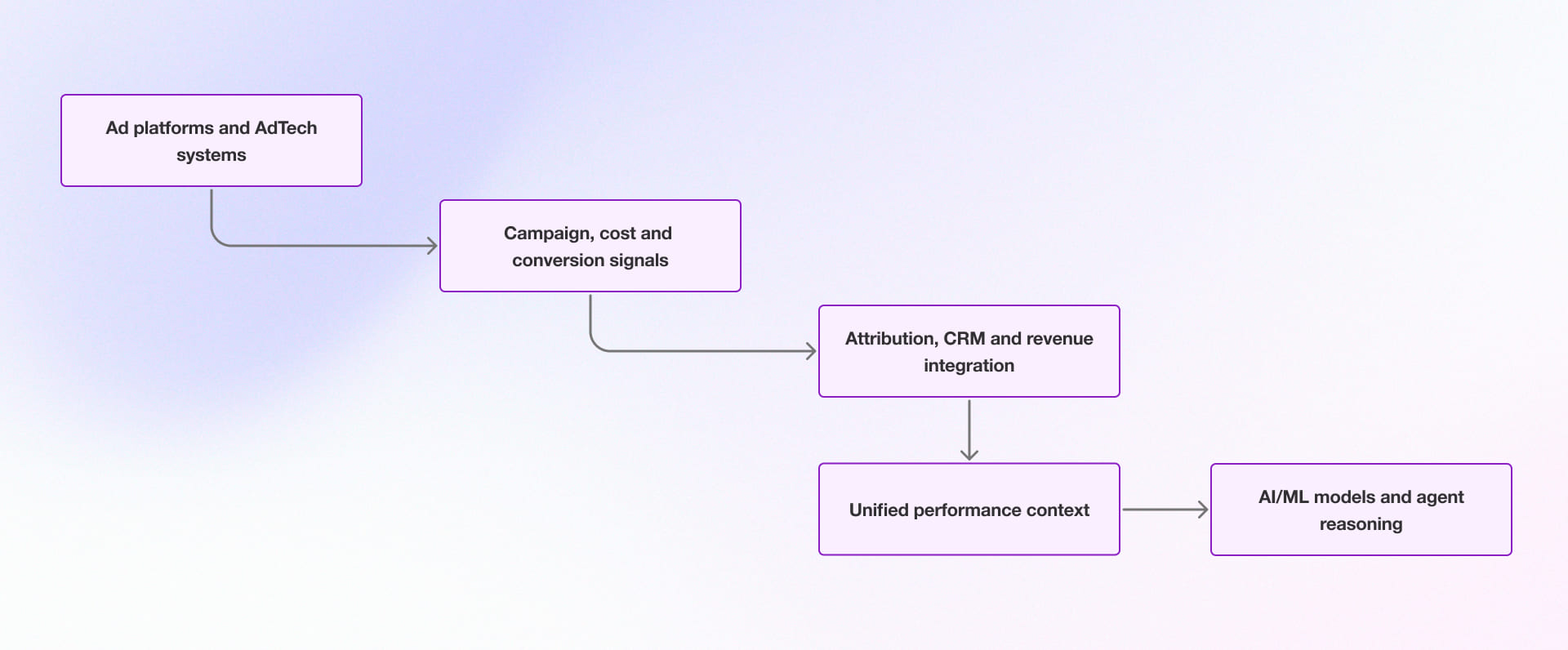
The AI agent must also receive a precise objective. Instead of asking it to “improve campaign performance,” define a goal such as:
Stage 4: Decide How Much Authority the Agent Should Receive
The agent should not receive execution authority simply because it can generate a recommendation. Its level of control should depend on data reliability, decision confidence, financial impact, and reversibility.
Agent Authority Decision Tree
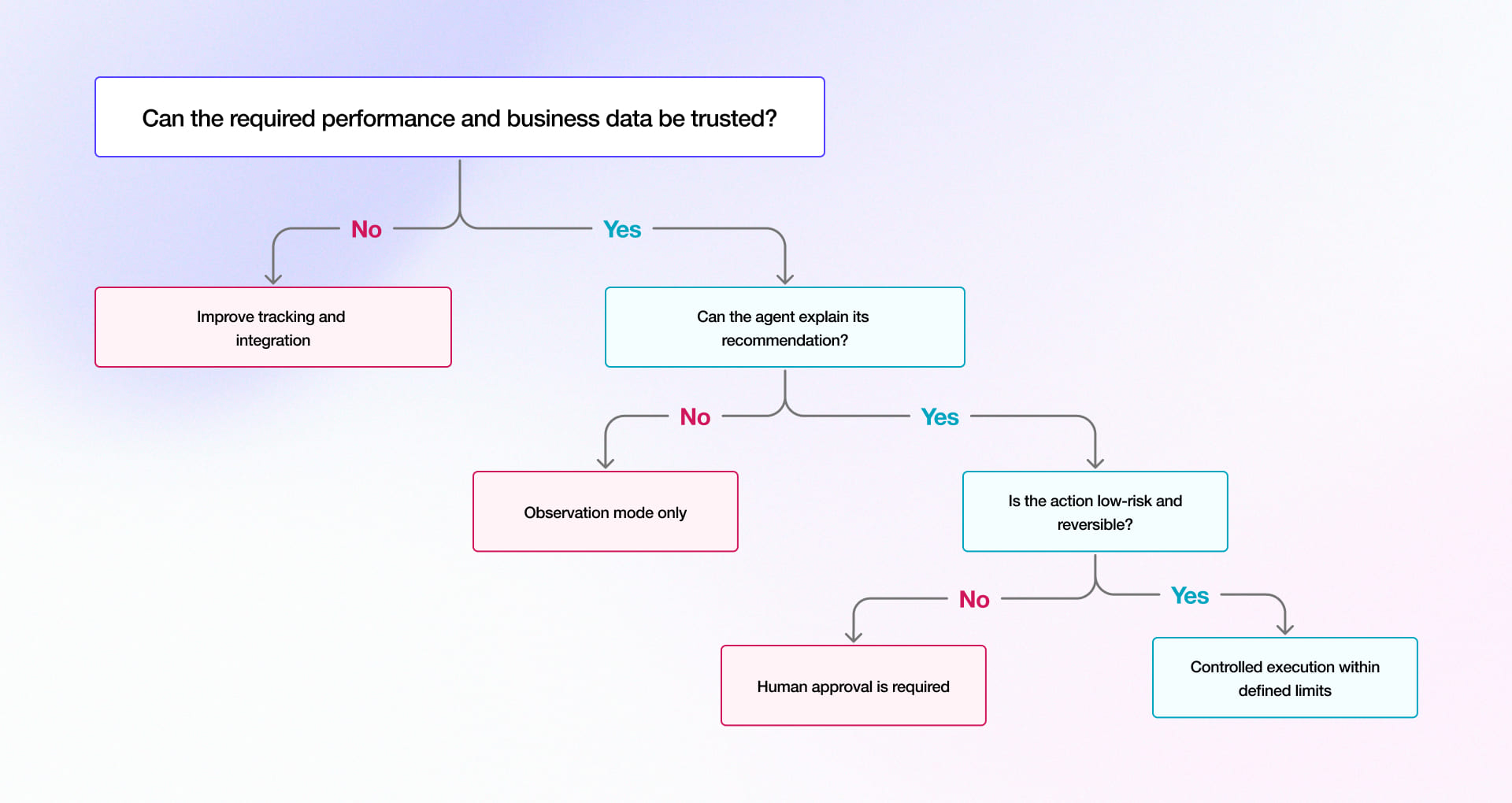
- A practical rollout normally progresses through three modes:
- Observation mode: The agent monitors performance and explains changes.
- Recommendation mode: The agent suggests bid, budget, audience, creative, or inventory actions for human approval.
- Controlled-execution mode: The agent performs selected low-risk actions within approved limits.
Stage 5: Close the Loop and Scale
Once the agent demonstrates reliable performance, connect every action with its downstream result.
The system should measure whether a bid adjustment, budget shift, audience change, or inventory exclusion improved qualified conversions, revenue, ROAS, retention, or customer value.
Closed Agentic Optimization Flow
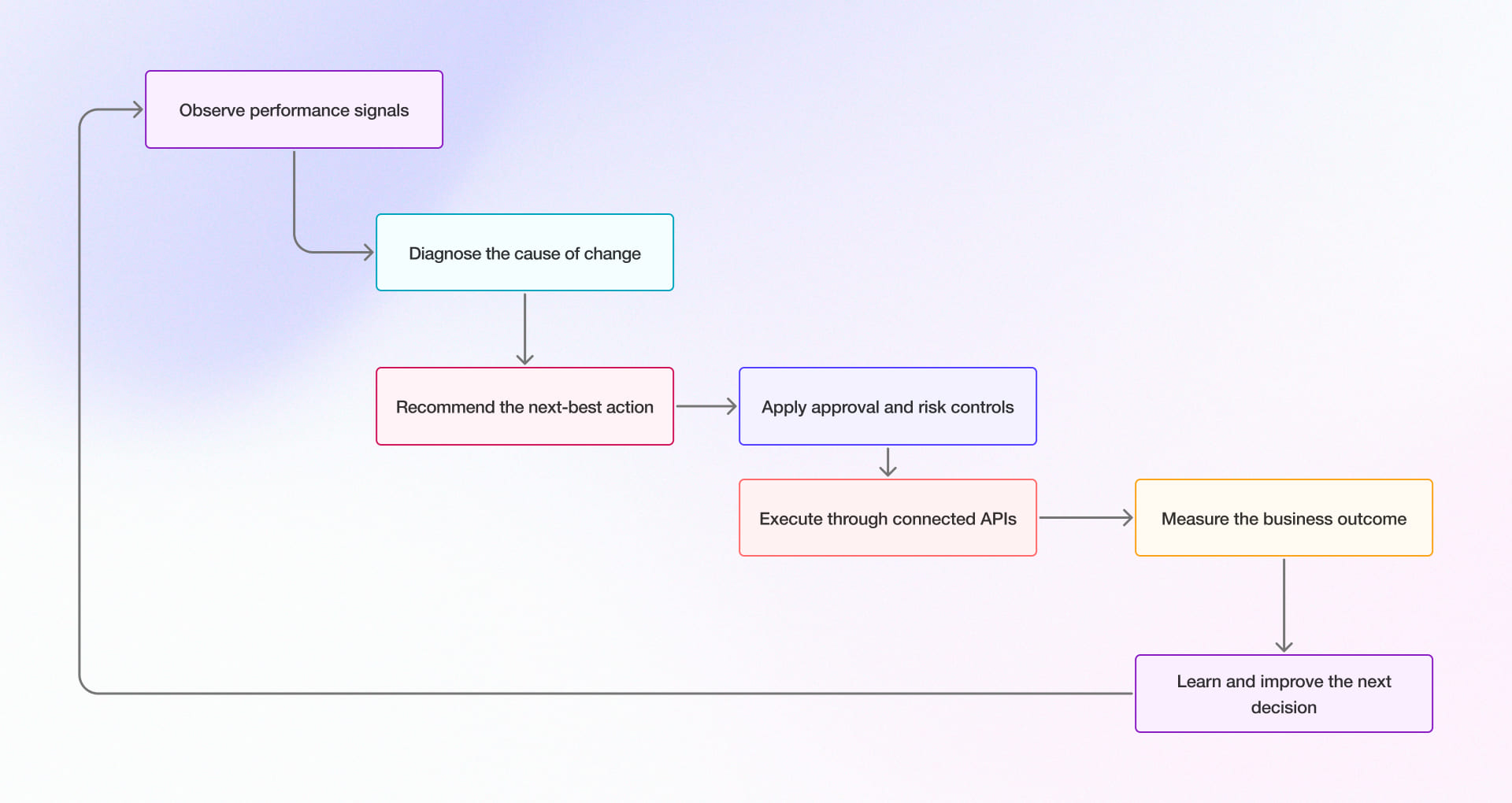
Scaling should mean expanding proven capabilities, such as giving one agent control over the entire performance operation, optimization, and decision refinement. The organization can add new channels, data sources, use cases, and specialized agents as the foundation matures.
How Rishabh Software Bridges Strategy and Execution for Agentic AI in Performance Marketing
Building agentic AI for performance marketing requires the same two capabilities together: top-notch expertise in AdTech software development and enterprise-grade AI/ML architecture. Most technology partners bring one or the other.
Rishabh Software has practice-proven expertise in building AdTech platforms across DSPs, supply-side-platforms, self-serve ad platforms, ad exchanges, and data management platforms, and has already applied agentic AI architectures to programmatic CTV execution, giving our teams direct, hands-on experience with the orchestration, guardrail design, and real-time integration challenges that agentic performance marketing raises.
Paired with our Microsoft Data and AI Services and AI agent development services, we help enterprises move deliberately through the stages above: consolidating tracking data, validating ML-driven optimization, and introducing supervised agents before expanding into full orchestration.
If your team is evaluating where to start, or already running early agentic pilots and looking to scale them responsibly, our AdTech and AI engineers can walk through your current stack and map the shortest, most governed path to autonomous optimization.