

Programmatic deals have become far more dynamic than simply buying and selling ad inventory. A deal’s success cannot be determined exclusively by the revenue it generates. It depends on how well it performs throughout the campaign, from accurate setup and steady delivery to buyer participation, inventory quality, and campaign pacing.
Every deal continuously generates performance signals. Some indicate healthy delivery, while others can reveal early signs of underdelivery, declining buyer interest, or revenue loss. The real challenge isn’t collecting this data, it’s knowing which signals matter, connecting them across the advertising ecosystem, and acting on them before they affect campaign performance and publisher revenue.
In this blog, let’s explore why programmatic deal health monitoring has become essential for publishers looking to reduce revenue leakage and improve campaign performance. We will also walk you through the key indicators of deal health and the capabilities to consider when building or adopting a scalable deal health monitoring solution.
Why Revenue Leakage Happens Before Anyone Notices in Programmatic Deal
Revenue leakage is rarely the result of a single failed campaign or technical issue. It builds gradually as small performance gaps emerge across the deal lifecycle. Individually, these changes may not seem important, but together they can have a brutal impact on revenue, campaign efficiency, advertiser satisfaction, and more.
When Revenue Leakage Usually Begins,
- Disconnected Data: Performance signals remain scattered across supply-side platform, demand-side platform, ad servers, and data analytics tools, making it difficult to see the complete picture.
- Delivery Gaps: Small deviations in pacing or impression delivery often go unnoticed until campaign targets are missed.
- Weakening Buyer Demand: Changes in bidding activity, buyer participation, or spend gradually reduce deal competitiveness.
- Pricing Decisions: Floor prices that no longer reflect market demand can quietly reduce fill rates and yield.
- Inventory Quality: Inventory or audience mismatches limit campaign performance without immediately triggering operational alerts.
- Delayed Response: By the time issues appear in periodic reports, the opportunity to recover lost revenue has often passed.
Where Should Deal Health Be Monitored Across the Advertising Lifecycle
A healthy programmatic deal is one that regularly hits its goals for delivery, demand, and revenue throughout the campaign. Instead of waiting for post-campaign reports, publishers should check the deal’s status at every step from setup and activation to delivery, optimization, and final analysis. This helps spot problems early and keep the campaign performing well over time.
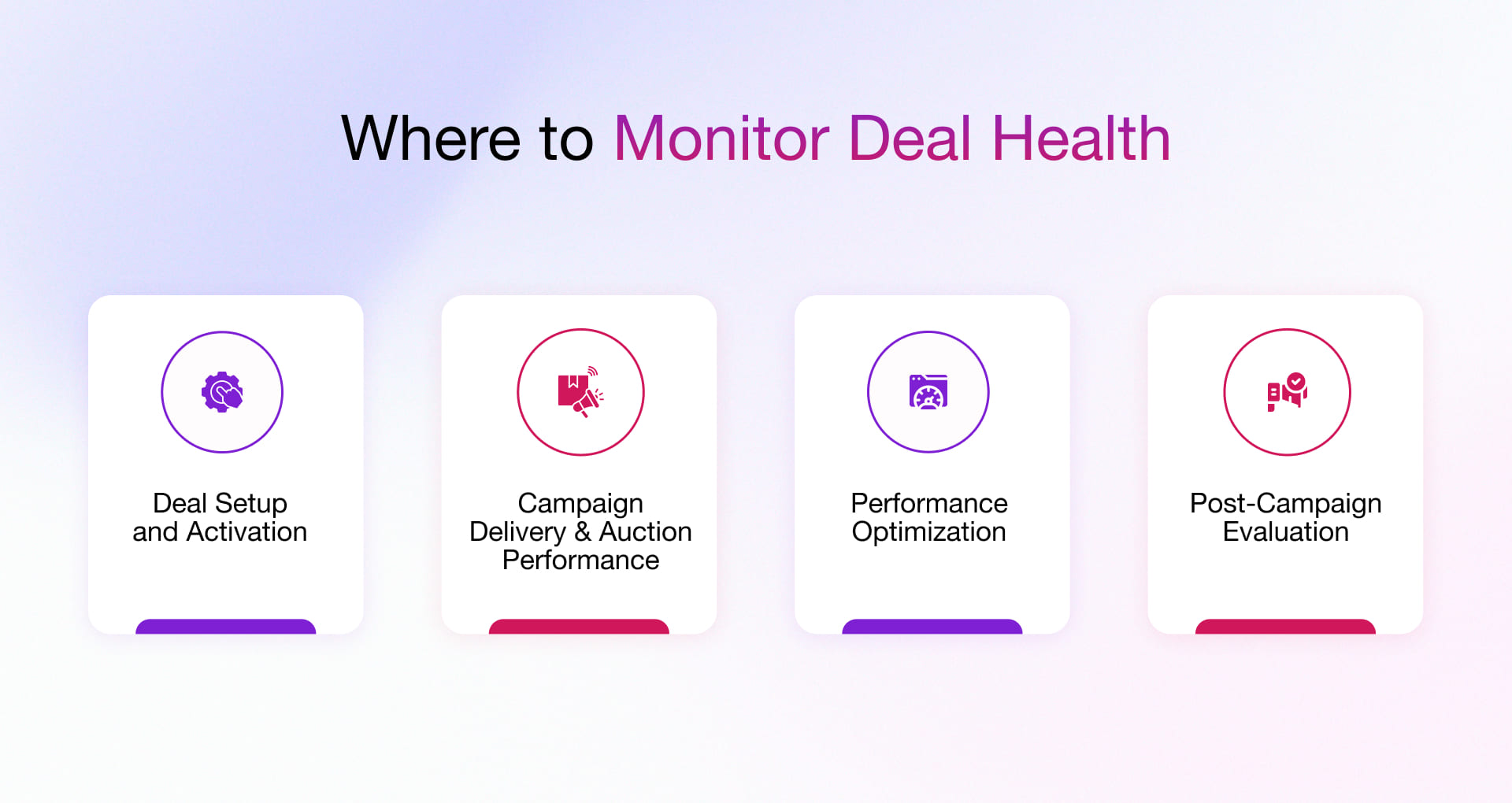
Stage 1: Deal Setup and Activation
A programmatic deal’s health begins before the first bid request is sent. During setup and activation, publishers need to check important settings such as Deal IDs, audience targeting, which inventory can be used, creative approvals, and how the supply-side and demand-side platforms connect. Small mistakes here can lead to delivery errors, unused inventory, or delays in starting the campaign. Getting these details right from the start helps ensure the deal is ready to work properly at the auction.
Key deal health factors to monitor:
- Deal ID and SSP/DSP configuration accuracy
- Audience targeting and segmentation
- Creative approval status
- Inventory eligibility
- Pricing and floor price configuration
- Campaign readiness before launch
Stage 2: Campaign Delivery and Auction Performance
Once a deal goes live, its performance is shaped by buyer demand, auction dynamics, and inventory quality. Continuous monitoring at this stage helps publishers identify performance shifts early, uncover optimization opportunities, and close gaps before they impact delivery or revenue.
Key deal health factors to monitor:
- Delivery pacing
- Impression delivery
- Bid request and bid response rate
- Win rate
- Fill rate
- Buyer participation and spend
- Revenue trend
- Auction competitiveness
Stage 3: Performance Optimization
Performance optimization is where publishers move from monitoring to action. Insights gathered during campaign delivery are used to fine-tune pricing, inventory, audience targeting, and demand strategies, ensuring the deal continues to perform efficiently as market conditions evolve.
Key deal health factors to monitor:
- Inventory utilization
- Audience quality and match rate
- Floor price effectiveness
- Yield performance
- Supply path efficiency
- Performance trends over time
Stage 4: Post-Campaign Evaluation
Once a campaign concludes, publishers can evaluate overall deal performance to identify optimization opportunities for future campaigns. Looking over how the deals performed helps publishers see what worked well, where they missed chances, and how they can handle programmatic deals better next time.
Key deal health factors to evaluate:
- Campaign delivery vs. target
- Revenue contribution
- Buyer retention and engagement
- Deal profitability
- Inventory performance
- Renewal opportunities
- Benchmarking against similar deals
Core Capabilities of a Scalable Deal Health Monitoring Platform
Ad Operations leadership requires a consistent way to monitor programmatic deal health at every stage of the programmatic deal lifecycle. Teams that build or adopt a custom monitoring solution that aligns with their business goals can detect problems sooner, improve performance and prevent revenue leakage. The following framework outlines the core capabilities required to build a scalable deal health monitoring platform.
1: Unified Data Layer Across SSPs, DSPs, Ad Servers, and Audience Platforms
Deal health cannot be evaluated from a single platform. Delivery, bidding, inventory, audience, and revenue signals exist across multiple systems, making data fragmentation in programmatic ads one of the biggest barriers to operational visibility. A unified data layer consolidates these signals into a single view, enabling teams to monitor every active deal consistently.
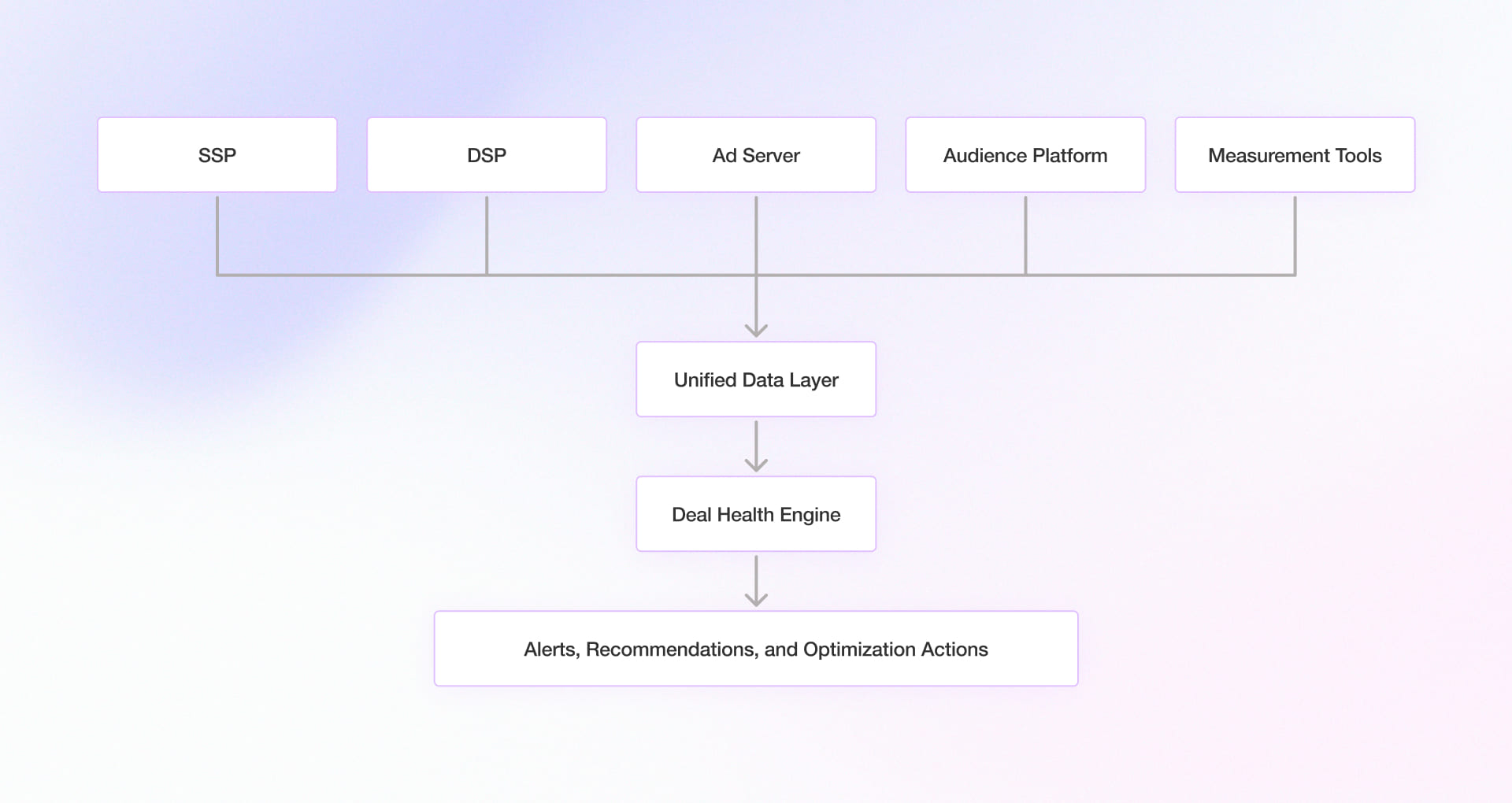
Core Capabilities
| Capability | Why It Matters |
| SSP & DSP integrations | Consolidates demand-side and supply-side performance |
| Ad server connectivity | Tracks delivery, pacing, and impression data |
| Audience platform integration | Measures audience quality and targeting accuracy |
| Standardized Deal IDs | Eliminates reporting inconsistencies |
| Unified data model | Creates a single source of truth |
2: Real-Time Monitoring and Intelligent Alerting
Combining AI/ML development services with data engineering services can advance the capabilities of your programmatic deal health monitoring solution across areas such as real-time monitoring and intelligent alerting. Being smart means choosing smarter, AI in programmatic advertising.
Examples of monitoring rules:
- Delivery pacing falls below target
- Buyer participation declines
- Win rate drops significantly
- Fill rate decreases
- Revenue deviates from the expected trend
3: Transform Monitoring Data into Actionable Deal Intelligence
Revenue intelligence transforms delivery, bidding, inventory, and buyer activity into actionable insights that help teams understand why deal performance is changing, which deals require immediate attention, and where intervention will have the greatest business impact. Rather than reacting to isolated metrics, Ad Operations teams can make faster, data-driven decisions based on the overall
Key capabilities:
- Deal Health Scoring: Evaluate every active deal against predefined business rules and performance thresholds.
- Signal-Based Anomaly Detection: Identify unusual patterns across delivery, demand, pricing, and auction performance.
- Revenue Risk Prediction: Forecast potential underdelivery or revenue loss before campaign objectives are affected.
- Root-Cause Analysis: Correlate signals across multiple platforms to determine what’s driving performance changes.
- Recommended Next Actions: Surface data-driven recommendations to help teams prioritize and resolve high-impact issues quickly.
4: Build for Scale, Performance, and Extensibility
As publishers expand across channels, devices, and demand partners, monitoring requirements grow drastically. A scalable architecture ensures new connected media platforms, inventory sources, and business rules can be incorporated without redesigning the platform, allowing organizations to support increasing deal volumes while maintaining consistent performance.
Key design considerations:
- Modular architecture
- API-first integrations
- Cloud-native scalability
- Configurable monitoring rules
- Support for evolving AdTech standards (OpenRTB, sellers.json, SupplyChain Object)
KPIs Every Programmatic Deal Health Dashboard Should Track
Regardless of how a deal health platform is built, its effectiveness ultimately depends on tracking the right performance indicators. For AdOps teams, reliable delivery, demand, auction, and revenue KPIs provide the visibility needed to identify issues early and make informed optimization decisions. Publishers get more value from a focused mix of delivery, demand, auction, and revenue KPIs. Together, this smaller set tells a complete story of how a programmatic deal is truly performing, than any single metric could on its own.
| KPI | What it indicates | Why It matters |
| Bid Request Volume | Demand opportunities available | A sudden decline may indicate inventory or demand issues. |
| Bid Response Rate | Buyer participation | Measures how actively buyers respond to bid requests. |
| Win Rate | Auction competitiveness | A declining win rate can signal pricing or demand challenges. |
| Fill Rate | Inventory utilization | Shows how efficiently available inventory is being monetized. |
| Impression Delivery | Campaign progress | Helps identify underdelivery and pacing issues early. |
| CPM/eCPM | Revenue efficiency | Tracks the value generated from available inventory. |
| Revenue | Overall financial performance | Measures whether the deal is meeting its revenue expectations. |
| Campaign Pacing | Delivery against plan | Indicates whether campaigns are on track to meet agreed targets. |
| Deal Status | Operational health | Highlights deals that are healthy, at risk, or require immediate attention. |
| Revenue at Risk | Potential revenue loss | Estimates the financial impact of unresolved delivery or performance issues. |
Best Practices for Monitoring and Optimizing Deal Performance
- Separate Buyer-Side and Supply-Side Signals
A weak deal is not always a demand problem. Check whether the issue is coming from low buyer bids, limited eligible inventory, aggressive floors, audience scarcity, creative restrictions, or DSP setup gaps. - Review Deal Setup Quality Before Optimization
Many performance issues start with basic configuration mismatches. Validate deal ID mapping, floor price, GEO, device, format, audience rules, priority settings, and buyer eligibility before making larger changes. - Use Pacing Patterns to Spot Silent Risk
A deal may look active but still be unhealthy if spend is too concentrated, delivery is inconsistent, or demand drops during key hours. Look at the pacing by hour, day, buyer, and inventory source. - Create Feedback Loops With Buyers and Traders
Deal health improves faster when publishers understand why buyers are not bidding or winning. Regular feedback from DSPs, agencies, and trading teams helps refine floors, inventory packages, targeting, and activation strategy.
Build a Programmatic Deal Health Solution That Prevents Revenue Leakage Before It Happens
Programmatic deal health is no longer just about monitoring campaign metrics. It requires the ability to unify signals across SSPs, DSPs, ad servers, and audience platforms, identify performance risks early, and enable timely optimization.
At Rishabh Software, as a trusted Adtech software development services provider, we help AdTech enterprises design and build intelligent deal health monitoring solutions tailored to their ecosystem. From engineering unified data foundations and real-time monitoring capabilities to implementing an AI-powered deal health score engine, anomaly detection, and revenue intelligence, we help publishers move from reactive reporting to proactive revenue optimization.
If you’re looking to build a scalable deal health platform that delivers actionable insights and protects advertising revenue, our Adtech experts are ready to help.