
Commercial debt collection involves more than tracking overdue payments and following up with borrowers. For commercial lenders, recovery decisions depend on a broader view of borrower exposure, repayment behavior, collateral positions, covenant compliance and outstanding obligations across multiple credit facilities. When this information sits across disconnected lending, servicing, credit and legal systems, collections teams often lack the visibility needed to identify emerging risks and determine the right recovery action.
Modernizing commercial debt collections requires a connected approach to borrower data, risk assessment and recovery workflows. Commercial finance firms need to bring facility-level information into a unified borrower view, identify early warning signals, prioritize accounts based on exposure and recovery potential, and establish clear ownership of exceptions and follow-ups. This blogpost explores the operating model, technology capabilities and implementation roadmap lenders can use to strengthen commercial debt recovery without necessarily replacing their existing lending systems.
Why Commercial Debt Collections Require a Different Recovery Approach
Consumer collections run on volume, with thousands of small balances and scripted contact cycles. Commercial collections run on judgment, because every borrower has its own cash cycle, covenants, and collateral, plus a relationship manager who wants to keep the client.
A late payment usually points to credit stress, so the first call should cover cash flow and collateral. Push too hard on a borrower with a short cash gap and you can lose the relationship and the recovery. Go too soft on a borrower in decline and you can lose the collateral cushion.
Collectors can only choose between those moves when they see the whole file: borrower, facility, servicing history, collateral and portfolio position. A digital-first lending platform puts that file in one place across the loan lifecycle, which an isolated overdue record never will.
Understanding The Complexity of Commercial Debt Recovery
Take a hypothetical packaging manufacturer that pays its term loan on time, maxes out its credit line, and breaches a covenant on cash flow coverage. Since no payment is overdue, no alert fires. A collector working an overdue list never sees the problem here, but a collector with the full borrower view spots it and calls the relationship manager immediately.
Four layers explain why this case needs a full view. Every commercial case has them:
- Exposure: One borrower often has a term loan, a revolving credit line, and sometimes an equipment loan. Each facility has its own terms and status. The manufacturer’s term loan looks clean while its revolving credit line tells a different story.
- Collateral: Receivables get older and inventory loses value. The amount a lender will advance against them may still rest on the last on-site review, so a fully drawn credit line can sit on weaker collateral than the file shows.
- Obligations: Covenants and guarantees decide which remedies the lender can use, and when. The manufacturer’s covenant breach may open new options.
- People: Relationship managers, credit officers and legal counsel each own part of the decision, so in this case the relationship manager gets the first call.
The Hidden Cost of Fragmented Commercial Debt Collections
When your data sits in separate systems, your team loses hours. Collectors rebuild each borrower’s profile manually for every case. Promises to pay end up in spreadsheets and personal inboxes. Credit, servicing, finance and legal each keep their own version of the facts, and an audit question like “who approved this forbearance?” can take someone days of digging through email threads.
Every week of lag also narrows your options on a deteriorating account. A reminder tool or a dashboard won’t fix that while the underlying data stays scattered. You can fix the data without replacing your core system. Modern lending data architecture connects borrower, invoice, collateral and servicing data into one current view on top of the systems you already run.
An Actionable Operating Model for Debt Collection Process Modernization
A strong commercial collections operation gives every team the same view of the borrower, ranks accounts by what the lender can recover, and assigns an owner to every decision. You can build that model on the systems you already run. Modernizing business debt collection involves these five working parts:
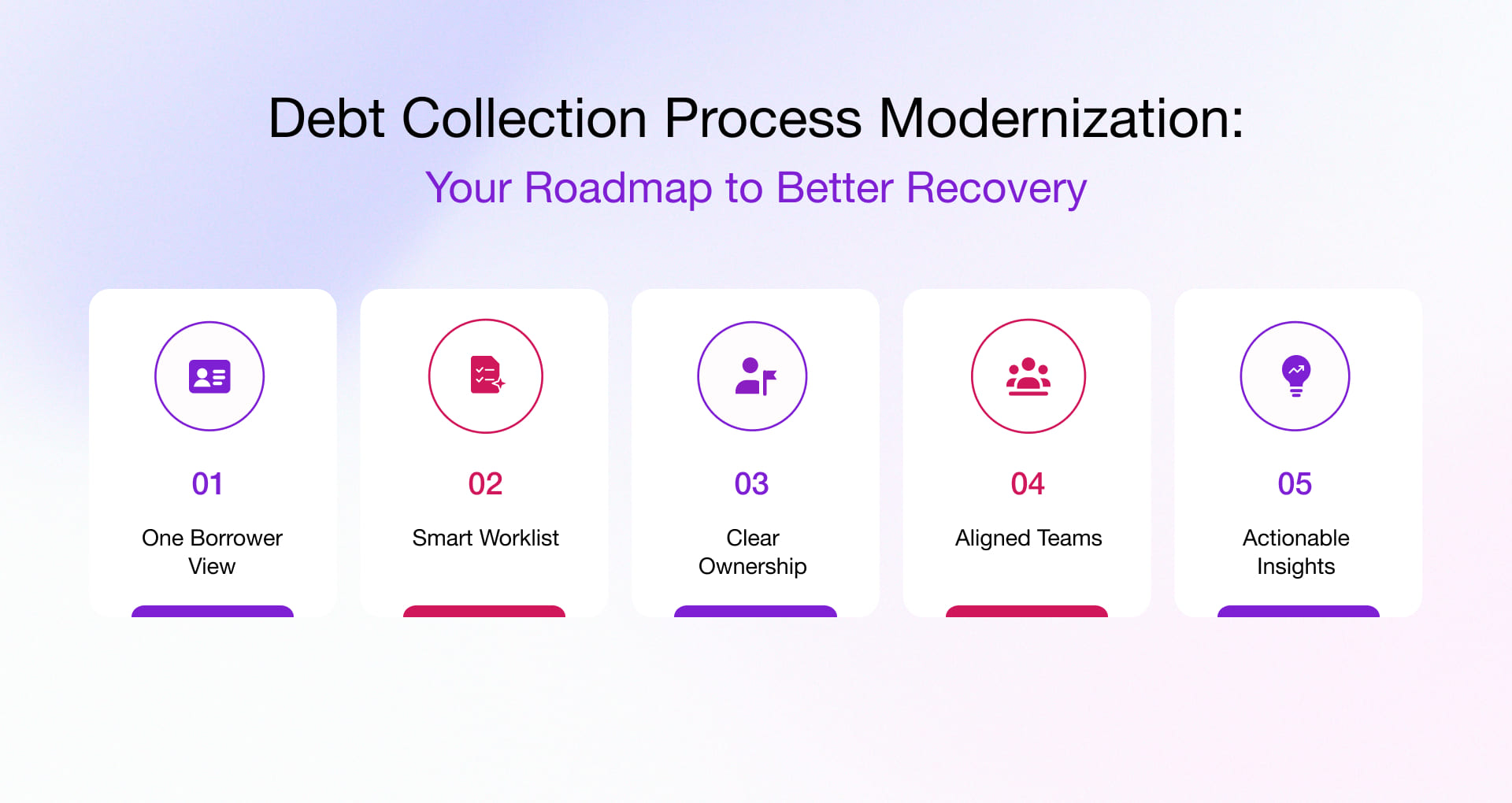
1. Build one borrower record: Pull facility, payment, collateral, and contact data into a single view, so collectors don’t need to juggle four systems to understand one borrower.
2. Rank your worklist by recovery value: Rank accounts by how much is at risk, how well collateral covers it, and how healthy the borrower is. Keep days past due as one factor, but don’t sort by it alone.
3. Name an owner for every exception: Give each exception one person and each escalation a clear trigger, such as a covenant breach or a missed promise to pay.
4. Put credit, collections, legal, and servicing on the same record: When all four teams see the same facts, handoffs are no longer dependent on emails.
5. Report recoverable value by segment: Show leaders what they can recover from each part of the portfolio, along with the overdue totals.
Agree on definitions before you build anything. If credit and servicing define delinquency differently, no dashboard will reconcile the two. A common data language in lending sets one meaning for borrower, facility, exposure, delinquency and recovery status, and every team uses it.
Use software to identify the right case on the right day and leave the recovery decision to an experienced collector. Fix a broken debt collection process before you digitize it, because software only makes a bad process run faster.
Six Must-Have Capabilities in Debt Collection System Modernization
A successful debt collection software modernization needs six capabilities. Each one fixes a specific bottleneck, so you can check your current setup against the list and see which gaps cost you the most.
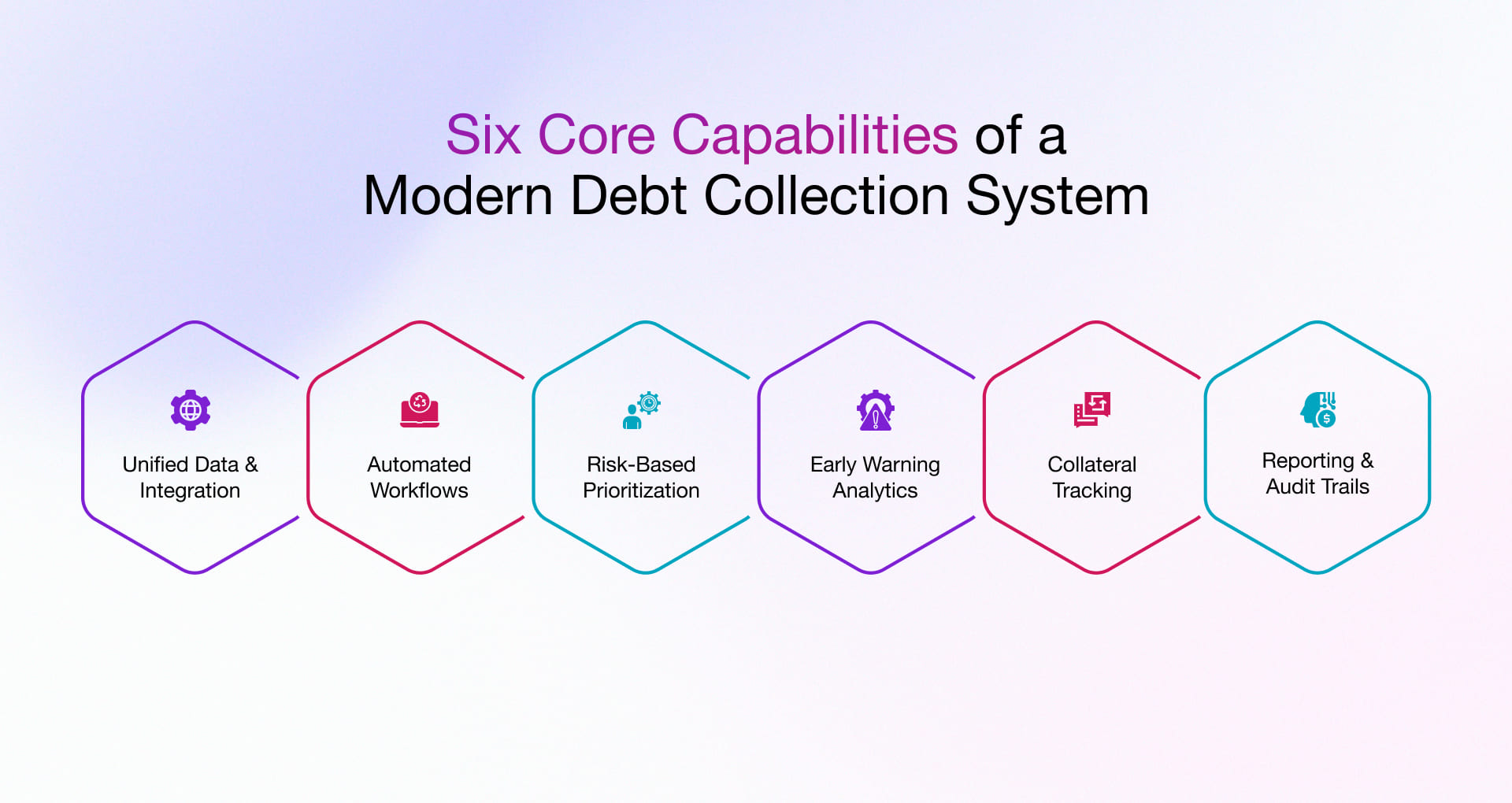
- Unified data and integration: Scattered records hide a borrower’s total exposure, so connecting your lending, servicing, payment and collateral systems gives collectors one view and saves them from chasing details across screens.
- Workflow automation and case management: Missed follow-ups cost recoveries, but automatic assignment, reminders and escalation triggers keep every case moving because the system prompts the next step before anyone has to remember it.
- Risk-based prioritization: A queue sorted by age treats a small overdue balance and a large deteriorating exposure the same way. Whereas, ranking cases by exposure, collateral coverage and borrower signals sends collectors to the most recoverable accounts first.
- Early warning analytics: Repayment patterns, borrowing base movement and covenant trends often show stress before the first missed payment, so your team can act while options are available.
- Collateral and exposure tracking: When valuations, advance rates, and guarantee data stay current, you can see your real recovery position and decide how hard to push with the actual numbers in front of you.
- Reporting, communication, and auditability: Logged interactions and reconciled promises to pay give leaders a clear record of what the team did. A portfolio dashboard shows what it recovered, so nothing needs reconstructing when an auditor asks.
All six run on the same foundation – API-led integration, modular design, cloud readiness, security and data governance. You can keep your core systems and add modern services around them.
What To Modernize First: A Practical Roadmap
An ideal way is to start without replacing your existing system. The roadmap runs in five phases, with data first, automation second and AI last, so each step builds on clean work from the one before.
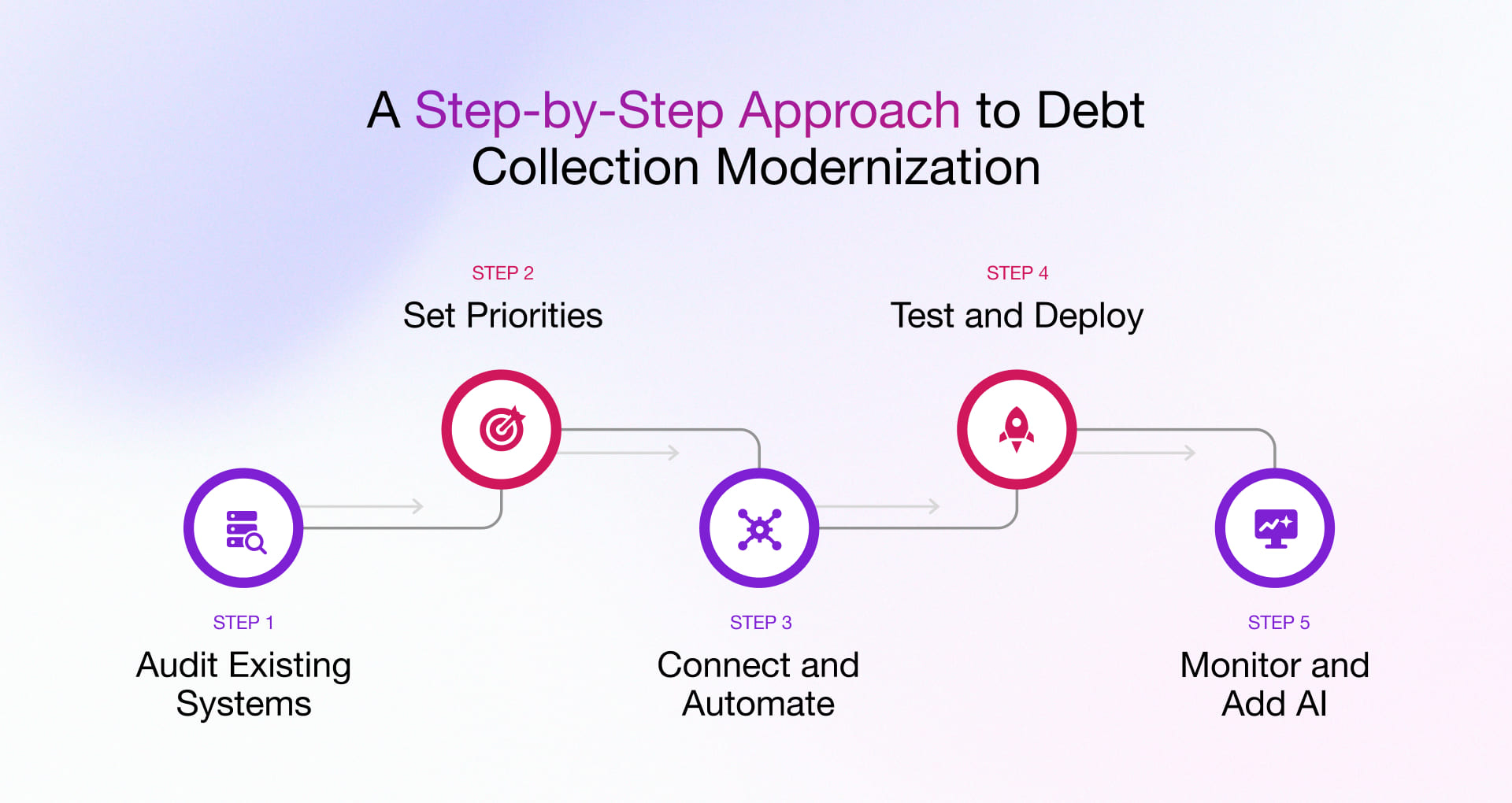
- Phase 1 – Audit: map your applications, data sources, integrations, and manual steps, and look closely at the handoffs between credit, collections, legal and servicing, since most cases tend to halt there.
- Phase 2 – Plan: set your priorities, target architecture, integration needs, and security controls and start with the problem that costs you the most.
- Phase 3 – Connect and Build: integrate your lending and payment systems, standardize how exceptions get handled and add workflow automation and risk-based worklists so the cleaner data starts driving daily work.
- Phase 4 – Test and Deploy: check data accuracy, integration reliability, security, and user experience, and train your collectors before go-live so they trust what they see from day one.
- Phase 5 – Monitor and Apply AI: once your accounts rank by expected recovery value, AI in debt collection can sharpen that ranking with payment behavior, account history and credit signals. It works best at this stage because when automation is fed inaccurate or outdated data, it only produces bad decisions faster.
Measuring the Performance of Commercial Debt Collections
Record a baseline for each metric below before you change anything, because without a benchmark, you can’t show what improved. Rerun the same numbers after each phase, and add the last two metrics, which matter most in commercial lending.
- Days past due (DPD) tells you how late each obligation runs.
- Delinquency and roll rates show how many accounts slip and how many slide into a worse bucket.
- Cure rates track the share of delinquent accounts that return to current.
- Recovery rates and loss severity show what you actually get back and what you lose.
- Promise-to-pay fulfilment shows how often borrowers keep their word.
- Collection cost per account and case resolution time put a price on each file in staff hours and calendar days.
- Collector productivity measures how much each person gets done.
- Portfolio exposure and recovery trends show where the book is heading.
- Covenant and collateral exception resolution time shows how fast your team closes the issues that signal trouble early.
- Exposure in cases with no named owner shows where accountability has a gap.
How to Assess Your Commercial Debt Collection Maturity
Four questions reflect where you stand today. A “no” on one or two points to a targeted fix, and a “no” on all four points to a broader platform rebuild.
1. Can your collectors reach borrower, facility, payment and collateral data in one place?
If they can’t, your systems need better integration and if they can’t connect or scale at all, that calls for legacy application modernization.
2. Do your cases follow set rules, owners and escalation paths?
If they don’t, start with targeted process fixes, because automating inconsistent rules only spreads the inconsistency.
3. Can your team rank accounts by recovery potential and spot weak borrowers early?
If it can’t, risk-based worklists and early warning analytics will close that gap.
4. Can you trace every action, keep clean records and pass an audit without a scramble?
If you can’t, heavy manual work is the likely cause and workflow automation with logged interactions will fix it.
How Rishabh Software Helps Commercial Finance Firms with Debt Collection Software Modernization
Your collections team can work from one borrower view without replacing the systems it already uses. As a hands-on lending software development company, we build the applications, integrations and data platforms that give your collections team one borrower view without replacing the systems it already uses.
- Custom lending and collections platforms – when off-the-shelf software can’t match how your team manages exposure, collateral, and escalations, we build a platform around your own rules, so your collectors work the way your credit policy says they should.
- Lending and third-party integration – your lending, servicing, payment, borrower, and financial data systems connect into one flow, so your collectors find what they need on one screen when a borrower calls.
- Workflow and exception automation – your cases go to the right owner, your follow-ups go out on schedule, and your escalations trigger when your rules say they should, so your collectors spend their time on the calls that need judgment.
- Analytics and reporting – your leaders see what the portfolio can recover and where recovery is heading, and they make each call from current numbers, with no wait for a month-end report.
- Legacy application modernization – you keep the collections systems your team already knows, and we make them easier to maintain and add the modern capabilities you need, so your people don’t have to stop work while the upgrade happens.
Real-World Success Story: Modernizing a Legacy Asset-Based Lending System
Legacy lending systems can slow reporting and limit operational visibility. We helped an asset-based lender modernize its existing platform and reduce reporting time by 75%. The project shows how better data integration and system modernization can improve reporting efficiency and support more informed collection and recovery decisions. Read the legacy asset-based lending system modernization for SMBs case study to see the challenges, solution, and measurable results.