In the programmatic ecosystem, fragmented data is a known constraint, not an unexpected surprise. Audience insights are scattered across platforms such as SSPs, DSPs, DMPs, and ad exchanges, each with its own schema, timing, and visibility. The result is incomplete attribution, inconsistent reporting, and optimization decisions based on only part of the picture, forcing teams to work harder while achieving less.
The real challenge isn’t about identifying the problem. It’s closing the gaps. The real progress comes when you shift from stitching reports to architecting unified pipelines, resolving identifiers, and enabling real-time activation across the platforms you use.
In this blog, we will explore the structural causes of data fragmentation, how it erodes campaign ROI and transparency, and the strategies that can help advertisers create a connected data foundation that finally unlocks the full promise of programmatic.
What Causes Data Fragmentation in Programmatic Advertising?
First things first, before jumping into the strategy part, let’s start from the root: why is data fragmentation growing so fast, and how is the data-driven era affecting the AdTech ecosystem?
1. Fragmented Identity Across Platforms
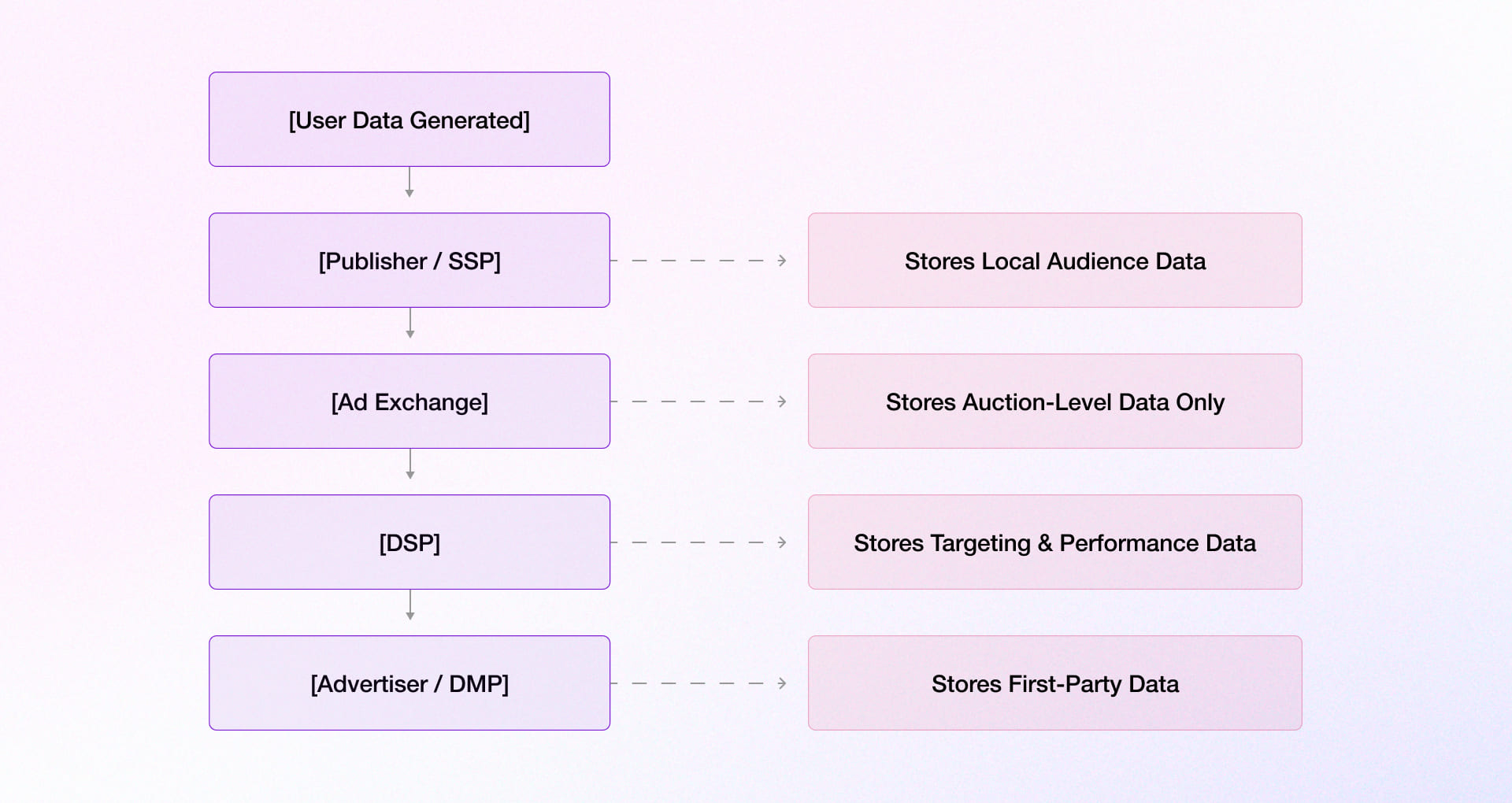
If there’s one primary cause of data fragmentation in programmatic advertising, it’s the inconsistent resolution of user identities across platforms. The programmatic ecosystem operates through the collective functioning of platforms such as demand side platforms, supply side platforms, ad exchanges, and data management systems. Notably, each of these platforms stores user information in its own way, typically using third-party cookies, mobile IDs, or hashed identifiers. When these identifiers fail to align, a user’s behavioral data becomes scattered across multiple, disconnected systems.
-
- Inconsistent ID Sync: Technical limitations such as latency, third-party cookie opt-outs, and network timeouts cause stoppages in ID syncing. This entire disruption creates a loophole called “same data with multiple IDs,” where impressions, clicks, and conversion journeys of the same user are recorded separately. That leads to,
- Wasted impressions
- Poor look-alike and audience modeling
- Lower return on media spends
- Isolated by Privacy: Cross-domain tracking is deliberately restricted by browsers such as Apple’s ITP and Mozilla’s ETP. By limiting the use of third-party cookies, these policies confine user data within individual domains. When third-party cookies stop working:
- Data gets trapped inside individual platforms
- Attribution models lose key signals
- Real-time activation becomes difficult
- Inconsistent ID Sync: Technical limitations such as latency, third-party cookie opt-outs, and network timeouts cause stoppages in ID syncing. This entire disruption creates a loophole called “same data with multiple IDs,” where impressions, clicks, and conversion journeys of the same user are recorded separately. That leads to,
Privacy-driven changes continue to reshape how advertisers measure and personalize experiences and that shift isn’t slowing down.
As a result, audience information remains siloed, fragmenting measurement and reducing the effectiveness of campaign activation. As highlighted by McKinsey, privacy-driven shifts like third-party cookies are reshaping how advertisers measure and personalize engagement.
-
- Disconnection Across Devices: Audiences jump constantly between web, mobile, and CTV. Without a universal identity framework:
- Each device becomes a separate “user”
- Reach and frequency are misreported
- Upper-funnel and CTV exposure rarely connects to lower-funnel conversions
- Disconnection Across Devices: Audiences jump constantly between web, mobile, and CTV. Without a universal identity framework:
An omnichannel strategy is only as strong as the ability to recognize the same person across screens.
2. Protocol and Data Flow Limitations
Data flow is the most important thing, especially when discussing data fragmentation in the programmatic ad landscape. Data fragmentation has its own challenges. First, we are referring to ID not sync; there may be IDs that match up, but the data flow between platform/system/solution is fragmented and broken down due to the data exchange protocols that don’t sync, and limited insight into data.
- OpenRTB inconsistencies: Bid requests submitted to multiple SSPs can represent the same impression, but if a transaction ID is used in some bidding channels, then it is impossible for the DSP to de-duplicate the bids for efficiency of bidding.
- Asymmetrical visibility: No one player in the ad supply chain has seen the full picture, as the publisher, exchange and DSP are all working from siloed parts of the auction intelligence.
- Bid Shading and Proprietary Algorithms – Different DSPs use different bidding logic based on siloed data set and interpretation of performance, all leading to unique bid.
3. Siloed Enterprise Data Architecture
Within ad business, data fragmentation is often reinforced by internal data design and workflow decisions rather than external ecosystem constraints.
- Tool Sprawl and Data Duplication: Advertisers/ad agencies use multiple platforms such as CRM, CDP, analytics, and attribution tools, each holding its own copy of audience data in a different format.
- Schema Drift: Metrics such as “conversion” or “engagement” are defined differently across tools, causing discrepancies that make unified reporting unreliable.
- Access and Ownership Barriers: Security and compliance rules, while necessary, often restrict how teams and systems can share or integrate data, heading to departmental silos.
4. Reactive System Integration
Many adtech ecosystems have evolved reactively with new platforms or tools added as short-term fixes rather than as part of a unified data strategy.
- Disconnected Integrations: Each system introduces its own schema, API, and event-tracking logic. Without standardization, these integrations become brittle and inconsistent.
- Lack of Data Governance: Without a clear data strategy, organizations end up managing multiple “sources of truth,” making it difficult to reconcile insights across touchpoints.
How Data Fragmentation in Programmatic Advertising Impacts Campaign Performance and ROI
Most marketers feel the effects of data fragmentation long before they diagnose the cause. Budgets don’t stretch as far as expected. Targeting becomes less precise. Reports contradict each other. And optimization decisions rely more on assumptions than truth.
Fragmentation doesn’t just complicate operations; it quietly drains performance. In this section, we break down the core areas where disconnected data leads to wasted spend and reduced visibility into what’s actually working.
1. Inefficient Audience Segmentation
Programmatic advertising runs on the illusion of precision, millions of data points promising to identify exactly who your audience is and when they’re ready to buy/convert as a lead. But when that data is scattered across disconnected DSPs, advanced analytics platforms in CTV ads, and walled gardens, segmentation becomes more guesswork than science. You think you are building audience clusters; in reality, you are herding pixels. Without unified user IDs, each platform ends up seeing its own version of the same person or worse, missing them entirely.
2. Poor Targeting
When audience data lives in silos, your ads start shooting in the dark. The whole premise of “right message, right user, right time” collapses under the weight of missing context. One platform thinks the user is a tech enthusiast, another tags them as a parent, and a third has no clue who they are. The algorithm dutifully spends your budget trying to please all three and lastly ends with pleasing none.
3. Skewed Attribution and Measurement
Attribution was supposed to tell us where to invest. Instead, fragmentation turns it into a blame game. Each ad platform claims victory, waving its conversion reports like a participation trophy. But when the same user’s journey is split across multiple identifiers, you can’t really tell which impression mattered or if any did. The result is inflated performance metrics and deflated ROI.
4. Poor Frequency Management
You know that feeling when you see the same ad six times in one hour? That’s not a strategy, that’s fragmentation. Without shared identifiers, advertisers can’t control how often users see a creative. The same person gets hit again and again because the system doesn’t recognize them across apps or browsers. Budgets leak through repetition, and users tune out from fatigue.
5. Weakened Personalization
Personalization needs continuity, a consistent thread of who the user is, what they like, and how they interact. Fragmented data cuts that thread. You lose the ability to tell a coherent story from one channel to the next. The result is tone-deaf messaging: irrelevant offers, mismatched timing, or a creative that doesn’t acknowledge prior engagement. It’s personalization without the “personal.”
Proven Strategies to Reclaim Control Over Ad Data in Programmatic Advertising
We have explored the main reasons and impacts of data fragmentation in AdTech. Now, let’s see how you can overcome this challenge with minimal effort, practical guidance, and proven strategies. Read this section carefully to make the most of it.
1. Create one source of truth for your audience and campaign data
When your DSP report shows one number, your analytics tool shows another, and your CRM shows yet another, you know you and your team are flying blind. A 2025 survey found that 54% of marketers say disconnected platforms are one of the biggest blocks to getting value from their data.

If you pull all your campaign data, audience segments, attribution metrics, and performance logs into one place, you make your decisions sharper. Let’s say an advertiser merges web-visit logs, ad impressions, and CRM leads into a central system. They may quickly spot that one audience segment generates many clicks but few conversions, something not visible when each platform reports in isolation.
If you are the one who wants to enhance their advertising efforts, building a centralized system is a game-changer for you. You can connect with us, a leading AdTech development services provider.
2. Prioritize first-party data ownership
Cookies from outside your own domain are less reliable than they used to be. A study reports that nearly half of advertisers expect to stop relying on third-party cookies by the end of 2025.
Another statistic is from Google: 70% of publishers believe first-party data will give them a competitive advantage in the future.
If you track user behaviors, sign-ups, app opens, and collect permissioned data, you gain insights that aren’t tied to someone else’s tech. For example, a publisher using user sign-ups + reading behaviors can create an audience segment they sell with confidence, rather than renting broad and less-reliable segments.
3. Use cloud-based infrastructure and API-driven data flows
Fragmentation often hides in the seams between systems. If your DSP, your analytics tool, and your CRM don’t talk in real time, you are making decisions based on old or partial data. Optimization speed improves after migrating campaign data to a cloud warehouse and automating ingestion and reporting.
For advertisers, that means: have your ad impressions, your audience logs, and your conversion data feed into the same cloud repository. Set up APIs so when a campaign spends a budget, you see the ripple through visits, leads, and sales within hours, not days.
4. Agree on consistent definitions across platforms
If an advertiser calls someone a “high-value user” and a publisher calls them an “engaged user”, but each uses different criteria, you end up comparing apples to oranges. Standardized definitions stop that.
For example, when all parties agree that “qualified lead” means “visited more than twice + spent more than 30 seconds + submitted a form”, then DSP reporting, CRM data, and buyer dashboards show aligned results. It makes attribution clearer and optimization faster.
5. Adopt privacy-friendly identity and data clean rooms
Tracking across devices and domains is getting harder. But marketers still need to measure reach, attribution, and audience overlap. Privacy-first identity tools and clean rooms are the response. For instance, a major broadcaster uses a clean room to match advertiser CRM data with its own audience set without sharing raw identities.
For you as a marketer, you can ask for partner data joining via a clean room, rather than one party handing over raw data. That maintains control while preserving measurement fidelity.
6. Align marketers, agencies, and publishers around shared data goals
Often, fragmentation exists because incentives differ: the publisher wants high CPMs, the advertiser wants low CPA, and the agency wants a broad reach. Those misalignments create gaps.
As a programmatic advertising landscape, you can convene regular briefs where you and your agency/publisher review the same dashboard, speak the same metric language, and commit to shared KPIs. When everyone sees the same numbers, you stop arguing over whose view is correct and start improving what matters.
Partner with Rishabh Software to Eliminate Data Fragmentation Challenge
Most advertisers know they’re not fully maximizing their data, but few have the visibility to understand where signals are breaking down. Fragmentation across DSPs, SSPs, exchanges, and analytics tools can distort performance measurement, inflate cost, and create inconsistent audience understanding. That’s exactly where Rishabh Software helps.
We begin by mapping how data moves across your media supply chain, identifying the points where identity alignment, campaign metrics, or log-level data become disconnected. From there, we architect scalable, cloud-native pipelines that unify campaign performance data, audience insights, and attribution signals in real time.
Our adtech specialists ensure that every platform speaks the same data language, enabling:
- Consistent identity resolution across channels and devices
- Transparent performance reporting with full data lineage
- Smarter optimization decisioning through real-time analytics
- Future-ready governance and compliance built into your workflows
We deliver end-to-end support including data architecture design, API integrations, streaming analytics, identity frameworks, and AI-driven insight generation, so you can focus on what matters most: efficient growth and accountable media performance.
Frequently Asked Questions:
Q: How can fragmented data impact automated bidding algorithms and predictive modeling?
A: When your data lives in silos, your bidding algorithms are practically flying blind. Incomplete data leads to inaccurate user profiles, resulting in poor predictions and wasted ad spend. Automated systems depend on clean, unified data to make smart, real-time decisions. Fragmentation throws that off, so your bids might be off target and your ROI takes the hit.
Q: What technologies or frameworks are commonly used for solving data fragmentation in ad tech?
A: Ad tech teams usually turn to data lakes, APIs, and ETL pipelines to stitch scattered data together. Tools like Apache Kafka, Spark, and Airflow handle the heavy lifting, moving, cleaning, and syncing data in real time. Add identity resolution systems and data clean rooms, and you get a setup that keeps audience data consistent and privacy-safe across the board.