Most enterprises still rely on legacy systems that drain budgets, limit innovation, and increase risk, while leadership expects AI-enabled, cloud-native and always-on experiences. A Pega survey of 500+ IT leaders found that organizations still rely on legacy software, even as they cite performance, scalability, integration, and security as top modernization priorities. The same survey cited around $370 million a year as a technical debt is wasted by the same organizations.
Enterprise application modernization is the way to stop feeding this sunk‑cost machine and start turning your core stack into a growth engine. Whether it is breaking down monoliths, moving to cloud‑native and serverless, or making your applications AI‑ready, the real objective is simple: reclaim capacity from maintaining the past and redeploy it into building the future. If your systems are still functional but increasingly fragile, slow, and expensive, the risk is not modernization, it is waiting until the next failure, security incident, or missed opportunity forces your hand on much worse terms.
This blog covers key challenges, solutions, benefits, warning signs, and a 7-step approach to modernize legacy applications and stay competitive.
Why is Enterprise Application Modernization Critical for Your Business?
Modernization isn’t just an IT upgrade, it aligns core systems with how you sell, serve customers, and use data. This section explains how staying on legacy apps quietly increases costs, risk, and missed opportunities when change is delayed.
1. Accumulated Technical Debt
Many times, upgrades are postponed or new requirements are added onto legacy architecture. Quick fixes, custom code, or point integration also become a part of system that becomes risky or difficult to change. Even a report by McKinsey highlights that enterprises are spending 40% of their IT budgets into dealing with legacy systems and tech overcoming tech debt instead of investing in innovation.
2. Limited Agility to Respond to Change
Enterprises still running on legacy applications struggle to make even simple changes. Rigid monoliths, hard-coded rules, and brittle integrations slow releases and extend testing cycles. This lack of agility is a leading reason to replace legacy systems. Without modernization, organizations miss market opportunities and can’t respond quickly to new regulations, products, or customer expectations.
3. Security Vulnerabilities and Compliance Risk
Security gaps and compliance risks in legacy systems can lead to data loss and audit failures. Running on unsupported platforms makes them easy targets for attackers. That’s why application modernization is critical for businesses.
4. Restricted Scalability for Growing Workloads
Legacy systems often struggle to cope with a surge in users, data, or channels. Older architecture performs well with predictable, on-prem usage and struggles with multiple channel or global demand.
5. Poor Application Performance and Reliability
Slow response times, delayed transactions, periodic outages are what your customers face if your business still runs legacy systems. Performance drops as data grows and customization layers accumulate on outdated infrastructure. Your operations teams stay in reactive mode with a little room for improvement work.
6. Increasing Legacy Maintenance and Support Costs
Keeping legacy apps up and running costs more due to extended support contracts, custom patches, and scarce specialists. Such platforms deliver less and demand more resources and time.
7. Poor Collaboration and Inefficient Workflows
Since there is disconnect legacy systems and scattered data and processes, internal teams tend to depend on paper-based methods. Besides, lack of APIs and workflow capabilities, end-to-end automation or unified views of the business remains complex and sluggish. Due to such, your employees never contribute to improving processes or catering to customers instead they will only chase information and fix errors.
8. Inability to Shift from CapEx to Flexible OpEx Models
Outdated and on premises comes with large up-front hardware and license purchase while depreciation at its pace. Such systems tightly hold onto infrastructure and licensing models so that business owners can never switch to cloud-native, consumption-based pricing. Modern cloud services allow business owners to spend on OpEx models so that there is no waste of resources.
5 Top Enterprise Application Modernization Benefits for Revenue, Efficiency, and Security
Modernizing your legacy systems can provide many benefits, like transforming them into scalable and secure systems. Business application modernization is seen as a crucial strategy to improve the efficiency and competitiveness of businesses. Here are some reasons for adopting enterprise app modernization to stay ahead of the competition:
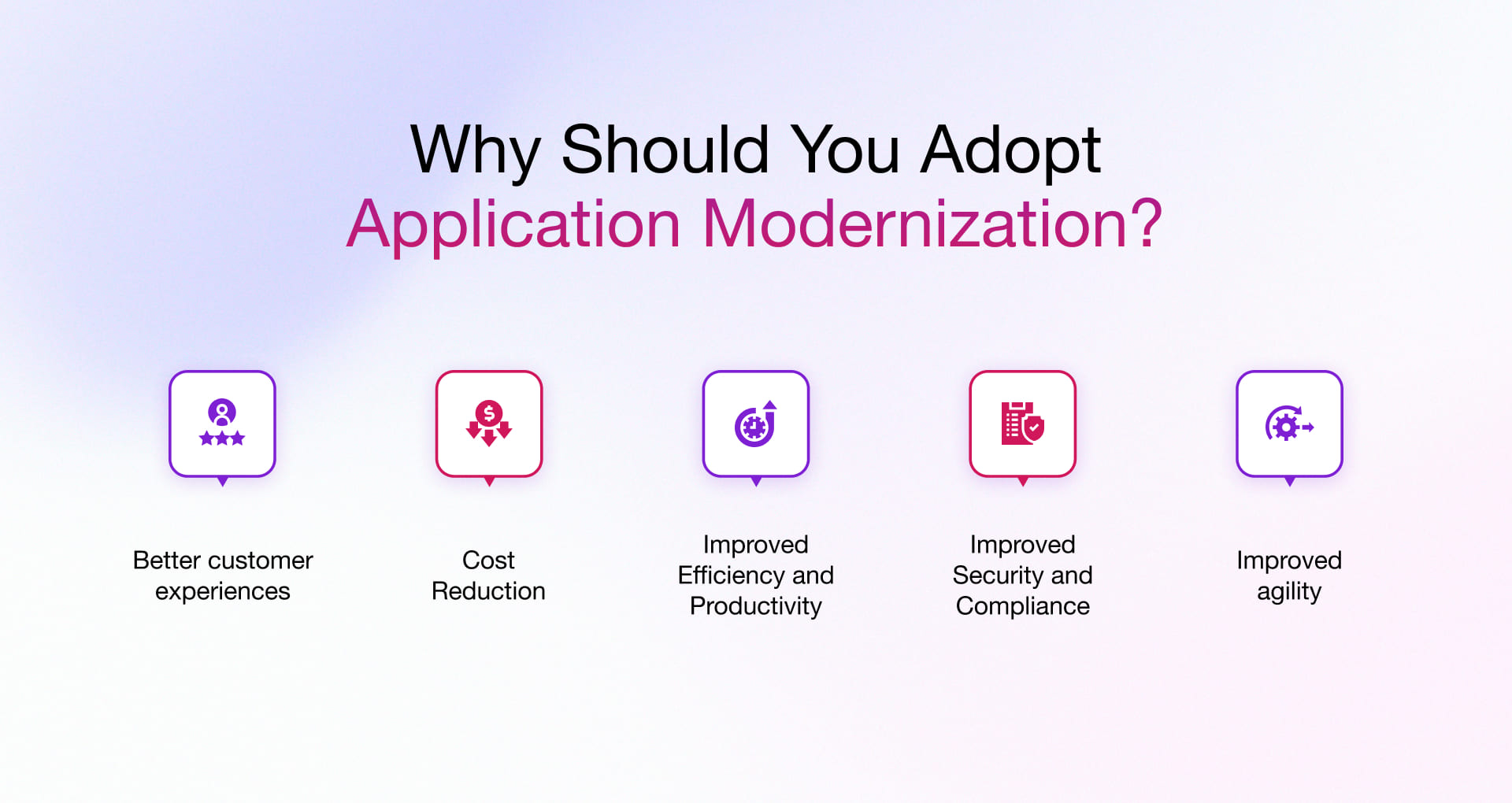
- Improved Agility: Legacy systems can be inflexible in adapting to new business needs. They can be slow at responding to changing market conditions. Modernizing applications helps overcome technical debt and develop new features quickly.
- Better Customer Experiences: Modernized apps help you provide faster, personalized services to your customers due to improved response times and resilience. For instance, they allow your customers access to information and support through multiple channels like mobile devices, social media, chatbots, etc.
- Cost Reduction: You optimize resource utilization using the latest technologies to modernize legacy systems. You reduce support costs as it is easier and cheaper to maintain them.
- Improved Efficiency and Productivity: Modernized applications help streamline business processes, making them more efficient and increasing productivity. Utilizing cloud services, automation, or Artificial Intelligence (AI) helps reduce manual tasks and optimize workflows.
- Improved Security and Compliance: Outdated technology could pose security risks in legacy systems. Modernizing apps helps implement the latest security protocols and compliance standards.
Enterprise Application Modernization Challenges That Derail Projects and How We Avoid Them
Modernization often fails not because the strategy is wrong, but because complexity, people, and risk are underestimated. These common challenges derail projects, understanding them helps you apply simple approaches to prevent delays.
1. Legacy System Complexity
Decades of patches, custom logic, and hidden dependencies make legacy systems brittle. It’s like picking up one module for alteration while risking performance of three others, so projects drag and scope shrinks.
How we avoid it:
Using automated analysis plus SME interviews, we begin with a structured discovery and dependency mapping phase without touching code. This enables phased, risk-free, and high-value component first modernization.
2. Microservices Complexity
When transitioning to microservices too fast, several factors like service sprawl, noisy inter-service dependencies, and operational overheads can make it difficult for your internal teams to handle.
How we avoid it:
Our approach consists of designing a right-sized microservices architecture introducing observability and DevOps practices upfront and modernize interfaces before internals. This approach has rewarded our clients with agility without drowning in operational complexity.
3. Data Integrity Constraints
Keeping data strategy an afterthought, enterprise app modernization can corrupt records, break referential integrity, or even create silent mismatches between legacy and new systems.
How we avoid it:
We begin with building a data modernization track including profiling and cleansing data, performing test migrations with reconciliation checks, and enforcing governance. This ensures a new system is equipped with governed data.
4. Stakeholder Interest Alignment
Business, IT, security, and operations have varied, conflicting priorities, so modernization initiatives get diluted, delayed, or quietly killed.
How we avoid it:
We run collaborative discovery and value-mapping workshops to align stakeholders on outcomes, scope, and KPIs. Post which we then maintain executive steering and transparent reporting so that decisions are agile and the modernization program stays seamless.
5. Security & Compliance Risk
If there are security vulnerabilities, modernization becomes an entry point for attackers, weakens control, and break compliance.
How we avoid it:
We prioritize embedding security from day zero such as threat modeling, role-based access, encryption. Auditability, and Zero-Trust-aligned patterns. Therefore, stay worry free since it not only strengthens security posture but also restricts new risk.
6. Cultural and Operational Shifts Management
Even the best architecture fails if the teams resist changing, would want to work in silos, or lack skills to operate modern platforms.
How we avoid it:
We do technical work with change management such as playbooks, training, and co-delivery with your teams. Practices like DevOps, cloud, and modern engineering becomes part of how your people work and just slide in the deck.
How to Know If Your Enterprise Applications Need Modernization (Warning Signs)
Enterprise applications are software solutions that businesses use to streamline their operations, manage workflows, and facilitate communication between departments. As technology evolves, companies may find their current enterprise applications no longer meet their needs. Here are some factors that can determine enterprise application transformation:
- Age: The age of the application can be a factor in determining if modernization is needed. Applications over a decade old may be built on outdated technology and may lack the flexibility and scalability that modern businesses require.
- Compatibility: Enterprise applications may not be compatible with newer hardware and operating systems. If an application cannot run on the latest technology, it may need to be modernized.
- User Experience: A poor user experience can impact productivity and hinder user adoption. If employees struggle to use an application or if it is not intuitive, it may be time to modernize the user interface.
- Security: Security threats constantly evolve, and older applications may not have the necessary security features to protect against modern threats. Modernizing an application can help ensure it is secure and meets industry standards.
- Integration: As businesses adopt new technologies and systems, integrating existing applications becomes increasingly important. Older applications may not have the necessary integration capabilities, making it difficult to share data between systems.
- Scalability: As businesses grow, the demand for their systems increases. Older applications may not be able to meet the needs of a growing organization. Modernizing an application can ensure that it can handle the increased demand.
- Maintenance: Older applications may be challenging to maintain and require significant resources. Modernizing an application can reduce maintenance and make it easier to manage.
By considering these factors, businesses can determine if modernizing an application will provide a positive return on investment and help them achieve their goals.
You could also look at multiple metrics to analyze your situation and decide if your enterprise application needs modernization. They include:
- Track app performance, like uptime percentage, the time between failure and recovery, etc.
- Measure maintainability, like percentage of code, complexity level, TCO, risk, etc.
- Business drivers like business fit, business value, agility
7 Key Enterprise Application Modernization Technologies
Enterprise app modernization is an ongoing process that utilizes the latest technologies. The key technologies used include:
- Cloud Services: Modernized enterprise applications belong on cloud platforms like Azure and AWS, where they can scale elastically, inherit managed security, and shed data‑center constraints. We re‑platform your workloads to cloud‑native services so you gain agility, resilience, and a cost model that matches actual usage instead of hardware cycles.
- Containerization: Legacy workloads become far easier to modernize once they are encapsulated as containers that run consistently anywhere. We use Docker and Kubernetes to standardize runtimes, isolate services, and enable safe rollouts (blue‑green, canary), turning risky releases into controlled, incremental steps.
- Microservices: Breaking monoliths into domain‑based microservices is how large systems become change‑friendly again. By designing and implementing a microservices architecture, we let your teams scale hot paths independently, adopt best‑fit tech stacks per service, and modernize high‑value capabilities without rewriting everything at once.
- Artificial Intelligence: AI is both an innovation accelerator and a new capability layer for your apps. We use AI‑assisted analysis to understand legacy logic faster, then embeds ML and NLP into the modernized applications to automate decisions, personalize experiences, and spot anomalies in real time.
- Low-Code/No-Code Development: Certain legacy workflows and satellite apps don’t need heavy engineering; they need fast, safe replacement. We leverage low‑code and no‑code platforms to rapidly rebuild these experiences, giving business users modern interfaces and automation while core systems are refactored in parallel.
- DevOps: Sustainable modernization depends on a disciplined delivery engine, not ad‑hoc releases. We implement DevOps practices such as CI/CD, automated tests, infrastructure as code, observability so every change to your modernized estate is traceable, repeatable, and reversible.
- Internet of Things (IoT): For asset‑heavy operations, the real value of modernization shows up when applications can act on live signals from the field. Rishabh integrates IoT data streams into your modernized apps, enabling real‑time monitoring, predictive maintenance, and event‑driven workflows that legacy, batch‑driven systems simply cannot support.
7-Step Enterprise Application Modernization Strategy
It is imperative to have a clear strategy before starting the enterprise system modernization process. We have compiled 7 steps for application modernization that include:
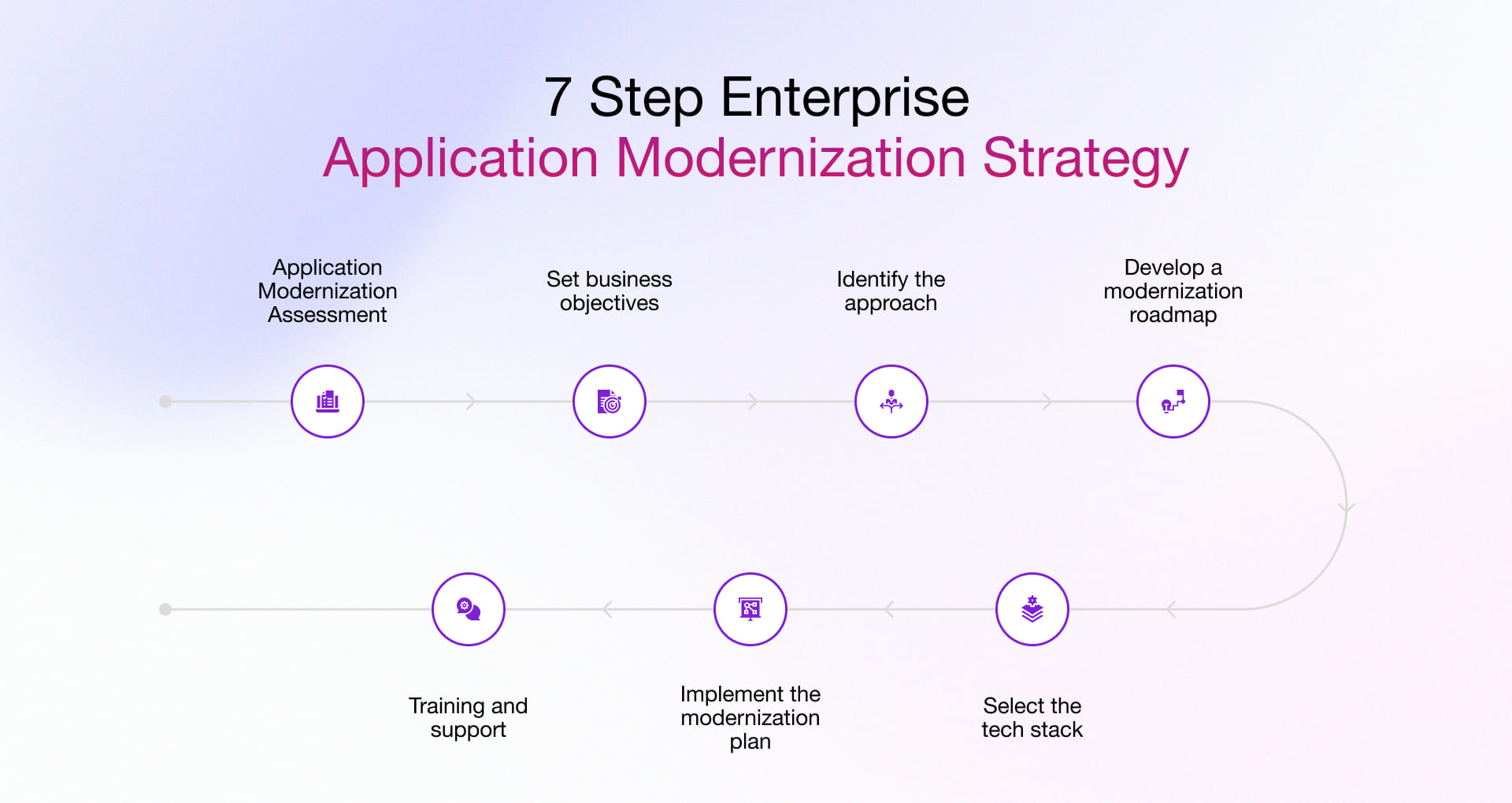
1. Application Modernization Assessment:Before undertaking transition, the entire legacy system is analyzed including architecture, code quality, tech stack, integrations, UX, and operational pain points. The goal is to separate what must be modernized, what can be retired or consolidated, and where modernization will release the most business value with the least risk.
2. Set Business Objectives:Modernization is anchored to measurable outcomes, not just technical clean‑up such as agility, cost reduction, resilience, CX, compliance. Clear objectives and KPIs define scope and priorities so every modernization decision can be traced back to a business result the leadership team actually cares about.
3. Identify The Modernization Approach: Each application gets the right treatment, not a one‑size‑fits‑all recipe, meaning either it is rehost, replatform, refactor, rearchitect, replace, or retire. This mix‑and‑match approach ensures you move quickly where you can, invest deeply where it pays off, and avoid over‑engineering low‑value systems.
Please read our blog on the 6 R’s of Cloud Migration Strategy for more information.
4. Develop A Modernization Roadmap: A phased roadmap turns the strategy into a sequence of controlled releases: waves, timelines, dependencies, and cutover plans. It balances risk and momentum, protects business‑critical periods, and makes it clear what will change, when, and for whom.
5. Select The Tech Stack:Target architectures and platforms are chosen to support your next 5–7 years, not just this release cloud provider, runtimes, data platforms, integration layer, security controls. The emphasis is on cloud‑native, API‑first, observable systems that are easier to evolve, scale, and govern over time.
6. Implement The Modernization Plan:Execution follows the roadmap with disciplined engineering: CI/CD pipelines, automated testing, progressive rollouts, and tight performance/security gates. Legacy risk is reduced step by step while new capabilities come online, so the business sees value early instead of waiting for a big‑bang go‑live.
7. Train And Support End-Users:Modernization is only successful when people adopt the new way of working. Focused training, embedded champions, and post‑go‑live support help end‑users transition smoothly, tap into new features, and provide feedback that drives the next iteration in the modernization cycle.
Proven Enterprise Application Modernization Best Practices for Low-Risk Delivery
Listed below are enterprise application transformation best practices that can help you successfully modernize your legacy application, enhance its functionality, and meet the evolving needs of your business.
- Adopt A Microservices Approach: The microservices-based environment treats each process as a separate service. So, it is easier to update, scale, or change the process as it has its own logic and database. This makes your applications more agile and scalable.
- Use Modern Development Methodologies: Traditional software development methodologies may not be suitable for modernizing legacy applications. Agile and DevOps methodologies are popular approaches that allow continuous development, testing, and deployment, which can help speed up the modernization process.
- Provide Complete Stack Visibility: You need full stack visibility to monitor overall performance. Your modernized apps communicate with the legacy system, and you need a complete picture from the end user’s perspective. It helps you identify potential problems.
- Leverage Cloud Services: Moving entirely to the cloud is not always wise. It would help to utilize the cloud to meet your business needs strategically. Discover the amount of data and workflows you need to migrate to the cloud and how your on-premises and cloud apps will communicate. Will this meet my requirements, or should I look at other alternatives?
- Track Performance Metrics: Have metrics created in advance to track your modernized apps’ performance? Monitor the code quality and the entire infrastructure from the cloud to databases to networks. It helps you spot areas that need improvement by identifying problems early.
- Eliminate User Concerns: As users are accustomed to working with legacy systems, any change forces them to leave their comfort zone. It is natural for them to feel dislike or raise objections. So, it is necessary to overcome user concerns and resentments with modernized applications as quickly as possible in the most appropriate manner. It helps to communicate the need for modernization before starting the process and its benefits for users. Also, train them to utilize the modernized apps better for improved outcomes.
- Train Employees: Modernizing a legacy application often involves learning new technologies and methodologies. It’s essential to provide adequate training for employees to ensure that they can effectively use the new system.
- Embed Security at Every Stage: When modernizing legacy applications, addressing security challenges should be one of the top focus areas. The modernization process should embed security at each stage by utilizing appropriate tools. Identifying security challenges in legacy systems early and fixing them is the key to safeguarding your business. Utilize strong access controls and data encryption for robust security of your applications.
Why Partner with Rishabh for Enterprise Application Modernization?
Enterprise app modernization is a complex process and requires skills and experience for success. As an experienced enterprise application development partner, we offer legacy application modernization services to enable businesses to upgrade & migrate their legacy software applications with minimal disruption to data & business processes.
Our modernization specialists serve enterprises across industries. They utilize the latest technologies to support you with application reengineering, API integration, cloud enablement & UI/UX modernization. We help you throughout the legacy app modernization cycle, from conducting a feasibility study and developing an optimal application modernization plan to implementation.
Success Stories:
Case Study 1: Modernizing Legacy Administration Management Solution

A healthcare solution provider wanted application modernization services to improve its legacy administration management application’s performance, reliability, and scalability with new features & enhancements. Due to complex workflow and code maintainability, their legacy application struggled to manage appointments, scheduling, invoicing, and report generation for varied medical services.
Our team re-engineered the legacy application using agile and waterfall methodology and developed a one-of-its-kind software to provide multiple integrations of home health care into a single solution. The modernized solution streamlines the pre-employment & annual medical assessment process, enables smooth appointment scheduling for clients, and improves transparency between the service provider and the end customer.
Key takeaways;
- 30% boost in application performance
- 10x surge in assessments performed across healthcare locations
- 145% increase in total revenue
Read more about how our modernizing legacy administration management solution helped the US-based healthcare provider increase revenues.
Case Study 2: Production Planning & Reporting Software Modernization

A Flexible Intermediate Bulk Container (FIBC) manufacturer utilized a legacy MS Excel-based reporting system. It couldn’t provide the required insights for production planning, leading to increased costs. They wanted a unified solution to monitor machinery, human resources, stocks, and orders effectively.
We helped the manufacturing company revamp the Production Planning and Reporting Software to enable tracking & management of daily production processes, production estimation planning, and streamlining related processes. The modernization initiative was divided into various phases –upgrade & integration for accurate tracking & measurement to improve the application’s interface.
Key takeaways;
- 50% reduction in production cost
- 100% data accuracy with automated data collection
- 30% increase in inventory management efficiency
Read more about how our created Production Planning & Reporting Software Modernization solution helped unify & effectively monitor machinery, human resources, stocks, and orders.
Frequently Asked Questions
Q: What is enterprise application modernization?
A: Enterprise application modernization is the structured process of updating legacy business applications with their architecture, infrastructure, code, and interfaces so they align with current and future business needs. It typically involves moving towards cloud‑ready or cloud‑native platforms, adopting modern patterns like microservices and APIs, and improving UX, security, and data integration so core systems stop holding back innovation.
Q: How do you typically approach an enterprise system modernization program?
A: A mature approach starts with assessing the current application portfolio, defining business‑aligned objectives, and choosing the right strategy per system rehost, replatform, refactor, rearchitect, replace, or retire. From there, a phased roadmap, cloud‑aligned target architecture, DevOps/CI‑CD practices, and strong security and observability ensure modernization is delivered in controlled increments rather than a risky big‑bang.