Low-code has become a core approach to modern software development, driving digital transformation across enterprises. It enables businesses to create and implement new processes or applications quickly while supporting the development of enterprise-grade, scalable solutions. This allows organizations to streamline processes, accelerate release time, enhance customer satisfaction, boost employee productivity, and increase ROI.
At the same time, businesses today require applications that are not only fast to build but also governed, secure, and seamlessly integrated with existing systems and data ecosystems. The low-code/no-code, rapid application development market has grown significantly in recent years due to the increasing demand for such enterprise-ready applications.
And, while there exist multiple low-code development platforms to serve this, Microsoft’s Power Apps AI-first platform, a part of the Power Platform Suite, has emerged as a leading choice for building scalable, integrated, and intelligent business applications.
Did you know?
- Microsoft Power Apps has been recognized by Forrester & Gartner as a leader in low-code app development platforms.
- In a recent Microsoft blog, it was stated that Power Apps is used by more than 25 million users every month.
Read on to learn from this article how you can leverage Power Apps to build feature-rich custom solutions to fit your business needs.
Low-Code vs. Traditional Development– Which is Better?
| Power Apps (Low-code) | Traditional Development | |
| Agility | Allows hassle-free development of enterprise-grade applications with an easy-to-use drag-and-drop interface and minimal coding, empowering teams to thoroughly build and deploy full-stack applications with integrated data, automation, and AI capabilities. | Traditional app development platforms often require heavy manual coding and have a complicated configuration system which makes them less agile. It requires a specialist focus on programming languages or development platforms. |
| Development Time | Application development is much quicker, inclusive and more manageable that facilitates faster development and delivery within a few weeks/days. | The demand for application deployment is growing faster but using traditional software development can be expensive, slow-to-release, and littered with coding errors issues with development cycles somewhere between a couple of months and a year. |
| Governance & Security | Built-in governance, security, and compliance controls with role-based access and centralized data management, enabling secure and controlled application development at scale. | Needs effort to implement custom security and governance frameworks, which leads to complex challenges, requires skilled resources and ample of time, along with continuously keeping an eye on risk factors. |
| Responsive Design | Enables developers, business users, and CRM Administrators to create custom native mobile and web applications by connecting to the cloud or on-premise data source. | With this approach, the developer needs to create a separate app for each operating system. |
Microsoft’s Power Apps has quickly become the low-code platform of choice as it cuts down on development time and resource needs as compared to the traditional approach. Further, it leverages Microsoft Dataverse, a cloud-based, low-code data platform that securely stores and manages business data used by applications. It organizes data into tables, along with relationships, business logic, and forms that make it easier to work with that data.
App screens are also built on top of these data models and forms. This means if you add a new field to an existing data model, the apps you build going forward automatically reflect those changes. This built-in capability simplifies maintenance and helps maintain consistency across applications.
Why Consider Power Apps Low-Code Platform?
Accelerated time-to-release
- The traditional app development process requires a significant amount of time to build a minimum viable product (MVP). Whereas Power Apps provides an easier interface with a visual drag & drop environment and AI-assisted (Copilot-driven) capabilities that enable programmers to build user interfaces/prototypes quickly while supporting scalable, enterprise-grade application development.
- Power Apps provides a what you see is what you get (WYSIWYG) development experience preview that shows exactly how the actual app will look. Users experience the real working of the app early in the development process, and if any new requirements arise, new features can be added in the next version with governance and control.
Simplified Development
- With multiple APIs, libraries, functions, and objects, coding an app becomes complex and can be daunting for business users and developers. Power Apps simplifies this by handling most of these elements through an intuitive visual interface while maintaining security and governance standards.
- Whether you want to develop a mobile app, a browser-based app, or an internal enterprise solution, Power Apps manages the underlying dependencies, frameworks, and configurations, enabling teams to focus on business logic and integration.
Advanced Features and Reusable Components
- One major aspect of Power Apps’ low-code functionality is the use of pre-configured modules and components designed for enterprise use cases.
- These components include common core functions that can be reused to deploy multiple scalable solutions quickly while ensuring consistency and maintainability across applications.
Platform Agnostic
- Low-code/no-code platforms offer cross-platform compatibility.
- Power Apps enables seamless operation across devices and operating systems, allowing organizations to deliver consistent user experiences across mobile, web, and enterprise environments.
Power Platform Integration
- Integrates with a vast ecosystem of 1000+ connectors, enabling seamless connectivity across Microsoft and third-party services.
- Power Apps works closely with Microsoft 365, Power Automate, Power BI, and Copilot to enable end-to-end process automation, data-driven insights, and intelligent workflows.
- This integration enables a single, secure place where apps, data, and AI agents collaborate in a unified way
Improved Operational Efficiency
- Empowers organizations to automate repetitive and time-consuming business processes using scalable applications built with Power Apps.
- Provides powerful business logic, workflow automation, and now AI-assisted capabilities (Copilot) to build solutions ranging from simple tasks to complex enterprise scenarios.
Flexible Cost Structure
- Microsoft Power Apps enables faster delivery of business applications while optimizing development efforts compared to traditional approaches.
- Licensing depends on factors such as usage, connectors, and Dataverse requirements, allowing organizations to choose plans aligned with their scale, complexity, and integration needs.
Microsoft Power Apps Major Components
Listed below are four main components of Power Apps that can be used to address specific development needs.
Canvas Apps
- A pixel-perfect application that connects to over 1000+ different data sources
- Ideal to create a highly tailored app made to address a specific business problem by starting with a blank canvas. It provides more flexibility and user control and is best suited for goal-oriented applications.
Model-Driven Apps
- Automatically generates a user interface based on data model inside Microsoft’s Dataverse
- Allows you to quickly build an app by adding components (forms, charts, views & dashboards). Ideal for developing apps that require complex business logic.
Power Pages
- Easily design AI-powered, low-code websites for external users to securely interact with your business data.
- Built with Copilot capabilities, it enables faster site creation, content generation, and seamless user experiences.
Dataverse
- A database platform that securely stores & manages business application data created in Power Automate and Power Apps.
- Provides multiple ways to easily create business rules, flows, logic, & integration capabilities required for rapidly building data models and services.
- One thing that is making a huge difference is AI-powered applications, Copilot experiences, and intelligent agents, enabling businesses to build more context-aware and data-driven solutions.
Real World Power Apps Industry Use Cases That Drive Impact
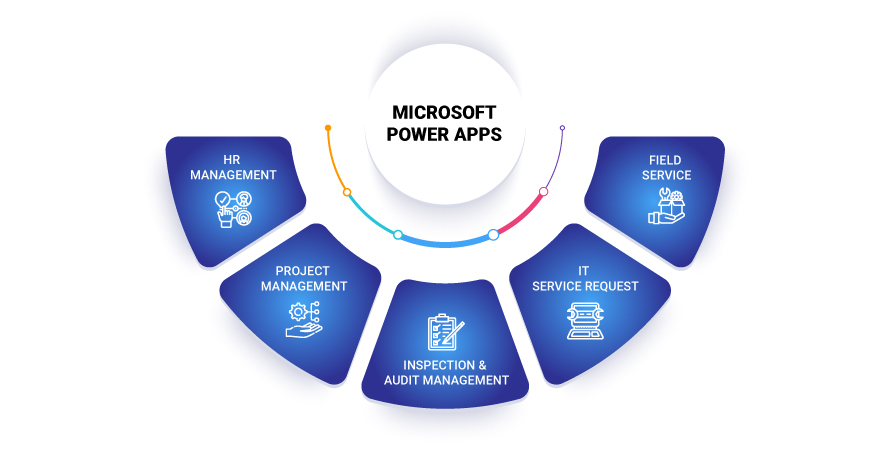
HR Management
- Recruiting & onboarding/offboarding process
- Workforce planning
- Time & attendance management
- Employee database management
- leave management
Project Management
- Task planning, scheduling & tracking milestones
- Team performance management
- Review progress & monitor outcomes
- Team collaboration in real-time
- Reporting (status, progress, resources used, & more)
Inspection & Audit
- Inventory audit process automation
- Perform different types of inspections on a unified platform
- Quality control and timely delivery of products by vendors
- Safety and compliance audits
- Incident reporting
IT Service Request
- Plan, assign & manage tickets
- Virtual agents & in-person support
- Ticket routing, reassigning & escalation
- Capture activities on case resolution in real-time
- Pre-built and custom reports to track IT help desk metrics
Field Service
- Streamline communication
- Manage resources based on required skills
- Assigning & scheduling work orders
- Seamless dispatching
- Remote access to required documentation
- Capture & share data in real-time
- Daily client correspondence history
Rishabh Software’s Power Apps Experience
We empower global enterprises with functional yet custom apps to better serve customers’ needs. This is made possible with our talent pool of skilled Power Platform developers with extensive experience in Microsoft Low-Code tools, Cloud, AI, and UX design. After assessing your unique requirements, we architect the right-fit solution with the optimum number of Microsoft Power Apps developers needed to meet your business objectives.
Our Success Stories – Power Apps in Action
Case Study: Vendor Management Platform
For a mid-sized enterprise, a vendor management platform was developed to streamline vendor onboarding, documentation, and compliance processes across the organization. The solution enables better coordination between internal teams and external vendors through a centralized system.
What does it offer?
- Accelerates vendor onboarding and approval processes
- Centralized document management and compliance tracking
- Real-time visibility into vendor status and workflows
- Automated notifications for approvals and updates
Case Study: Preselling App Development
A mobile preselling application was developed to empower field sales teams with real-time access to product catalogs, inventory, and order management tools. The app helps streamline order booking and improve overall sales efficiency.
What does it offer?
- Faster order booking and reduced manual errors
- Real-time access to product and inventory data
- Seamless sales operations with offline functionality
- Improved field productivity and customer responsiveness
Final Words:
As you can realize, custom Power Apps solutions can simplify and improve your business workflow. Low-code application development with Microsoft Power Apps enables organizations to build scalable, secure and efficient applications tailored to their needs. Whether you’re looking to deploy canvas apps, model-driven apps, Azure function apps, embedded apps, modernize legacy apps, migrate your data, or connect to Dynamics 365, we will get your projects up and running in no time! Further, if you’re evaluating critical business initiatives, looking for innovative apps to solve daily issues, or need help determining whether a solution built using Power Apps is the right fit for your organization, our team of experienced consultants can surely guide you.