
Every business function runs on data. Sales teams need visibility into pipeline performance. Finance teams need up-to-date forecasts. Operations teams need answers to performance and efficiency questions. Yet getting those answers depends heavily on data analysts.
What starts as a simple request can quickly turn into a ticket, a reporting queue, and a waiting period that delays decision-making. The challenge isn’t a lack of data. The real challenge is access. Business users know the questions they need specific answers, but often lack the technical skills to query data sources, write SQL, or navigate complex reporting tools. As a result, analytics teams become the gateway to information, creating bottlenecks that grow as reporting demands increase.
This is where BI agents are changing the way organizations interact with data. Instead of raising requests and waiting for reports, business users can ask questions in plain English and receive answers instantly, delivered as charts, tables, and contextual summaries.
Let’s look at why analyst bottlenecks continue to persist and how BI agents are helping organizations make trusted data more accessible.
Why Are Data Analyst Bottlenecks Slowing Enterprise Growth?
Most businesses have invested heavily in dashboards, reporting platforms, and self-service BI tools to make data more accessible. Yet many business users still rely on analysts to answer everyday questions, create custom reports, and interpret data. As reporting requests increase across departments, analytics teams often become the gatekeepers of information, creating delays that affect decision-making and business agility. Below are some of the most common factors contributing to analyst bottlenecks in modern enterprises.
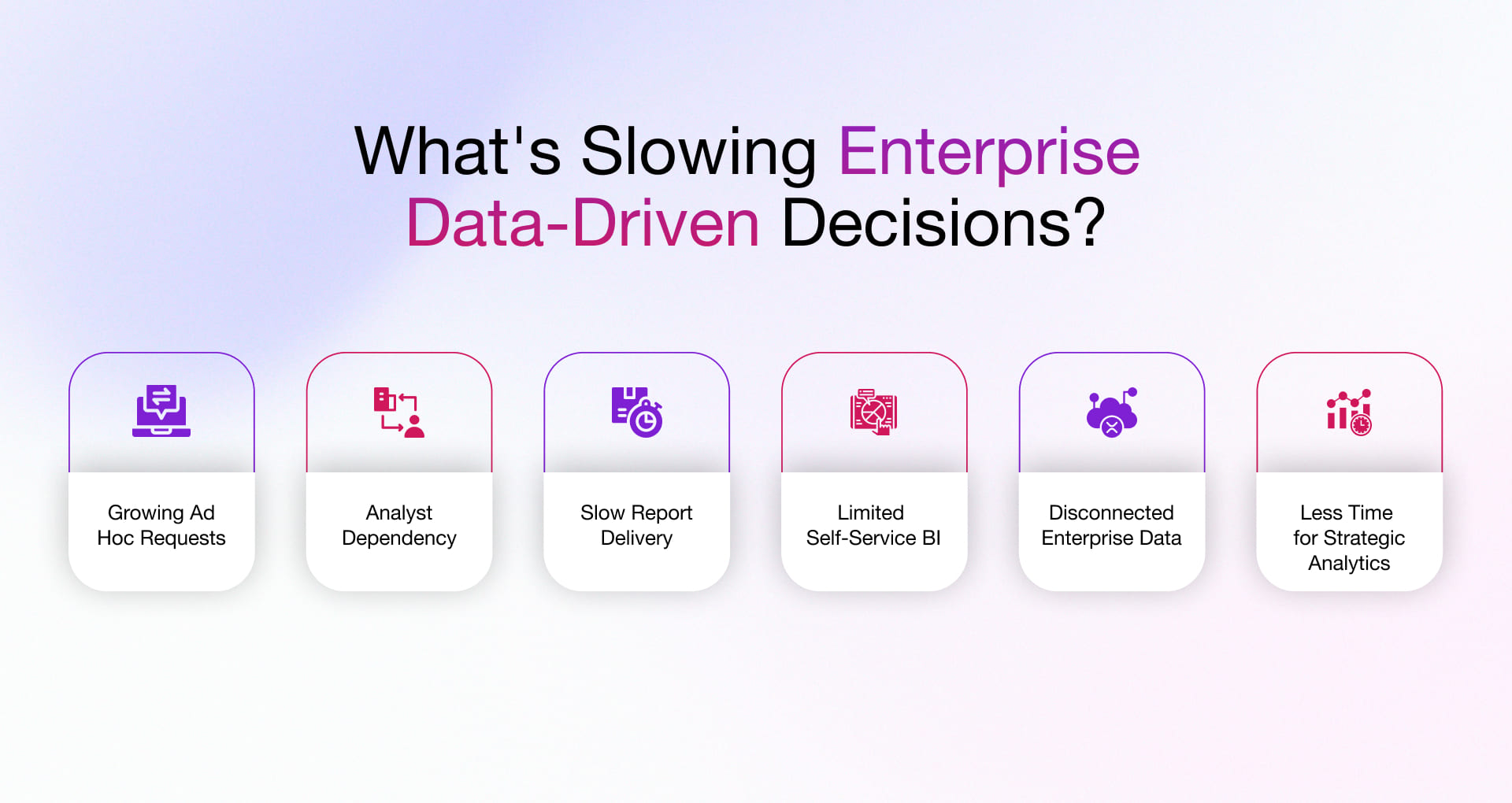
Growing Volume of Ad Hoc Data Requests
Business questions rarely follow a predefined reporting structure. Sales leaders want to understand why conversion rates have changed. Marketing teams need campaign performance breakdowns. Operations managers need visibility into KPIs that may not exist in standard dashboards.
As these one-off requests increase, analysts spend more time responding to individual questions and less time focusing on strategic analysis. Over time, reporting queues grow and response times slow down.
Dependency on Analysts for Routine Reporting
Many organizations still rely on analysts for tasks such as KPI lookups, report generation, dashboard modifications, and data validation. While these requests may be routine, they consume valuable time and create unnecessary dependencies between business users and analytics teams.
When every question requires analyst involvement, access to insights becomes slower than the pace of business demands.
Slow Report Creation and Dashboard Updates
Business priorities change quickly, but reports and dashboards often require manual updates. Analysts must review data sources, validate calculations, update visualizations, and ensure consistency before sharing results. Even simple reporting requests can take longer than expected when multiple teams are competing for analytics support.
Why Self-Service BI Often Falls Short
Many organizations introduced self-service BI tools to reduce dependence on reporting teams. While these platforms provide access to data, they still require users to navigate dashboards, understand data models, locate the right metrics, and build their own views.
For non-technical users, finding the right answer is not always straightforward. As a result, many continue to rely on analysts despite having access to self-service reporting tools.
Scattered Data Across Multiple Systems
Enterprise data is often spread across CRM platforms, ERP systems, data warehouses, spreadsheets, and departmental applications. Answering a single business question may require pulling information from multiple sources and validating it before it can be trusted.
This places additional pressure on analytics teams, who frequently act as the bridge between disconnected data environments.
Analysts Spending Less Time on Strategic Work
Analysts are hired to uncover trends, identify opportunities, and help guide business decisions. Yet much of their time is often spent answering repetitive questions, creating reports, and fulfilling routine requests. As operational demands increase, strategic initiatives are frequently pushed aside, limiting the broader value analytics teams can deliver to the business.
How BI Agents Change Enterprise Analytics Experience
Traditional analytics workflows often follow a request-and-response model. Business users identify a question, submit a request to the analytics team, wait for reports or dashboard updates, and then interpret the results. This exclusive process can create delays when reporting demands exceed analyst capacity.
BI agents introduce a more conversational approach to analytics. Instead of navigating multiple dashboards or relying on analysts for every question, users can interact with enterprise data using natural language. They can ask questions such as:
- What were last quarter’s top-performing products by revenue?
- Why did customer churn increase in the western region?
- Which sales opportunities are most likely to close this month?
The BI agent interprets the request, retrieves data from connected systems, applies the appropriate business context, and delivers answers in the form of charts, tables, summaries, or actionable insights.
By combining natural language interfaces, enterprise data access, and AI-driven reasoning, AI-powered BI agent help reduce reporting friction, improve access to information, and enable faster decision-making across business functions.
Let’s explore five ways BI agents help organizations reduce analyst dependency and accelerate access to trusted business insights.
5 Ways AI-Powered Business Intelligence Help Enterprise Teams Access Insights Faster and Reduce Analyst Dependency
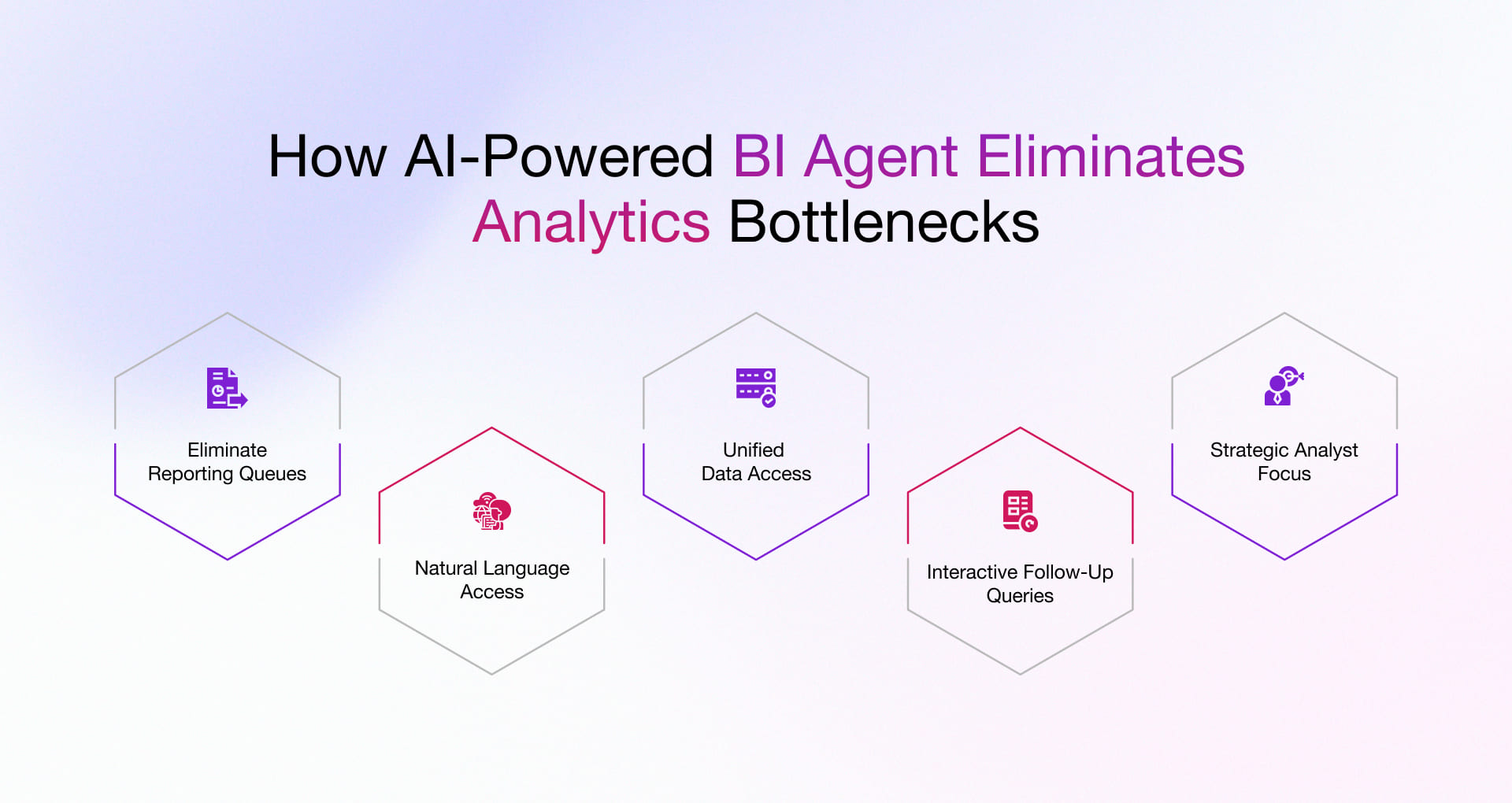
1. Eliminate the Reporting Queue for Everyday Questions
Many requests to the analytics teams are not complex analyses. They are straightforward business questions such as pipeline performance, regional sales trends, or campaign results. BI agents allow users to retrieve these answers directly, reducing the volume of requests that typically accumulate in reporting queues.
2. Close the Gap Between Business Questions and Data Access
Most business users understand the decisions they need to make. The challenge is access to the underlying data without relying on SQL, dashboard expertise, or analyst support. Natural Language BI agents provide a simpler way to interact with enterprise data, making information more accessible to non-technical teams.
3. Make Disconnected Data Easier to Consume
Enterprise data is spread across multiple systems. Analysts often spend considerable time bringing together information before they can answer a business question. By connecting to approved data sources, BI agents help users access information through a single interface rather than navigating multiple applications.
4. Reduce the Need for Repetitive Follow-Up Requests
A report rarely ends the conversation. Stakeholders typically want additional cuts of the data, comparisons, or clarification around performance changes. AI-powered BI agents support a more interactive approach to analytics, allowing users to ask follow-up questions without creating a new reporting request each time.
5. Allow Analytics Teams to Focus on Strategic Priorities
As reporting volumes increase, analysts often spend more time responding to operational requests than driving strategic initiatives. Reducing routine reporting demand enables analytics teams to focus on activities such as forecasting, performance optimization, data governance, and advanced analysis.
Turn Business Questions into Instant Answers with an AI-Powered BI Agent
Business users shouldn’t have to wait for reports, navigate multiple dashboards, or depend on technical teams to understand what’s happening across the organization.
An AI-powered Business Intelligence Assistant provides a simpler way to interact with enterprise data. Connecting to your approved data sources enables users to ask questions in plain English and receive answers instantly through charts, tables, and contextual summaries.
Whether the question is about sales performance, customer trends, operational KPIs, or financial metrics, the business intelligence agent retrieves the relevant information and presents it in a format that is easy to understand and act upon.
How AI-Powered BI Agent Helps Enterprise Teams
- Connects with enterprise databases, data warehouses, and business applications
- Enables natural language access to business data without requiring SQL expertise
- Delivers visual and narrative insights for faster understanding
- Reduces routine reporting requests and analyst dependency
- Supports governed self-service analytics with role-based access controls
- Provides a single access point for information spread across multiple systems
- Helps analytics teams focus on strategic initiatives instead of repetitive reporting tasks
By combining conversational access, governed data retrieval, and enterprise-grade security, an AI-powered BI Agent helps organizations better leverage their existing data investments while improving the speed and quality of decision-making.
If your teams are spending more time waiting for answers than acting on them, a conversational BI approach can help remove reporting bottlenecks and make trusted insights more accessible across the business.
Frequently Asked Questions
Q: What is Business Intelligence Agent?
A: BI agent is an intelligent analytics assistant that you can use to get governed insights into your business operations. It works by asking questions in plain language and receiving narrative summaries and graphical formats like charts and graphs. You no longer need to incur data analytics costs by hiring or expanding your existing team. Besides, it improves operational efficiency and enables faster decision-making.
Q: How is our BI agent solution different from traditional BI tools?
A: Traditional BI tools often rely on prebuilt dashboards and analyst-generated reports. Our BI agent lets users ask questions in plain English and receive guided answers without raising tickets. It transforms from static reporting to on-demand decision intelligence.
Q: Do I need to replace existing BI tools if I integrate a BI agent?
A: No. Our Conversational Business Intelligence Agent is built as an intelligence overlay that easily integrates with your existing databases, warehouses, and BI environment. It upgrades your current infrastructure without replacing it.
Q: Will a BI Agent Replace Data Analysts?
A: No. BI agents help reduce repetitive reporting requests, allowing analysts to focus on forecasting, advanced analytics, data governance, and strategic initiatives. They complement analytics teams rather than replace them.
Q: How does the natural language BI agent reduce the analytics team’s dependency?
A: The Conversational Business Intelligent agent automates routine queries, KPI lookups, and data breakdowns using natural language interaction. Business users can gain insights, while the analyst team can focus on modeling, prediction, and value-oriented initiatives rather than repetitive tasks.
Q: How does the BI agent ensure data governance and security?
A: Our BI agent is built with role-based access control, standardized metric definitions, and secure query execution. Governance guardrails are embedded into the workflow that ensure users receive accurate insights without compromising compliance or data privacy.
Q: How can we measure ROI after implementing the BI agent?
A: ROI is measurable by noting factors such as reduced turnaround time, lower analyst workload, controlled cloud usage, decreased ticket backlog, and improved decision speed.