
TL;DR: Lending teams often disagree on what fundamental KPIs like active customer or disbursement date actually mean, and that mismatch quietly drives up costs, delays deal closures and breaks AI models. A common data language creates a shared layer where these terms are uniformly defined across origination, risk, finance and collections.
This blog covers what that uniformity looks like in the real-world, why it matters now, how to build it and how a domain-native engineering partner can get you there, faster.
The Definition Gap Behind Conflicting Lending KPIs
Five department heads walk into a quarterly review meeting. Someone shoots a plain question: how many active clients do we have?
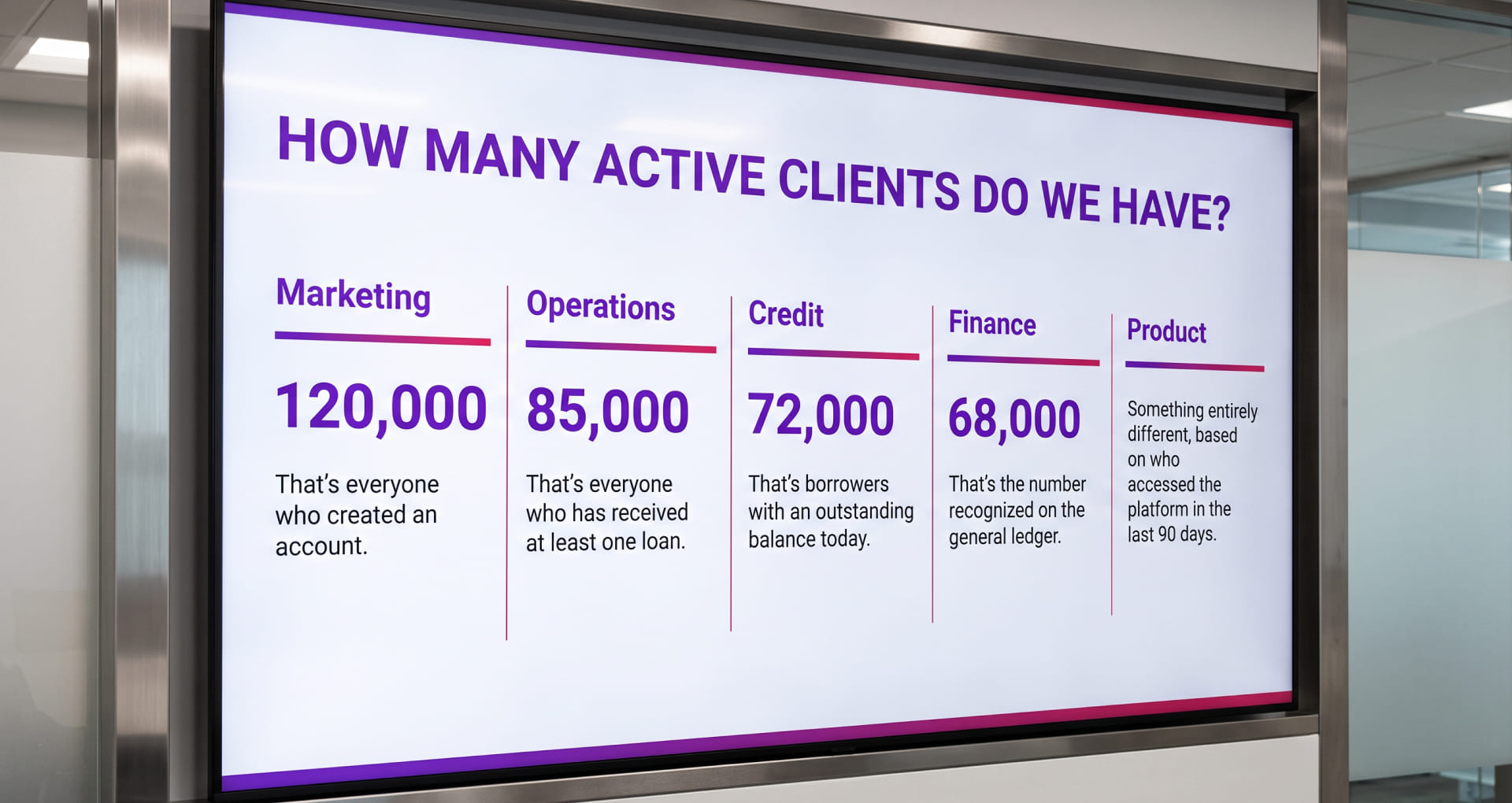
- Marketing reports 120,000. That’s everyone who created an account.
- Operations says it’s 85,000. That’s everyone who has received at least one loan.
- Credit declares 72,000. That’s borrowers with an outstanding balance today.
- Finance shows the number is 68,000. That’s the number recognized on the general ledger.
- Product states something entirely different, based on who accessed the platform in the last 90 days.
None of the teams made a spreadsheet error. The problem is that five teams built five different definitions around the same terms, and nobody noticed it until those numbers showed up on the same slide.
That’s a common data language problem. In lending, it doesn’t stay confined to one meeting. It shows up in loan approval rates, disbursement values, outstanding principal, portfolio at risk, non-performing loans, default rates, collection rates, recoveries, restructured loans, write-offs, repeat borrowers and customer profitability.
Every one of these metrics can mean something different depending on who reports it. In lending, this cost shows up as slower processes, discrepancies, more manual checks and AI projects that never move beyond testing.
The fix isn’t another dashboard. It’s agreement, and that agreement does more than clean up quarterly reviews. Left unresolved, the same data discrepancies increase operational risks and leave AI models quietly working with the wrong numbers.
The Real Cost of Fragmented Lending Data: Operational Bottlenecks, Increased Exposure, and Stalled AI Initiatives
The Disbursement Date Dilemma
Ask five people at a bank when a loan was disbursed, and you might get five different dates. A loan can be marked disbursed when:
- it’s approved
- when the payment instruction is sent
- when funds leave the lender’s account
- when the payment provider confirms settlement
- when the customer actually receives the money or
- when the loan goes active in the lending system
Each of those events can happen hours or days apart. When different teams anchor to different data points, daily loan volumes stop matching between departments and interest accruals and cash positions diverge. That’s how conversion and funnel metrics end up reflecting contradictory numbers in the same board deck.
Even in tightly regulated corners of lending, such as U.S. federal student loans, the disbursement date has a single legal definition: the date funds are actually made available to the borrower.
Commercial lenders rarely hold themselves to that same single standard internally, and it costs them.
Manual Reconciliation, Redundant Entry and Lost Capacity
When departments define things differently, someone has to reconcile the difference manually. That’s the quiet cost sitting underneath most lending operations.
Originating a commercial loan costs community banks roughly $17,000, and staff manually copy-pasting data between systems is a major reason why. By2026, financial organizations are expected to quit 60% of AI projects that lack AI-ready data due to poor data quality obstructing analytics and operational decision-making.
None of this is reported as a line item labeled “data disagreement”. It is evident as a headcount spent on reconciliation instead of growth.
Compliance Exposure and Audit Risk
Manual transfers and inconsistent definitions make it harder to keep documentation and audit trails consistent. When five departments answer the same regulator question with five slightly different numbers, that’s reflected as a control gap instead of a rounding error. Regulators, including the OCC, point to disparate data as a leading cause of credit risk management failures. Inconsistent definitions increase repurchase risk and penalty exposure precisely because they’re difficult to explain after the fact.
AI and Automation That Fail to Scale
This is where the real money gets left on the table. In KPMG’s 2025 Banking Survey 93% of banks cited data privacy and risk concerns, 89% named data quality, and 81% pointed to legacy systems or integration complexity as key challenges to modernizing data.
Here’s the part that should worry a CIO more than the abandonment rate itself: when a model pulls active customers from marketing’s engagement metric instead of finance’s balance-based definition, it doesn’t fail loudly. It runs and gives an answer, but that answer is technically correct but based on the wrong definition, and in lending, a confidently wrong risk score is worse than no score at all. Fixing that starts with naming it precisely.
That’s why lenders starting their AI journey often begin with high-volume documents like bank statements, pay slips & tax forms where extraction and validation create data standardization, as we describe in our post on AI-powered document processing in lending.
What Is a Common Data Language in Lending? A Practical Definition for CIOs and CDOs
A common data language is a shared and governed layer that sits above your systems. It combines a canonical data model, agreed definitions, mapped relationships, and data lineage. Teams and systems use this shared layer instead of maintaining their own versions of the data.
It’s not MISMO. MISMO provides the U.S. mortgage industry with standards for exchanging data between systems through frameworks such as ULDD, UAD, eNotes, and MCD. A common data language addresses a different problem: making sure your own teams agree on what that data means once it enters the organization, whether you’re a U.S. mortgage lender or a commercial lender operating across multiple countries.
For mortgage lenders looking to modernize connected lending workflows, custom mortgage software development services can help build scalable platforms with integrated data models, automation, and compliance capabilities.
That distinction matters because mapping data is not the same as data standardization. Mapping tells you where a field sits. It doesn’t tell you whether “active customer” or “disbursement date” means the same thing across origination, risk, finance, and collections.
A working common data language requires:
- Agreed KPI definitions that everyone uses consistently
- A canonical data model for core lending entities and terms
- Versioned lineage so every number can be traced to its source
- Machine-readable metadata and governance to maintain those definitions over time
Once that layer exists, the payoff becomes operational: fewer conflicting numbers, less reconciliation, cleaner data for AI and more consistent decisions across the lending lifecycle.
Top Reasons a Common Data Language Is a Competitive Imperative for Lenders
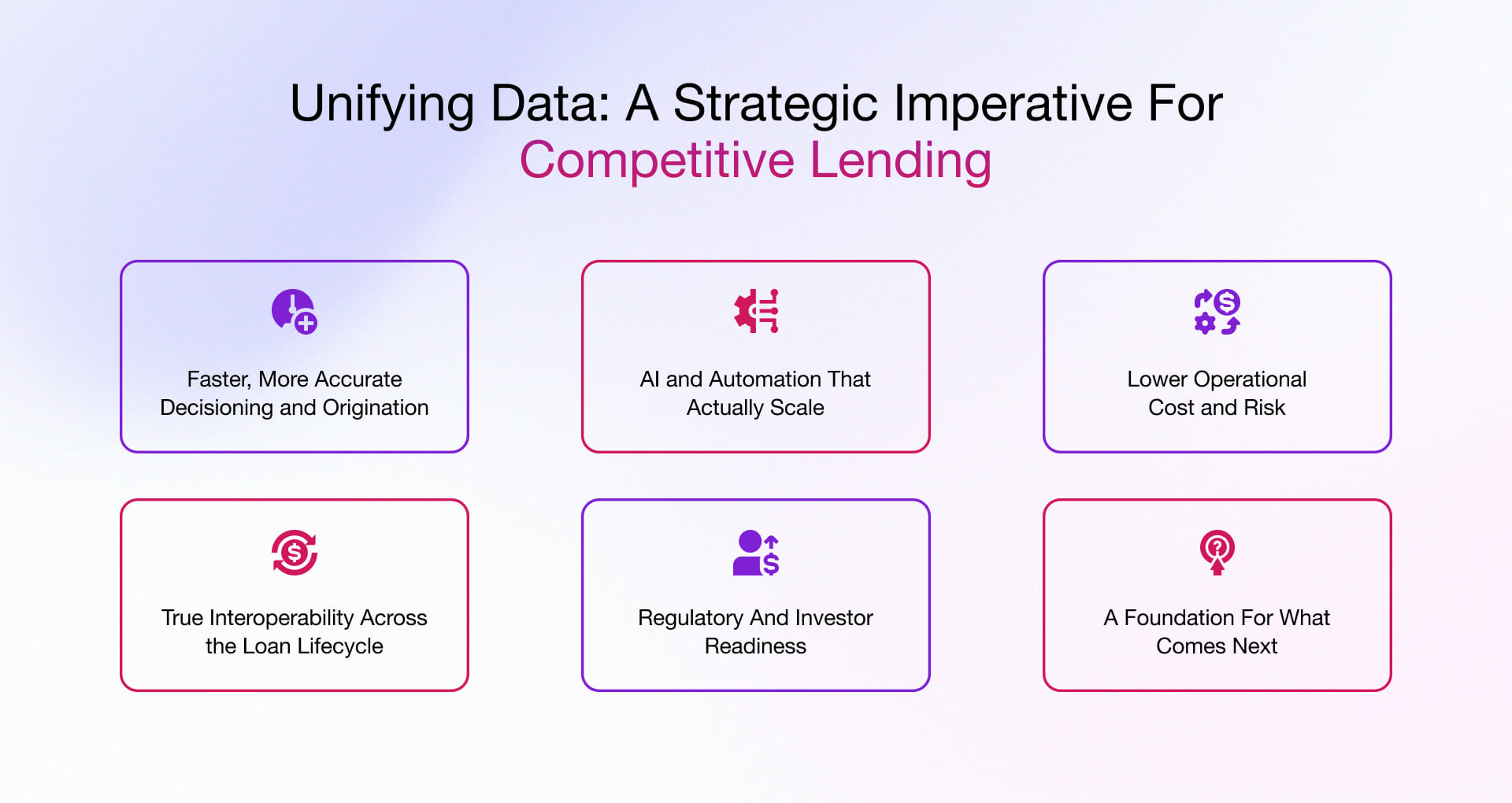
Faster, more accurate decisioning and origination
Fewer re-keying mean cleaner automated underwriting findings and fewer stipulation loops. MISMO adoption in U.S. mortgage operations has already shown it lowers per-loan costs, improves margins and cuts errors.
AI and automation that actually scale
Agentic workflows need data that’s consistent and traceable, not data that’s merely present. Integrating data across the loan lifecycle can lift predictive accuracy, but only if that data stays usable instead of getting locked back into a silo. Without a shared definition of active customer or disbursement date, every pricing or segmentation model ends up fighting your data instead of reading the market.
Lower operational cost and risk
Fragmented data across financial services could cost the global economy up to $6.5 trillion in lost GDP by 2030 if the trend holds. Lenders that lean into automation shorten cycle times, improve pull‑through, and save about $1,500 per loan, with top performers running nearly half the industry‑average cost to originate.
True interoperability across the loan lifecycle
Loan origination, closing, servicing and the secondary market stop requiring translation at every handoff once core workflows are standardized. In mortgage, AI-powered workflow automation shows how a single, governed process can connect POS, underwriting, closing and servicing without constant re-entry, as we explore in our AI mortgage workflow automation piece.
Regulatory and investor readiness
Cleaner delivery. Better audit trails. Examinations that go faster because every department’s answer to “what does this number mean” is the same answer. MISMO-aligned standards help lenders avoid penalties and delivery rejections tied to Fannie, Freddie, HUD and CFPB requirements.
A foundation for what comes next
APIs, open banking, and real-time data products get dramatically cheaper to build once the underlying definitions are settled. Over 3.2 million eNotes are now registered through MERS, and that scale only works because the data behind it is standardized.
None of this happens by declaring a policy; it happens by actually building the model and putting governance behind it.
From Standard Compliance to Operational Reality
Characteristics of a Working Common Data Language
A working version is built around a common data model, a single governed layer that both people and systems can read. It has clear ownership assigned per data domain: borrower, loan, collateral, income, status, disbursement date, active customer.
- It exposes machine-readable metadata showing definitions, lineage, and version history.
- It rolls out progressively, starting at the handoffs causing the most pain, like underwriting to servicing or marketing to risk.
- And it has a governance council with lending, risk, finance, and technology at the table, with actual authority to approve changes to definitions and KPIs.
MISMO Is U.S.-Centric. The Pattern Is Global.
MISMO standards, including ULDD, UAD, eNotes, and MCD, were built for the U.S. mortgage market and GSE delivery. Outside the U.S., there’s no equivalent formal compliance regime. Other markets lean on their own frameworks: FpML for syndicated loans, local regulator templates, or internally built canonical models.
The takeaway isn’t that MISMO doesn’t matter. It’s that MISMO is one implementation of a pattern that applies everywhere lending happens. Use it where it’s the standard and build the equivalent discipline where it isn’t.
Practical Starting Points
Here’s exactly how digital-first lending platforms are designed: with a unified data foundation that supports multiple products, channels and markets.
- Identify 5–10 key KPIs that must stay consistent across teams. Examples include active customer, disbursement date, NPL ratio, and default rate.
- Document the definition, formula, data source, owner and refresh frequency for each KPI.
- Build or improve a common data model based on MISMO or your regional standard. Treat it as a living product.
- Use a platform like Microsoft Purview or Fabric to put governance and data lineage in place.
- Start with the process that causes the most friction today, then expand step by step.
- Assign one clear owner per data domain. Support each owner with a small governance group that holds real decision rights.
Driving Adoption Across Lending, Risk, and Finance
- Begin where the pain is already visible. Common starting points include the handoff from underwriting to servicing or from marketing to risk.
- Publish a data dictionary that business users can actually read. Avoid creating a technical catalog that only engineers open.
- Link every definition change to release management. This prevents KPIs from shifting silently in production.
- Measure success by real outcomes. Track fewer reconciliation tickets, fewer audit findings, and fewer conflicting dashboards.
Why a Domain-Native Engineering Partner Gets You There Faster
A team that already speaks lending doesn’t need six weeks of onboarding before it can be useful. At Rishabh Software, our lending software development services are backed by hands-on domain expertise across BBC cycles, SWIFT messaging, KYC and AML workflows and collections operations. We build an augmentation and governance layer on top of what you already run, not a replacement for your core lending platform.
Across 10-plus lending engagements, that repetition builds real pattern recognition: pre-defined canonical models for borrower, loan, collateral, income, and status, with governance patterns for KPIs like active customer, disbursement date, PAR and NPL.
Proven Lending Expertise Across Real-World Engagements
We modernized asset-based lending and factoring operations for a prominent US-based financial institution, reaching full operational visibility and a 62% efficiency gain by replacing spreadsheet-based tracking with a unified data model and governed KPIs.
We built an end-to-end microfinance lending platform that cut loan processing time by 62% and operational costs by 50%. We achieved these results by unifying the definitions of loan status, disbursement date, and portfolio-at-risk across origination and collections.
We have also built digital payment infrastructure for banks and fintechs. The same rule applies: payment status, settlement, and transaction data must mean the same thing across every system. If they don’t, reconciliation breaks down. With this in place, clients saw 98% CSAT in Q1, driven by hassle-free payments.
In-built Compliance
Our team engineers data residency, retention and audit trails into the architecture from the very beginning instead of patching them after an audit finding. We have help up that standard across 9 regulated markets including Bahrain, UAE, Canada, Mauritius, Singapore, the Philippines, the US, the UK and Europe.
One Partner, Full Lending Lifecycle
Origination through collections, under one accountable team, removes the handoff points where definitions usually drift apart. That’s the value of 10-plus lending engagements across nine jurisdictions and 25 years of delivery experience: fewer seams for data to disagree across.
Whether you build this in-house or bring in a partner, waiting doesn’t make the problem smaller. Stop Translating Data: Start Speaking the Same Language Across Your Lending Business
Every quarter you wait, three things compound:
- Technical debt: more custom mappings, shadow systems, and one-off integrations.
- AI debt: more pilots built on incompatible definitions that become harder to unwind.
- Compliance debt: more audit findings tied to inconsistent data and unclear lineage.