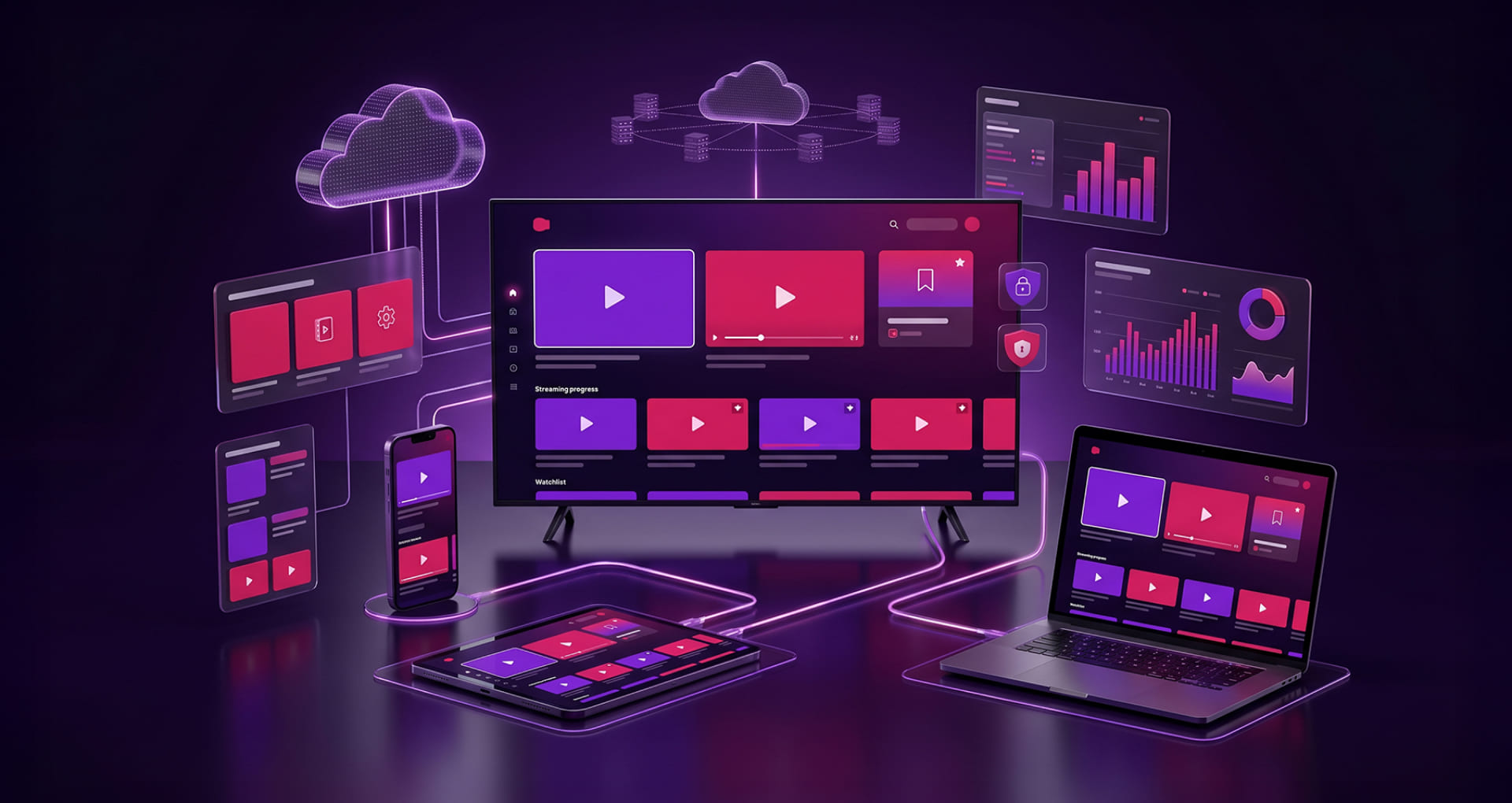
OOH advertising today includes both traditional formats such as billboards, posters, transit media, and static panels, as well as digital OOH formats like digital billboards, programmatic screens, and place-based media. As the industry shifts toward more connected and data-driven campaigns, managing inventory through spreadsheets slows down planning, increases errors, and limits visibility.
Out-of-home advertising is in genuine growth right now. According to EMARKETER, OOH advertising revenues reached a record $9.46 billion in 2025, marking 19 consecutive quarters of growth and a 3.6% year-over-year increase. Digital OOH was a major growth driver, accounting for 36.3% of total revenues and growing 10.5% year over year. But when inventory, availability, pricing, and bookings remain scattered across spreadsheets, PDFs, and emails, teams lose time, accuracy, and revenue opportunities.
In this blog, we will explore the hidden operational debt created by spreadsheet-driven OOH inventory management, why these challenges become more expensive over time, and how a centralized OOH and DOOH platform help media owners and aggregators improve inventory utilization, streamline operations, and support future growth
What Manual Out-of-Home Advertising Management Actually Costs
The cost of managing OOH inventory and campaign operations through spreadsheets extends far beyond direct expenses. It appears in the form of wasted time, fragmented workflows, manual errors, duplicated effort, delayed decision-making, and missed revenue opportunities. As OOH networks grow, these operational inefficiencies accumulate into a significant business cost that impacts planning efficiency, inventory utilization, campaign execution, and overall profitability. Let’s understand in detail.
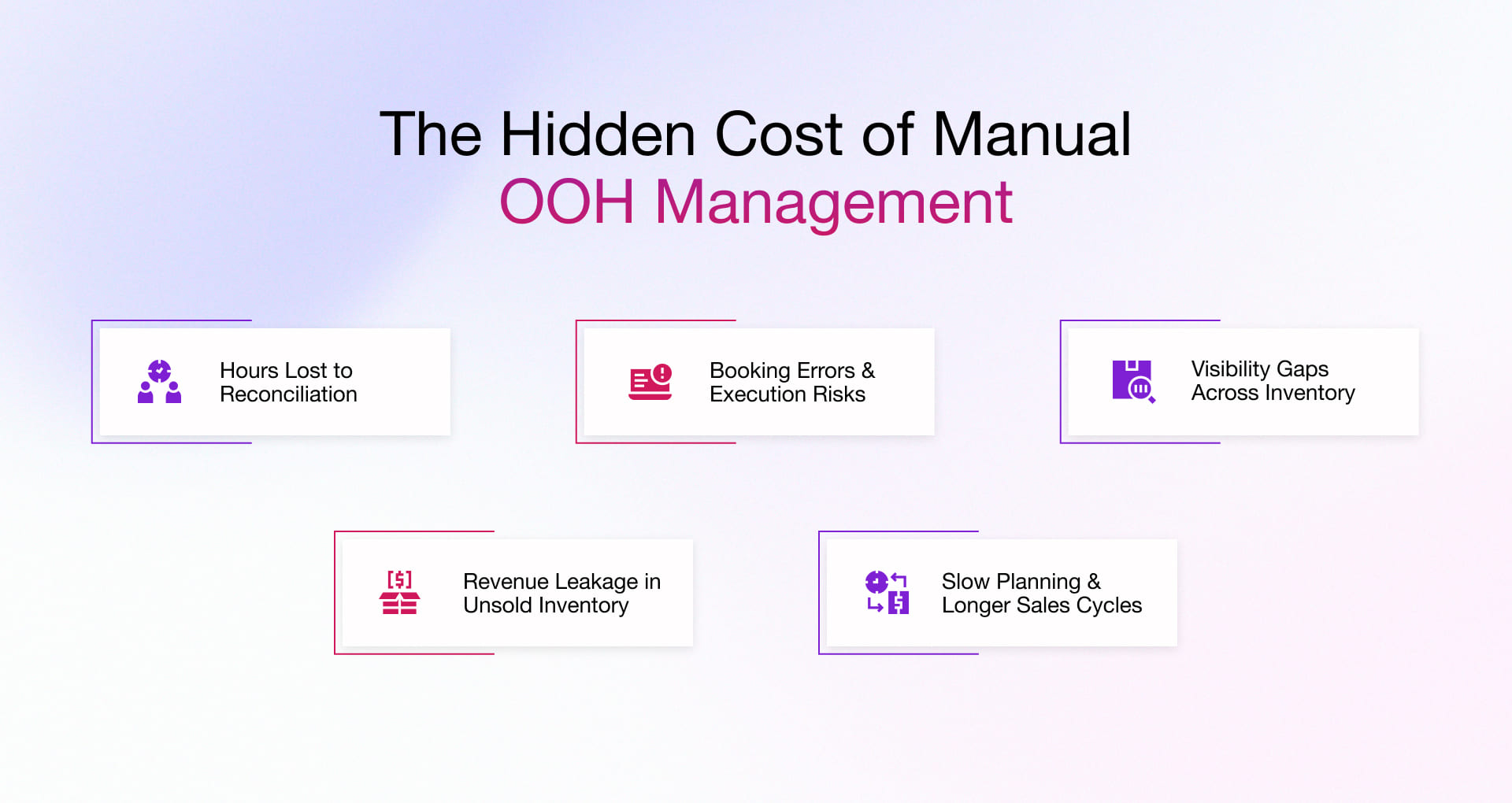
The Hours Lost to Inventory Reconciliation
Most OOH teams underestimate how much of their week goes into reconciliation instead of strategy. Pull availability from one media owner’s spreadsheet. Check it against another’s PDF rate card. Update a shared tracker that three people maintain slightly differently.
By the time a planner confirms what is actually available, half the value of being first to a client’s brief is gone. That time has a real price, even when no one invoices it. Every hour spent reconciling is an hour not spent on yield strategy or client growth.
Booking Errors and Campaign Execution Risks
Spreadsheets are flexible because nothing stops you from typing the wrong figure into the wrong cell, and that flexibility is also a defect. Double bookings happen when two planners update separate copies of the same workbook, and rate cards drift across regions running contracts and invoices in different currencies.
One ad booking and order management system reengineering for a digital advertising screen network ran into exactly this: overlapping bookings, invoicing errors, and redundant manual work just to keep contracts in one place. None of that shows up as a single dramatic failure. It shows up as a steady trickle of campaigns that ran wrong, late, or twice.
Visibility Gaps Across Inventory
The deeper problem behind most booking errors is that nobody has a clean view of what is actually available, sold, or live at a given moment. A media and entertainment client running campaigns through scattered Excel sheets and vendor-specific systems felt this directly before a DOOH aggregator platform modernization brought everything under one roof.
No single source of truth existed for what was actually live where, so sales teams often quoted against inventory already spoken for, or sat on availability nobody knew how to sell. As OOH networks increasingly rely on inventory from multiple media owners, maintaining a unified view of availability becomes even more difficult. Different inventory structures, pricing models, and booking processes create operational silos that slow campaign planning and reduce inventory utilization.
Revenue Leakage Hidden in Unsold Inventory
The hardest cost to quantify is the one spreadsheets hide best: unsold or undervalued inventory. When availability lives in static files that update slowly, planners default to selling what they remember rather than what fits a client’s audience and timing needs.
A panel rated for fifty thousand daily impressions says almost nothing about who those people are or whether they match a target profile, and that gap between raw traffic counts and real audience fit is exactly where yield gets left on the table. Without that context built into daily planning, media owners price inventory on instinct, which rarely captures full yield.
Slow Campaign Planning and Longer Sales Cycles
Every one of these problems adds friction to the same place: the gap between a brief and a signed booking. A media owner that cannot confirm availability in minutes loses deals to channels that can.
One booking system built with BI and data analytics for a DOOH network running over a million panels worldwide was built to help the team respond to booking requests immediately instead of losing sales to faster competitors. Shortening that response time is the difference between winning a brief and watching the budget move to display or CTV instead.
Why These Costs Increase as OOH Networks Scale
Managing a regional network with a few hundred panels is already challenging. The difficulty increases a lot as the network grows because using spreadsheets doesn’t scale well it gets more complicated, not just more work.
More Panels Mean More Combinations to Track
A network with a few hundred static panels can still operate using a master tracker and a patient operations manager. But for a network with thousands of digital and static panels spread across several cities, that approach doesn’t work.
Take the example of a Singapore-based outdoor advertising company with over 120,000 panels. At that size, even small recording-availability errors result in thousands of dollars in lost revenue each week from mismatched bookings. The data simply becomes too complex for spreadsheets to handle.
Static and Digital Panels Stop Being Separate Issues
Clients want to buy static and digital inventory together in a single package rather than negotiate them separately. This is good for revenue, but it means planners must see everything, formats, locations, and pacing, all at once.
For large portfolios with tens of thousands of panels across different regions, which is common now, no spreadsheet with formulas can realistically filter by factors like audience segment, proximity to landmarks, and format availability simultaneously. What worked for a thousand panels doesn’t work at ten thousand.
Programmatic Advertising Needs Data that Spreadsheets Can’t Provide Quickly Enough
Global programmatic digital out-of-home (OOH) advertising was about $1.7 billion in 2024. It’s still a small part of total OOH spend, but is expected to grow as more inventory goes digital. Some platforms are already moving beyond simple rule-based bidding, using AI to adjust pacing and pricing in real time rather than waiting for humans to check dashboards. These campaigns respond to live factors such as weather, time, and audience size. A spreadsheet updated once a day, even carefully, can’t supply data fast enough for systems that need updates every few seconds. This infrastructure gap, which might have been manageable at a smaller scale, now directly limits growth.
A Smarter Way to Manage OOH Advertising with a 360-Degree OOH & DOOH Platform
This growing cost of expansion has only one clear solution: moving from spreadsheets to digitalization as soon as possible. This could be through an ad management solution, a unified campaign management platform, or any digital system that helps streamline OOH operations. Let’s see how DOOH advertising platform is a smart choice:
One Source of Truth Across Static and Digital
Centralizing inventory means a planner in one city sees the same availability, at the same moment, as a planner in another. A unified platform for static and digital OOH inventory, campaigns, and ad operations makes that possible. Booking, scheduling, and reporting sync automatically instead of depending on someone remembering to update a shared file.
Automation Where the Friction Actually Lives
Booking, invoicing, and reconciliation are exactly the tasks automation handles well, and humans struggle to sustain over the years. RTB-based ad exchange platforms, demand-side platform integrations, supply-side platform connections, and programmatic CTV and DOOH exchanges increasingly automate everything from bid response to proof of play tracking, freeing ad ops time for strategy instead of cleanup.
Location Intelligence Built into Planning, Not Bolted on Afterward
The deeper audience question, who actually passes a panel and whether they match a client’s target profile, gets answered only when mobility and demographic data sit inside the planning workflow itself, not in a separate analysis run occasionally. Data analytics built directly into OOH and DOOH platforms turns panel-level location data into pricing decisions instead of after-the-fact reporting, the difference between selling a panel because it sits on a busy road and selling it because the right people pass it and actually look up.
Reporting that Actually Closes the Loop
A unified platform also solves the measurement fragmentation problem described above. Standardized metrics across every media owner and format mean one dashboard instead of a folder of mismatched PDFs, letting OOH compete for budget against channels that have offered that clarity for years.
Know More About Our DOOH Platform
Spreadsheets got OOH this far. They will not get the channel to where it is headed next. If your team is still reconciling availability across tabs and email threads, the cost is the time, accuracy, and revenue left on the table every week.
Our white-label DOOH Aggregator Platform helps media owners, aggregators, and advertising businesses centralize inventory management, streamline campaign planning, automate bookings, and gain real-time visibility across static and digital inventory. Built to support evolving OOH and DOOH business models, the platform offers configurable workflows, advanced reporting, seamless integrations, and the flexibility to scale alongside your operations.
Whether you manage a regional network or a large multi-location inventory portfolio, the platform provides a single source of truth for inventory, campaigns, and ad operations.