
Most businesses have already accepted that their legacy systems need to be modernized. The real question is how to modernize without interrupting operations, compounding technical debt, or burning through resources on a migration that delivers less than promised.
The evidence is close to home. Across recent engagements, we have seen this play out consistently:
- A leading client’s administration system was struggling with performance due to tightly coupled workflows. We helped improve scalability and responsiveness. Explore how we modernized the legacy administration system.
- A legacy lending platform was struggling with complex dependencies, making changes slow and high-risk. We simplified and modernized the system. Explore our modernization efforts for the Legacy Asset Based Lending System.
- A private bank’s CSR platform was struggling with rigid structures that limited reporting and regulatory alignment. We enabled greater flexibility. Read more to explore legacy CSR management solution modernization.
In each case, the problem was not a lack of intent. It was a lack of the right execution layer. This is where Generative AI for application modernization along with agentic AI change the equation. Together, they move application modernization from a project team’s plan in quarters to a process that analyzes, recommends, and acts with greater speed and precision.
In this blog post, we will discuss: the role Gen AI plays as a modernization engine, how agentic AI extends that capability into autonomous action, the steps to execute it confidently, and what reliable outcomes actually look like.
Generative AI as an Application Modernization Engine
Cost reduction is one outcome of application modernization. But for most businesses carrying legacy systems, it is not the most crucial one.
A GAO report found that 11 high-priority federal legacy systems were between 23 and 60 years old, costing approximately $754 million annually just to operate and maintain. Across the federal government, roughly 80% of a $100 billion IT budget goes toward keeping existing systems running rather than improving them. Here is a statistic that shows how the modernization process is at its peak and holds strong market potential, further removing legacy drawbacks:
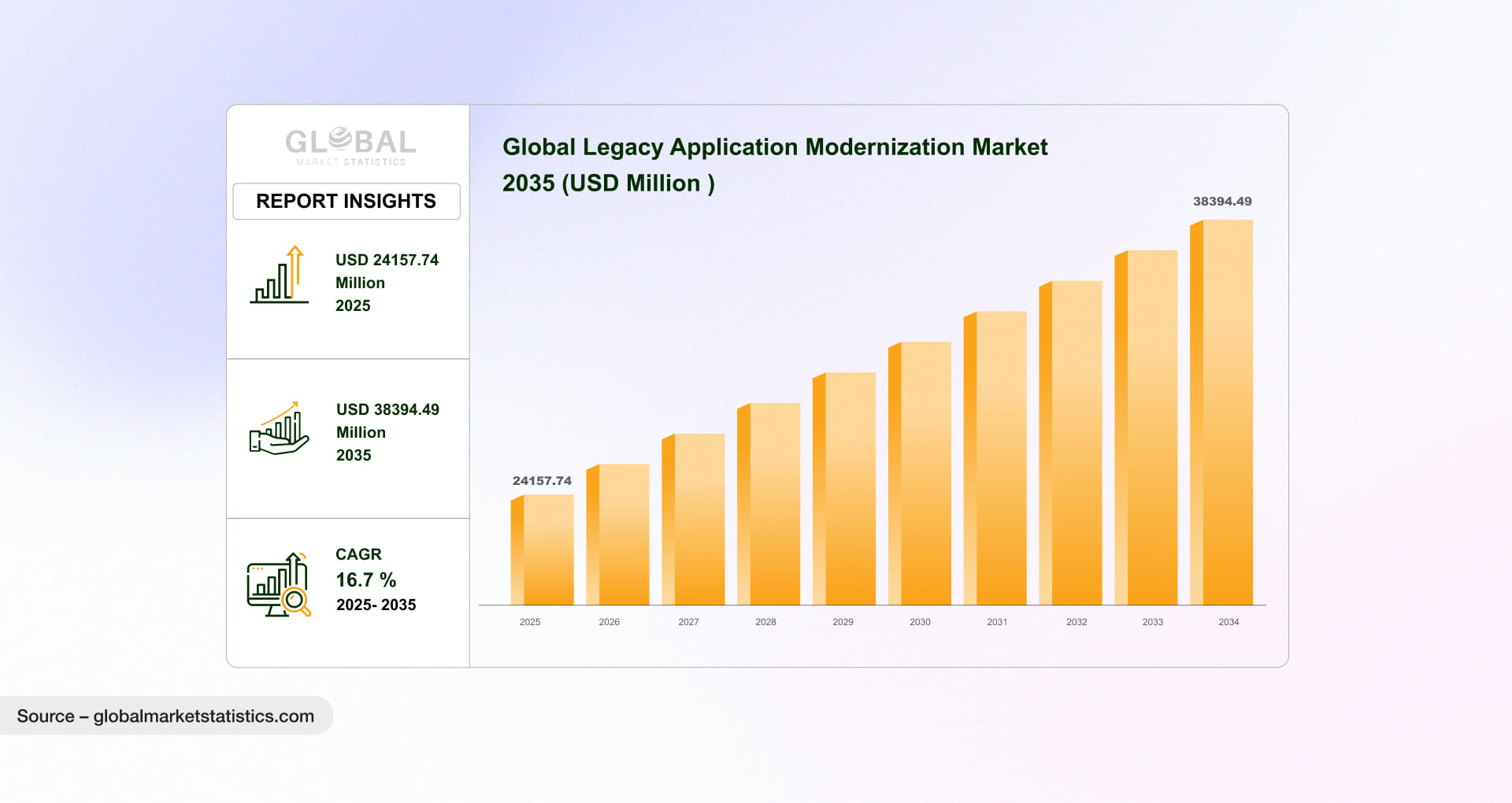
When most of the budget goes to maintenance, the modernization backlog grows, failure risk increases, and every quarter of delay makes the effort more expensive.
Generative AI changes that. It analyzes legacy codebases, surfaces dependencies, generates documentation, and recommends migration paths faster than any manual assessment cycle. That is what makes Generative AI in application modernization a true engine, not just another productivity tool.
1. Stopping Entropy Tax
Legacy systems increase costs over time and slow down innovation. Most effort goes into maintenance instead of growth.
Application modernization using Gen AI acts as a counterforce. GenAI acts as a counterforce by continuously analyzing and refactoring systems, reducing manual maintenance effort and catching inefficiencies before they compound. This prevents cost escalation and helps systems function reliably within a modern technological framework. The result is stable operations and improved ROI.
2. Uncovering Hidden Logic
Modernization initiatives often fail because critical system logic remains implicit and undocumented.
Generative AI in application modernization helps uncover this hidden logic. It analyzes legacy systems and captures intended behavior, bringing clarity before execution.
This structured approach reduces risk and supports change that is aligned with business outcomes.
3. Reducing Skill Dependency
Legacy modernization often depends on niche expertise, slowing execution and increasing cost.
Gen AI-powered applications modernization bridges this gap. It allows teams to work across systems without relying on specialists, while enabling them to experiment within a controlled environment. This avoids blunt-force modernization approaches that lead to technical debt and failure.
4. Accelerating Modernization Without Disruption
Traditional modernization slows business momentum and delays value realization. Moreover, traditional approaches hide operations thoroughly, requiring teams to pause operations, migrate everything, and hope nothing breaks a high-risk approach that delays value.
Gen AI and Agentic AI for Application Modernization: How They Deconstruct Legacy Systems
| Stage | Generative AI Role (Understanding) | Agentic AI Role (Action) | Strategic Output |
| System Boundary Identification | Analyzes codebase to uncover implicit structure and relationships across components | Defines decomposition boundaries and ensures a structured breakdown | Ecosystem maps and value-chain views |
| Dependency Mapping | Identifies hidden dependencies across modules, data layers, and workflows | Evaluates risk and sequences modernization steps to avoid disruption | Decision trees and logic flows |
| Modernization Prioritization | Assesses complexity, usage patterns, and business impact areas | Prioritize components based on ROI, risk, and execution feasibility | Executive decision matrices |
| System Deconstruction | Continuously analyzes system behavior and validates logic during breakdown | Executes controlled refactoring and modularization without disrupting operations | Operating model diagrams |
| Architecture Alignment | Refine system understanding as components evolve | Ensures components are integrated into the modern workflow and aligned with a scalable technological framework | Transformation delta views |
| Scenario Planning and Experimentation | Simulates different modernization approaches and outcomes | Selects optimal execution path and enables controlled experimentation | Scenario frameworks and strategic models |
Instead of rushing into modernization, take a strategic and measured approach with Rishabh Software’s generative AI consulting services. Our experts are well-versed in guiding you at every step, helping your business grow and scale with confidence.
From Analysis to Action: How GenAI Executes Application Modernization
Generative AI in application modernization brings a bold solution to long-standing roadblocks, while Agentic AI ensures that execution is structured, aligned, and continuously moving forward within a modern technological ecosystem.
Strategy Generation: AI-Driven Modernization Blueprints
The most critical roadblock in modernization is deciding the right path. High-density legacy systems make it difficult to decide between refactoring, rebuilding, or replacing.
Generative AI removes this uncertainty by analyzing system complexity, dependencies, and implicit logic to generate objective recommendations. It uncovers where effort delivers real value and where risk is concentrated.
- Identifies low-effort, high-impact opportunities for early wins
- Highlights high-risk areas that require deeper reform
Agentic AI ensures these insights remain dynamic. It sequences execution and aligns decisions with business priorities.
Autonomous Code Transformation
Execution is where most enterprise application modernization efforts struggle due to manual effort and fragmented approaches.
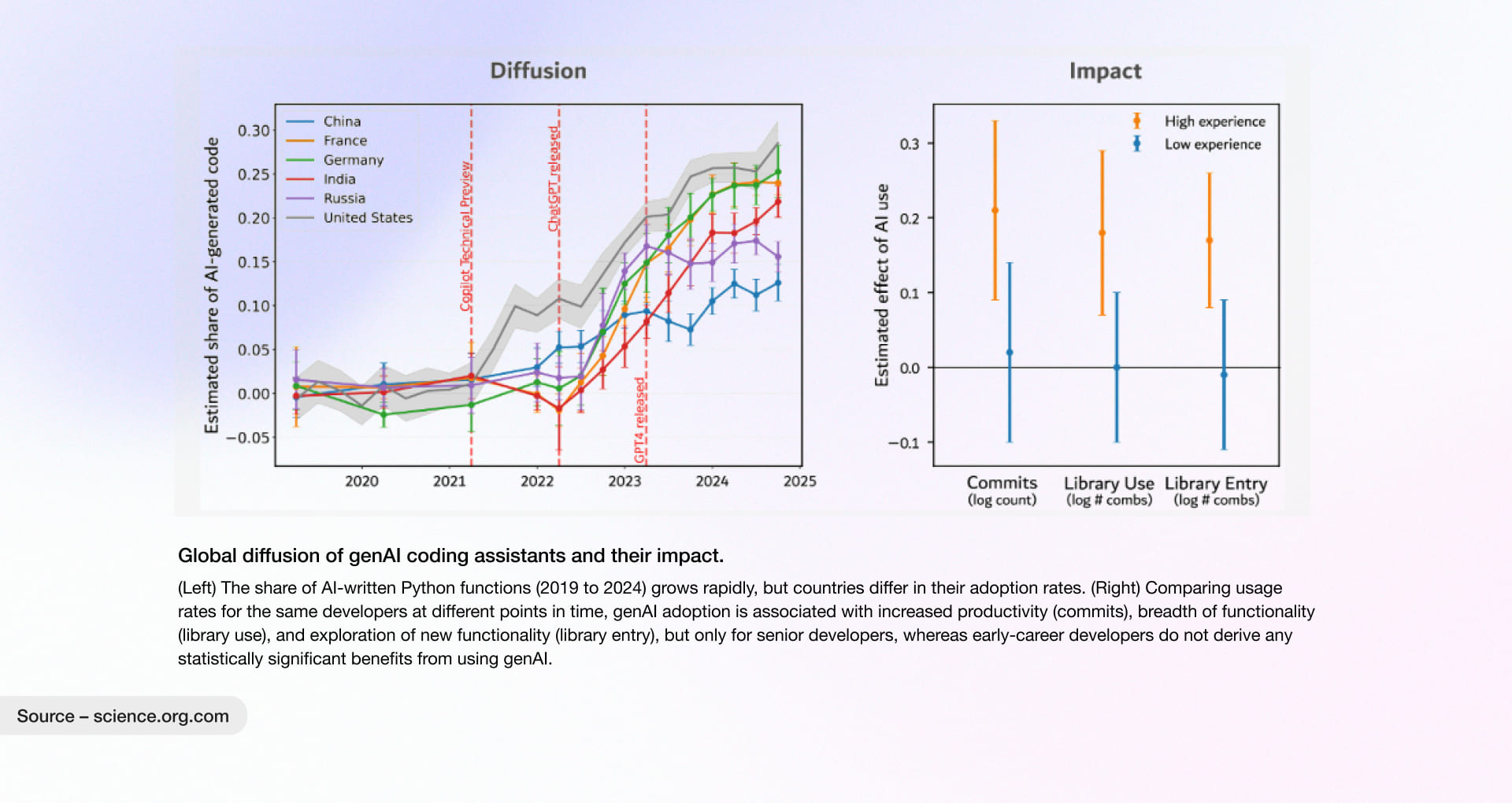
Gen AI-powered applications modernization shifts this by enabling contextual rewriting instead of simple code conversion. It understands system intent and transforms legacy logic into modern, modular components.
- Language conversion aligned with modern design patterns
- Monolith decomposition into bounded contexts and scalable services
Agentic AI:
- Orchestrates transformation across components
- Manages dependencies to ensure systems function reliably
AI-Generated APIs and Integration Layers
Modernization does not require immediate replacement. Legacy systems can evolve while continuing to operate. Generative AI acts as a bridge by creating API layers and integration frameworks that connect legacy systems to modern architectures.
- Wrapping legacy systems into API-enabled services
- Enabling integration into the modern workflow without disruption
- Supporting gradual architecture upgrades
Agentic AI ensures that:
- Integration remains stable and aligned
- Data flows are consistent across systems
Intelligent Test and Validation Automation
One of the biggest risks in modernization is discovering issues too late. Generative AI enables proactive validation by analyzing system behavior and generating test scenarios that ensure consistency between legacy and modern systems.
- Behavioral parity validation across systems
- Identification of edge cases and failure points
Agentic AI:
- Orchestrates validation cycles
- Flags issues early and ensures corrective action
Steps for Adopting Generative AI in Application Modernization
Yet despite this optimism, many organizations struggle to move forward due to limited visibility into legacy systems, uneven technological maturity, and persistent roadblocks. This creates a growing risk of being left behind. Application Modernization with Generative AI addresses this gap by turning complexity into structured, executable progress.
Here is a step-by-step approach to adopting Generative AI for application modernization read, evaluate, explore, and ultimately implement.
If you need assistance, then connect with us to leverage our AI and ML development services, led by experts who guide you at every phase.
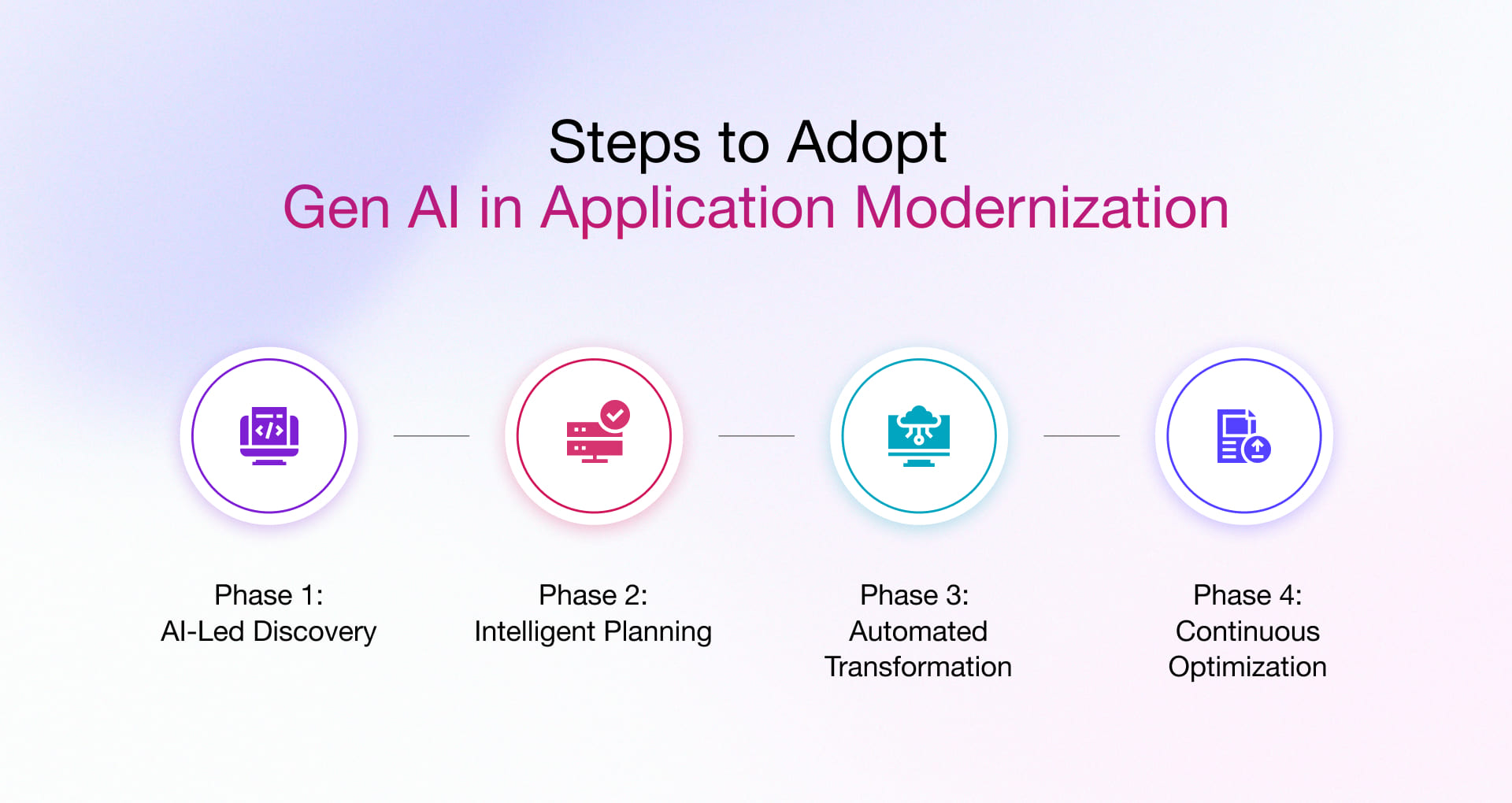
Phase 1: AI-Led Discovery and System Understanding
Modernization starts with a simple but critical question, what is actually happening inside your system today? In most legacy environments, the answer is not clear. Important logic sits buried across layers, documentation is incomplete, and over time, complexity builds up to a point where even small changes feel risky.
This is where Generative AI in application modernization makes a real difference. Instead of manually digging through code, it quickly analyzes large systems, surfaces hidden business logic, and maps how different parts of the system are connected. It brings to light relationships that were always there but never fully understood.
The outcome is not just visibility, but confidence. Teams finally get a clear picture of where risks exist, how systems are structured, and what needs attention, making it easier to move forward without hesitation.
Phase 2: Intelligent Planning and Simulation
Once there is clarity, the next step is deciding what to do with it. This is often where things slow down. Traditional planning relies on fixed roadmaps that look good initially but struggle to keep up as real system complexity starts to surface.
Application modernization with generative AI helps make planning more flexible and grounded in reality. It allows teams to explore different approaches, what should be improved, what needs rebuilding, and what can remain as is. Instead of guessing, decisions are based on how the system actually behaves.
This makes modernization feel more manageable. Work can be phased, priorities stay aligned with business goals, and teams can move ahead without constantly revisiting earlier decisions.
Phase 3: Automated Transformation and Refactoring
Execution is where the real effort begins and where many modernization initiatives lose momentum. Manual processes take time, require specialized skills, and often introduce new complexities along the way.
With Generative AI, this phase becomes more structured and less overwhelming. Systems are not just rewritten; they are improved. Existing logic is preserved, but its organization and implementation are updated to fit modern architectures.
Because of this, teams are not stuck maintaining outdated systems while simultaneously modernizing them. They can shift their focus toward building new capabilities and driving innovation, rather than constantly fixing the past.
Phase 4: Continuous Validation and Optimization
In many cases, that is when the real risks begin. Small inconsistencies, performance issues, or unexpected behaviors can surface over time, and if not addressed early, they can turn into far-reaching challenges.
Generative AI for application modernization helps in addressing this by continuously monitoring how the system behaves. It compares outcomes, identifies anything that does not align with defined KPIs, and highlights areas that need remediation. This allows teams to respond to realities on the ground, avoid potential deadlocks, and drive progress with more confidence.
Over time, this creates a more stable and reliable system. Instead of treating modernization as a one-time effort, it becomes an ongoing process, where systems continue to improve, adapt, and deliver value as the business evolves.
How Rishabh Software Drives Application Modernization with Generative AI?
Application modernization is not a single decision. It is a series of high-stakes calls made across discovery, planning, transformation, and validation, each action carrying real consequences if the execution layer is not strong enough to support it.
This is where Rishabh Software’s involvement goes beyond consulting. As a reliable Generative AI development company with deep application modernization experience, we bring Gen AI and agentic AI capabilities directly into the modernization process, covering system analysis, dependency mapping, code transformation, and continuous validation. If your organization is running systems that limit what your teams can build or how quickly you can move, that is the conversation worth having. Connect with us today to leverage our application modernization services to understand what structured and AI-driven modernization looks like for your environment.
Frequently Asked Questions
Q: What CIOs and CTOs Should Consider Before Adopting Generative AI For Application Modernization?
A: The team needs to evaluate four areas which include data quality requirements, security measures, system integration practices, and governance protocols. The organization should prioritize business value assessment, system scalability development, and managed implementation processes instead of testing their system through experimental methods.
Q: Which Industries Benefit the Most from Generative AI in Modernization?
A: The financial services, healthcare, retail, telecom, and digital manufacturing industries experience the greatest advantages from generative AI because their legacy systems and complex workflows lacking them behind. Generative AI helps organizations achieve greater efficiency while they modernize their systems and provide better user experiences.