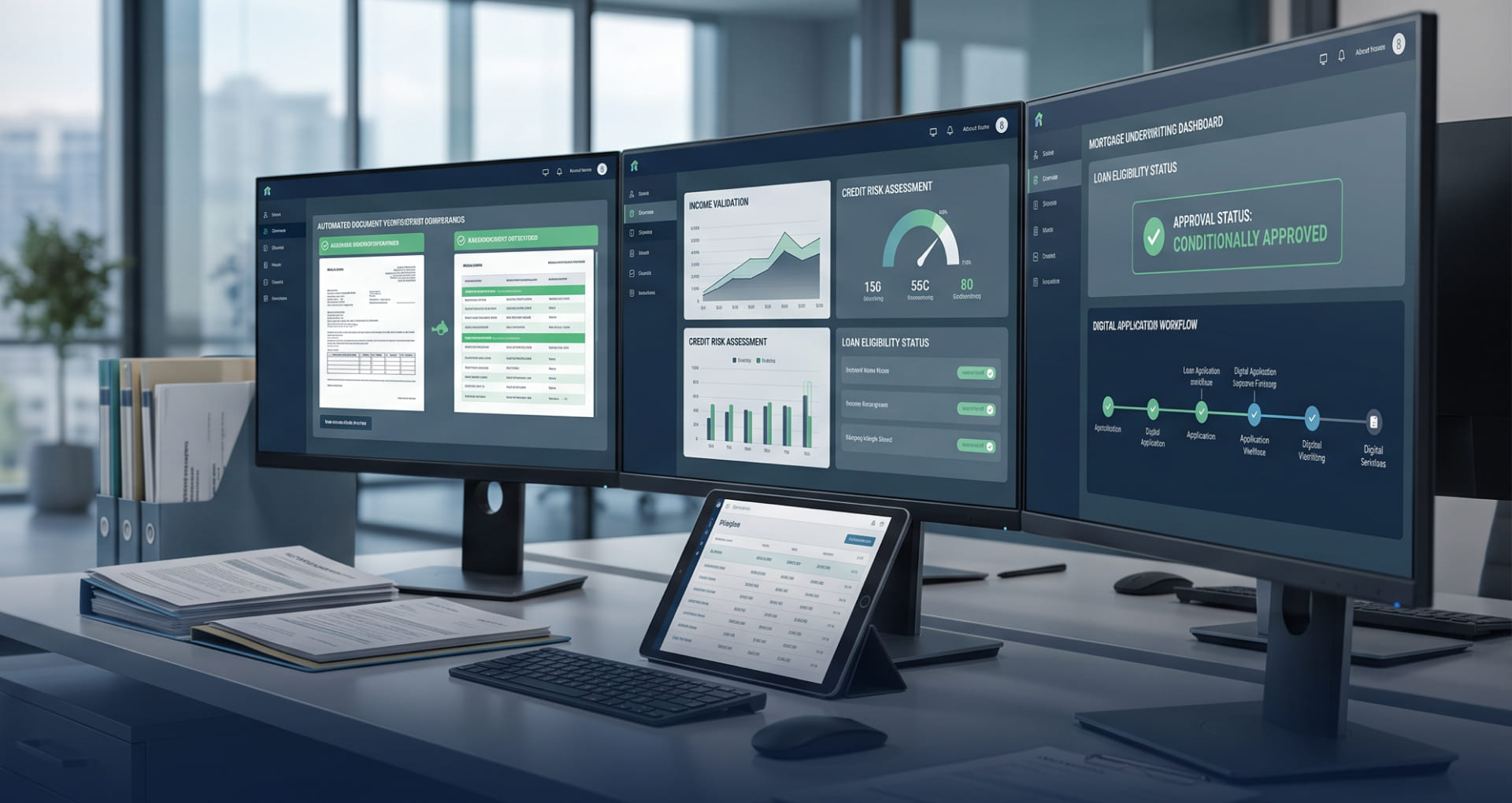
Mortgage lenders face growing pressure to control origination costs without compromising credit quality. Incomplete loan files, repeated reviews, manual verifications, and delayed decisions add to the cost of processing each loan. When profit margins are already tight, these inefficiencies can make it harder to scale lending operations profitably.
Mortgage underwriting automation helps address these issues by improving document readiness, automating routine checks, and routing exceptions to the right teams. Underwriters spend less time resolving data gaps and more time evaluating credit risk, while lenders can reduce avoidable rework and improve processing efficiency.
This blogpost examines where automated mortgage underwriting delivers measurable ROI, how it can improve loan throughput and conversion, and which metrics lenders should use to build a realistic business case.
The Metrics Behind the Mortgage Underwriting Automation Shift
Mortgage lenders are under pressure to reduce origination costs, shorten processing times, and improve productivity without compromising credit quality. These industry findings show the potential impact of automation on lending costs, turnaround times, and operational efficiency.
| Business signal | Figure | Source |
| Machine-learning automation can cut lender costs and shorten cycle time | Loans run about $1,500 (14%) cheaper and five days faster. | Freddie Mac, May 2025 |
| AI improves credit-analysis productivity and decision speed | 20 to 60% gain, 30% faster | McKinsey, 2025 |
| Digital validation reduces manual documentation and verification costs | 33% lower | Fannie Mae DU Validation Service |
| Agentic AI generates measurable returns when applied to targeted workflows | 2.3x within 13 months | IDC, 2025 |
Automated Mortgage Underwriting: A Game Changer for Lenders Under Margin Pressure
Mortgage profitability depends on controlling origination costs. Three operational pressures make this increasingly difficult.
Rising Cost Per Loan Is Eroding Profitability
- Mortgage production costs hit $11,988 per loan in Q1 2026, up from $11,102 in the prior quarter.
- Revenue per loan rose by roughly $973, yet net production profit held steady at $727.
- In 2025, top-performing independent mortgage banks spent $10,074 per loan. The bottom-performing group spent $12,603.
- Processing, underwriting and closing made up about 20% of retail origination costs.
Manual Rework Destroys Loan-Level Margins
Rework rarely appears as one expense. It shows up as extra hours spread across teams:
- A processor requests the same document twice.
- An underwriter resolves income figures that do not match.
- A loan officer answers for a condition that arrives late.
- A QC analyst corrects an error that intake could have caught.
Each loop also pushes the closing date toward the rate lock deadline.
Traditional Underwriting Caps Sustainable Growth
Volume growth usually triggers a hiring plan, but hiring is slow and experienced underwriters are scarce. Temporary staff fill the gap faster, at the cost of training time and more errors. Faster loans cost less, and your finance team already tracks the proof in cost per loan, productive hours, and cycle time. Here is where mortgage automated underwriting brings the money back.
How Mortgage Underwriting Automation Delivers Measurable ROI
Each of those pressures has a fix, and the fix shows up somewhere your finance team already tracks – cost per loan, productive hours and cycle time. Here is where the money comes back.
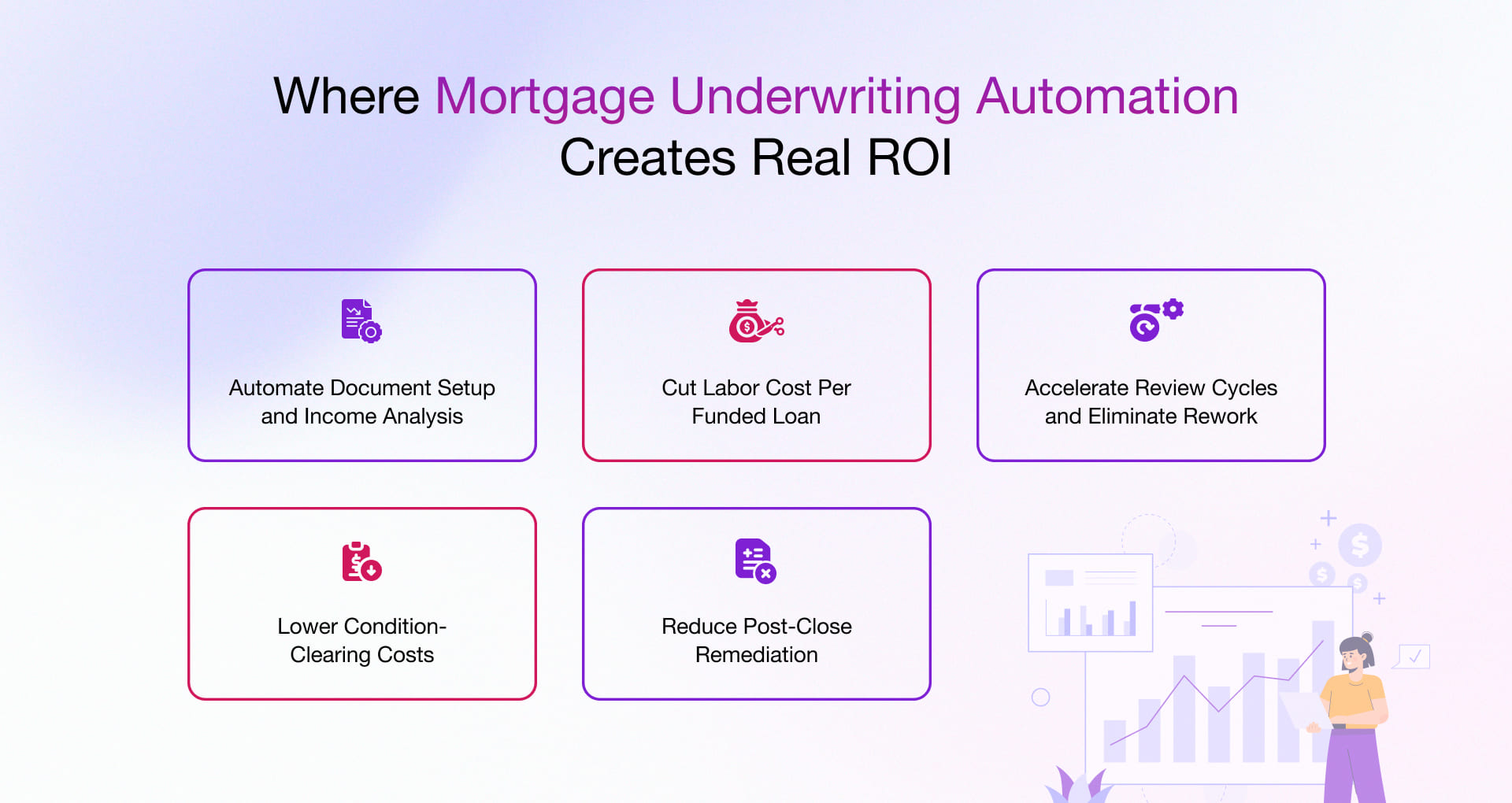
1. Automate Document Setup and Income Analysis
Underwriters spend a significant chunk of their time sorting documents, entering data, and calculating income. AI can classify documents, extract key details and prepare the file before underwriting begins. The underwriter receives a complete, organized file and can focus on the credit decision.
2. Cut Labor Cost Per Funded Loan
That reclaimed time reflects directly on the cost side. Measure underwriting labor against funded loans instead of applications, since fallout files consume hours without ever closing. Include that cost in the calculation, then apply the figure to your own loan volume to estimate potential savings.
3. Accelerate Review Cycles and Eliminate Rework
Automated validation catches missing pages, expired statements, and conflicting borrower information at intake, before the file reaches an underwriter. That means underwriters see a complete file on the first review instead of sending it back for gaps someone should have caught earlier. You can track review cycles, rework, and manual touches per loan to see the impact.
4. Lower Condition-Clearing Costs
Every condition adds another task for the underwriter, processor and borrower. Automation can identify likely conditions early, match new documents to open conditions, and route exceptions to the right team. Standard files can move through faster while underwriters focus on files that need human intervention.
5. Reduce Post-Close Remediation
Finding an error before closing costs less than fixing it later. Automated validation can run the same checks across every file and flag inconsistent or missing information before it becomes a post-close issue.
Underwriting is one piece of a bigger shift. See how mortgage workflow automation with AI transforms lending from intake through closing, for the fuller picture beyond underwriting alone.
How Lenders Can Leverage AI-Powered Underwriting to Boost Loan Conversions
Cost savings make the first argument. Improved conversion adds another dimension to the business case by helping lenders turn more applications into funded loans. Faster underwriting goes far beyond cost reduction; it turns more applications into funded loans.
1. Shorten Application-to-Decision Time
Borrowers do not wait forever. McKinsey found that AI improved credit turnaround by about 30% in one banking use case. Automation reduces idle time between document collection, verification, review and decisioning. The result is a faster, more predictable process.
2. Give Loan Officers Earlier Closing Visibility
Automated condition tracking shows what is complete, what is missing, and what could delay closing. Loan officers can give borrowers and agents clear updates without checking with multiple teams. They spend less time chasing status and more time serving borrowers and generating business.
3. Protect Rate Locks by Removing Bottlenecks
Lenders maximizing their automated loan underwriting capabilities were able to reduce their production cycles by five days. Faster underwriting gives teams more time to clear issues before a rate lock expires. This in turn reduces extension costs and prevents avoidable delays.
4. Improve Application-to-Close Conversion
Mortgage underwriting automation drives this conversion lift directly. Faster decisions, clearer updates and fewer delays all trace back to the automation upstream. Fewer applications freeze or fall out and so, most of them reach closing. You can track pull-through before and after implementation as even a small improvement here can outvalue the labor savings alone.
Scale Underwriter Capacity with Automation Without Adding Headcount
More conversion creates a new problem because it means handling more loans with the same team. Automation can help lenders handle higher application volumes without increasing staffing at the same rate.
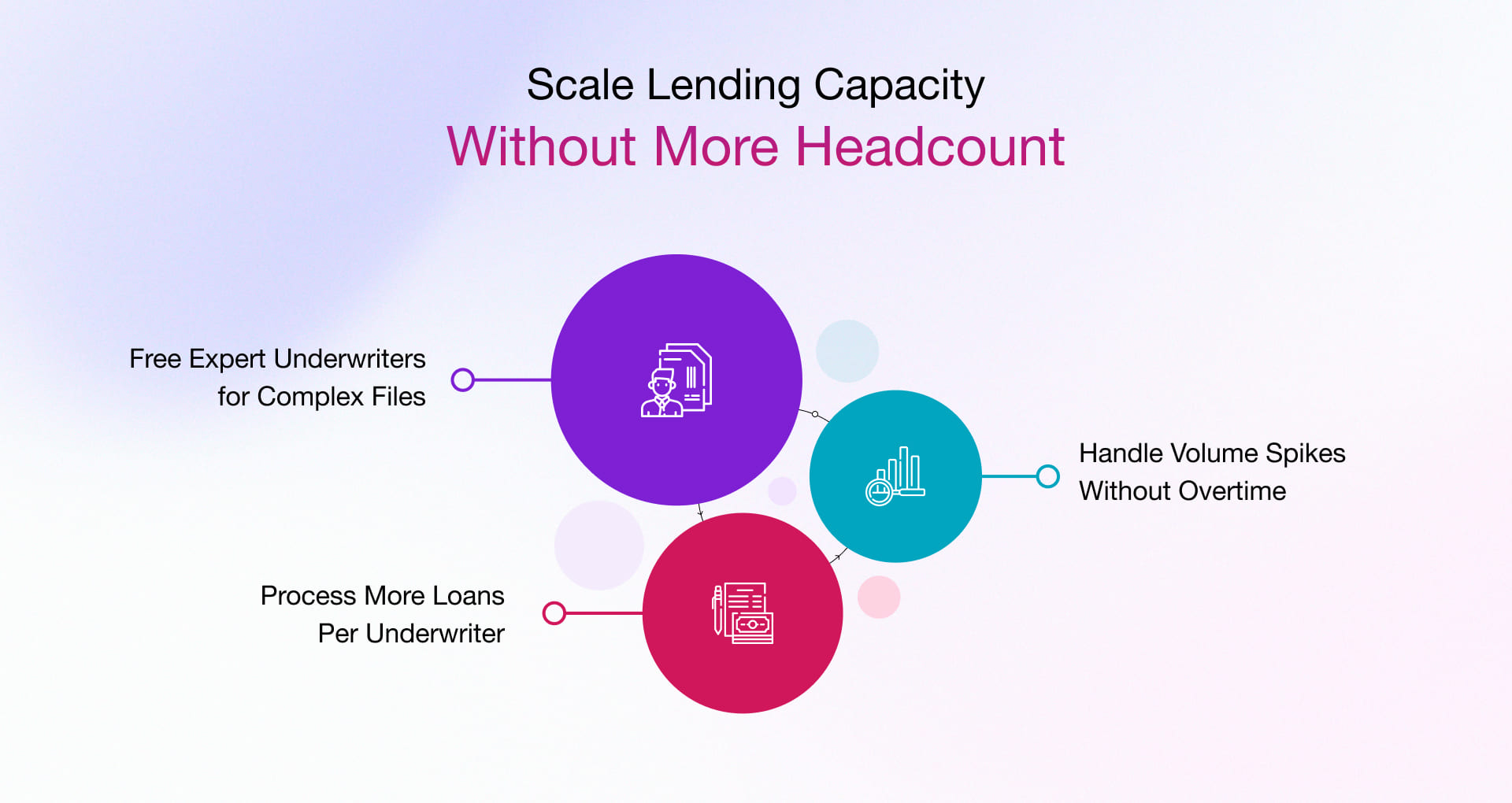
1. Free Expert Underwriters for Complex and High-Risk Files
Your best underwriter should not spend their Monday on a clean conventional file. Automation clears the routine steps and routes self-employed borrowers, unusual income and layered risk to the people trained to judge them. McKinsey describes the near-term underwriter role as AI supervisor and complex-case manager. Expertise lands where it changes outcomes.
2. Process Significantly More Loans Per Underwriter
McKinsey’s credit memo pilot showed productivity gains of 20 to 60% for credit analysts. AI-assisted underwriting can increase lending capacity without a proportional increase in headcount. In a 2026 NewFed Mortgage case study, underwriters reviewed 42 files per month compared with 31 previously which is a 35% increase. Track loans per underwriter per month as your baseline metric and measure the shift after you roll the system out.
3. Absorb Volume Spikes Without Overtime or Temporary Staff
A rate drop can triple daily application volume overnight. Manual shops respond with overtime, contractors, and rushed training, and error rates climb with each. Lenders running AI-assisted underwriting handle that same 3x spike at seasonal peaks without adding headcount, since the system absorbs the volume the way it handles any other file. Turn times hold, and so does the team.
Raise Loan Quality and Audit Readiness Through Automated Controls
Speed without control is a liability, and that’s exactly how regulators treat it. Automation adds value only when it makes the underwriting process consistent and accurate. Here is how it delivers both.
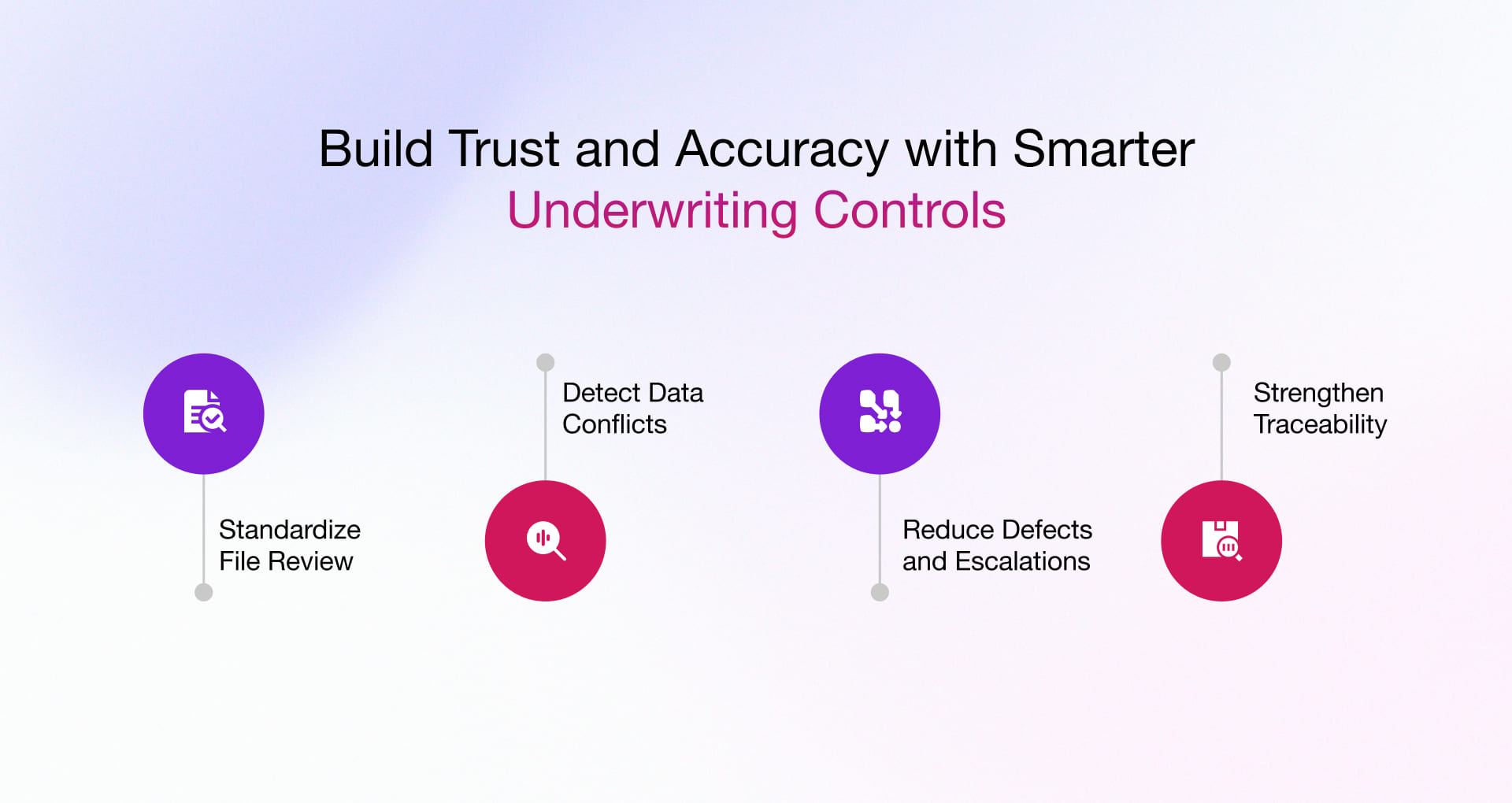
1. Standardize File Review Across Teams and Channels
Two underwriters can read the same guidelines and reach different conclusions. Retail, wholesale and correspondent channels can also follow different review practices. However, automated rules apply the same logic to every file, which creates more consistent decisions and makes results easier to compare across teams.
2. Detect Data Conflicts Before They Become Conditions
A deposit that contradicts stated income is a condition waiting to happen. Cross-document checks on income, assets, employment and property data flag it at intake and not on the third day after review. A condition that never forms never needs clearing.
3. Reduce Avoidable Defects and Escalations
Most defects are minor, like a missed disclosure, a miscalculated ratio, or an outdated form. Automated checks apply consistent validation rules across files, helping teams identify potential defects earlier and reduce avoidable escalations.
4. Strengthen Decision Traceability for Audits and Investors
Auditors and investors often ask one question: “Why did this decision happen”? Automated mortgage underwriting workflows can log each data source, rule, override and approver to give lenders a clear decision trail and makes audit preparation easier.
AI does not fix fair lending by default. Lenders still need to test models for bias, check outcomes, and document how automated decisions are made to stay ahead of regulators and investors. Custom rules and deep LOS integration aren’t a plug-and-play job, which is why our lending software development services start with your current workflow and not a ready-to-use template.
Turn Underwriting Automation into Measurable Margin with Rishabh Software
AI creates value only when it works across the lending workflow. We connect your systems, improve data quality, automate manual work, govern exceptions and measure results against cost per loan, cycle time, quality and capacity.
- We start with baseline cost per funded loan: We add labor, rework, and overhead, then divide by funded loans. Without a baseline, no one can prove savings.
- Track manual touches, time-to-decision, and clear-to-close: We count handoffs per file, hours to decision, and days to clear-to-close. These three show exactly where time leaks.
- Monitor conditions, defects, and pull-through: We track conditions per loan, defect rate, and pull-through to prove that speed did not cost quality.
- Calculate realistic payback including implementation costs: We put software, integration, change management, and training on the cost side, then weigh verified savings and revenue lift against it. That’s the only model built to survive a real budget review.
- Modernize workflows without disrupting production: Loans keep closing while we upgrade the system underneath. We start with one product line or channel, prove the model, then scale it across the rest.
- Configure to your products, policies, and risk appetite: Your credit policy is a competitive asset. We encode your overlays, product rules, and risk thresholds instead of handing you a standard prototype.
- Keep Human Control While Connecting Data Across the Lifecycle: We connect origination, underwriting, closing and servicing data so you get one view of each loan from application to payoff. Underwriters manage the judgment-heavy calls.
When workflows don’t fit an off-the-shelf tool, our custom mortgage software development services build automation around the exact rules and exceptions your underwriting team already uses.
Proof in Practice: A Lending Modernization Success Story
Modernization of Legacy Asset Based Lending System for SMBs
A leading US financial institution partnered with Rishabh Software to modernize its legacy asset-based lending system.
Challenges
- Fragmented data across lending processes
- Heavy manual work across approvals and payments
- GL mapping and classification errors
- Limited cash application automation
- Complex state-level compliance requirements
- Data security gaps
- Time-consuming reporting
Solutioning
- Real-Time Data Integration and Dashboards
- Regulatory Compliance and Reporting
- Robust Architecture for High Performance
- API-First Approach
- Integration and Scalability
- Fortified Security
Outcomes
- 62% faster credit assessments
- 99% fewer payment processing errors
- 75% shorter reporting times
This case study shows what modernization looks like in practice, and for the broader case against a full migration, see the hidden cost of legacy lending systems and the fix that doesn’t require a full migration.
Frequently Asked Questions About Mortgage Underwriting Automation
Q: What is mortgage underwriting automation and how does it work?
A: Software takes on the repetitive parts of reviewing a loan application. It pulls borrower data, checks documents, looks at credit and income, flags anything unusual, and helps the underwriter reach a decision faster. It frees up underwriters so they can focus on the files that actually need judgment. Cycle times drop, fewer mistakes slip through, and the team handles more volume without hiring more people. For anything complex or higher-risk, the underwriter still needs to see exactly how the system got there.
Q: Which mortgage underwriting tasks can lenders automate first?
A: The smart move is to automate labor-intensive tasks that don’t really need judgment like document sorting, pulling numbers off forms, running income calculations or matching liabilities against the credit report. None of that requires an underwriter’s experience. It just requires accuracy and speed. Once the system automates these steps alongside manual reviews, underwriters can shift their focus to complex cases.
Q: Can automated underwriting mortgage handle complex loan applications?
A: Yes, but AI should support the underwriter instead of replacing human judgment in complicated cases. AI is good at digging through self-employment income, catching patterns across multiple properties, or flagging a deposit that doesn’t add up. However, once you’re dealing with non-QM features, multiple business entities or income that swings month to month; you need a person making the call. AI just gets the file ready faster, so the underwriter isn’t starting from scratch.
Q: Is automated mortgage underwriting compliant with fair lending and regulatory requirements?
A: No, automation by itself does not make anything compliant. Lenders still need strong controls around fair lending, explainable decisions, data protection, audit trails and consistent treatment of applicants. Requirements vary by product and market, so compliance teams should review the rules and logic before anything goes live.
Q: Can automated underwriting system mortgage integrate with an existing loan origination system?
A: Most platforms connect through APIs to extract data out of your LOS, run their checks, and send results back. Your LOS stays the system of record throughout. How smooth that integration feels really comes down to your specific setup, the data structure you’re working with, and the workflows already in place. Some connections are nearly plug-and-play. Others take a bit more custom work to get right. See our guide on how to build a loan origination system for digital lenders to know what a modern, API-first LOS needs to support automation like this without creating technical debt.
Q: Build vs. Buy: which is better for mortgage underwriting automation software?
A: It depends on how unique the process is. Buying works when standard workflows already match what the lender needs. Building makes more sense when the lender needs custom rules, deeper LOS integration, or non-standard workflows. The smart first step is always to map the current underwriting process before deciding. That’s where we can help!
Q: How much does mortgage underwriting automation cost to implement?
A: There is no single price tag because the cost depends on several factors like – which tasks get automated, the current LOS, the number of integrations and data sources, compliance requirements, and how many workflows need coverage. The practical way to get a real number is to review the existing process first and decide exactly what should be automated. That gives a clear picture of effort and cost.