Automating document verification systems means facing a real crossroad. You either build your own solution from the ground up or buy a document verification platform that’s already built and running. Document verification has moved well past simple OCR and basic checks.
Most teams now need intelligent document processing, stacked AI checks & layout models that actually behave like they understand structure, and real-time fraud detection that can catch fake IDs, forged paperwork, or even AI-generated docs. For CTOs, engineering leaders, and ops managers in lending, insurance, healthcare, and background screening, this decision isn’t a side issue. Automated document verification hits speed, total cost, regulatory exposure and how much technical debt you quietly accumulate.
“Buy” options, usually SaaS, advertise fast launches and automatic updates, but they also bring vendor lock-in, rigid workflows, and pricing that tends to rise exactly when your volume starts growing.
“Build” in-house gives you better control and ownership of the technology, plus robust privacy and data handling.
This guide delivers practical analysis for CTOs, Heads of Engineering, Product Leaders, and Ops executives. It compares build and buy approaches on real enterprise conditions, including document variety, integration needs, regulatory demands, and long-term maintenance. You will find a few tradeoffs, a weighted decision matrix, and some evaluation steps you can use right away, in your own environment.
The goal is pretty straightforward: help you land on a confident selection that matches your volume, compliance commitments and technology roadmap, rather than just leaning on vendor marketing or a generic “best practice” rundown.
Why the Build vs Buy Decision Matters for Enterprise Document Verification
Synthetic identities, AI-generated forgeries and manipulated financial documents have made traditional rule-based verification increasingly ineffective. At the same time, customers expect documents to be verified in minutes, not days. That combination, more fraud and less patience, has turned choosing the right document verification solution into a genuine strategic decision.
Document verification is also the starting point for many critical business processes, including:
- Loan origination and underwriting
- Customer onboarding and KYC
- Employee onboarding
- Vendor verification
When verification is slow or inaccurate, the impact extends across the entire workflow by:
- Increasing manual review queues
- Delaying business decisions
- Raising operational costs
- Slowing customer onboarding and service delivery
How Document Volume, Variety and Complexity Drive Build vs Buy Choices
Your document mix determines what’s realistic. Standardized IDs are one thing; unorganized, multi-page financial packages or medical claims are another.
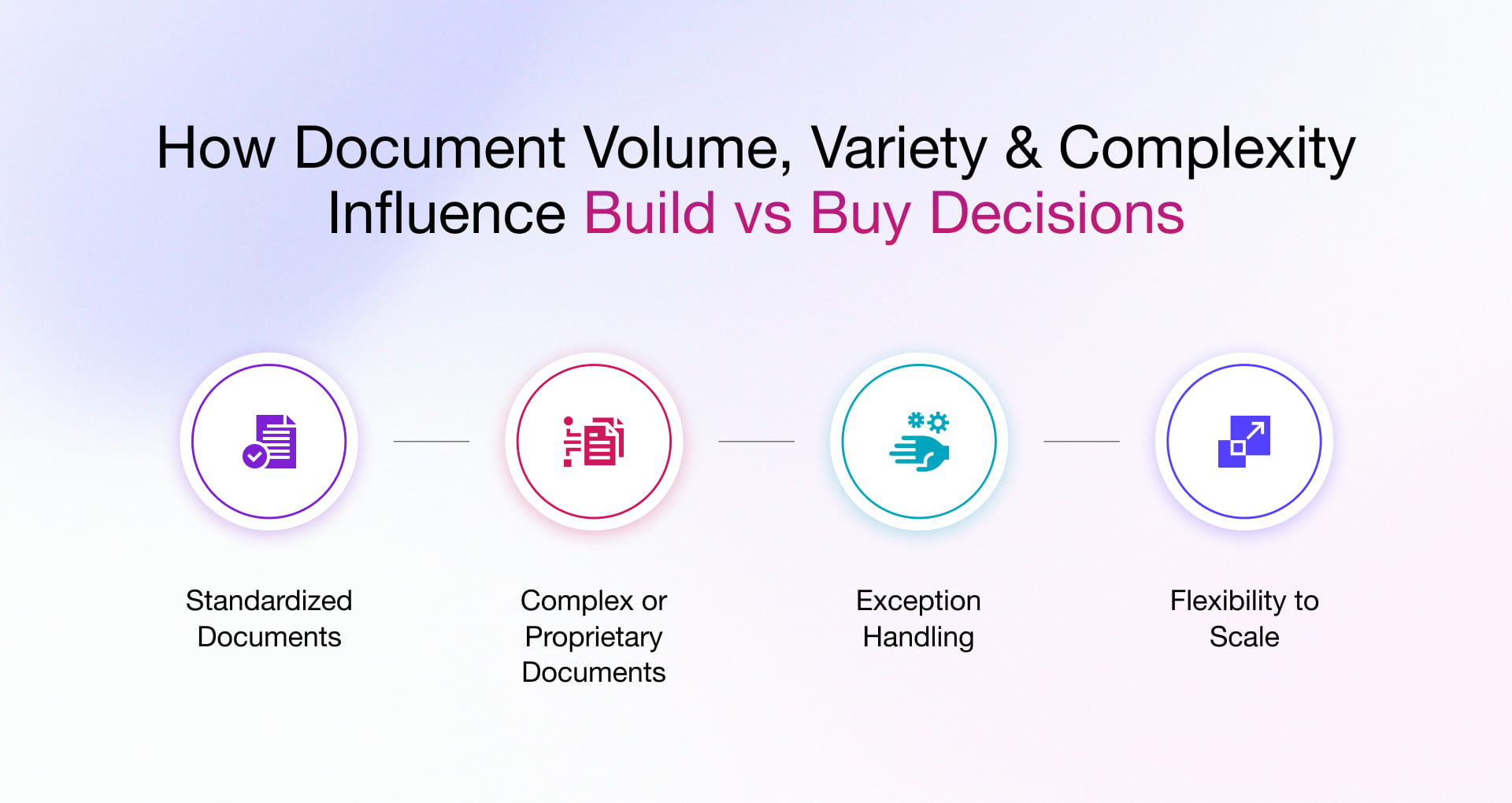
Standardized documents (passports, driver’s licenses, utility bills)
Commercial document verification platforms usually win here. They’ve trained on massive global datasets and deliver strong out-of-the-box performance.
Complex or proprietary docs (rent rolls, custom broker forms, medical claims)
Off-the-shelf document verification solutions often stumble. This is where custom fine-tuned models and layout-aware transformers deliver, especially when trained on your own historical data. Custom approaches frequently outperform generic ones in specialized financial settings.
Exception handling is the real test
No system is perfect. Bought platforms lock you into their review queues and logic. Building your own document verification system lets you create smart routing based on risk, value or custom rules and pivot fast when new fraud patterns appear.
Scalability
This is where SaaS vendors have their rate limits and shared infrastructure risks. Building requires strong Kubernetes and GPU skills for elastic performance, but you control the uptime.
If you’re interested in knowing how AI models handle document-heavy lending workflows, here’s an insightful read on AI driven document processing in lending!
Compliance, Security, and Regulatory Considerations in Build vs Buy
In regulated industries, compliance isn’t optional. GDPR, CCPA, HIPAA, GLBA plus data residency rules shape everything.
Buying: You need to vet vendors for SOC 2, ISO, PCI-DSS, etc. The big risk is whether they use your documents or PII for their model training. Multi-tenant setups mean third-party risk.
Building: Full control inside your VPC means true data sovereignty, simpler audits, and native encryption/RBAC. You can build explainable AI (XAI) so every rejection has a clear, defensible reason for regulators like ECOA or FCRA.
| Risk Area | Buy (SaaS) | Build (In-House) |
| Vendor Liability | High dependence on third-party | Full internal ownership |
| Model Drift | Vendor-managed (but updates can break) | Your team handles retraining |
| Regulatory Risk | Shared, needs heavy vendor oversight | Yours alone, but fully controllable |
| Cost Predictability | Can spike with volume | High upfront, steadier long-term |
A Practical Decision Framework for Build vs Buy in Enterprise Document Verification
Weighted Evaluation Matrix for Your Enterprise
Use the following decision matrix to score your organization’s readiness and requirements. Assign a weight (1–5) to each criterion based on its strategic importance to your enterprise, then score each approach (1–10) to calculate a weighted outcome.
|
Criteria |
Weight (1–5) | Buy | Build |
Hybrid |
| Time to Market |
5 |
9 (Weeks) |
3 (Months) |
7 |
| Cost at Scale |
4 |
4 (Higher fees) |
8 (Lower long-term cost) |
8 |
| Customization |
4 |
5 (Limited) |
10 (Full control) |
9 |
| Data Privacy |
5 |
6 (Vendor-managed) |
10 (In-house) |
10 |
| Fraud Agility |
3 |
8 (Vendor AI) |
5 (Own models) |
8 |
| Maintenance |
4 |
8 (Vendor) |
3 (In-house) |
7 |
Core Criteria Breakdown
1. Cost (CapEx vs. OpEx):
Evaluate total cost of ownership over a 3 to 5-year horizon. Compare the initial capital expenditure of hiring ML engineers and building infrastructure against the compounding operational expenditure of SaaS subscription tiers at your projected volume growth rates.
2. Control & IP Ownership
Determine whether core verification logic is a proprietary competitive differentiator for your business. If specialized document extraction gives your underwriting engine a market advantage, owning the intellectual property is critical.
3. Speed to Value
Assess your immediate business deadlines. If regulatory changes or competitive pressures demand a new mortgage workflow automation within a stipulated time, building from scratch is rarely viable without capitalizing on pre-built architectural accelerators.
4. Future-Proofing
Evaluate how easily the system can incorporate advancements in artificial intelligence. An agile architecture should allow you to swap out underlying OCR engines or upgrade to newer multimodal LLMs without rebuilding the entire integration layer.
Most enterprises need a clear signal for which path fits their situation. Here’s how that signal typically breaks down:
Build if:
- You are looking at real, sustained volume growth for the next 3–5 years, and you want an architecture that you can actually scale, then extend, on your own schedule.
- Your document types, the workflows, or the compliance obligations are specific enough that pretty much no standard, off-the-shelf platform maps cleanly to what you need, not even close.
- You’ve got internal engineering capacity… the kind where you can take ownership of model retraining, continuous monitoring and that long term upkeep too.
- Data control and IP ownership are strategic priorities, not just nice-to-haves.
- You’re optimizing for total cost of ownership over a long horizon, where amortized in-house investment eventually undercuts recurring license fees
Buy if:
- Speed to deployment matters more than deep customization and you need a working system in weeks, not quarters
- Your document variety and fraud patterns are broad enough that a vendor’s larger training dataset gives you better out-of-the-box accuracy than you could build alone
- Your internal engineering bandwidth is better spent on core product than on maintaining a verification pipeline
- You need vendor-backed compliance certifications and support SLAs rather than building that assurance from scratch
The Hybrid Approach: Build + Buy an Automated Document Verification System
For most enterprises, hybrid ends up being the practical middle ground. You buy the commodity stuff: classification, extraction, base-level verification. Then you build the parts that actually matter for your business: routing logic, compliance rules, exception handling, internal orchestration. You get to market faster, but you keep control of the pieces that count.
Hybrid works well when there’s a clean line between “generic processing” and “our specific logic.” It does take some careful integration planning, though. The handoff between the vendor’s system and yours is exactly where things tend to break if you rush it. Get that separation right, and hybrid can give you a solid mix of speed, control and room to scale.
When you’re piloting any of this, don’t test with your cleanest documents. Test with blurry scans, weird edge cases, non-English documents, the occasional adversarial fake. Check the API performance, the latency and just how well it smoothly fits into what you already have running.
Making The Right Build Vs. Buy Call
There’s no universal answer here in 2026, and there probably never will be. It really comes down to your volumes, how complex your documents are, what compliance demands of you, how much engineering bandwidth you actually have and where you’re trying to go long-term. For a lot of mature enterprises, a custom document verification platform ends up striking the best balance of speed, control and cost.
Ready to de-risk your technology roadmap and design enterprise-grade automated document verification? Book an architecture assessment with our lending software development team today. Our engineers will review your document volume, compliance mandates and integration requirements to deliver a tailored build vs buy roadmap designed for scalable growth.
Frequently Asked Questions
Q: What are the pros and cons of building vs buying an enterprise document verification system?
A: Building gives you full control over data, models, and the roadmap, but it also requires ongoing engineering effort and there’s real execution risk baked in. Buying gives you quicker deployment and access to broader training data; however it creates vendor dependency and you usually end up with less granular control over the compliance details.
Q: Which approach is better for complex, high-volume document workflows?
A: It depends on document variety more than volume alone. High-volume but narrow document types are often manageable to build in-house. High-volume with wide document variety and evolving fraud patterns usually favor buying, unless the organization is prepared to invest heavily in ongoing model retraining.
Q: How do compliance requirements affect the build vs buy decision?
A: Compliance requirements can rule out options on both sides. Strict data residency rules may eliminate certain vendors; strict explainability requirements may make an under-resourced in-house build risky. Compliance should be scored explicitly in the evaluation matrix, not treated as an afterthought once a technical direction is chosen.